$3.5 billion in SBA debt relief was a pandemic-era subsidy, not a standing forgiveness program. Today, if your payment is crushing cash flow, sba debt relief usually means restructuring, deferment, or settlement, and the automatic CARES Act payments are long gone.
That's the reality most owners run into after a slow quarter, a lost contract, or a bad year that didn't quite become a default. The loan still exists, the lender still expects a payment, and the only real question is whether you can buy time, reset terms, or exit cleanly before the account turns ugly.
Table of Contents
- What SBA Debt Relief Actually Means in 2026
- How SBA Loans Work and Why Servicing Matters
- Relief Programs and Lender Workout Options
- Eligibility and Documentation You Need to Qualify
- Step-by-Step Negotiation Strategy With Your Lender
- Refinancing Versus Restructuring Your SBA Debt
- Common Misconceptions That Cost Borrowers Money
- Your 30-60-90 Day Action Plan and When to Call a Broker
What SBA Debt Relief Actually Means in 2026
A contractor I'd worry about is the one who opens the lender statement, does the math twice, and realizes the payment won't fit this month without raiding payroll or vendor reserves. That borrower usually wants one thing, relief. What they usually need is something less glamorous and more useful, a workout that keeps the loan alive.
Automatic help is not the same as forgiveness
The internet keeps mashing together three different outcomes. Automatic payment relief means someone else pays for a period, like the COVID-era subsidy that covered principal and interest for eligible SBA loans. Workout relief means the lender changes the terms, often through forbearance, deferment, extension, or modification. Forgiveness means the debt is legally reduced or wiped out, which is rare outside a separate settlement process.
That distinction matters because the old pandemic program was specific and temporary. For borrowers approved before the CARES Act, the federal relief law later provided $3.5 billion to resume principal-and-interest payments on SBA-guaranteed 7(a), 504, and microloan balances, with some borrowers getting three extra months starting in February 2021 and, for the smallest or hardest-hit borrowers, up to eight months total of forgiveness on those payments. New loans approved between February 1, 2021, and September 30, 2021, got up to six months of principal and interest covered, capped at $9,000 per month. That was a response program, not a permanent escape hatch. SBA debt relief program details
The practical goal is survival or exit
If your SBA payment is squeezing you now, the main objective is to keep the loan performing or to exit it cleanly. Nobody serious opens with “forgive the balance.” Lenders want evidence that the business can recover, or that they can recover more through a sensible restructure than through a charge-off.
Practical rule: If the business can still throw off enough cash to support a revised payment, ask for a workout. If it can't, you start thinking about settlement, refinance, or a controlled exit.
The right move depends on timing. A borrower who acts early still has an advantage. A borrower who waits until the account is in collection has fewer options and a lot less credibility.
How SBA Loans Work and Why Servicing Matters
You can't negotiate a serious workout until you know who owns the relationship. With SBA loans, the answer is almost always the bank or CDC, not the SBA itself.
The guarantee structure lenders live by
Under the SBA's 7(a) program, the agency guarantees 85% of loans of $150,000 or less and 75% of loans above that threshold, with a maximum loan size of $5 million. The SBA's role is closer to a co-signer than a direct lender. The bank still underwrites the loan, services the account, and decides whether to push for a workout or a more aggressive collection path. SBA 7(a) loan program
That structure changes the tone of negotiation. The lender is not making a charity decision. It is comparing the expected loss on a distressed account with the likely result of keeping the borrower alive long enough to collect. That's why lender behavior often looks practical rather than emotional. A modified loan that pays is usually better than a default that drags on.
For a plain-English breakdown of what your loan agreement controls, the loan agreement resource from Coto & Waddington is worth reading before you start a workout conversation.
Who controls servicing and workouts
The lender's servicing team handles the day-to-day relationship. The SBA's rules shape what the lender can approve, but the lender usually runs the process until the account gets serious enough to require escalation. The SBA's own SOP framework is what matters in the background, because that's where the lender's playbook lives.
The bank owns the relationship, but the SBA guarantee shapes the bank's risk. That's why a lender can often approve a payment change on its own, yet needs SBA involvement for compromise, guarantee claims, or debt disposition.
If you want to understand underwriting behavior before you ask for relief, the underwriting guide is a useful companion. It shows how lenders think before things go wrong, which is the same mindset they bring when the loan starts to strain.
Relief Programs and Lender Workout Options
The package you want to avoid is the one where the lender learns you're in trouble from a missed payment and a voicemail. The package you want is the one that gives them a reason to say yes before the account hardens.
The right lever for the right problem
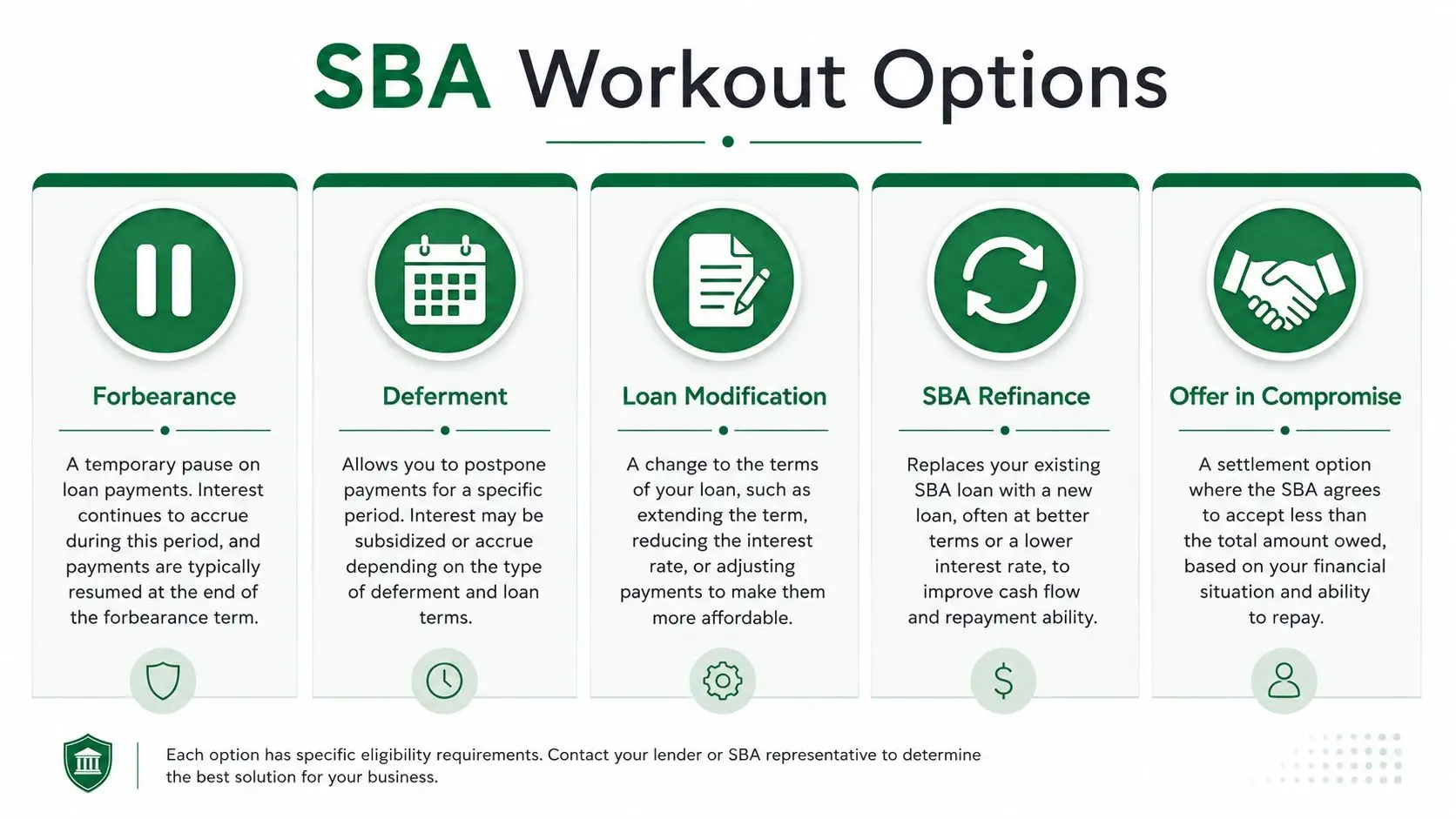
A short cash squeeze calls for forbearance. That is the lender agreeing to pause or slow collection pressure while you catch up. A longer but still repairable downturn usually points to deferment, a maturity extension, or a note modification that lowers the monthly burden. A structurally broken loan points toward refinance or, if there's no path back, a negotiated compromise after default.
The historical CARES Act subsidy belongs in the rearview mirror. Existing 7(a), 504, and microloan borrowers got six months of covered principal, interest, and fees in the original program, with some new loans made before September 27, 2020 included as well. That was emergency relief for a specific period. It is not a live workaround for today's payment stress. CARES Act SBA debt relief summary
For borrowers trying to compare debt tools in a broader business-debt context, find small business debt help from Morgan & Morgan Attorneys at Law P.C. is a practical starting point when the issue involves more than one creditor.
What each option really does
- Forbearance: Best for a temporary dip. The lender gives breathing room, but the debt doesn't disappear.
- Deferment: Best when the business needs time, not mercy. Payments are pushed out, then the loan resumes.
- Loan modification: Best when the payment is too high for the current cash flow. This often means a longer term or a different payment structure.
- SBA refinance: Best when the old loan no longer fits and a brand-new SBA loan can replace it on better terms.
- Offer in Compromise: Best when repayment in full is unrealistic and the account has moved into the formal resolution lane.
If your problem is really a ballooned payment on real estate debt, the commercial real estate refinance guide is the right way to think about the exit path. Different debt, different fix.
Bottom line: Don't ask for forgiveness when what you need is time. Don't ask for time when the loan is already beyond repair.
Eligibility and Documentation You Need to Qualify
A lender does not buy a hardship story on faith. It buys a payment plan that looks believable on paper and a borrower who acted early enough to still deserve a conversation.
Build the package lenders actually use
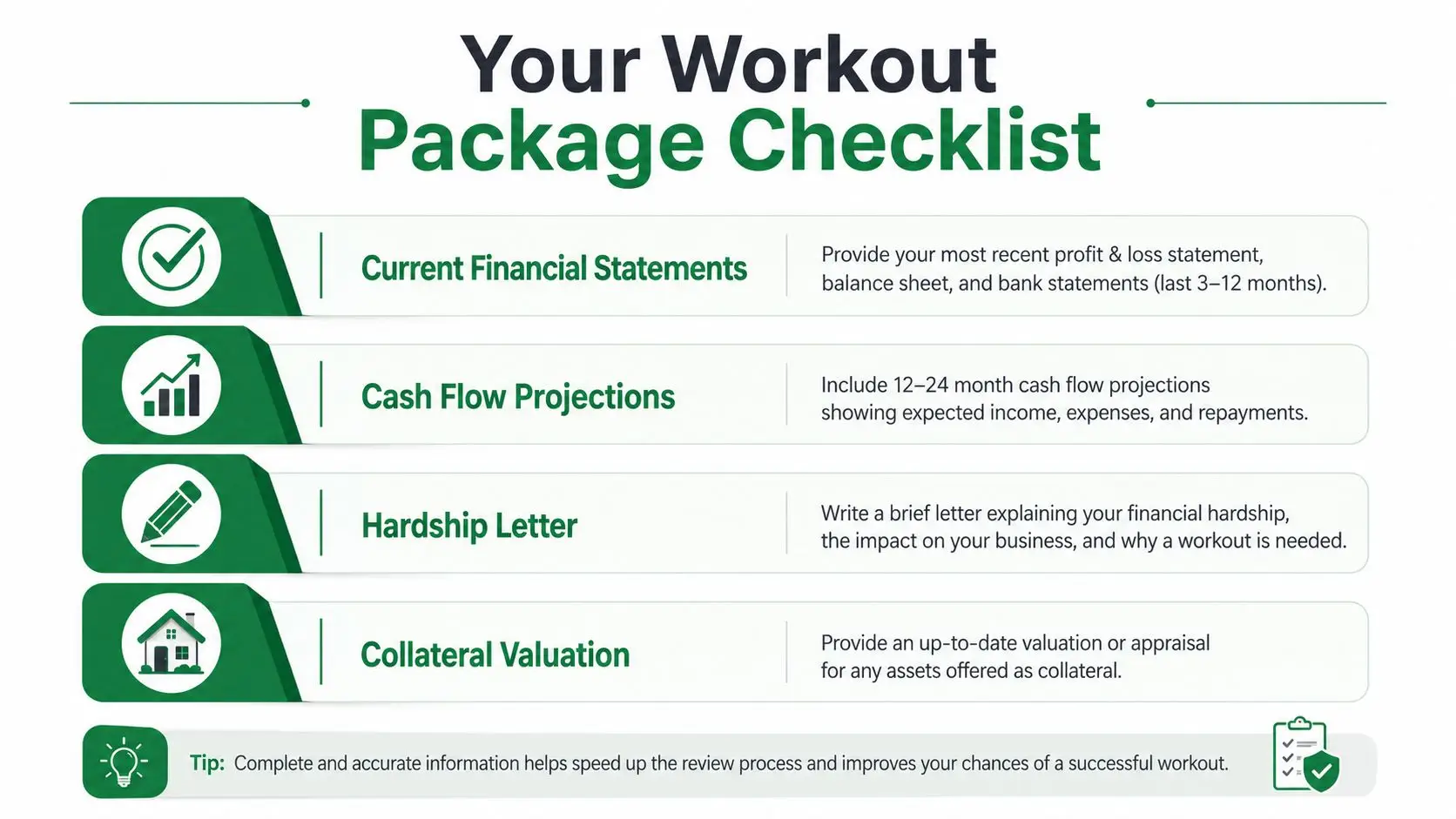
Start with current financial statements, not last year's tax return and a shrug. Add a plain hardship explanation tied to a specific trigger, such as a lost contract, a sharp cost increase, or the departure of a key employee. Then show the recovery path in month-by-month cash flow, not vague optimism.
A complete package usually includes:
- Updated P&L, balance sheet, and cash flow statement: These show whether the business can support a revised payment.
- Hardship letter: Keep it factual. Say what changed, when it changed, and why the current note no longer works.
- Recovery plan: Put the next few months on paper and show where the money comes from.
- Backup evidence: Contracts, customer emails, tax records, or other documents that prove the problem is real.
The rule here is simple. The more complete the file, the faster the lender can make a decision. A polished narrative with missing numbers usually loses to a plain file that answers the lender's questions.
Don't disappear from the lender
Borrowers who stop paying and stop communicating usually lose options fast. The lender starts treating the account as a collection problem instead of a relationship problem, and that changes who gets involved. If you're already under pressure, the worst move is pretending the issue will resolve itself.
The SBA loan application checklist is useful here because the same discipline that makes a file approvable on the front end also makes a workout credible on the back end. Good documentation still wins.
A decent package with real numbers beats a dramatic explanation with no support. Every time.
Step-by-Step Negotiation Strategy With Your Lender
The first call after a strained payment matters more than most owners think. If you make it early, you're showing intent. If you make it after silence, you're already defending yourself.
The first 72 hours
Call the lender, don't email a novel. Say the payment is becoming difficult, that you want to keep the loan current if possible, and that you're assembling updated financials for a workout request. Don't say the business is dead unless that's the case, because once you frame it that way, the conversation shifts toward liquidation.
Write down the name, time, and substance of every conversation. The person on the other end may change later, but your notes won't.
The review window
Once the hardship package is submitted, most lenders need time to review the file, ask for clarifications, and decide whether the proposed payment change makes sense. That review often takes longer than borrowers want, which is exactly why a clean file matters. The lender is trying to compare your proposal with the likely recovery from default.
What the lender wants to hear
- You're still engaged: You're not hiding.
- The cash-flow problem is specific: Not “things are tight,” but why they're tight.
- The proposal is realistic: A lower payment beats a fantasy payment.
- You know your next move: You can explain how the business gets through the next several months.
If the lender refuses a reasonable proposal, or if the account is already moving into formal compromise territory, that's when SBA-level resolution becomes relevant. At that point, the issue stops being a routine servicing conversation and starts looking like a legal and financial cleanup.
Practical rule: The borrower who documents every contact and stays cooperative usually has more leverage than the borrower with the louder complaint.
Refinancing Versus Restructuring Your SBA Debt
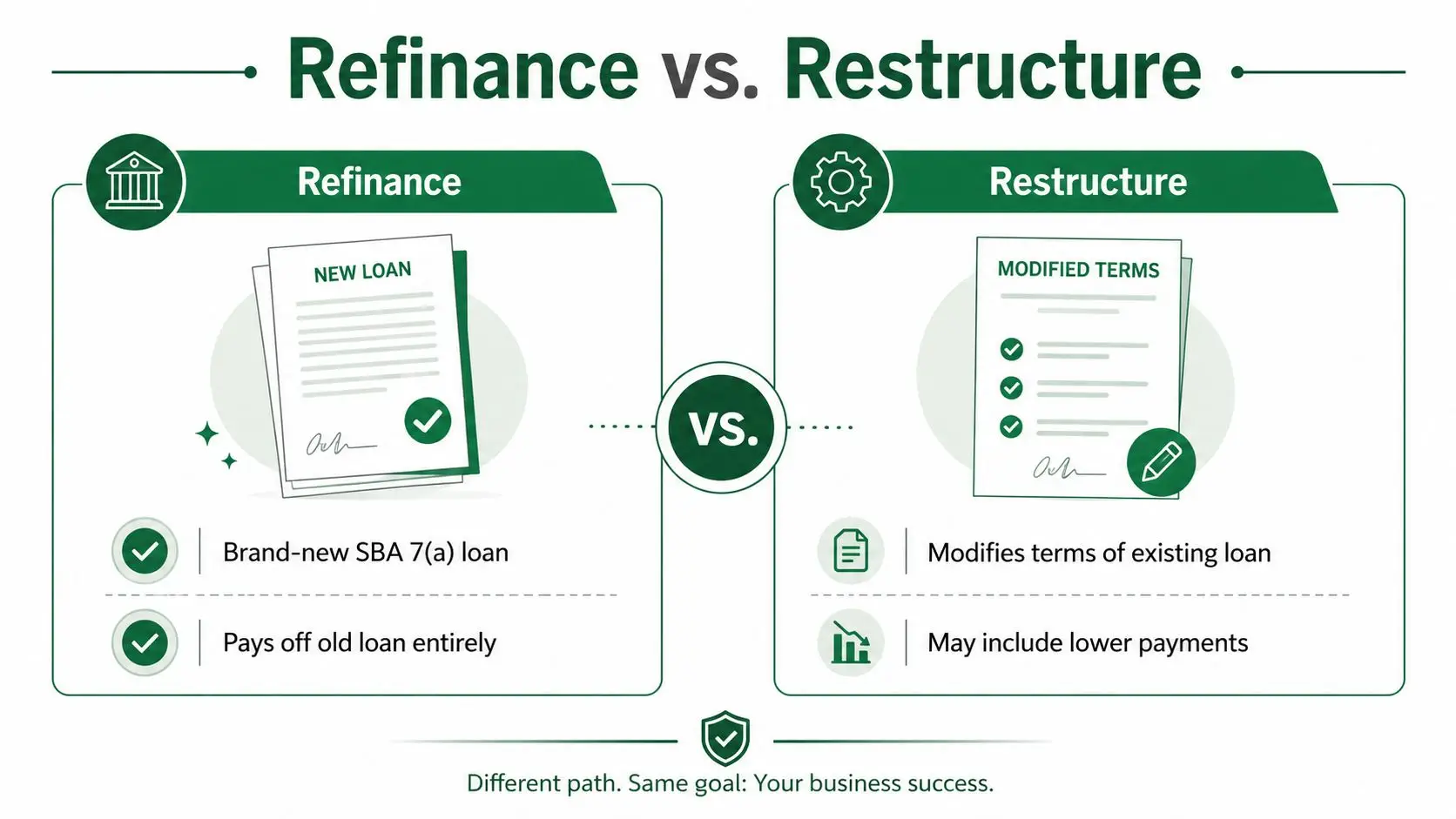
These are not synonyms, and owners get burned when they treat them that way. Restructuring changes the existing loan. Refinancing replaces it with a new one.
When refinancing makes sense
Refinancing is the right move when the business has recovered enough to support a new payment and the owner wants better terms, a cleaner structure, or consolidation of other debt. A new SBA loan can pay off the old one and reset the obligation on a better footing. That can happen even outside a distress event.
When restructuring makes sense
Restructuring is the smarter move when cash flow is still fragile and the goal is to make the loan survivable. Lower the payment. Extend the maturity. Adjust the burden so the business can breathe. That is a survival tool, not a victory lap.
If you want a broker to shop the market, GoSBA Loans is a no-cost SBA loan brokerage that coordinates proposals from multiple lenders, but that's only useful when the business can support the new debt load. Otherwise, shopping terms is a waste of everyone's time.
The SBA loan refinancing guide is the better resource when the issue is replacing old debt with a cleaner structure.
Use this rule of thumb
If you can service a new payment, refinance. If you cannot, restructure first and refinance later. Owners who reverse that order usually end up asking for relief twice.
Common Misconceptions That Cost Borrowers Money
Most bad decisions around SBA debt relief start with a bad assumption. Strip away the myths and the path gets much clearer.
Myth one, SBA loans get forgiven like PPP loans
No, they don't. PPP had a forgiveness track tied to documented payroll and qualifying expenses. That was a specific pandemic-era structure. Ordinary SBA loans, including 7(a), 504, Express, and EIDL, generally get repaid unless a separate settlement process applies.
Myth two, default is the only path to relief
That's the expensive myth. The best opportunity usually exists before default, when the account is still salvageable and the lender still wants a performing loan. Once the file slips into collection, the borrower gives up time, options, and negotiating strength.
Myth three, brokers only help with new loans
Wrong. A full-service SBA broker can help package a workout, coordinate a refinance that pays off the existing lender, or help line up a settlement path when the account has moved into formal resolution. The point isn't originations only. The point is matching the debt to the business's actual capacity.
The SBA loan myths guide is worth skimming if you've been told conflicting things by different lenders or advisors.
If someone tells you “just wait for forgiveness,” they're selling hope, not a solution.
Your 30-60-90 Day Action Plan and When to Call a Broker
Days 1 through 30 are about stabilization. Contact the lender, gather the file, and stop the bleeding. Days 31 through 60 are about submission and negotiation, with the goal of getting a written workout before the account drifts further behind. Days 61 through 90 are for execution, refinance closeout, or escalation if the lender won't move.
| Situation | Best Lever | Typical Timeline |
|---|---|---|
| Temporary cash squeeze | Forbearance | Fast, if the lender is responsive |
| Ongoing but fixable strain | Modification or deferment | Several weeks |
| Stronger business with a payment mismatch | Refinance | About one closing cycle |
| Account no longer viable as written | Offer in Compromise | Longer, after default-related steps |
Call a broker when the loan is large, multiple parties are involved, or you can't negotiate objectively because you're too close to the pain. That's also the right move when an SBA refinance could materially improve terms and you need a clean path through underwriting and closing.
GoSBA Loans helps owners package SBA financing, refinance existing debt, and coordinate lender proposals across multiple options. If your SBA payment is getting in the way of operating the business, visit GoSBA Loans and get a real plan on the table before the account turns into a collection problem.
