You're under contract on a business, the seller wants reassurance, and the lender is asking for a cleaner file than the one you've got in your inbox right now. That's the moment most buyers start searching for a business loan broker, because the problem usually isn't finding a lender, it's finding the right lender for a deal that fits. A strong broker can help you package the story, narrow the lender list, and keep the process moving. A weak one can waste weeks with the wrong submissions and put the purchase at risk.
Table of Contents
- Why Most Business Owners End Up Googling a Loan Broker
- What a Business Loan Broker Actually Does
- Services Brokers Provide With SBA Deals in Mind
- Benefits and the Real Downsides of Using a Broker
- How Broker Fees and Compensation Actually Work
- The Step-by-Step Process of Working With a Broker
- How to Vet and Choose the Right Broker
- Common Pitfalls and How to Avoid Them
Why Most Business Owners End Up Googling a Loan Broker
The search usually starts after a hard no, a slow maybe, or a lender who likes the business but not the structure. You may have already sent tax returns, a debt schedule, and a half-finished purchase agreement to one bank, only to hear that the deal is “outside appetite.” At that point, the question stops being whether you can borrow and becomes who can place this specific file.
That's where a business loan broker enters the picture. If you're trying to buy a company, refinance expensive debt, or finance an owner-occupied property, the broker's job is to translate your deal into lender language and route it to places that fund similar files. A good SBA-minded broker is useful precisely because lender appetite is narrow, and it changes by deal size, industry, collateral, and timeline. The wrong submission can make a good buyer look disorganized.
The market itself makes the choice more important. IBISWorld estimates the U.S. Loan Brokers industry at $9.1 billion in 2026, with 18,807 businesses operating in the sector, up from 18,166 in 2025, and revenue declining at a 17.1% CAGR over the five-year period ending 2026, while profit margin fell to 7.5% of revenue in the current year (IBISWorld). That mix says two things at once, the channel is large, and it's under pressure. In a fragmented market, broker quality varies a lot.
If you're early in the SBA process, this SBA loan requirements guide is a helpful companion because it shows where borrowers often get stuck before a broker ever submits the file. The right broker works upstream of the lender call. The wrong one just forwards problems to someone else.
What a Business Loan Broker Actually Does
A broker is not just a middleman with a list of banks. The better analogy is a translator and route-planner, someone who takes a borrower's deal story and matches it to the narrow appetites of individual lenders. That includes screening the deal, building the package, and deciding which lenders are realistic before a single submission goes out.
The working parts of the role
In practice, a broker sources lender options, pre-qualifies the file, organizes documents, and shops proposals. The important part is not volume, it's fit. Industry KPI frameworks treat pull-through rate as the key metric, meaning the share of submitted applications that fund, because it reflects underwriting quality, lender match, and file completeness. Adjacent metrics like cycle time, fallout rate, approval rate, and incomplete application rate show where the process breaks down (Floify KPI framework).
Practical rule: if a broker can't explain why each lender on the list fits the deal, they're probably spraying files instead of placing them.
Who they are, and who they are not
A direct lender funds the loan. A loan officer usually works for one lender and sells that lender's products. A banker inside a bank may manage the relationship, but that doesn't mean they can shop across the market. A broker sits outside that single-institution box, which gives the borrower more lender breadth but also makes accountability more important. If the broker is paid by multiple sources and won't explain it, ask more questions.
For SBA financing, this distinction matters a lot. Lenders differ on deal size, ownership structure, collateral, acquisition use, and whether they want a clean expansion story or a more complex transaction. A broker who understands that spread can save weeks. One who doesn't can make a fundable SBA request look like a bad fit.
Services Brokers Provide With SBA Deals in Mind
The value of a broker shows up when the deal is more than a vanilla term loan. SBA financing is often used for acquisitions, owner-occupied real estate, working capital, and refinance situations where structure matters as much as price. The broker's job is to turn those moving parts into a lender-ready package, then steer it to the right program.
What changes by SBA program
For SBA 7(a) acquisitions, the broker coordinates the story around buyer equity, seller note treatment, cash flow, and lender appetite. Under the SBA's 7(a) rules, the guaranty is generally 75% for loans above $150,000 and 85% for loans of $150,000 or less, with the maximum SBA guaranty across all 7(a) loans capped at $3.75 million because the SBA will not guaranty more than 75% of a $5 million loan (SBA advocacy report). That structure matters because lenders think in terms of risk, and brokers have to present the deal in a way that fits that risk.
For 504 owner-occupied real estate, the broker helps coordinate the capital stack and outside reports that often slow files down. For SBA Express and smaller working-capital requests, the advantage is usually speed and clarity, not heavy structuring. The broker's role is to keep the file lean and lender-specific rather than overbuilt. In acquisition deals, that same discipline can keep a buyer inside the purchase agreement window.
A clean file doesn't just look professional. It reduces rework, and rework is what kills timing.
Where the broker adds the most value
Broker coordination matters when there are third-party reports, lender comparisons, and a closing calendar that can't drift. A solid broker lines up the lender appetite before the seller's patience runs out. They also keep the SBA authorization path from becoming a bottleneck by choosing lenders that are set up for the type of deal in front of them.
| SBA Program | Typical Use Case | Max Loan Size | Where Broker Adds Value |
|---|---|---|---|
| SBA 7(a) | Business acquisition, working capital, refinance | Program-driven, lender specific | Matching lender appetite, shaping equity structure, coordinating underwriting |
| SBA 504 | Owner-occupied commercial real estate | Program-driven, project specific | Capital stack coordination, third-party report timing, closing management |
| SBA Express | Faster working capital needs | Program-driven | Lender fit, simplified packaging, speed to decision |
| Small SBA loans | Smaller bridge or expansion needs | Program-driven | Fast routing, cleaner file prep, shorter lender shortlist |
For a practical example of how lender selection changes pricing and structure, the SBA broker term sheet guide is worth reading after this article.
Benefits and the Real Downsides of Using a Broker
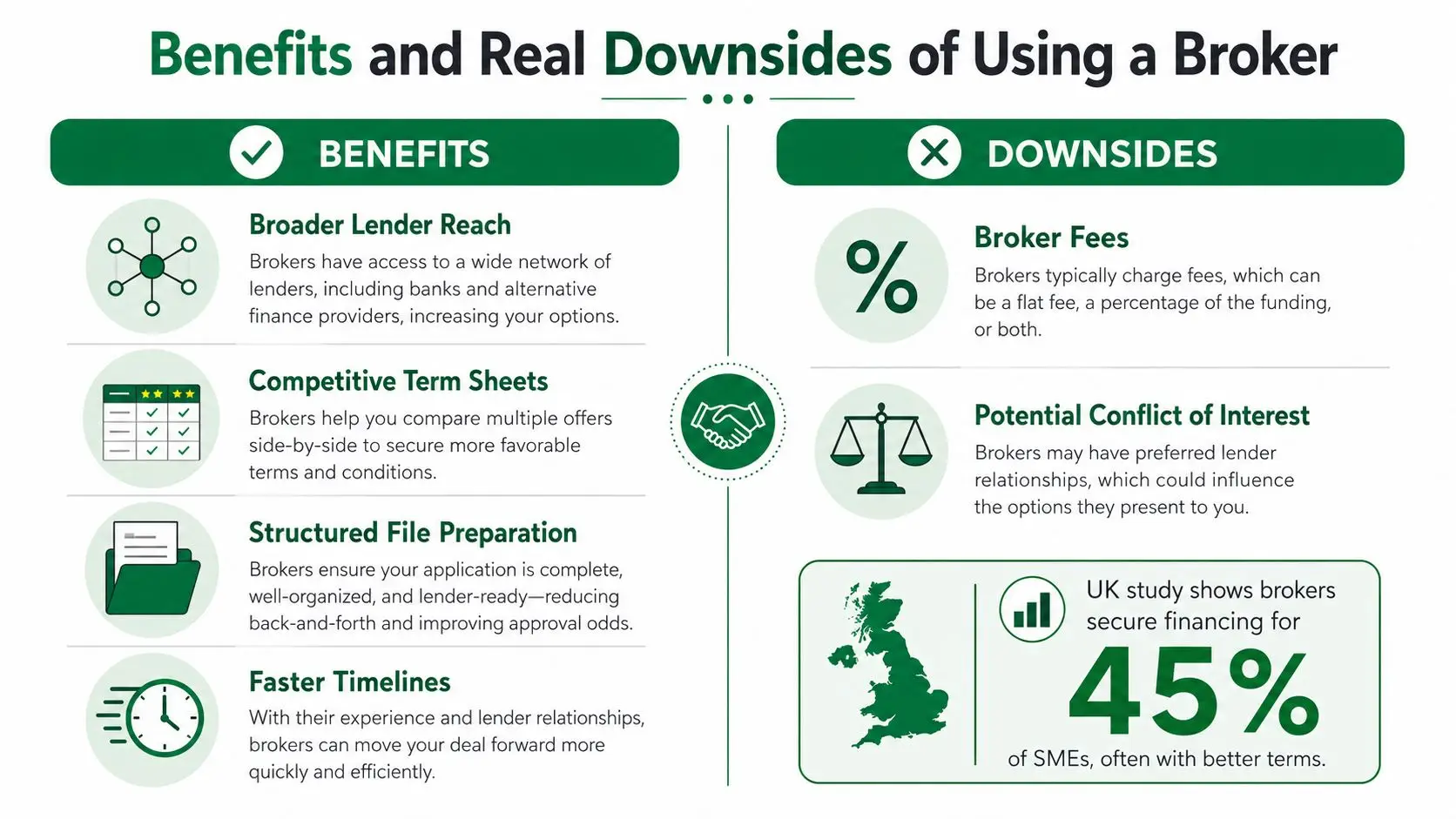
The upside is straightforward. A good broker gives you broader lender reach, competitive term sheets, structured file preparation, and a better chance of getting a response inside a real-world deadline. That matters because the broker channel isn't just theoretical. In the UK commercial finance market, brokers facilitated £38 billion in SME lending in 2023, after £45 billion in 2022, and 32% of small businesses funded through brokers had previously been refused capital elsewhere (The Intermediary).
The benefits borrowers actually feel
The first gain is lender breadth. A borrower can go from one bank's narrow view to multiple competing underwriting desks. The second gain is deal packaging. Clean files get reviewed faster, and structured submissions usually create less friction than a pile of loose PDFs. The third gain is the ability to use competing term sheets, which gives you room to improve structure, not just rate.
The trade-offs that matter
Fees are the obvious downside. Broker compensation can be borrower-paid, lender-paid, or hybrid, and each structure has different conflicts and incentives. A broker can also slow down if their pipeline is overloaded, and some will promise placement in programs they don't really control. If a broker behaves like every file is eligible for every lender, that's usually a sign they're overselling.
The decision is not “broker or no broker.” It's whether the broker's access, process, and transparency are strong enough to justify the cost in your specific deal. For borrowers who need speed, lender choice, and a cleaner path through underwriting, the trade can make sense. For a simple file with obvious bank fit, it may not.
How Broker Fees and Compensation Actually Work
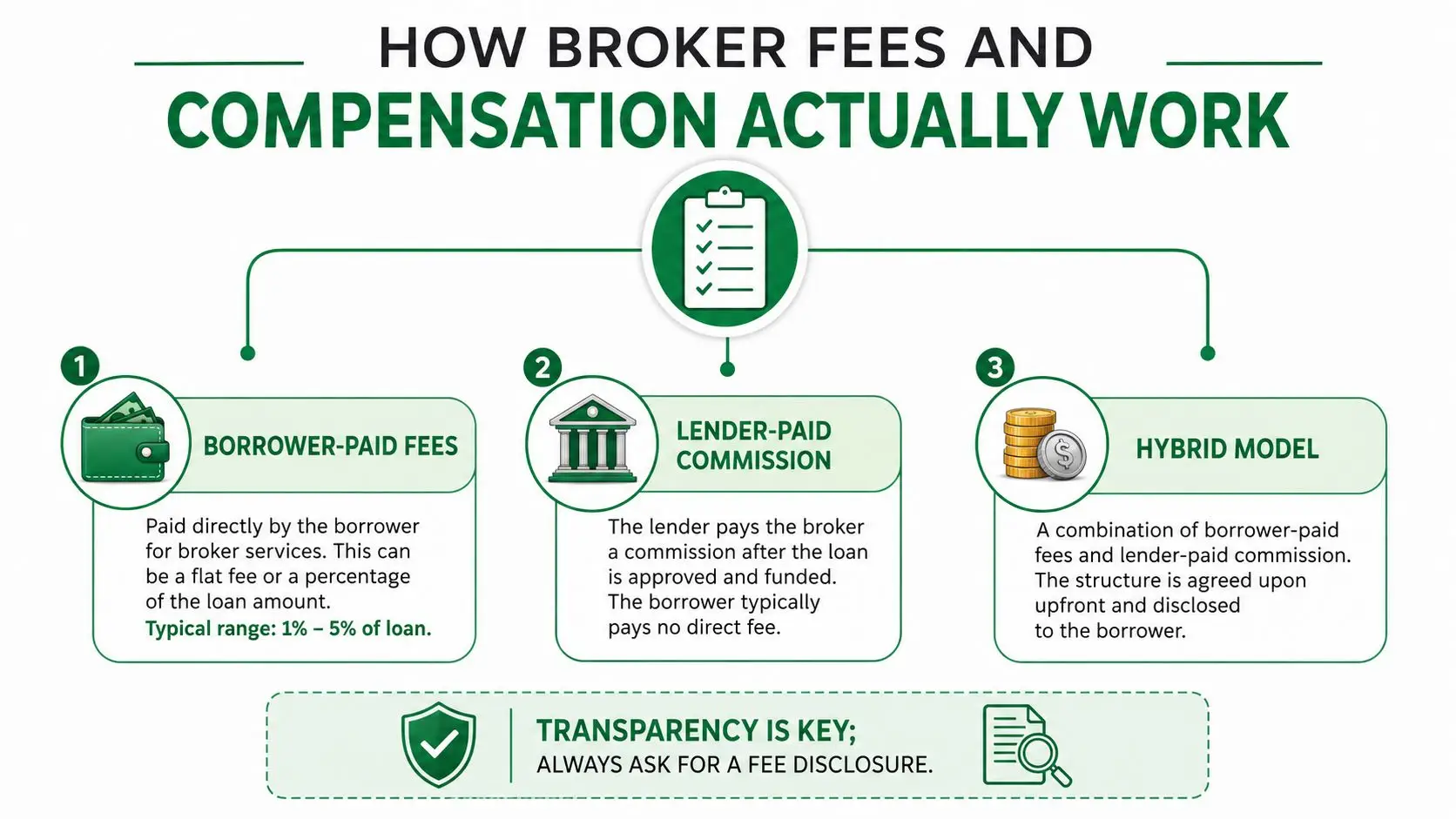
Most borrower confusion starts here, because compensation shapes behavior. A broker can be paid by the borrower, by the lender, or by both through a hybrid structure. You should know which one applies before you sign anything, because the answer affects who the broker is really optimizing for.
The three common models
A borrower-paid fee is usually a flat fee or a percentage of the loan amount, disclosed up front. A lender-paid fee means the broker is compensated by the lender, which can create a pricing trade-off the borrower should ask about directly. A hybrid model mixes the two.
For an SBA acquisition deal, a borrower-paid percentage can get expensive fast, so ask for the exact number in writing and the point in the process when it's earned. If you're also trying to understand how owner compensation affects cash flow and equity math, this guide on owner draws and loans is useful context because underwriting often looks at how money moves through the business.
What transparency should look like
The CFPB's small-business lending framework requires reporting of broker fees for originated or approved-but-not-accepted credit extensions, and its Section 1071 data architecture expects transaction-level identification and structured capture rather than vague narrative disclosures (CFPB data points chart). That makes fee transparency more than a courtesy. Legitimate brokers should be willing to put compensation in writing.
For a practical benchmark, a $1 million SBA 7(a) acquisition loan with a 2% borrower-paid fee would equal $20,000. If the compensation is lender-paid, the cost may show up indirectly in pricing instead of as a line item. Either way, ask for the exact structure before you send financials.
For a deeper breakdown of disclosures and deal economics, see the SBA broker fee guide.
The Step-by-Step Process of Working With a Broker
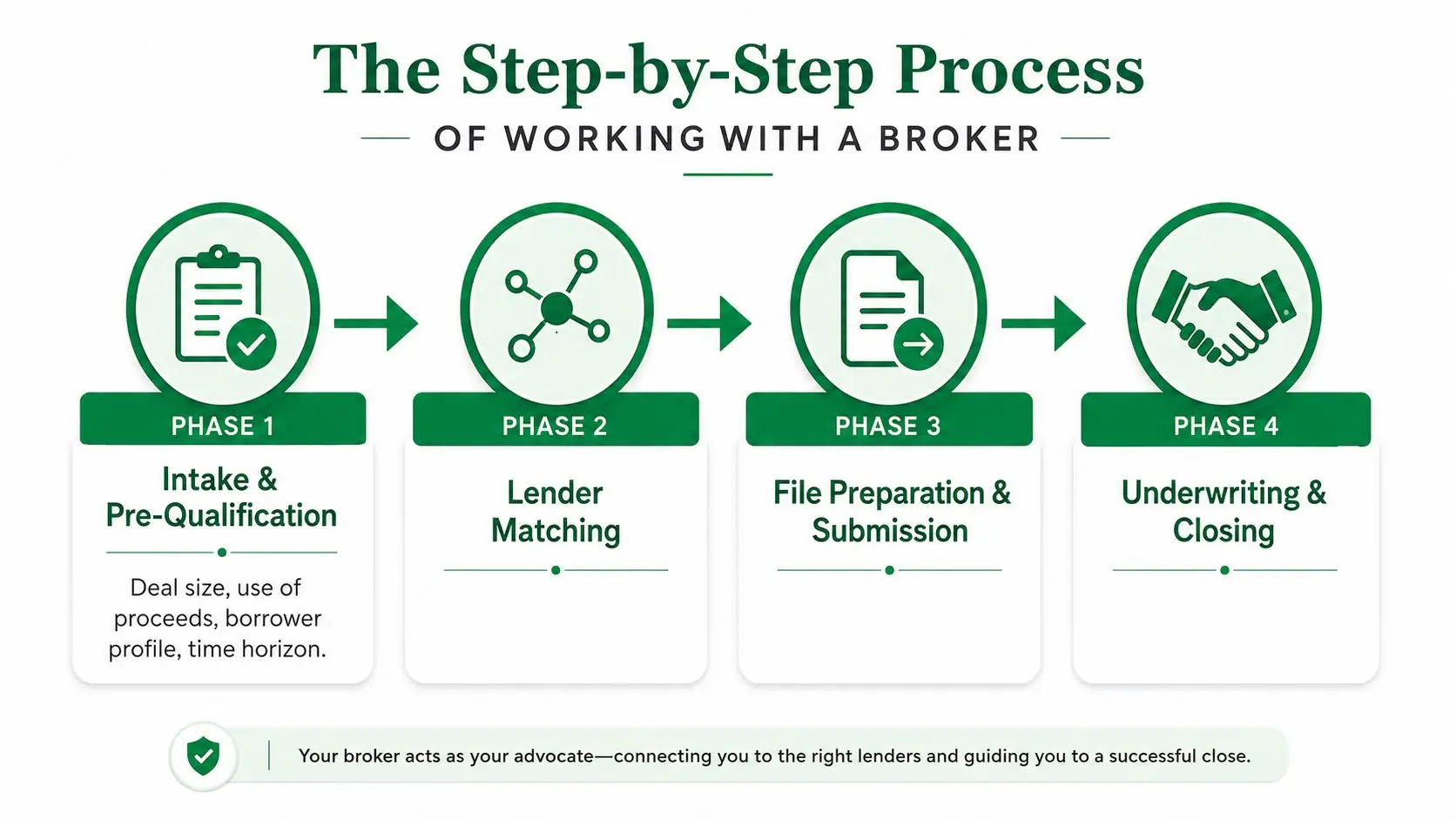
The process should feel orderly, not mysterious. Most delays happen when a broker jumps to lender outreach before the deal is ready or sends the file to lenders that won't touch the structure. When the workflow is tight, the file moves faster because each step prepares the next one.
The first pass is qualification
The broker should start with deal size, use of proceeds, borrower profile, and time horizon. That first call tells you whether the file is acquisition financing, refinance, working capital, or real estate. It also tells the broker whether the lender list should be narrow or broad.
Then comes document assembly
That stage usually includes financial statements, tax returns, a debt schedule, projections, and the purchase agreement or property details if those exist. Underwriting gets easier when documents are complete and labeled the same way every time. If you want to understand the mechanics of lender review, the underwriting process guide gives a good general framework without getting lost in jargon.
Submission, term sheets, and closing
Once the file is packaged, the broker routes it to lenders whose appetite fits the deal. Offers are compared on rate, term, structure, and covenants, then the lender underwrites the file and the SBA authorization process kicks in for SBA loans. Closing coordination follows, including third-party reports, legal docs, and funding.
Most SBA acquisitions close in 90 to 120 days from a signed LOI, so the broker's quality shows up in whether the file is ready to submit before the seller starts asking for certainty. A clean process can shorten resubmission cycles and keep the buyer inside that window. A sloppy one makes the timeline feel endless.
For a practical checklist before you start, the SBA loan application checklist is a useful reference point.
How to Vet and Choose the Right Broker
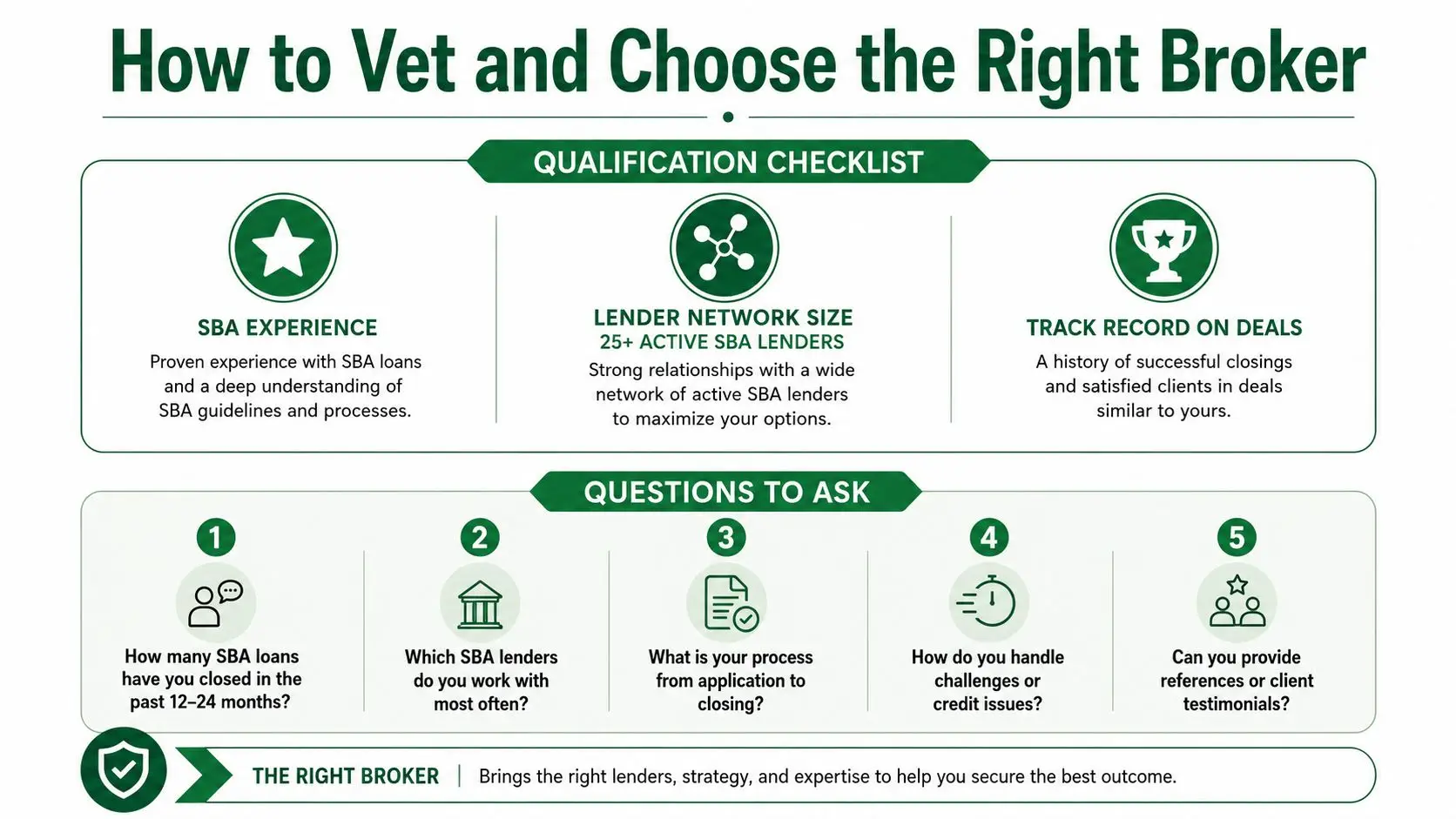
A broker should earn trust on paper, not just in a sales call. The easiest way to screen them is to ask for specific proof of SBA experience, lender breadth, and recent closings. If they get vague, you've probably learned enough.
A real vetting checklist
Look for SBA deal experience, a lender network that's broad enough to create competition, a track record on funded dollars and closed deals, references from recent borrowers, and clear written fee disclosure. A broker who works SBA acquisition files every week is usually easier to trust than one who “also does SBA” but mostly focuses on other products.
Questions that expose the difference
- How many SBA 7(a) acquisition loans have you closed in the last 12 months? A strong answer is specific and immediate. A weak answer sounds like marketing.
- Which lenders are you submitting this deal to, and why? Strong brokers explain fit by deal size, industry, and structure.
- Are you compensated by me, by the lender, or both? Good brokers answer directly.
- Can you share a recent borrower reference? Real operators usually can.
- What's your average time from intake to term sheet? If they can't answer, they probably don't track process tightly.
If a broker guarantees approval before reviewing the file, they're selling confidence, not underwriting skill.
The loan agreement process guide is a useful companion if you want to understand how terms harden into legal documents and where negotiation risk can show up.
What not to tolerate
Walk away if the broker won't put fees in writing, asks you to sign before reviewing the deal, or refuses to explain lender selection. The best broker relationship starts with facts. Everything else is noise.
Common Pitfalls and How to Avoid Them
The first mistake is choosing the lowest advertised fee. Cheap often means thin lender access, weak packaging, or a broker who needs a lot of submissions to land one approval. That looks affordable on the front end and expensive after fallout starts.
The second mistake is sending sensitive financials before you have a written engagement. Once documents leave your hands, you want to know who is seeing them and why. A disciplined broker controls distribution and only sends a file where it belongs.
The third mistake is ignoring lender type. If the broker is pushing lenders that aren't set up for the deal, the SBA authorization stage can drag because the lender isn't built for the path you need. A fourth mistake is accepting the first term sheet without comparison, especially on an acquisition where structure matters as much as rate.
The fifth mistake is treating the financing timeline as separate from the purchase agreement. It isn't. The buyer's deadline, seller expectations, and lender process all have to line up or the deal can break in the middle of the closing cycle.
A simple decision rule helps: if the broker answers the vetting questions, pulls references, explains lender fit, and puts fees in writing, the relationship is worth starting. If they dodge any of those, keep looking.
GoSBA Loans handles SBA loan brokerage for acquisitions, working capital, and owner-occupied real estate by coordinating lender matching, underwriting support, and closing steps that buyers usually struggle to manage alone. If you're comparing broker options for a real deal, visit GoSBA Loans and see how a lender-focused process can help you move from LOI to funding with fewer surprises.
