The surprising part of the SBA citizenship requirement in 2026 is that citizenship alone no longer saves the deal. A U.S. passport is not enough if the owner's principal residence is outside the United States, its territories, or possessions, because SBA Procedural Notice 5000-876626 now requires 100% of direct and indirect owners, and most SBA-required guarantors, to clear both tests under the updated 7(a) and 504 rules, effective March 1, 2026. That turns the old foreign-ownership conversation into a stricter domestic-residency gate, and it changes how I underwrite every acquisition file I touch. SBA Procedural Notice 5000-876626
Table of Contents
- What the SBA Citizenship Requirement Looks Like in 2026
- Who Qualifies and Who Does Not Under the New Rules
- Understanding the 6-Month Lookback and Indirect Ownership Test
- Documents Lenders Now Require to Prove Citizenship and Residency
- How the Rules Differ Across SBA Programs
- Real Deal Structures That Break Under the New Rules
- How to Prepare Before You Apply for an SBA Loan
- Alternatives and How a Broker Like GoSBA Loans Helps
What the SBA Citizenship Requirement Looks Like in 2026
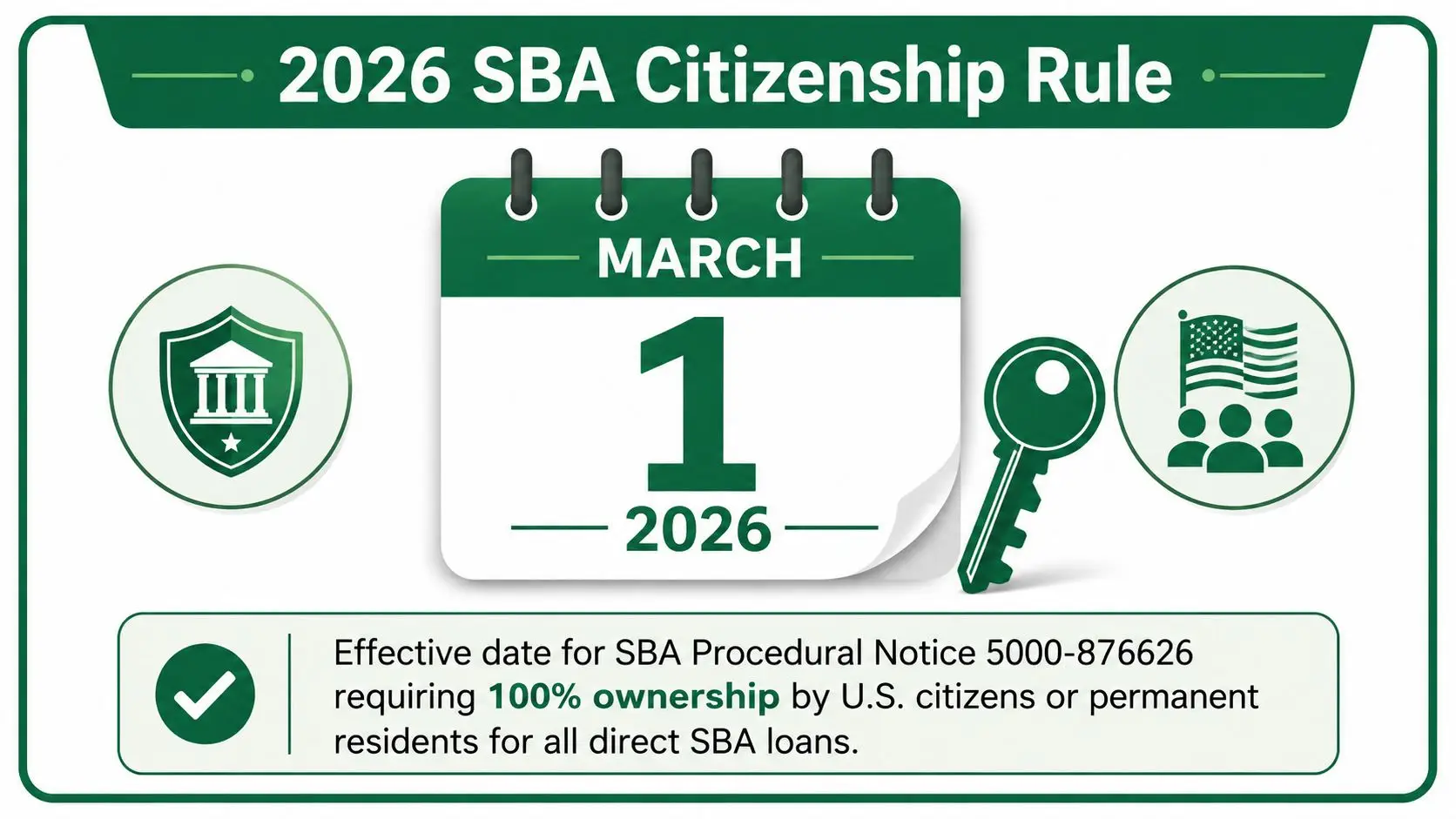
The 2026 rule is blunt. For 7(a) and 504 loans, the SBA now requires 100% of direct and indirect owners to be U.S. citizens or U.S. nationals whose principal residence is in the United States, its territories, or possessions, with only narrow exceptions for required guarantors under the notice itself. The residency test sits right beside the citizenship test, and either one can kill the file fast.
The old partial-ownership era is over
Borrowers used to build structures around small foreign stakes and hope the SBA would tolerate them. That playbook is dead under the updated standard. The SBA moved from a limited foreign-ownership tolerance, including a prior 5% exception, to a full domestic ownership requirement for the relevant ownership interests. The agency tied the change to an executive-order-driven policy framework, then expanded the restriction again on March 9, 2026 to cover foreign nationals and non-citizens across other SBA-backed lending programs as well. NAGGL summary of the 2026 citizenship rule change
Practical rule: if one direct or indirect owner fails the test, I treat the whole SBA request as blocked until the cap table changes.
What that means in plain English
This is a pass or fail underwriting gate. A lender cannot wave through a strong operating company just because the revenue looks good, and a minority foreign stake buried inside a holding company still matters because the SBA looks through ownership layers, not just the top-level borrower. That is why I start every file with ownership, citizenship, residency, and guarantor status before I talk about terms. If you want a clean checklist of the baseline rules lenders apply, review the SBA loan requirements overview.
Who Qualifies and Who Does Not Under the New Rules
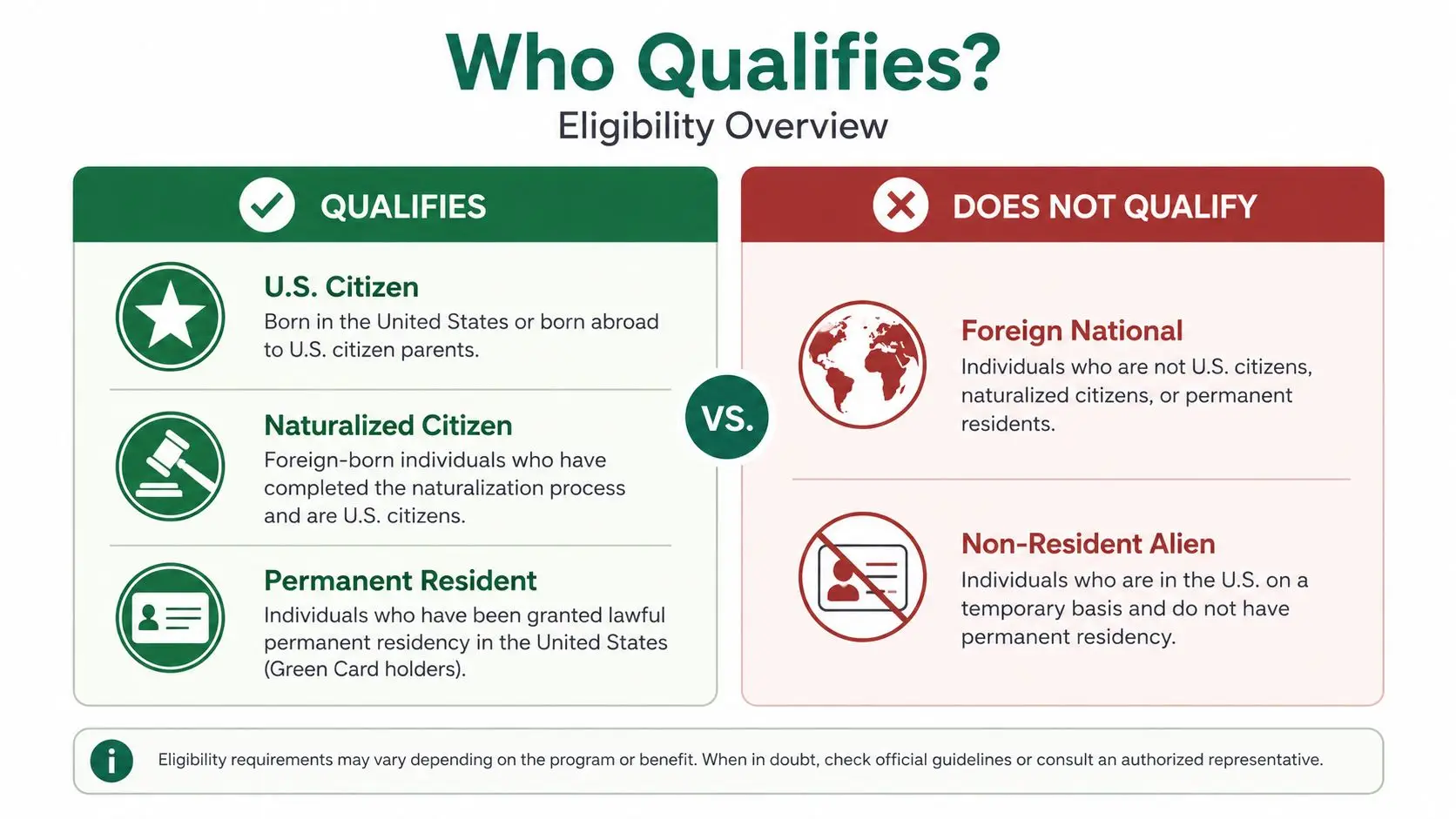
The clean answer is simple. U.S. citizens and U.S. nationals can qualify only if their principal residence is in the United States, its territories, or possessions. That second part matters as much as the passport, because the SBA's current test is no longer just about who you are, it's about where you live.
The qualifying bucket is narrower than people think
A lot of borrowers assume a valid passport solves the problem. It doesn't. The updated rule requires both the right status and the right residence, so a citizen who lives abroad can still fail the ownership test. The same logic applies to U.S. nationals, because nationality alone is not the finish line.
The disqualifying bucket catches more people than borrowers expect
Green card holders, visa holders, refugees, asylees, DACA recipients, and undocumented individuals all sit in the danger zone for ownership and guaranty purposes under the SBA's current framework. The 2026 policy shift matters because a borrower doesn't get to carve out a “small” non-citizen interest and hope the lender ignores it. One ineligible owner can sink the file. That's true in acquisition deals, investor-heavy structures, and family businesses with cross-border ownership histories. Non-U.S. citizen eligibility guide
A borrower can be operationally strong and still be ineligible on paper. The SBA cares about ownership and guaranty status first.
Work and management are different from ownership
Non-citizens can still show up in a business as employees or managers, but that doesn't help the loan if they own any direct or indirect interest that the SBA counts. That distinction matters in real files, because founders often confuse control with ownership. Under the current rule, the lender cares about equity, beneficial interests, and required guaranties, not just job title or day-to-day authority. IMMP policy tracking on SBA noncitizens
Understanding the 6-Month Lookback and Indirect Ownership Test
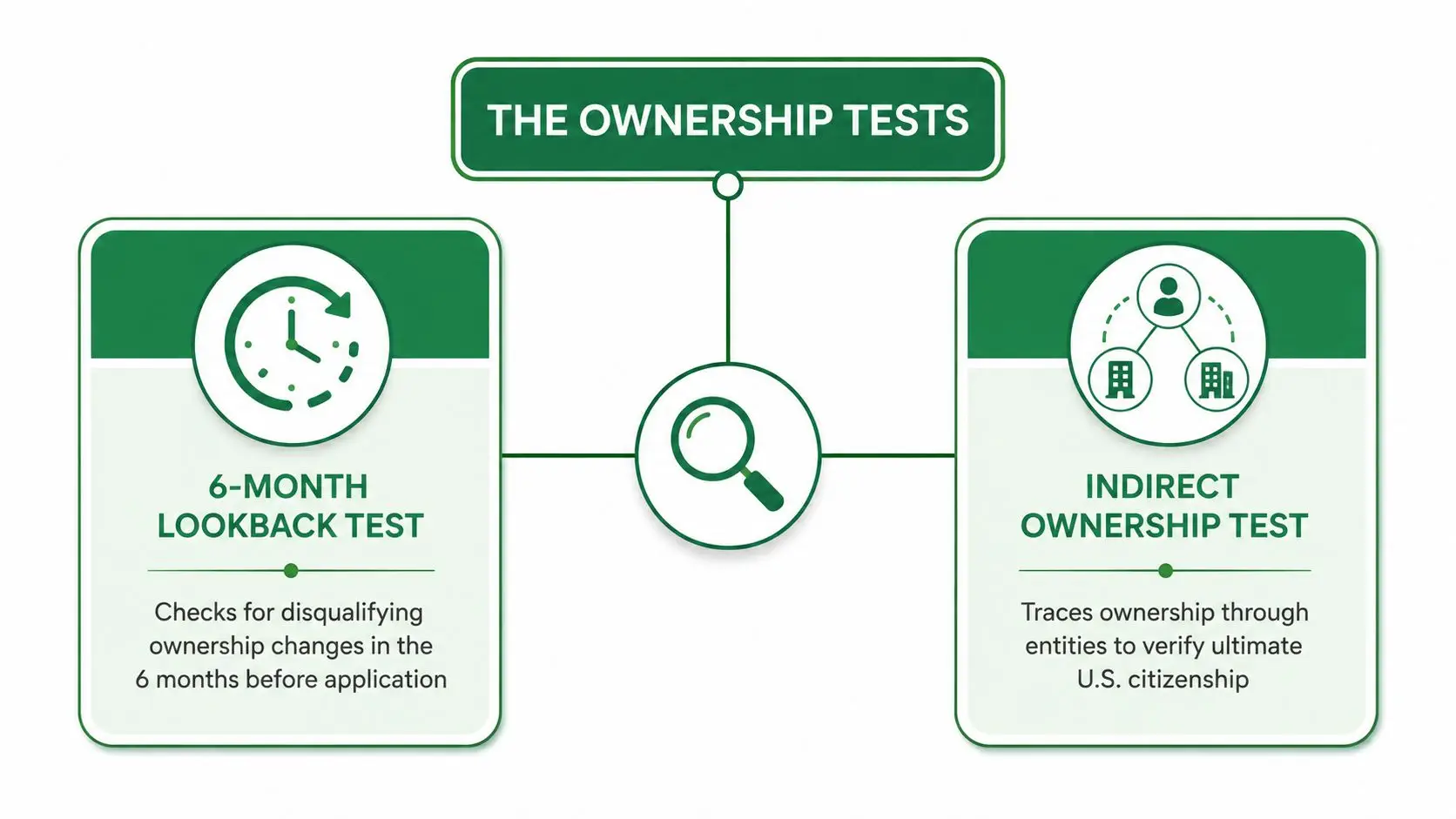
Procedural Notice 5000-876626 puts a hard stop on sloppy timing. If any direct owner, indirect owner, or required guarantor was an ineligible person during the 6 months before the SBA loan number is issued, the loan is ineligible unless that person has fully divested before issuance. That rule is not a technicality, it is the trap that kills files that otherwise look clean on closing day.
A last-minute cleanup does not save a bad record.
The lookback is a trap for last-minute cleanups
I do not trust a same-week ownership fix unless the exit is permanent and the paper trail is airtight. If an ineligible person touched the cap table during the lookback window and is still in the ownership chain when the loan number gets issued, the deal can fail even if every signature is in place. The SBA made that timing rule apply to delegated cases and to non-delegated cases that enter R1 status in E-Tran on or after March 1, 2026.
For partial exits, use the right process and document it correctly. If the transaction involves a transfer, review GoSBA Loans' guide to a partial change of ownership before you assume the structure is clean.
Indirect ownership means you trace through every layer
The lender does not stop at the borrower LLC. It has to trace through parents, holding companies, trusts, syndicates, and any other upstream entity until it reaches the ultimate owner. That is why search funds, family trusts, and investor-heavy capital stacks break so often, even when the operating company's visible cap table looks fine. If an ineligible person sits anywhere in the chain, the application is exposed.
Broker rule of thumb: if you cannot draw the ownership chain on one page, the SBA lender is going to slow the file down and ask for more.
That tracing burden is exactly why lenders use tools like automated identity document extraction to collect and verify ownership records faster. The operational impact shows up fast in acquisition financing. A small foreign stake in a parent fund, a non-citizen beneficiary in a family structure, or an upstream investor with residency problems can contaminate the whole file. I have seen buyers focus on the target company and miss the problem sitting one or two layers above it. Cap table tracing matters more than the business plan.
Documents Lenders Now Require to Prove Citizenship and Residency
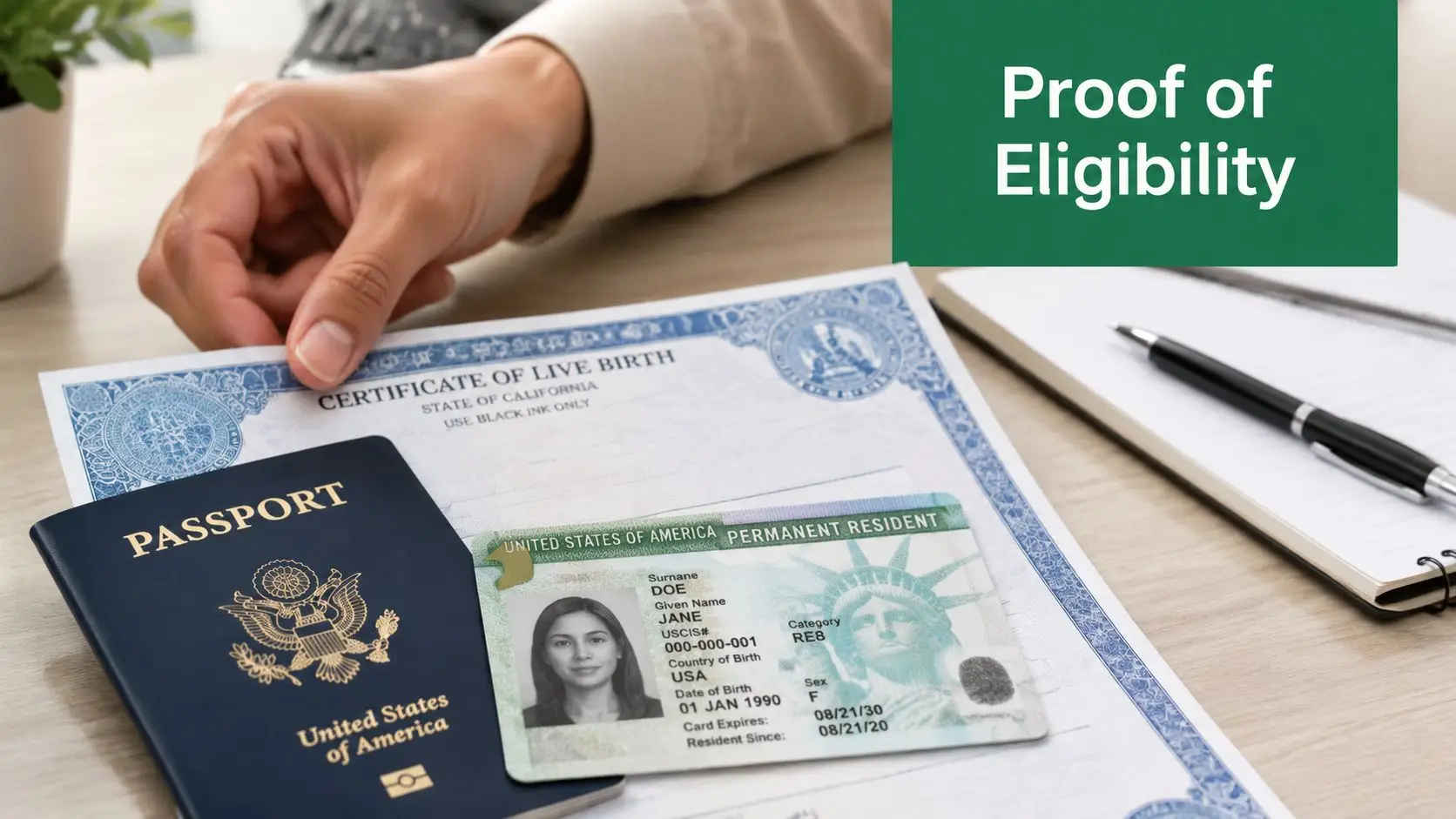
Lenders now need proof, not assumptions. For a U.S. citizen, the cleanest file usually starts with a passport, birth certificate, or naturalization certificate, plus documents that support principal residence in the United States, such as a tax return address, voter registration, or a driver's license at a U.S. address. The residence piece is where many otherwise eligible borrowers get caught.
How I tell borrowers to document the file
Collect the evidence before you submit the application. Don't wait for the lender to ask after underwriting has already started, because that is how avoidable delays turn into dead deals. For dual citizens and U.S. citizens living overseas, the residency issue needs special attention, since a valid passport won't overcome a foreign principal residence.
- Citizenship proof: passport, birth certificate, or naturalization certificate.
- Residency proof: recent tax transcript, voter registration, and a driver's license or other U.S. address record.
- Ownership proof: current cap table, operating agreement, trust documents, and every upstream entity chart.
- Guarantor proof: the same citizenship and residency evidence for any SBA-required guarantor.
- Exit proof: if someone divested, keep transfer agreements and updated entity records.
Why document extraction matters
A tight file saves time, especially when the lender is verifying multiple owners and guarantors. Tools that support automated identity document extraction can help teams organize passports, certificates, and related identity records faster, but the lender still has to review the underlying facts and confirm the person qualifies. Automation helps with intake. It does not replace eligibility judgment.
I also tell borrowers to use an internal checklist before they send anything. The SBA loan application checklist is a useful starting point, but for this issue the deliverable is a clean evidence packet for every owner and guarantor. If one file is weak, the whole package slows down.
How the Rules Differ Across SBA Programs
The 2026 citizenship screen isn't identical across every SBA product, but the strictest version is the one that matters most for borrowers chasing acquisition capital. The flagship 7(a) and 504 programs carry the clearest full-ownership domestic standard, and the SBA later said the restriction also reached Microloan and Surety Bond programs. In practice, borrowers shouldn't assume another SBA path will soften the rule.
Program comparison
| Program | Citizenship Test | Residency Test | Applies to Guarantors | Effective Date |
|---|---|---|---|---|
| 7(a) | 100% of direct and indirect owners must be U.S. citizens or U.S. nationals | Principal residence must be in the U.S., its territories, or possessions | Yes, except narrow exceptions | March 1, 2026 |
| 504 | 100% of direct and indirect owners must be U.S. citizens or U.S. nationals | Principal residence must be in the U.S., its territories, or possessions | Yes, except narrow exceptions | March 1, 2026 |
| Microloan | Citizenship screening extended under later 2026 notice | Principal residence requirement also applies | Yes, where SBA-required guarantors are involved | March 9, 2026 announcement |
| Surety Bond | Citizenship screening extended under later 2026 notice | Principal residence requirement also applies | Yes, where SBA-required guarantors are involved | March 9, 2026 announcement |
| Express | Follows the same ownership and residency framework | Follows the same residency framework | Yes, when guarantors are required | March 1, 2026 framework |
What to do with that table
Use it as a decision filter, not a wishlist. If the ownership structure fails the 7(a) or 504 test, don't waste a week pretending another SBA product will save it. Find a non-SBA path, restructure the deal, or fix the ownership issue first. Some borrowers can still use conventional financing, credit unions, or other capital sources for the same transaction, but the SBA route won't bend just because the deal is attractive.
Real Deal Structures That Break Under the New Rules
A lot of broken SBA files look fine until you map the ownership. That's the whole problem. The 2026 rule punishes structures that used to sit in a gray area, and the common failure points are predictable if you know where to look.
Search funds and syndicates
A search fund acquirer with a non-citizen participant is the first structure I flag. In the old world, people sometimes argued that passive capital didn't matter much. That argument doesn't survive the current indirect ownership test, because the SBA wants the ultimate owners to meet the citizenship and residence standard. If the upstream stack contains an ineligible person, the file is exposed.
Family-owned businesses with layered ownership
The second failure pattern is a family company where a non-citizen parent sits above the borrower entity. Borrowers often think the operating LLC is what matters. It isn't. If the owner chain runs through a parent entity with an ineligible person above it, the loan can fail even when the local management team is fully U.S.-based.
Investor-heavy capital stacks and expat buyers
A foreign strategic investor, family office, or preferred equity holder can poison a file if they sit anywhere in the direct or indirect chain. The same goes for a U.S. citizen who has lived abroad and no longer keeps a U.S. principal residence. That borrower is not automatically safe just because the passport is American. Residency kills the file in those cases.
The real fixes
- Divestiture: a bona fide, permanent transfer can clean up the cap table if it happens before the loan number is issued.
- Parallel debt: useful when you need outside capital but can't put the ineligible party in the SBA borrower stack.
- Waiting for eligibility: sometimes the right answer is to wait until the ownership change is real and documented.
If the deal depends on squeezing around the rule, it's usually the wrong structure.
How to Prepare Before You Apply for an SBA Loan
Start with the ownership chain, not the loan request. I've seen too many borrowers assemble financials, projections, and purchase agreements before checking whether the cap table can even pass the SBA screen. That wastes time and creates false confidence.
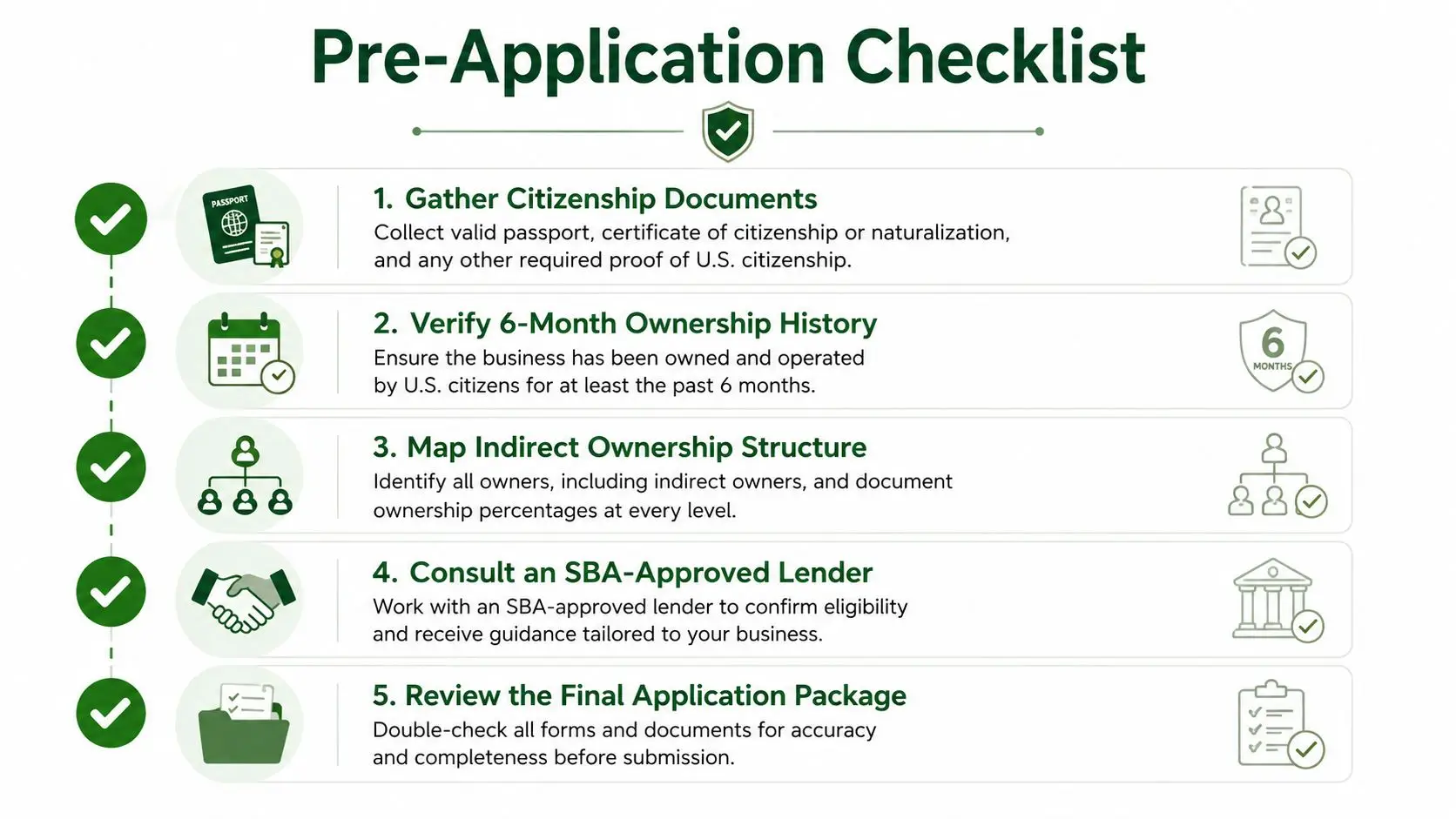
My pre-application sequence
- Audit every owner layer. Map the borrower, every parent, every trust, and every indirect interest. If you miss a layer, you miss the risk.
- Collect status documents early. Get the passport, birth, or naturalization proof for each owner and guarantor before the lender asks.
- Check residency in writing. Verify that each owner's principal residence is in the U.S., its territories, or possessions.
- Fix the problem parties. Decide whether a non-citizen will divest, move to a non-owner role, or wait until the structure is eligible.
- Tell the lender before submission. Don't let the 6-month lookback start against an ineligible owner because you delayed disclosure.
What I want in the file
A borrower-ready packet should make the lender's job easy. It should show who owns what, who guarantees what, and why every relevant person meets the current standard. If there's a weak link, disclose it before submission and build the deal around the truth, not the hope that underwriting won't notice.
The cleanest SBA file is the one that answers the ownership question before the lender asks it.
Alternatives and How a Broker Like GoSBA Loans Helps
If you don't qualify today, stop forcing an SBA deal that won't close. Conventional bank loans, credit-union small-business loans, seller financing, and investor debt are all valid alternatives when the ownership stack fails the SBA screen. In some markets, Community Advantage-type options may also be part of the conversation, but the key point is simple, if the SBA ownership test fails, you need a different capital plan.
A later citizenship change can fix the issue, but timing matters. The 6-month lookback is still the gate, so the borrower has to clean up the ownership history before the SBA loan number is issued. That's why I tell clients not to guess. They should map the cap table, confirm the residency facts, and then decide whether to move forward, wait, or restructure.
For borrowers and advisors who want a second set of eyes on the structure, GoSBA Loans works as a broker across SBA and non-SBA financing paths and can help match the deal to the right lender or alternative structure. In a market with tighter citizenship screening, that kind of early filtering saves money and prevents dead-end applications.
If your deal has any foreign ownership history, expat owner, or layered entity structure, don't submit it blind. Visit GoSBA Loans to get the ownership stack reviewed against the current SBA citizenship requirement before you burn time on a file that can't clear underwriting.
