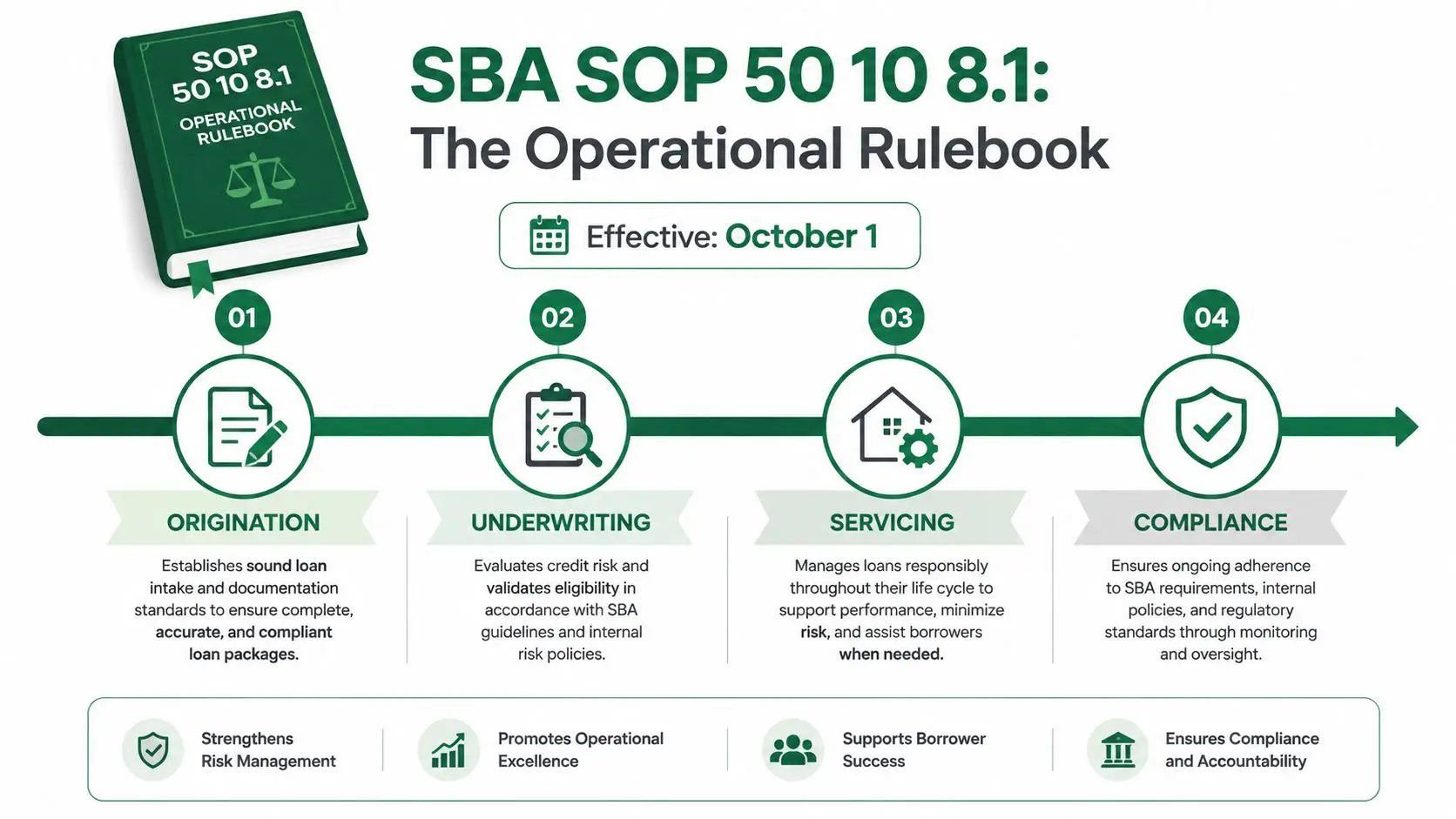
October 1, 2026 is the cutover. Any SBA loan number issued on or after that date falls under SOP 50 10 8.1, and files numbered before it stay under SOP 50 10 8.
That's the part people keep getting backward. The new rulebook doesn't just tweak paperwork, it changes which deals clear underwriting, which ones get delayed, and which ones die when the loan number is issued too late SBA's SOP 50 10 8.1 notice shows the effective date and the programs it governs.
Table of Contents
- What SBA SOP 50 10 8.1 Is and Why It Matters Now
- Eligibility, Credit, and Collateral Rules Under the New SOP
- Acquisition Underwriting Changes Versus Prior Versions
- How the New Rules Play Out in a Real Acquisition
- Borrower and Broker Compliance Checklist
- The Access Versus Prudence Trade-Off
- Next Steps for Borrowers and How a Broker Helps
What SBA SOP 50 10 8.1 Is and Why It Matters Now
SOP 50 10 8.1 is the SBA's operating rulebook for how lenders, CDCs, applicants, and borrowers move through the 7(a) and 504 loan process. It is not a statute you negotiate. It is the policy stack lenders work inside when they originate, underwrite, and close SBA-backed deals. The SBA's document listing shows version 8.1 and the October 1, 2026 effective date, so that is the cutoff lenders will plan around.
Why the date matters to buyers
The market likes to talk about announcements and ignore the loan number. That is the mistake.
If an acquisition is priced in summer 2026 but the SBA loan number lands after October 1, 2026, the file gets judged under the new SOP, not the old one SOP 50 10 8.1 coverage notice. That changes timing, diligence, and what belongs in the purchase agreement. Buyers who still underwrite to the old playbook will run into avoidable re-trades, delayed authorizations, and lender pushback when the file finally gets reviewed.
What changed in plain English
The new SOP folds tougher acquisition rules into one operating document. It tightens how lenders size debt, how they verify earnings, and how they handle ownership-change files. It also pushes for more uniform judgment across lenders, less “we do it this way here” discretion, and tighter file discipline at the front end.
Practical rule: if the deal depends on hopeful projections, seller optimism, or “we'll clean it up before closing,” the file is already weak.
The deal-level move is simple. Brokers and borrowers need to align the transaction timeline to the new framework, not force the framework to fit the deal. Start with the rulebook, then work backward to price, equity, seller note, and close date. Use this SBA loan requirements guide to check the baseline before you spend months on a structure that will not survive submission.
Eligibility, Credit, and Collateral Rules Under the New SOP
The quickest way to waste a week under SBA SOP 50 10 8.1 is to assume eligibility can be cleaned up later. Lenders are being pushed to document the borrower, the business, the owners, and the collateral position up front.
The file has to fit the borrower, not the other way around
The SBA still requires a for-profit operating U.S. business that meets size and occupancy standards, and the old exclusions still apply. Non-profits, passive real estate, and lending businesses remain ineligible. That sounds basic, but mixed-use structures and holding companies still get caught here.
The credit screen is tighter. Recent summaries say the SBA lowered the 7(a) small-loan ceiling to $350,000, raised the minimum business credit score to 165, and tightened collateral and ownership rules CRS summary. For thin-file buyers and smaller acquisitions, that means less room for a lender to hand-wave weak borrower history.
Collateral is still practical, not theoretical
Collateral still isn't required on loans under $25,000 CRS summary, and above that amount lenders still have discretion on valuation haircuts and discounting. The change is documentation. The SOP pushes lenders to explain how they think about collateral, cross-collateralization, and personal residence protections instead of relying on a loose verbal understanding.
That matters because borrowers who assume “the business assets are enough” usually learn too late that the lender wants a cleaner structure.
Borrower reality: if your credit file is thin, your ownership structure is messy, or your collateral schedule is weak, the new SOP leaves little room for optimism.
| Requirement | SOP 50 10 8.1 Rule | Borrower Impact |
|---|---|---|
| Business type | Must be an operating, eligible for-profit U.S. business | Passive or ineligible entities get screened out early |
| Small-loan tier | Recent summaries note a $350,000 small-loan ceiling | Smaller files face tighter standardization and less flexibility |
| Business credit score | Recent summaries note a minimum score of 165 | Thin-file buyers can lose approvals before pricing is even discussed |
| Collateral under $25,000 | No collateral required this SBA collateral requirements guide | Very small loans stay simpler |
| Collateral above $25,000 | Lender discretion on discounting and structure | Borrowers need a clean collateral memo, not assumptions |
If you are bringing a deal to market, use this SBA collateral requirements guide to map what the lender is likely to ask for before you promise a seller anything. A sloppy collateral story slows down even a good borrower.
Acquisition Underwriting Changes Versus Prior Versions
SBA SOP 50 10 8.1 changes acquisition underwriting in ways that hit the deal structure, not just the file checklist. Buyers who still build around the old playbook will lose time, and some will lose the deal.
Quality of Earnings is now a gating item
For Initial Acquisition or Business Expansion transactions with a purchase price of $3 million or more, the lender must use a Quality of Earnings (QoE) report and keep it in the file SBA information notice. That is a hard shift from relying mainly on tax returns, seller add-backs, and a hopeful underwriter memo.
A QoE changes the posture of the deal. It forces third-party verification of earnings, and that can cut borrowing capacity when the seller's story does not match the cash flow. Buyers need to order it before they ask for the loan number, not after the lender starts pushing back.
DSCR got firmer, and projections got weaker
Independent coverage of the new SOP says the minimum DSCR for Initial Acquisitions and other ownership-change deals moves to 1.25x. Doeren Mayhew summary That matters because deals that barely worked before may no longer clear. Projections still help tell the story, but they will not save weak historical cash flow.
Equity has to be real
The same coverage says outside-investor equity can cover only up to 50% of the borrower's required 10% equity injection, and only when each investor owns less than 20% and has no control. That shuts down a lot of sponsor-heavy structures that looked clever on paper. The lender wants actual buyer skin in the game, not financial engineering dressed up as equity.
| Underwriting Element | SOP 50 10 8 (Prior) | SOP 50 10 8.1 (New) |
|---|---|---|
| QoE for acquisitions | Often discretionary and lender-driven | Required for $3 million+ acquisitions |
| DSCR standard | More room for lender judgment | Reported minimum of 1.25x for specified ownership-change deals |
| Use of projections | More room to support the story | Historical or adjusted historical cash flow matters more |
| Outside-investor equity | More flexibility in deal structuring | Can cover only up to 50% of required 10% injection, with ownership and control limits |
If you want a clean comparison of how lenders underwrite these files, this SBA underwriting guide is the right reference point. The issue is not the theory. It is whether your capital stack survives lender math.
How the New Rules Play Out in a Real Acquisition
A buyer chasing a $4.2 million business acquisition with a $3.6 million SBA 7(a) loan can't wait until closing to clean up the file. Under the new SOP, the structure has to be credible at LOI stage, because the lender will test the cash flow, the equity, and the earnings quality before the deal gets a number.
The buyer has to solve the file before the lender does
At this size, the lender will expect a QoE before the SBA loan number request. That means the buyer should already know whether the earnings support the debt, whether customer concentration is a problem, and whether any seller add-backs will survive scrutiny. If the buyer waits until after the appraisal comes back, the deal has already burned time it can't recover.
The purchase agreement also needs to reflect the new discipline. Seller note terms, earn-out mechanics, and working capital language should be written so they don't conflict with lender underwriting, collateral perfection, or the SBA's view of acceptable credit support. The deal should be drafted to close cleanly under the new rulebook, not patched together after the lender asks hard questions.
The equity and DSCR need to hold together
Many buyers underwrite themselves into a corner. The new SOP expects the buyer to bring enough real equity, and the file has to show at least 1.25x DSCR on the lender's sizing view. If the structure only works because a seller note behaves like cash or a projection assumes a perfect year one, the deal is fragile.
A useful way to think about it is this, first write the story, then test the numbers, then choose the structure. If the equity source memo, seller financing, and forecast all point in different directions, the lender will notice immediately.
For buyers who want a broader M&A process map, the Coto & Waddington M&A playbook is a solid legal-process reference. It pairs well with SBA planning because both sides of the table need the transaction drafted before the financing is requested.
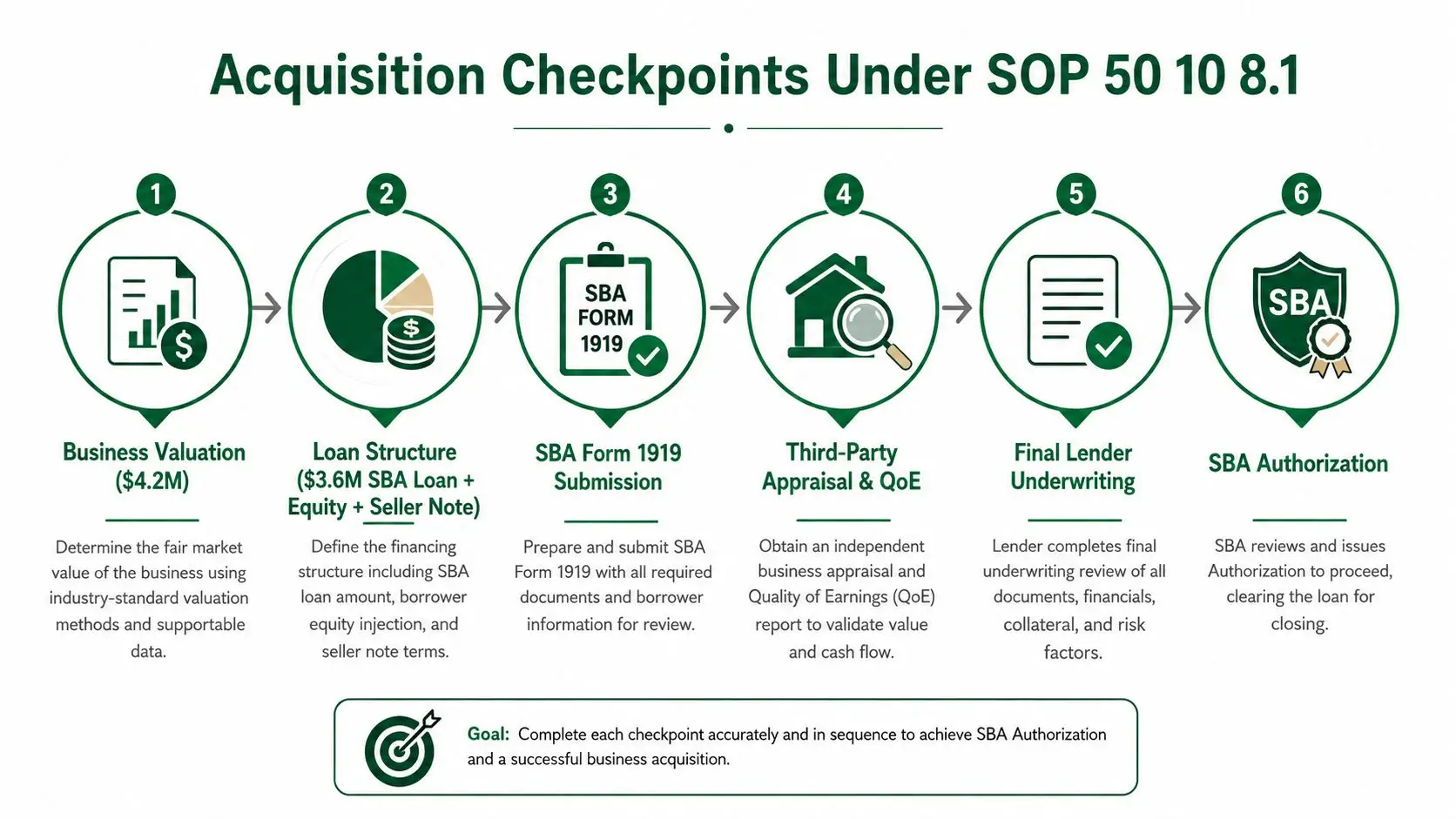
The working lesson from this kind of deal is blunt. Buyers who prep the file at LOI stage can still close on the new playbook. Buyers who wait until closing often discover they bought a business they can't finance on the terms they wanted. For a useful sequencing reference, see this LOI-to-closing timeline guide.
Borrower and Broker Compliance Checklist
If a lender can't open the file and find the right documents fast, the file slows down. That's true under any SOP, but SBA SOP 50 10 8.1 gives underwriters fewer reasons to improvise.
Bring the file in the order the lender expects
The submission package should be built around the documents the lender will request, not around the borrower's personal folder system. The core items are predictable, and each one has a job.
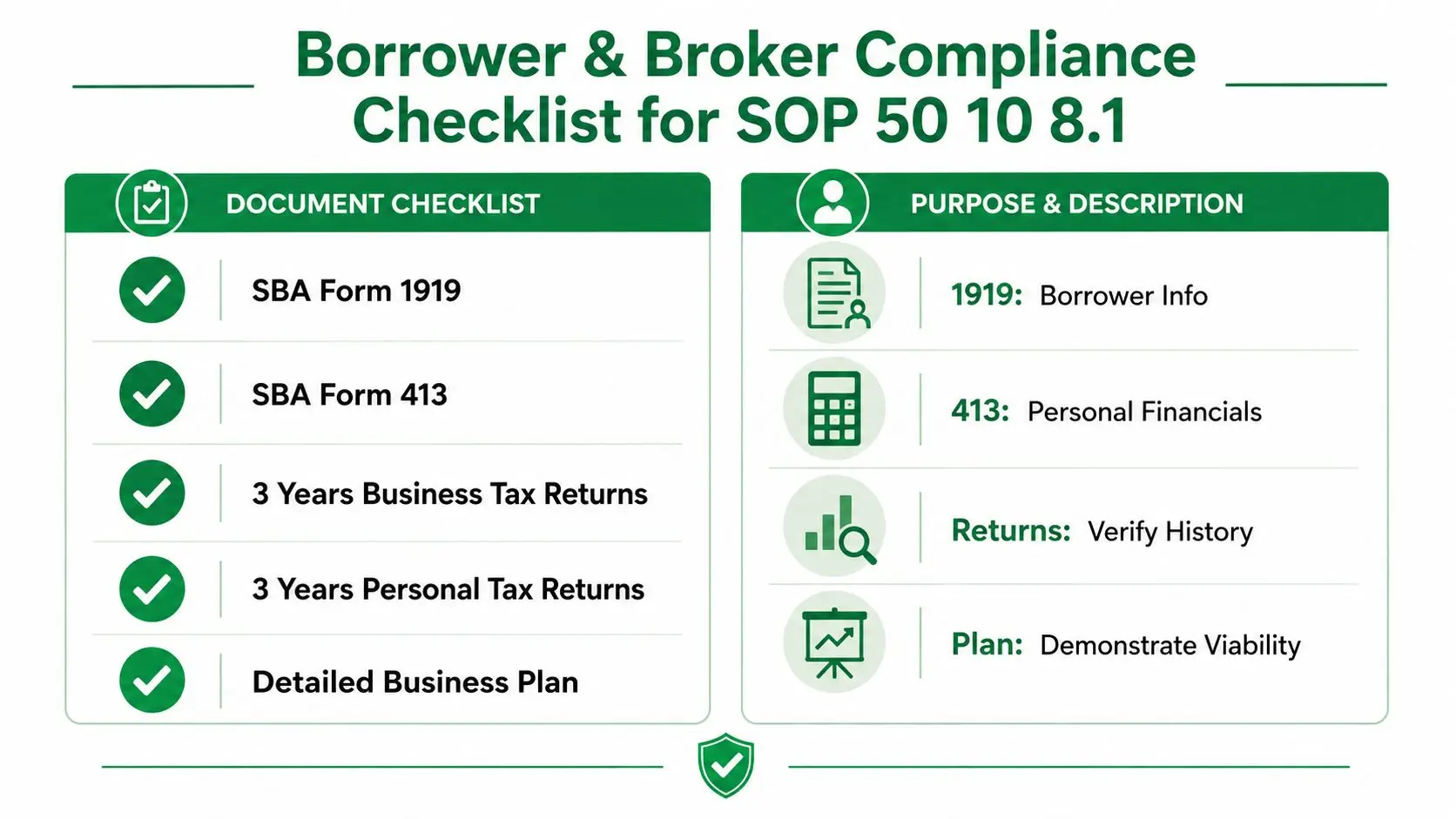
- SBA Form 1919: request the current borrower application and verify the ownership disclosures before submission.
- SBA Form 413: obtain the personal financial statement early, because the lender will use it to test liquidity and guarantor strength.
- 3 years of business tax returns: file them in clean sequence so the underwriter can trace historical cash flow without chasing missing pages.
- 3 years of personal tax returns: match them to the guarantor package and make sure every owner's return is present.
- Project-specific QoE for $3 million-plus acquisitions: commission it before the SBA loan number request, not after the lender asks for it.
- 10% equity injection sourcing memo: verify where the cash comes from, and document any non-cash support with clarity.
- Collateral position schedule: list the collateral, the lien positions, and the lender's lien perfection checklist together.
- Updated SBA loan disclosure package: confirm all ownership, credit, and structure disclosures are current before file submission.
Practical rule: a clean submission file isn't just complete, it's ordered. Underwriters hate reassembling deal documents that should've been indexed correctly the first time.
If you want a borrower-facing checklist to compare against your own packet, this SBA loan application checklist is a useful baseline. Use it as a filing discipline tool, not a comfort blanket.
The Access Versus Prudence Trade-Off
The lazy take is that SBA SOP 50 10 8.1 makes financing harder. That's too shallow. It does make financing harder for marginal deals, but that's the point.
The rulebook prices in deal quality earlier
The 1.25x DSCR floor, the $3 million QoE trigger, and the tighter collateral posture remove a lot of weak acquisitions from the queue. That's bad news for sponsors hoping to stretch a deal. It's good news for a program that's tired of looking at thin files, weak earnings support, and financing structures that only work if everything goes right.
The borrowers most likely to feel the squeeze are the ones with the least room to absorb it. Immigrant-owned businesses, first-time franchise buyers, and smaller add-on acquisitions can get caught between equity, diligence cost, and timing. That doesn't mean those businesses are bad. It means the new SOP assumes lenders should see stronger proof before they commit taxpayer-backed credit.
Prudence isn't the same as exclusion
I differ from the shallow commentary. The new SOP isn't just a gate. It's a filter. It asks whether the deal really deserves federal support on the terms being requested. If the answer is no, the borrower should hear that early and pivot to a different capital source instead of forcing an SBA file into a shape it can't hold.
The broader policy question is access versus underwriting quality, and the new SOP lands squarely on the prudence side. That may reduce volume at the margins, but it also reduces the number of deals that make lenders nervous after closing.
Some borrowers won't like the new standard. Lenders will like the cleaner files it produces.
Next Steps for Borrowers and How a Broker Helps
Treat the next 30 days like a working deadline. If you are buying a business, refinancing buyer equity, or structuring a partner buyout, the file should be ready before the SBA loan number is requested.
Days 1 through 7 get the documents moving
Pull SBA Form 1919, SBA Form 413, and the last 3 years of business and personal tax returns. If the acquisition price is above $3 million, start the QoE scope now. Lenders want to see that work underway early, not after the credit memo is already taking shape.
A broker helps by turning the file into lender-ready form before terms get quoted. That means spotting ownership problems, missing tax pages, and weak add-backs before they slow the deal.
Days 8 through 14 test the structure, not the dream
Model the transaction at 1.25x DSCR, then stress it. If the deal only works under rosy assumptions, it does not work. Tighten the structure until historical and adjusted historical cash flow can support the proposed debt.
A multi-lender process matters. One lender may accept the structure while another asks for a different support package, and you do not want to learn that after a single bank has already burned a week.
Days 15 through 30 lock equity and line up submissions
Confirm the 10% equity injection source, document any outside investor participation carefully, and map the collateral package. If the file depends on a non-cash support piece, state that plainly and prove it.
A broker also keeps pressure on timing. They track which lender will issue the SBA loan number first and whether that timing pushes the deal into the post-October 1, 2026 rule set. That detail decides the underwriting standard.
If you want a team to handle lender matching, structure review, and submission coordination against SBA SOP 50 10 8.1, visit GoSBA Loans. They coordinate SBA lenders, help package acquisitions for underwriting, and keep the file moving so you are not guessing which rulebook applies when the loan number is issued.
