You're looking at a consulting business that seems healthy on paper, but the seller runs most client relationships, the revenue is lumpy, and the asking price feels like it came from a different market. That's the exact point where valuation of consulting companies stops being a spreadsheet exercise and becomes a deal-structure problem. The right number only matters if a lender will fund it, the buyer can operate it, and the earnings transfer after closing.
A consulting firm's value is tied to how durable the cash flow really is. Buyers pay for recurring work, client retention, bench depth, and systems that survive a founder's exit, while lenders care about the same traits because they affect repayment risk. That's why two firms with similar revenue can land at very different outcomes, especially when one depends on one rainmaker and the other runs through a team with repeatable delivery.
Table of Contents
- Why Consulting Firm Valuation Is Different
- Core Valuation Methods for Consulting Firms
- Industry Multiples and What Drives Them
- Consulting-Specific Risk Adjustments
- Worked Valuation Example for a Consulting Firm
- Financing and Deal Structure Implications
- Your Consulting Firm Valuation Checklist
Why Consulting Firm Valuation Is Different
A buyer sitting across from a seller with a $2 million revenue management consulting firm often hears the same pitch, the relationships are strong, the pipeline is solid, and the founder is “still very involved.” Then the diligence file arrives, and it turns out the founder personally brings in most of the work. That kind of business can still be attractive, but its value is not the same as a product company with locked-in subscriptions or a service platform with a deep operating bench.
The asset walks out the door every night
Consulting firms are valued on the transferability of earnings, not just the size of earnings. The firm's actual asset is usually a combination of people, client trust, and proprietary know-how, which means the buyer has to ask a harder question than “how much profit does it make?” The key question is, “how much of that profit stays after the founder leaves?”
That's why valuation of consulting companies is often closer to underwriting a relationship business than pricing inventory. A lean firm with a great reputation can command a healthier multiple if the work renews, the team delivers without the owner, and clients don't vanish with the seller. A larger firm that still depends on one person can be worth less than the market expects because the buyer is taking on execution risk, not just buying cash flow.
For firms trying to look more institutional, building products with consulting clarity is a useful frame. The point is not to become software. The point is to make the delivery model, client handoff, and revenue stream easier to transfer.
Practical rule: If the seller is the main salesperson, strategist, and relationship owner, treat the asking price as a starting point, not a conclusion.
The valuation range matters because consulting deals rarely price as a single neat number. The multiple moves with recurring revenue, client concentration, founder dependence, and the depth of the delivery team, and lenders will look at those same factors when they decide whether the deal can close. That's why consulting valuation and SBA underwriting tend to push in the same direction, even when the seller wants to focus only on top-line growth.
Core Valuation Methods for Consulting Firms
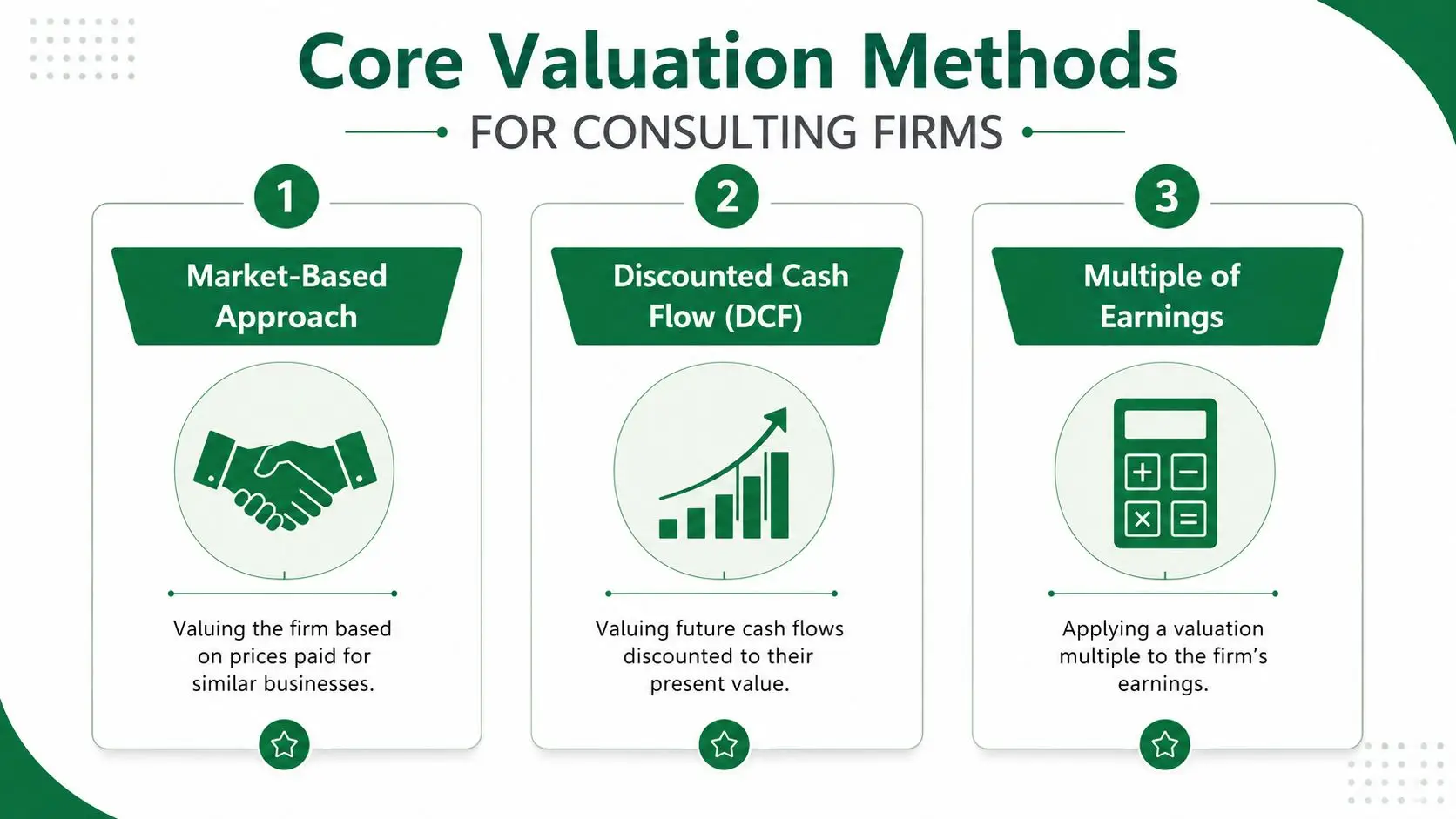
A credible valuation usually starts with more than one method, then reconciles the results into a range. For consulting firms, the three methods that matter most are market-based valuation, discounted cash flow, and asset-based valuation. The formula is simple in each case, but the judgment sits in the inputs.
Market-based approach
The market-based approach looks at what buyers have paid for similar businesses. In practice, that often means a multiple of revenue, EBITDA, or SDE, adjusted for firm quality and deal structure. The general formula is:
Value = Comparable multiple × earnings measure
For small and mid-sized consulting firms, this is usually the anchor method because buyers and lenders both think in multiple terms. It works best when the firm has enough operating history, reasonable comparables, and a recognizable revenue model. It breaks down when the business is too idiosyncratic or when the seller is comparing a founder-heavy boutique to a more institutional peer.
Discounted cash flow
DCF values the firm based on future cash flow converted back to present value. The formula is:
Value = Sum of future cash flows discounted by risk and time
That makes DCF useful when the firm has predictable recurring revenue, a stable client base, and enough history to support a forward view. It can be powerful for a larger practice with sticky engagements, but it gets fragile fast if the forecast depends on aggressive growth assumptions or if the buyer has to replace a founder-led rainmaker immediately.
ExitWise notes that the common methods for consulting firms are discounted cash flow and a market-based approach, and that the valuation process reviews revenue, profits, and growth over the past few years before selecting the method and issuing the report. A practical comparison of earnings-based methods is also laid out in this SBA EBITDA guide.
Asset-based approach
Asset-based valuation is usually the weakest fit for consulting firms because the balance sheet rarely captures the core value. It may matter in a liquidation scenario or when the firm has meaningful equipment, but most consulting practices are not valued for tangible assets. The business is worth what its relationships, people, and recurring earnings can support, not what its desks and laptops fetch.
Bottom line: In consulting acquisitions, professional valuations often triangulate value across multiple methods, then weight the method that best matches the firm's revenue quality and transferability.
If you need a deeper view on how numbers are assembled from financial statements, Escrow Consulting Group's financial insights are useful context for the diligence mindset, especially around clean reporting and earnings consistency.
Industry Multiples and What Drives Them
The starting point for most consulting deals is a multiple of earnings, but the right multiple depends on what kind of earnings you're buying. The practical benchmark for many small and mid-sized consulting firms is about 1.0x to 3.0x annual revenue or 4.0x to 7.0x normalized EBITDA, with weaker, owner-dependent firms often lower and more durable firms higher. A separate market view notes that smaller owner-dependent firms often trade around 2x to 4x EBITDA, while larger, more institutional firms can sit around 4x to 7x EBITDA. Public-company data can look much richer, but that's a different market with different liquidity and growth expectations.
What the market is actually saying
An analysis of 32 public consulting companies found a 2024 median revenue multiple of 1.6x, a median EBITDA multiple of 13.2x, and a median P/E multiple of 27.5x. In 2023, the same group sat at 1.1x, 13.8x, and 18.7x, respectively, showing that public market pricing can move materially from year to year. The same market context also described the U.S. management consulting market at about $374 billion in 2023, which helps explain why public trading metrics and private transaction metrics don't line up neatly.
The gap matters. Public firms are priced for scale, access to capital, and liquidity, while private buyers are underwriting transition risk, founder risk, and bankability. If a seller quotes a public multiple to defend a private asking price, the buyer should push back hard.
Multiples by firm profile
| Firm Profile | Revenue Multiple | EBITDA/SDE Multiple | Key Drivers |
|---|---|---|---|
| Owner-led boutique | Lower end of the market range | 2x to 4x EBITDA or 2.0x to 5.0x SDE | Founder dependence, project work, limited bench |
| Small consulting firm with some repeat work | Middle of the market range | 4x to 7x EBITDA | Mixed client base, some recurring engagements, moderate transferability |
| Larger institutional firm | Higher end of the market range | Toward the upper end of EBITDA ranges | Senior delivery team, recurring revenue, less key-person risk |
| Services-SaaS hybrid | Premium to the base range | Above the base range | More durable revenue, software-like stickiness, stronger transferability |
The drivers are easy to name and hard to fake. Recurring revenue, low client concentration, a second line of leadership, and repeatable delivery all support a higher multiple. A thin bench, short-term projects, and a seller who still closes every deal pull the number down.
Buyers usually pay for proof, not promises. If the firm can't show how revenue survives a leadership handoff, the multiple should reflect that reality.
For a broader SBA-oriented perspective on how buyers compare businesses, this business valuation methods SBA guide is a useful companion.
Consulting-Specific Risk Adjustments
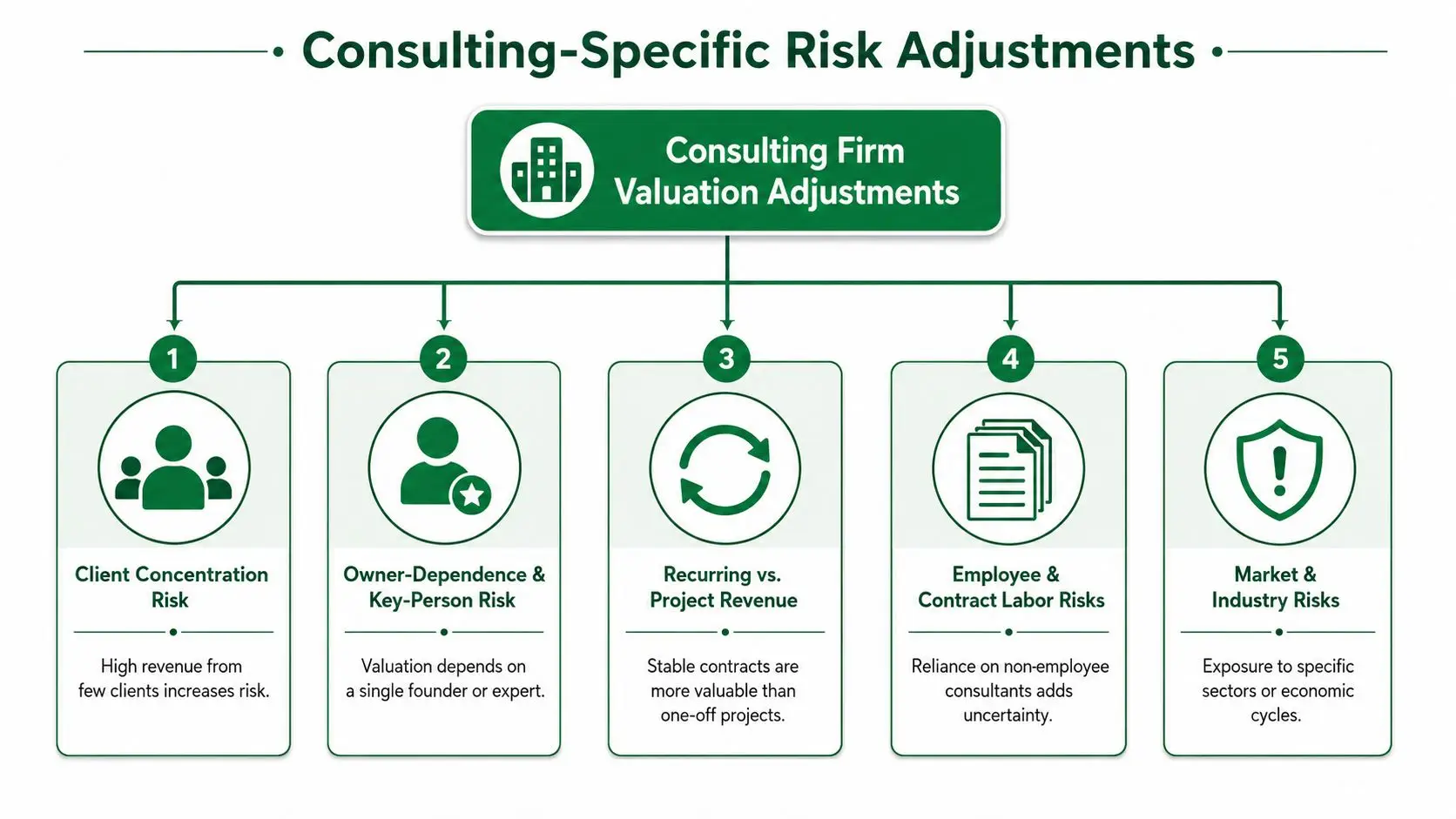
A consulting firm's headline multiple can look fine until the adjustments start. The five issues that change the number most are client concentration, owner dependence, revenue recurrence, contract quality, and margin sustainability. Each one either makes the earnings more transferable or reminds the buyer that the founder is carrying the business on their back.
Client concentration and owner dependence
Client concentration is the fastest way to trim a multiple. If one customer drives a large share of revenue, the buyer is exposed to renewal risk, budget cuts, and relationship migration after closing. The same is true when the founder is the only person who can sell, scope, and retain the account.
A firm with very concentrated revenue might still transact, but the buyer will usually demand a discount and more protection in the deal structure. If the top client leaves, the value can change overnight. If the seller is still the face of the business, the risk rises again.
Recurring revenue and contract quality
Recurring revenue is worth more than one-off project work because it's easier to underwrite. Retainers, multi-year contracts, and embedded advisory relationships create more predictable cash flow than project-based staffing. Buyers and lenders both like predictability because it supports repayment and reduces post-close volatility.
Contract quality matters too. A signed agreement that can be transferred cleanly is better than a handshake relationship that depends on personal trust. If contracts are short, terminable at will, or tightly tied to the seller, the multiple should reflect that fragility.
Team depth and margin stability
A deep bench of senior consultants reduces key-person risk and improves continuity. It also gives the buyer confidence that client delivery won't collapse when the founder steps back. That usually supports a stronger multiple because the business becomes more institution-like.
Margin sustainability is the final filter. If profitability depends on unusually lean staffing, unpaid owner labor, or one-time projects, the reported margin can overstate the true economics. This SBA intangible asset guide is a useful reminder that the value buyers care about usually sits in intangible strength, not physical assets.
Worked Valuation Example for a Consulting Firm
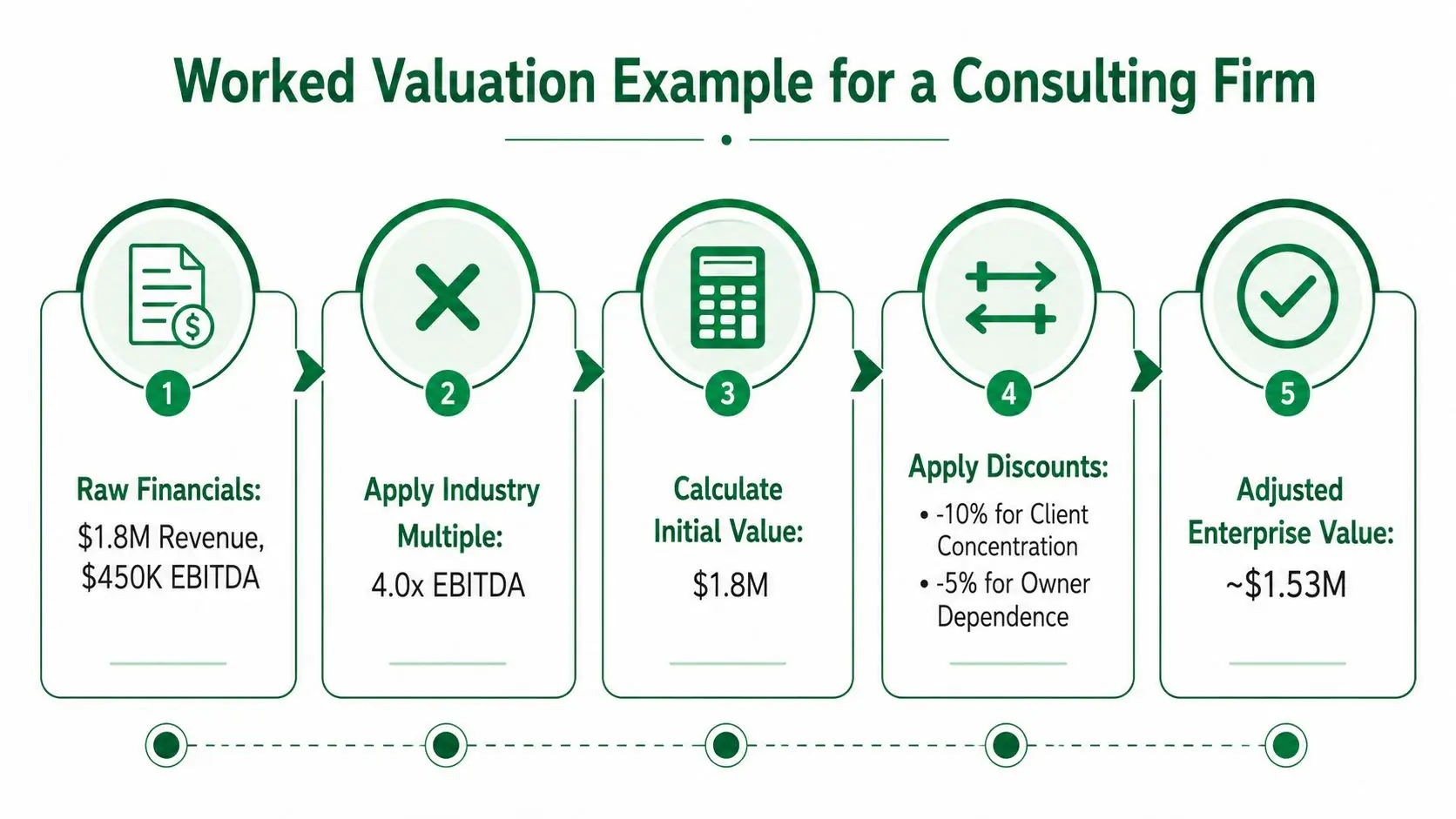
A mid-sized consulting firm with $1.8 million revenue and $450,000 reported EBITDA can look straightforward until you normalize the numbers. If the owner pays themselves above market, runs personal expenses through the business, or books one-time project revenue that won't repeat, the reported EBITDA is not the earnings number that should drive the purchase price. The first job is to separate true operating profit from accounting noise.
Step 1, normalize earnings
Start by reviewing owner compensation, discretionary spending, and unusual items. In consulting, that often means adding back above-market owner pay and discretionary expenses such as personal travel, meals, home office costs, memberships, and family payroll, because those items can materially distort SDE or EBITDA. The buyer is purchasing the business's economic earnings, not the seller's lifestyle choices.
If a one-time project inflated the year's revenue, strip that out too. The goal is to estimate recurring profitability, not reward a temporary spike.
Step 2, choose the multiple
For a firm with some client concentration and owner dependence, a buyer may lean toward the lower part of the consulting range. If the business has repeat work, a second line of leadership, and cleaner transferability, the multiple moves up. The range from the earlier section matters here because valuation is really a negotiation over risk.
Step 3, calculate the value
Using the reported EBITDA of $450,000 and a 4.0x EBITDA multiple gives an initial value of $1.8 million. If diligence shows heavier concentration or stronger founder dependence, the buyer might argue for a lower end multiple. If the delivery team is strong and revenue is repeatable, a higher multiple can be justified, which is how a similar earnings base can support a materially wider valuation range.
A practical way to sanity-check the purchase price is to compare it with the buyer's financing capacity and post-close debt service, not just the seller's ask. This acquisition price guide can help frame that discussion before the LOI hardens into a number.
The cleanest valuations in consulting aren't the ones with the highest multiples. They're the ones where the earnings survive diligence without heroic assumptions.
Financing and Deal Structure Implications
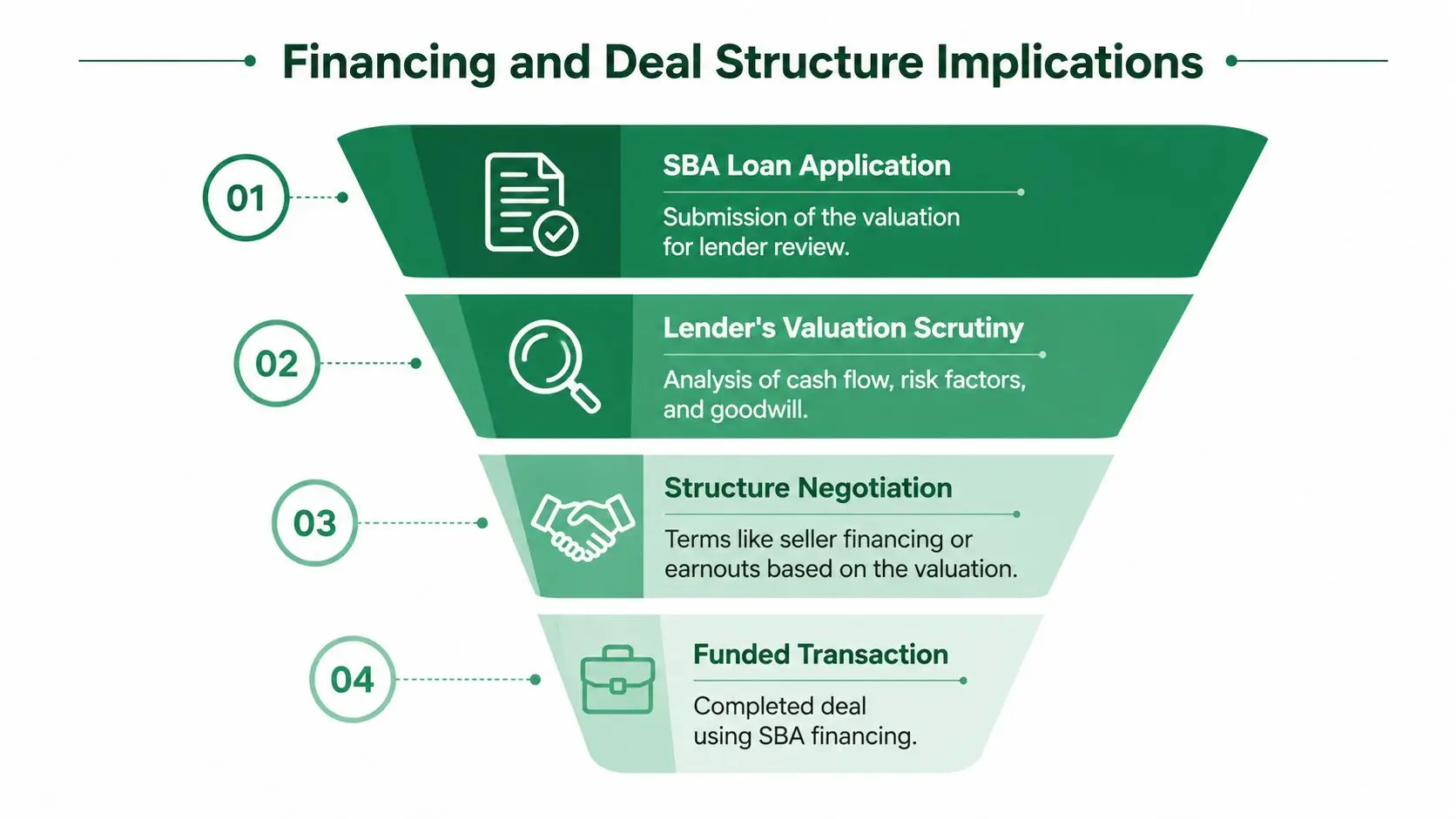
A consulting firm can be “worth” one number in a seller's mind and a different number in a lender's underwriting model. The SBA lens matters because the valuation has to support an approved capital stack, not just a purchase agreement. A price that looks fair on EBITDA can still fail if the structure doesn't satisfy lender expectations for equity, seller carry, and repayment support.
What lenders look at
SBA underwriting cares about whether the earnings are transferable and whether the debt can be repaid from business cash flow. That puts consulting firms under a sharper microscope when the founder is also the rainmaker. If the business depends on personal relationships or a narrow client base, the lender may reduce the weight it gives to reported earnings.
The SBA SOP also pushes buyers toward clean documentation and defensible valuation support, which is why a formal business valuation report matters more in a consulting deal than in a simple asset purchase. The seller's story is not enough. The lender wants to see how revenue, profits, and growth have behaved over the recent period and how the value was selected.
How structure changes what the deal is really worth
A seller note on standby can bridge a pricing gap when the lender won't support the whole ask with senior debt. Buyer equity injection also matters because it changes the capital stack and signals commitment, while earn-outs can defer some of the price until the client base proves it will stay. In practice, the headline valuation is only one piece of the deal.
A note on buyer cash contribution is especially important. For SBA 7(a) acquisitions after the current rule change, buyers should plan around the 5% minimum equity injection requirement, which forces more disciplined pricing and less room for wishful thinking. If the seller wants a premium multiple, the deal often has to absorb that premium through structure, not just hope.
For sellers, seller financing for business acquisition is often the lever that keeps a good consulting deal alive when bankable cash flow is tight. For buyers, that same structure is a signal to keep the valuation grounded in what the business can support.
Your Consulting Firm Valuation Checklist
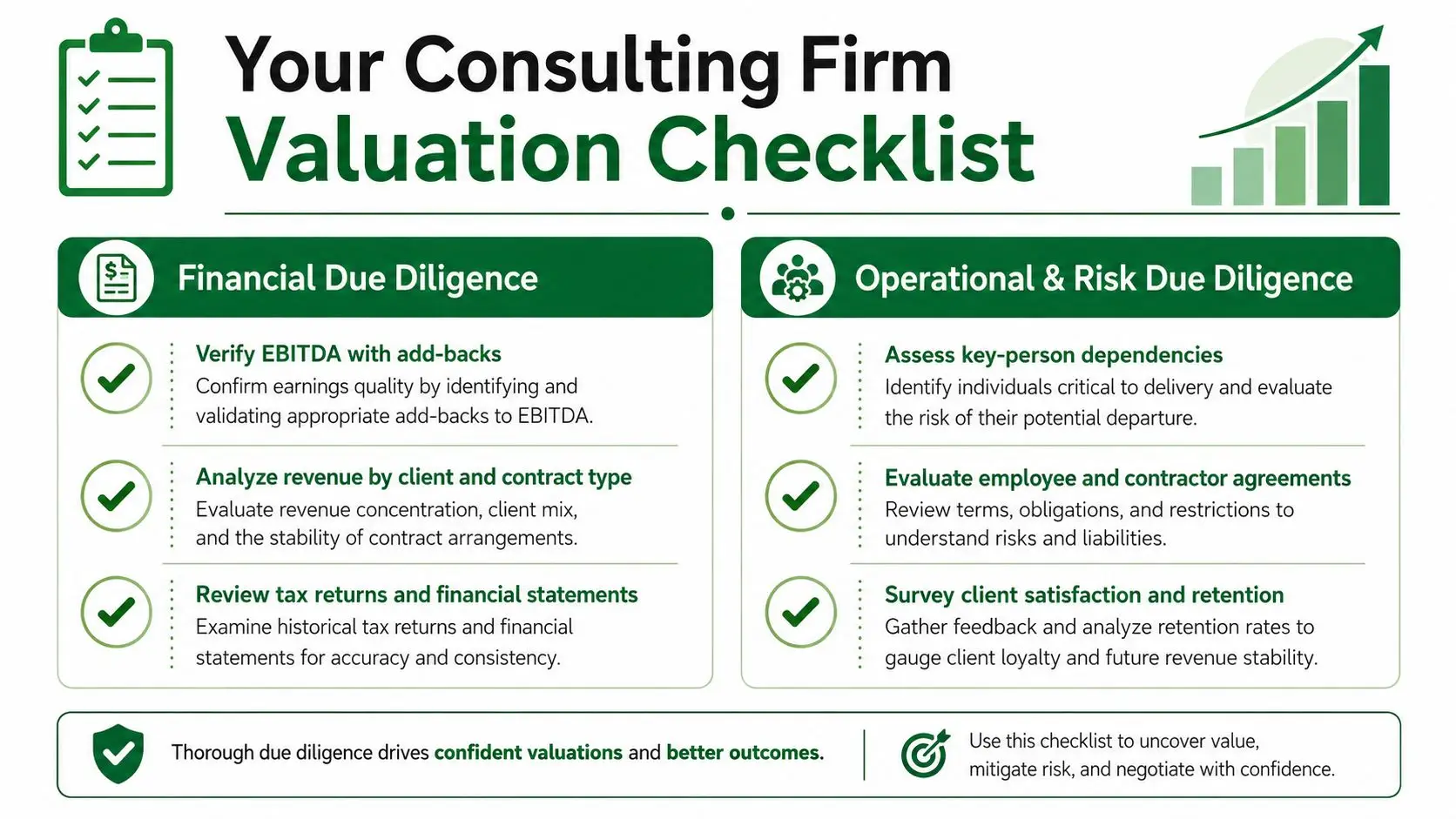
A good buyer doesn't just accept the asking price. They test it against financials, contracts, and the realities of who runs the firm. If you're reviewing a target, start with the earnings quality and then move into transferability.
Financial due diligence
- Verify EBITDA with add-backs. Check whether owner compensation and discretionary expenses were normalized properly, because those items can materially change the valuation.
- Analyze revenue by client and contract type. Revenue that depends on a few clients or short projects deserves a harder discount than recurring work.
- Review tax returns and financial statements. If the story in the deck doesn't match the tax return, assume the seller's number is the optimistic one.
Operational and risk due diligence
- Assess key-person dependencies. If the founder controls sales and delivery, the business is riskier than the headline revenue suggests.
- Evaluate employee and contractor agreements. A consulting firm with loose labor arrangements can lose continuity fast after closing.
- Survey client satisfaction and retention. Happy clients are not the same thing as sticky clients, so ask whether they renew, expand, and stay through leadership transitions.
If you want a legal lens on ownership structures and investor rights, startup stock rights explained is a useful reminder that deal terms can matter as much as the number itself.
If the seller can't support the revenue quality, the multiple should come down. If the buyer can document stronger transferability, that becomes a key point in negotiations. When the company is too complex or the paper trail is too thin, bring in a professional valuation expert before you sign the LOI.
If you're evaluating a consulting acquisition and want a lender-focused view of the numbers, GoSBA Loans can help you think through the SBA financing side of the deal, from valuation support to capital stack design. Visit GoSBA Loans to pressure-test your target, compare structure options, and get a financing strategy that matches the value of the business.
