Acquisition cost is the total all-in amount it takes to buy and operate a business or asset, not just the sticker price. If a buyer agrees to pay $1.0 million and ends up with $50,000 in legal, due-diligence, and closing expenses, the actual acquisition cost is closer to $1.05 million under this framework, and that gap is where deals get strained fast (CFI on acquisition cost).
That's the number first-time buyers miss. They budget for the purchase price, then get surprised by lender fees, professional reports, working capital needs, and closing items that show up late, when their cash is already spoken for.
Table of Contents
- Understanding Acquisition Cost Beyond the Sticker Price
- Breaking Down the Components of Total Acquisition Cost
- Acquisition Cost vs Customer Acquisition Cost vs Purchase Price
- Financing Your Acquisition Cost with SBA Loans
- Real-World Acquisition Cost Calculation Example
- Strategies to Minimize Out-of-Pocket Acquisition Costs
- Tax Treatment and GAAP Accounting for Acquisition Costs
- Your Acquisition Cost Closing Checklist
Understanding Acquisition Cost Beyond the Sticker Price
A buyer can feel safe at $1.5 million and still get hit with another $120,000 in legal, diligence, and closing items right before funding. That gap is not a rounding error. It is the difference between a deal that clears underwriting and one that needs emergency capital at the worst possible time.
The number you should underwrite
In deal work, acquisition cost is the full amount required to obtain the business or asset and put it into use. A buyer should underwrite beyond the headline price and include the costs tied directly to closing and putting the asset to work, such as purchase price, discounts, incentives, closing costs, legal fees, registration fees, and other necessary expenditures (CFI on acquisition cost). For fixed assets, the same rule applies, the cost basis includes the amount paid plus the costs needed to place the asset in service, not just the invoice line item (Contentsquare on acquisition costs).
That distinction matters because each party in the deal is looking at a different number. The seller focuses on the headline price. The lender focuses on the full project cost, the capital stack, and how much cash must stay in the business after closing. You should focus on the total cash you need to close and operate, because that determines whether the deal is financeable.
Practical rule: if a cost exists only because you're buying the business, assume it belongs in your acquisition cost review unless your lender or accountant says otherwise.
Why first-time buyers get tripped up
First-time buyers often build their model around the purchase price and stop there. That works until the closing package shows up with due diligence fees, financing charges, working capital, and post-close setup costs. At that point, the buyer is not just buying a company, they are funding a transaction.
The mistake shows up fast in ROI math. Leave out required working capital and you overstate return while starving the business on day one. Leave out lender fees, seller note terms, or pari passu debt that changes how much cash is required, and the structure looks better on paper than it does at closing. SBA deals expose this gap quickly, which is why the buyer needs a real closing budget, not a rough purchase-price estimate. A practical reference for the diligence process is the guide to M&A due diligence process, because buyers who understand diligence scope usually catch the expensive surprises before they become closing problems.
Use the purchase price as the starting point, then build a second number that includes every directly attributable cost needed to close and operate. If that second number feels uncomfortable, it should. That figure is the acquisition cost, and it is the one that tells you whether the deal works.
Breaking Down the Components of Total Acquisition Cost
The cleanest way to estimate a deal is to separate the price you're paying from the costs you're absorbing to get the asset across the finish line. Buyers who skip this step usually discover the missing items in the last week before closing, which is the worst time to renegotiate capital structure.
What belongs in the stack
A proper acquisition budget usually includes the purchase price, broker compensation, legal review, diligence reports, lender fees, working capital, escrow, and any capital expenditures needed to make the asset usable. Federal grant accounting rules also recognize that acquisition cost can include the net invoice price plus modifications, attachments, accessories, or auxiliary apparatus needed to make the asset usable, with ancillary charges such as taxes, freight, duty, protective in-transit insurance, and installation handled according to the recipient's regular accounting practice (2 CFR 200.308).
Due diligence is where many buyers underestimate both time and spend. If you need a quality of earnings review, environmental work, or a third-party valuation, those are real acquisition costs, not optional extras. A practical reference for the diligence process is the guide to M&A due diligence process, because the buyer who understands diligence scope early usually has fewer ugly surprises later.
For a clean lender-facing budget, I like to group costs into three buckets, price, transaction costs, and operating runway. That simple split keeps you from burying working capital inside “miscellaneous” and forgetting it exists until payroll is due.
| Cost Component | Typical Range | Negotiable |
|---|---|---|
| Purchase price | Deal-specific | Yes |
| Broker fees | Deal-specific | Sometimes |
| Legal fees | Deal-specific | Partly |
| Due diligence reports | Deal-specific | Sometimes |
| Working capital injection | Deal-specific | Yes |
| Escrow deposits | Deal-specific | Sometimes |
| Transfer taxes | Deal-specific | Usually limited |
| Capex to make assets operational | Deal-specific | Sometimes |
| Seller note on standby | Deal-specific | Yes |
| Contingency reserve | Deal-specific | Yes |
The smartest buyers are aggressive on what they can negotiate and conservative on what they can't. Escrow, legal scope, and seller support often have some flexibility. Taxes, required reports, and lender conditions usually don't.
For a closer look at fee categories that often catch buyers off guard, the SBA loan closing costs complete fee breakdown for 2026 is worth reading before you sign an LOI.
Acquisition Cost vs Customer Acquisition Cost vs Purchase Price
A buyer can lose control of a deal budget fast by treating these three terms as interchangeable. The seller cares about the headline number. The lender cares about the full source-and-use picture. The marketing team cares about something completely different.
Three different meanings, three different uses
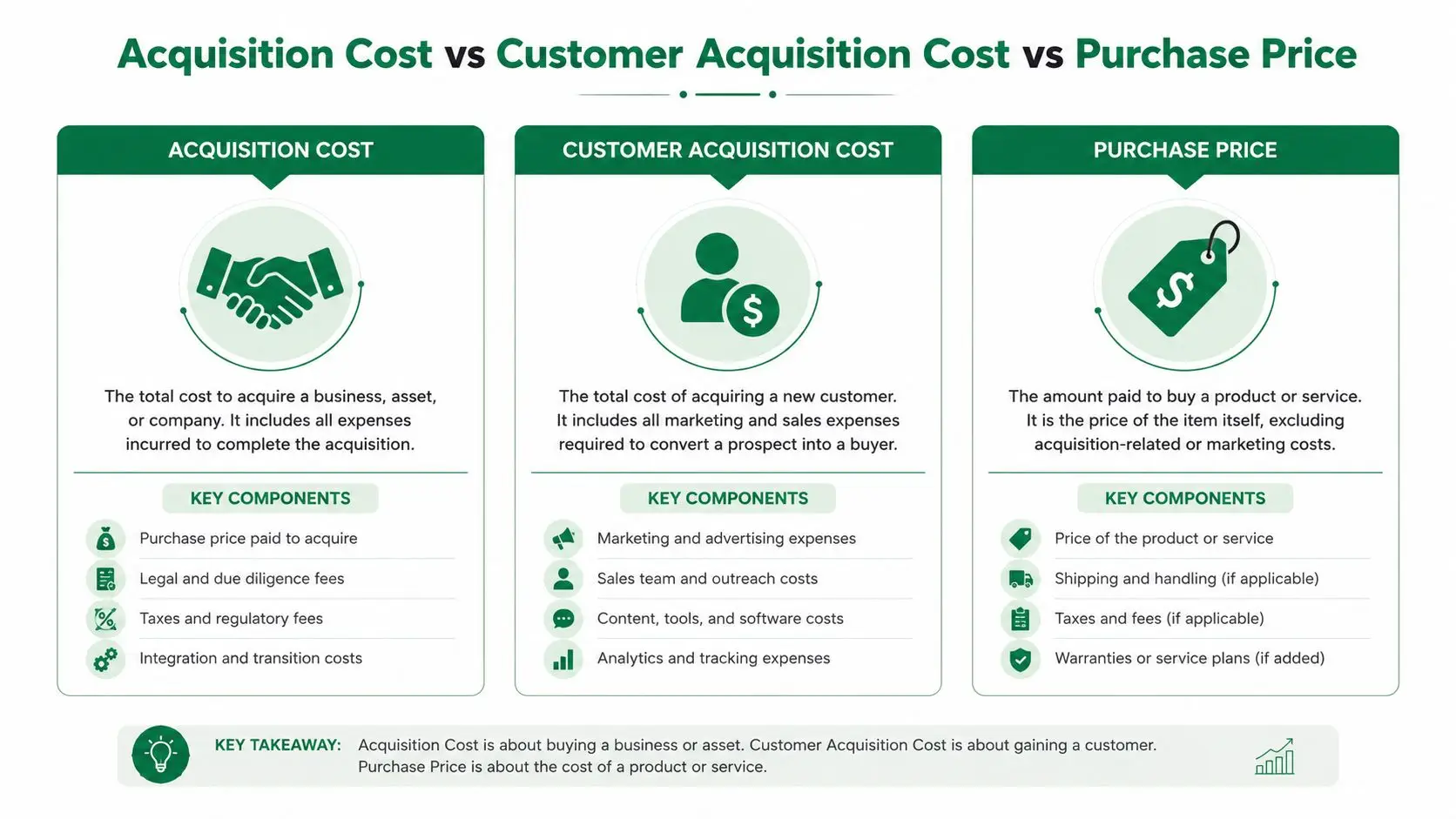
Purchase price is the contract number for the business or asset itself. It is the amount the buyer agrees to pay before closing fees, working capital needs, and any post-close cleanup costs get added in.
Acquisition cost is the all-in cost to buy the business or asset and get it ready to operate. For a buyer, that includes the purchase price plus direct transaction expenses and other closing items that belong in the source-and-use schedule, not buried in a side note.
Customer acquisition cost (CAC) is a marketing metric, calculated as total sales and marketing spend divided by the number of new customers acquired (CFI on CAC). In practice, it can include advertising, sales staff, software, and related overhead, not just ad spend. A straightforward definition and component breakdown is also covered by HubSpot's explanation of customer acquisition cost.
The differences matter because each term answers a different question. Acquisition cost asks what it takes to close and fund the deal. CAC asks what it costs to win one customer. Purchase price asks only what the seller wants for the business or asset.
How to avoid apples-to-oranges mistakes
If you are buying a business, keep CAC out of the conversation unless customer economics are part of your underwriting. If you are managing growth, do not use purchase price language when you are discussing marketing efficiency. Mixing the terms makes lender packages sloppy and makes buyer decisions worse.
A first-time buyer also needs to separate valuation from cost. A seller may quote a number that sounds clean, but the lender underwrites the acquisition using the actual deal structure, including debt service, working capital, and how much cash the buyer still needs after closing. For that side of the process, the business valuation for SBA loans guide is useful because it shows how lenders frame what an acquisition is worth.
Use this rule: if the spend is tied to closing a transaction, call it acquisition cost. If the spend is tied to winning customers, call it CAC. If it is only the number in the sale agreement, call it purchase price.
Financing Your Acquisition Cost with SBA Loans
If you're trying to minimize cash out of pocket, SBA financing is usually where the key structure work happens. The goal isn't just to borrow money. The goal is to fund the acquisition, preserve liquidity, and still satisfy the lender's equity rules.
Structure beats slogan
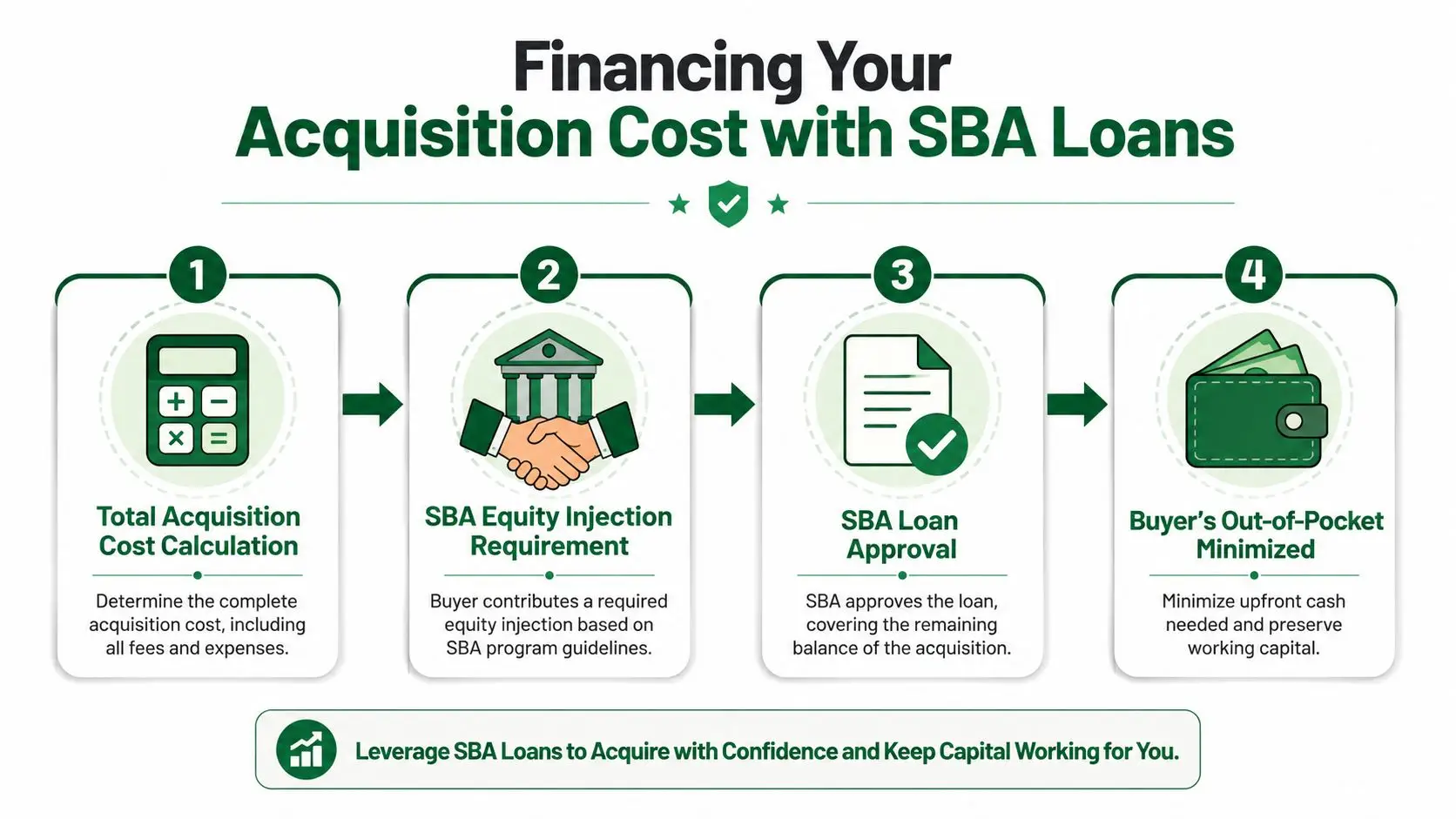
For many acquisitions, SBA 7(a) is the primary tool for buying a business, and SBA 504 is often used when owner-occupied commercial real estate is part of the transaction. The key is that the loan has to work against the total project cost, not just the sticker price, so working capital and other closing items need to be mapped early.
SBA deal structure also matters when you're short on liquid cash. A seller note on full standby can be used to support the equity story in the right structure, and a pari passu arrangement can help in investor-heavy capital stacks when the deal has multiple layers of senior and quasi-senior capital. If you're shopping for terms, GoSBA Loans coordinates proposals from multiple SBA lenders and can structure around acquisitions, working capital, and owner-occupied real estate, but it's still the borrower's job to show a coherent source-and-use plan.
The first practical question is not “How much can I borrow?” It's “How much equity must I really bring, and what can count toward that requirement?” That answer drives whether a deal closes cleanly or stalls in underwriting.
Cash-outlay discipline matters
A buyer who wants to preserve liquidity should push hard on three levers. First, use the loan to cover legitimate acquisition-related costs where the program allows it. Second, negotiate seller support through standby notes or credits. Third, keep enough post-close runway so the business isn't undercapitalized on day one.
For more detail on business-acquisition lending mechanics, the business acquisition loan guide is a good companion read if you're comparing structures before you commit.
The hard truth is that a deal can look affordable at the LOI stage and still be too tight at closing. If the capital stack only works when everything goes right, it doesn't really work.
Real-World Acquisition Cost Calculation Example
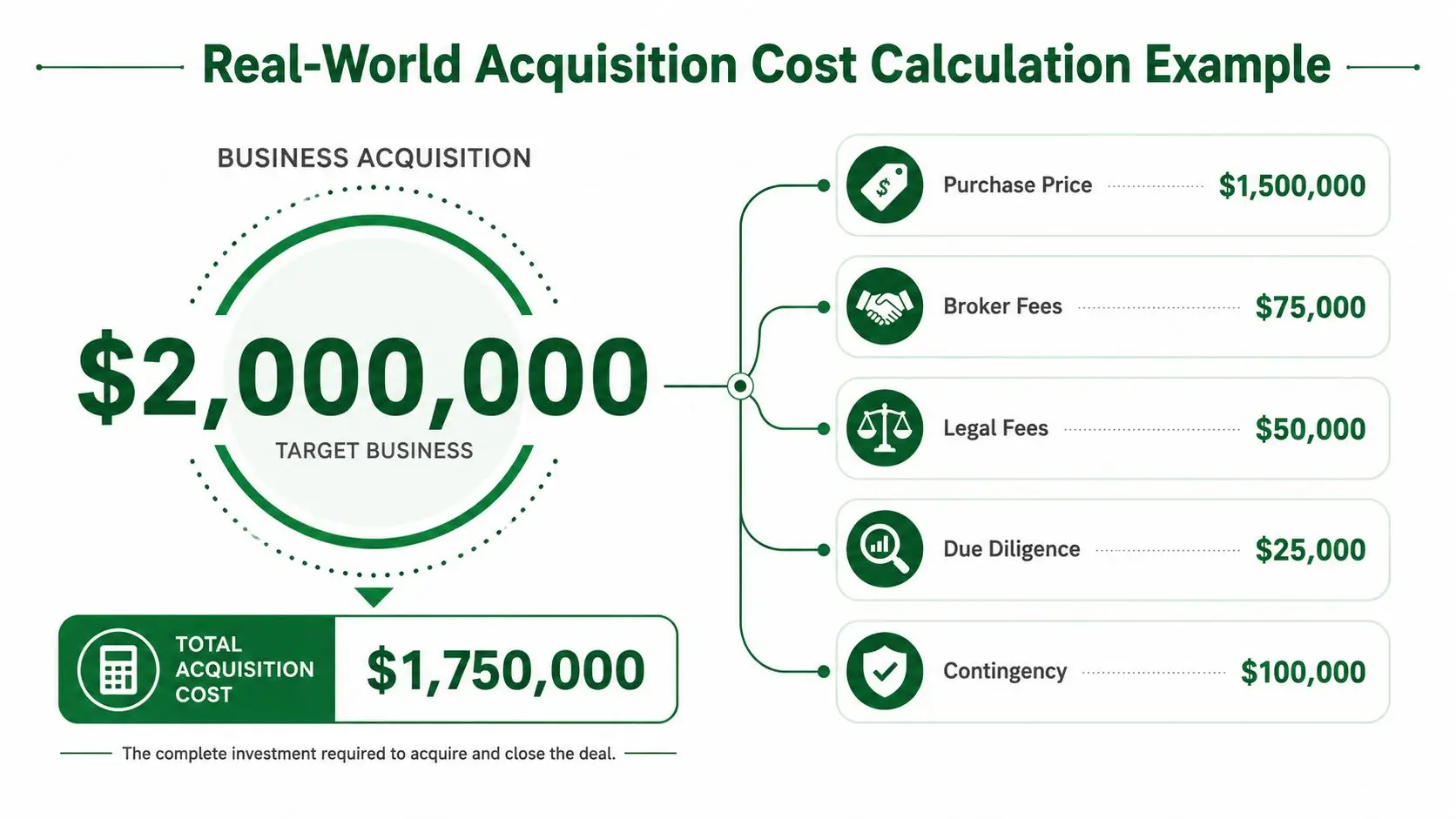
Run the deal math before you get attached to the seller's asking price. A business may be listed at $2,000,000, but the total acquisition cost is higher once broker fees, legal work, diligence, contingency, and lender requirements are in the file.
A clean source-and-use view
A practical acquisition budget usually looks like this:
| Item | Amount |
|---|---|
| Purchase Price | $2,000,000 |
| Broker Fees | $75,000 |
| Legal Fees | $50,000 |
| Due Diligence | $25,000 |
| Contingency | $100,000 |
| Total Acquisition Cost | $2,250,000 |
That table is the right starting point. The buyer is funding the transaction itself, plus the cushion needed to avoid getting squeezed by surprises at closing.
Now add the financing layer. If the lender covers most of the project cost, the buyer's cash outlay can stay manageable, especially when a seller note on full standby supports the equity position. If you want a deeper look at that structure, the seller financing for business acquisition guide explains how seller debt can reduce the immediate cash burden without making the deal look weak to the lender.
A first-time buyer should also line up the closing file early. For a more formal checklist that helps line up lender paperwork, the SBA loan closing checklist is the right kind of pre-close discipline.
What the example teaches
The first lesson is simple, the total cost is larger than the purchase price. The second lesson matters more, because the gap between those numbers tells you whether you have working capital after closing or just a thinly funded deal on paper.
A proper source-and-use schedule exposes the problem before it shows up at closing. Without one, you are guessing on cash, fees, and post-close runway. That is how buyers end up with a business they own but cannot comfortably operate.
Strategies to Minimize Out-of-Pocket Acquisition Costs
If you want to keep more cash in your pocket, don't just look for a lower price. Negotiate the structure. That's where experienced buyers separate themselves from people who only know how to argue over valuation.
Push costs into the structure, not your checking account
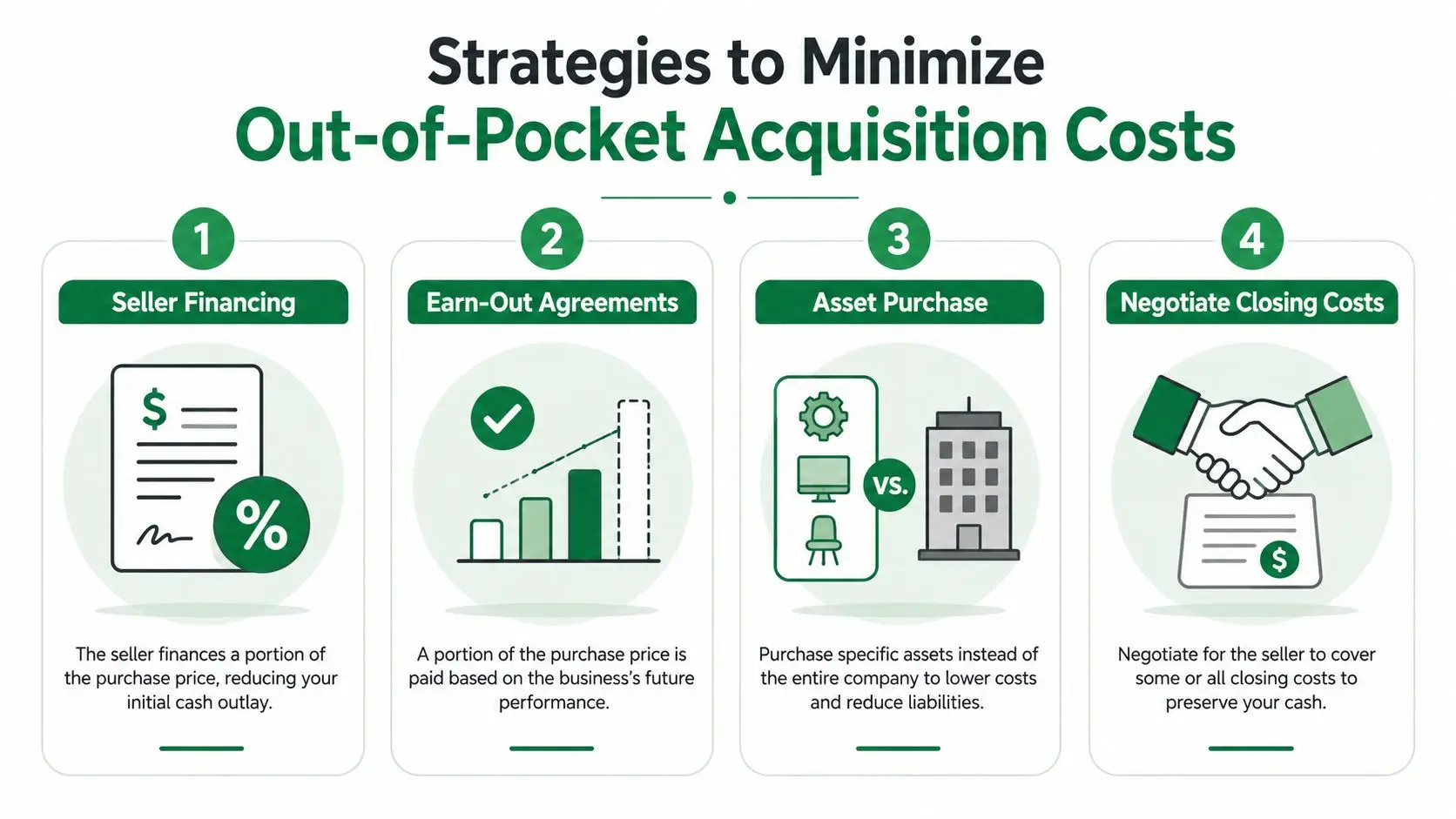
Seller financing is one of the cleanest ways to reduce immediate cash pressure because it can bridge the gap between lender proceeds and total project cost. Earn-out agreements can also reduce upfront risk when the seller is willing to tie part of the price to performance. Asset purchase structures can help buyers isolate what they want to buy instead of funding unnecessary liabilities. And negotiating closing costs often matters more than people think, because even modest fee relief can keep a deal from getting tight at funding.
The key is timing. Don't spend heavily on diligence before you know the seller is serious and the lender will support the structure. Don't agree to capital expenditures on day one if the same work can be deferred safely until after closing. And don't ignore seller credits if the business needs working capital support.
If you want practical examples of how seller support can fit into an acquisition, the seller financing for business acquisition guide is worth keeping open while you negotiate.
My rule for first-time buyers: use seller flexibility first, lender leverage second, and your own cash last.
GoSBA Loans is one option buyers use when they want help comparing lender proposals, especially if the goal is to reduce upfront cash and keep the equity story clean. That's not about hype, it's about getting a structure that a lender will fund.
Tax Treatment and GAAP Accounting for Acquisition Costs
The way you book acquisition cost matters almost as much as the way you finance it. Buyers who misunderstand capitalization versus expense treatment often misread their own financials in the first year after closing.
Capitalize the right costs, expense the rest
In a business combination, acquisition-related costs are expensed as incurred rather than capitalized into goodwill. Deloitte's ASC 805 guidance specifically identifies finder's fees, advisory fees, legal and accounting fees, valuation and consulting fees, general administrative costs of maintaining an acquisitions department, and costs of registering and issuing debt or equity securities as acquisition-related costs that affect current-period recognition (Deloitte ASC 805 guidance).
That distinction affects reported earnings, deal economics, and how your CPA explains the transaction on the books. For fixed assets, the base cost is the amount needed to get the asset ready for use, and that basis becomes the starting point for depreciation or amortization. In plain English, the more accurately you classify costs, the less likely you are to distort margins or asset returns later.
Why this matters for tax planning
Tax treatment and book treatment can diverge, so you need a CPA who knows the deal structure and the asset class. Some costs get capitalized, some get expensed, and some create timing differences that affect cash flow without changing the economics of the acquisition.
If the acquisition includes real estate, local tax rules can change the way carrying costs are handled, which is why a resource like the SALT cap on Texas property taxes explainer can be useful when the deal touches property tax planning. Don't wing that part.
A buyer who ignores accounting treatment tends to think the business is performing worse than it is, or better than it is, depending on how the costs were booked. Neither outcome helps you run the company.
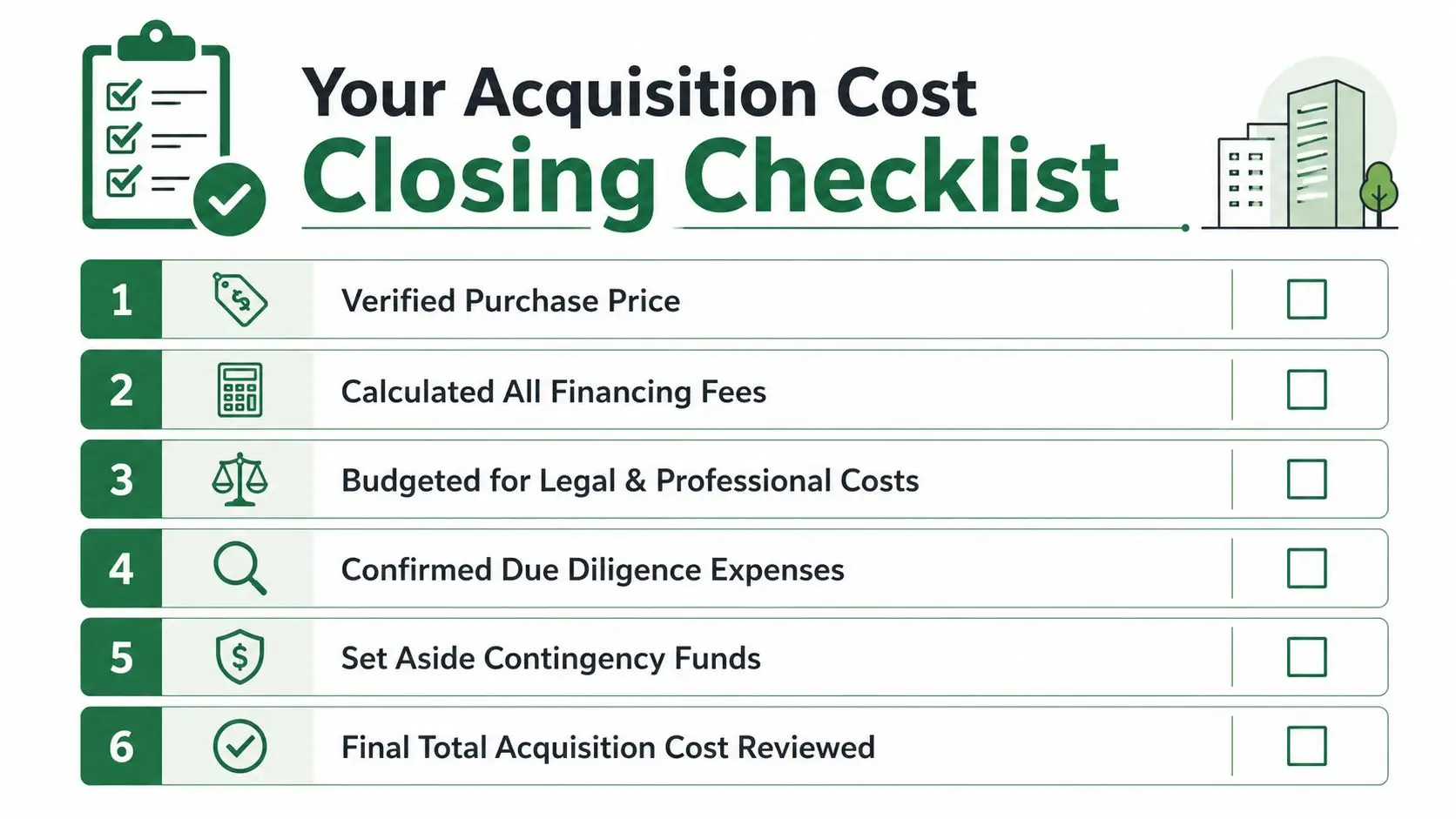
Your Acquisition Cost Closing Checklist
A good closing checklist prevents stupid mistakes. A great one protects your liquidity, your lender file, and your sanity.
What should be checked before funds move
- Verify the purchase price: Make sure the LOI, purchase agreement, and lender summary all match.
- Confirm all financing fees: Don't wait for closing to discover lender charges, legal costs, or third-party report bills.
- Budget legal and professional costs: Keep them separate from the price so you know what's financeable.
- Track due diligence expenses: Quality of earnings, environmental, and valuation work can add up quickly.
- Reserve contingency funds: Deal fatigue disappears fast when a last-minute issue hits.
- Review the final total acquisition cost: That number should match your source-and-use plan before you sign.
For a practical companion on funding mechanics, the guide for business owners is useful if your acquisition also involves equipment or other assets that affect depreciation planning.
The final check is simple. If you can't point to every dollar needed to close and fund the first stretch of operations, you're not ready. If you can, you're negotiating from strength.
If you're buying a business and want a lender structure that doesn't overburden your cash, GoSBA Loans helps buyers compare SBA financing options, seller notes, and closing mechanics before the deal gets locked in. Visit GoSBA Loans if you want a clear view of how your acquisition cost, equity injection, and closing budget fit together before you commit.
