Manufacturing finance has crossed into industrial-scale territory. U.S. commercial and industrial loans at all commercial banks reached $2,897.1489 billion in May 2026, up from $2,736.2772 billion in January 2026 according to FRED's business loans series, while SBA manufacturing lending has a long record of its own, with 164,246 loans totaling $74.3 billion from 1992 to 2025. That's why Made in America Manufacturing Loans in 2026 aren't a niche product or a policy slogan, they're a financing channel that now sits alongside plant expansions, acquisitions, equipment upgrades, and working-capital planning.
The shift is that the federal framework is beginning to match the scale of the projects manufacturers pursue. Congress described H.R. 3174 as raising SBA loan limits for small manufacturers from $5 million to $10 million under 7(a) and from $5.5 million to $10 million under 504, while the SBA's 2026 initiative introduced a 90% guarantee on qualifying International Trade Loans for manufacturers in NAICS 31 to 33. Temporary fee waivers also changed the math for certain deals, which matters because fees, not just rate, can decide whether a project clears underwriting.
For operators, the practical question is simple. Which program fits the use of proceeds, how much equity is really needed, and what will the lender underwrite before anyone talks about closing?
Table of Contents
- The 2026 Manufacturing Financing Landscape
- Comparing SBA Loan Programs for Manufacturers
- Eligibility Requirements and Documentation Checklist
- Real Deal Scenarios and Capital Stack Examples
- Why Government Guarantees Don't Guarantee Approval
- Step-by-Step Application Process and Timeline
- Maximizing Your Fundability and Next Steps
The 2026 Manufacturing Financing Landscape
The financing backdrop for manufacturers changed fast because policy finally moved in the same direction as demand. The House report on H.R. 3174 described a proposal to lift SBA manufacturing limits to $10 million under both 7(a) and 504, and the Congressional Budget Office summarized it the same way, as a direct increase in the maximum guarantee for small manufacturers under both core SBA programs to $10 million. That's a meaningful shift because it moves the conversation away from small-ticket working capital and toward acquisitions, plant expansion, and major fixed-asset purchases. Congressional report on H.R. 3174
The SBA's March 2026 manufacturing announcement added another layer by offering a 90% federal guarantee on qualifying International Trade Loans for manufacturers, compared with the standard 75% guarantee on flagship 7(a) loans. The same material says the program is aimed at NAICS 31 to 33 and can support startups, expansions, modernization, acquisitions, working capital, inventory, equipment, and real-estate improvements. That combination matters because manufacturers rarely need only one type of capital, they usually need a fixed-asset package plus liquidity to get the new line running. SBA announcement on the Made in America Loan Guarantee
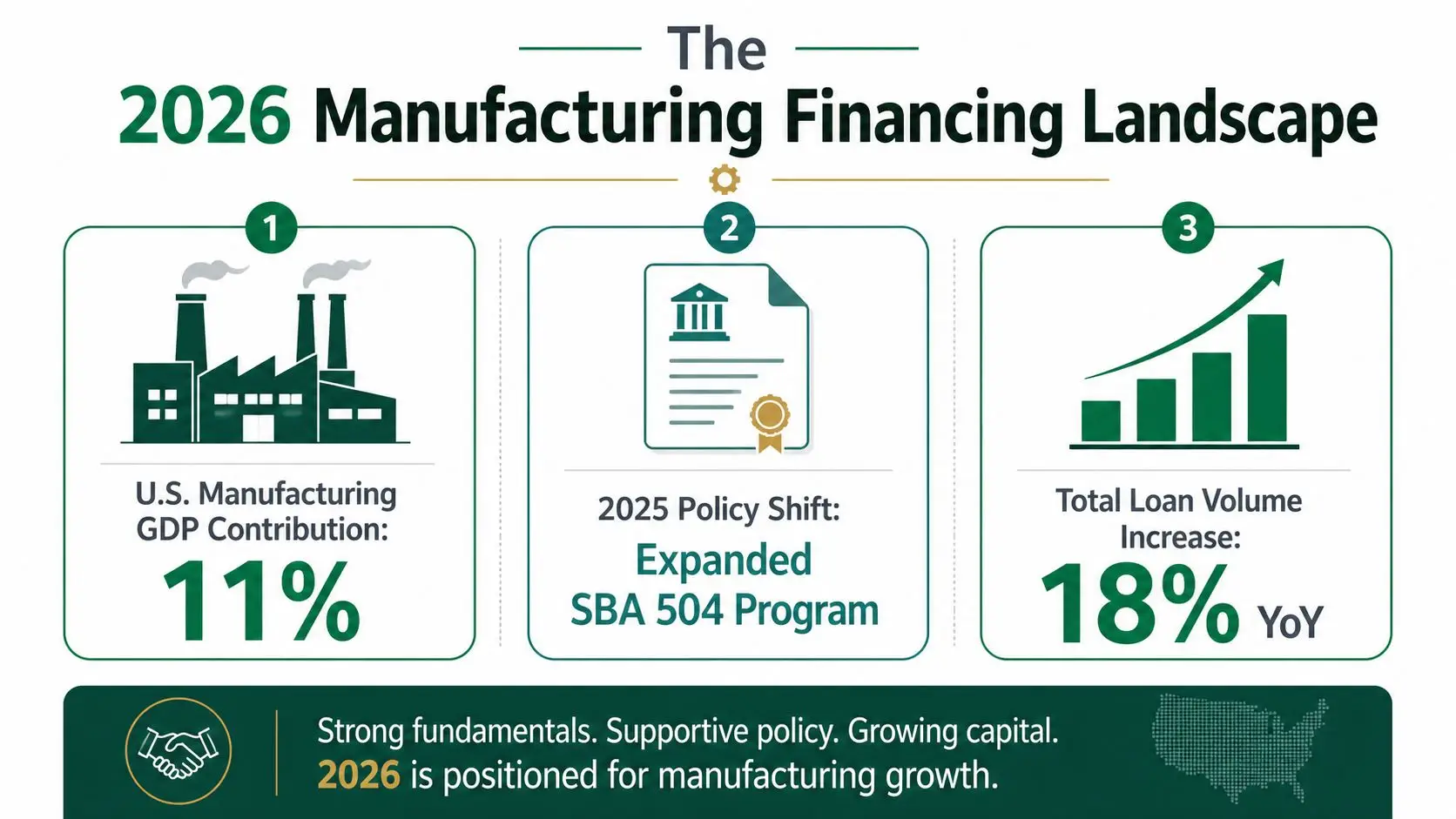
What changed for borrowers
The headline change is not just larger limits, it's a different way of thinking about project size. Congress also kept the SBA Express maximum at $500,000, which shows the policy was aimed at larger capital needs rather than microloans. In plain terms, the financing framework now points at equipment, buildings, and growth capital instead of plugging small operating gaps.
Temporary fee relief also softened transaction friction for qualifying manufacturers. Independent commentary on the 2026 SBA changes says the agency waived upfront guaranty fees on 7(a) manufacturing loans up to $950,000 and eliminated upfront and annual fees on 504 manufacturing loans through September 30, 2026. That kind of change doesn't just lower closing cost, it can change whether a deal pencils cleanly enough for a lender committee to say yes.
The big policy story is not “cheap money,” it's larger, cleaner capital stacks for manufacturers whose projects outgrew older SBA caps.
A useful comparison point comes from the SBA's manufacturing training ecosystem too. Even operational training like a silica awareness course by TP Training matters because lenders like to see compliance maturity, especially in plants where safety processes affect uptime, insurance, and management discipline.
Comparing SBA Loan Programs for Manufacturers
Manufacturers usually end up comparing three paths, not one. 7(a) fits acquisitions, working capital, partner buyouts, and mixed-use transactions. 504 fits real estate and long-life equipment. MARC fits revolving liquidity where purchases, production cycles, and inventory build aren't cleanly captured by a fixed installment loan.
Here's the practical split. If the deal is mostly about buying a company or funding cash needs, 7(a) is usually the workhorse. If the deal is about a plant, an expansion, or equipment with long useful life, 504 is often the cleaner structure. If the business needs raw materials, inventory, and operating expenses that rise and fall with orders, MARC can match the cash-conversion cycle better than a term loan. For a broader program overview, the ultimate guide to SBA 7(a) loans in 2026 is a useful companion reference.
| Program | Max Amount | Guarantee % | Best For | Typical Timeline |
|---|---|---|---|---|
| 7(a) for manufacturers | $10 million under the proposed manufacturing framework, with current SBA structures still governed by existing program rules | 75% standard guarantee, 90% for qualifying international trade structure | Acquisitions, working capital, partner buyouts, mixed-use deals | Often slower than a PLP-based file, because underwriting is broader |
| 504 | $10 million under the proposed manufacturing framework for the SBA-backed second mortgage | SBA-backed second is typically paired with a conventional first mortgage | Owner-occupied real estate, construction, heavy equipment, major improvements | Usually project-driven and tied to appraisal, environmental, and closing milestones |
| MARC | $5 million | Revolving credit structure, not a standard percentage guarantee story | Working capital, raw materials, inventory, production costs, operating expenses | Depends heavily on lender and collateral review |
MARC deserves more attention than it gets because it's built for manufacturing cash flow, not just asset purchases. The SBA describes it as combining revolving and term-loan features, running up to 20 years total, and requiring a lien on all business assets except vehicles and trading assets. That makes it a better fit for businesses where purchasing inputs and converting them to receivables doesn't line up neatly with a regular amortization schedule. SBA MARC program description
Eligibility Requirements and Documentation Checklist
Lenders start with a simple question. Is the borrower a manufacturer, or just close to manufacturing? For these programs, that usually means a business in NAICS 31 to 33 with a real production footprint, not a distributor with light assembly tucked into the operation. The classification matters because it decides whether the file can even be reviewed under the manufacturing-specific treatment.
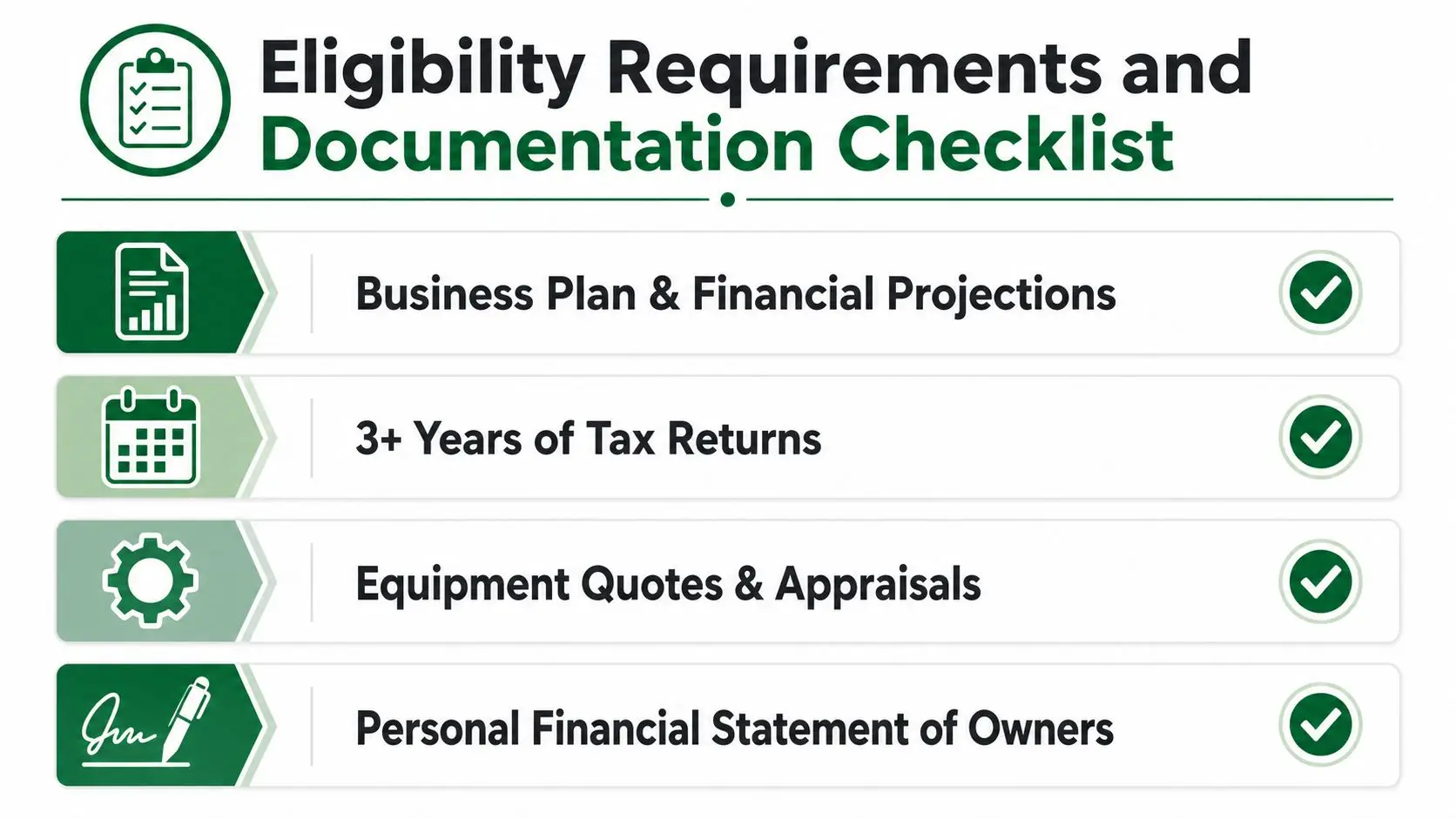
Underwriters then look for a file they can read without guessing. Clean tax returns, consistent financial statements, and a clear explanation of how the business makes money move a file faster than a polished pitch deck. Equipment-heavy operators need depreciation schedules and fixed-asset detail that tie out. Job shops and contract manufacturers need cost accounting that shows how labor, materials, and overhead affect gross margin.
What lenders usually want first
- Three years of business and personal tax returns. Lenders want trend lines, not one strong year.
- Interim profit and loss statements. These show performance since the last tax filing.
- Accounts receivable and accounts payable aging reports. These help lenders judge working-capital pressure.
- Business plan and projections. The projections need to match the actual equipment or acquisition logic.
- Equipment quotes or appraisals. These anchor the transaction value.
- Personal financial statement for each owner. SBA lenders still care about sponsor strength.
Practical rule: if the borrower cannot explain inventory turns, customer concentration, and margin swings in plain English, the lender will assume the answer is buried in the numbers.
Ownership matters even more in acquisition deals. If a buyer is taking over a machine shop or production business, the lender needs confidence that management continuity will hold after closing. A good application checklist keeps the file organized before it reaches underwriting, and the SBA loan application checklist is a practical way to make sure the basics are in order.
For buyers who need to verify supply-chain or fabrication specifics during due diligence, it can also help to verify SEFA 8M compliance early, because asset quality, specification conformity, and documentation discipline tend to affect both lender comfort and post-close execution. That matters in plant-heavy businesses, where missing paperwork can slow closing more than the credit profile itself.
Real Deal Scenarios and Capital Stack Examples
A lot of manufacturing borrowers ask for the “best loan,” but the answer is usually a capital stack, not a single product. The structure has to match what the business is buying, how quickly the asset pays back, and how much working capital the operation will burn before it stabilizes. A deal that looks strong on paper can still fail if the equity is thin or the sources and uses don't line up.
Acquisition of a CNC machine shop
A buyer pursuing a $3.5 million acquisition of a CNC machine shop would usually lean on 7(a) for the purchase, with a seller note on standby to strengthen the structure. The equity requirement is the part many buyers underestimate, because the SBA structure still expects meaningful sponsor capital even when the lender is comfortable with the business. The seller note helps because it shows the seller still has skin in the game after closing.
The most important underwriting question in that deal isn't “Can the bank make the loan?” It's “Can the buyer operate the shop without breaking cash flow in the first six months?” A buyer with industry experience, a clear transition plan, and realistic post-close working capital has a much better file than a purely financial buyer with no production background.
Plant expansion with real estate and equipment
A $6 million expansion is often cleaner through 504 for the building and long-life equipment, then a 7(a) working capital line to cover inventory ramp-up. That split works because 504 is built around fixed assets, while 7(a) handles the liquidity gap that comes from hiring, stocking materials, and waiting for receivables to catch up. In manufacturing, those are usually separate problems, so forcing them into one bucket can distort the project.

Seasonal liquidity through revolving credit
A seasonal manufacturer is often better served by MARC than by a standard term loan. Raw material purchases, production costs, and operating expenses can swing hard before receivables come in, so the borrower needs credit that behaves more like working capital than like a mortgage. That's exactly where revolving structure matters.
If the business keeps needing to borrow, pay down, and borrow again, a revolving structure usually fits better than a fixed monthly amortization.
The main lesson is that the capital stack should follow the operating cycle. Real estate, equipment, inventory, and production expenses don't all deserve the same repayment shape, and the strongest files usually separate them cleanly.
For a deeper look at how fixed-asset transactions are structured, the 504 loan guide is the right reference point.
Why Government Guarantees Don't Guarantee Approval
A 90% guarantee sounds like it should make approval automatic. It doesn't. Lenders still underwrite the borrower, the project, and the exit risk, and the manufacturing credit market has a long memory. SBA loan intelligence shows manufacturing has produced 164,246 SBA loans totaling $74.3 billion from 1992 to 2025, with an 11.3% default rate, so credit committees know this space can be profitable and still dangerous. SBA loan intelligence data via FRED context
The lender's real questions are usually basic, but they're unforgiving. Is cash flow strong enough to service the debt? Is collateral adequate? Does the buyer know the industry? Does the company depend on one or two customers? Is the project realistic, or is the borrower padding projections to make the debt fit?
What actually moves approval odds
- Debt service coverage. Strong files usually need a cushion, not a break-even story.
- Customer concentration. If one customer drives too much of the revenue, the lender gets nervous fast.
- Management continuity. Buyers need a transition plan that survives the seller leaving.
- Collateral quality. Equipment and real estate help, but only if the lender can value them credibly.
- Use of proceeds. Expansion, acquisition, and refinance each create a different risk profile.
The 2026 policy changes may widen the box for some borrowers, but not all of them. A well-banked manufacturer with solid operations will probably see the most immediate benefit because the guarantee and fee relief improve economics on transactions that already look financeable. First-time buyers and transition-heavy deals can benefit too, but only if the file shows real operating competence and a believable post-close plan. That's the gap the SBA underwriting guide is meant to clarify.
The short version is blunt. A guarantee reduces lender pain, it doesn't remove lender judgment.
Step-by-Step Application Process and Timeline
Manufacturing deals slow down when borrowers wait too long to start the financing conversation. If the seller signs a letter of intent and the buyer starts shopping lenders two weeks later, the file usually loses time right away. The better move is to begin lender conversations during due diligence, not after it ends.
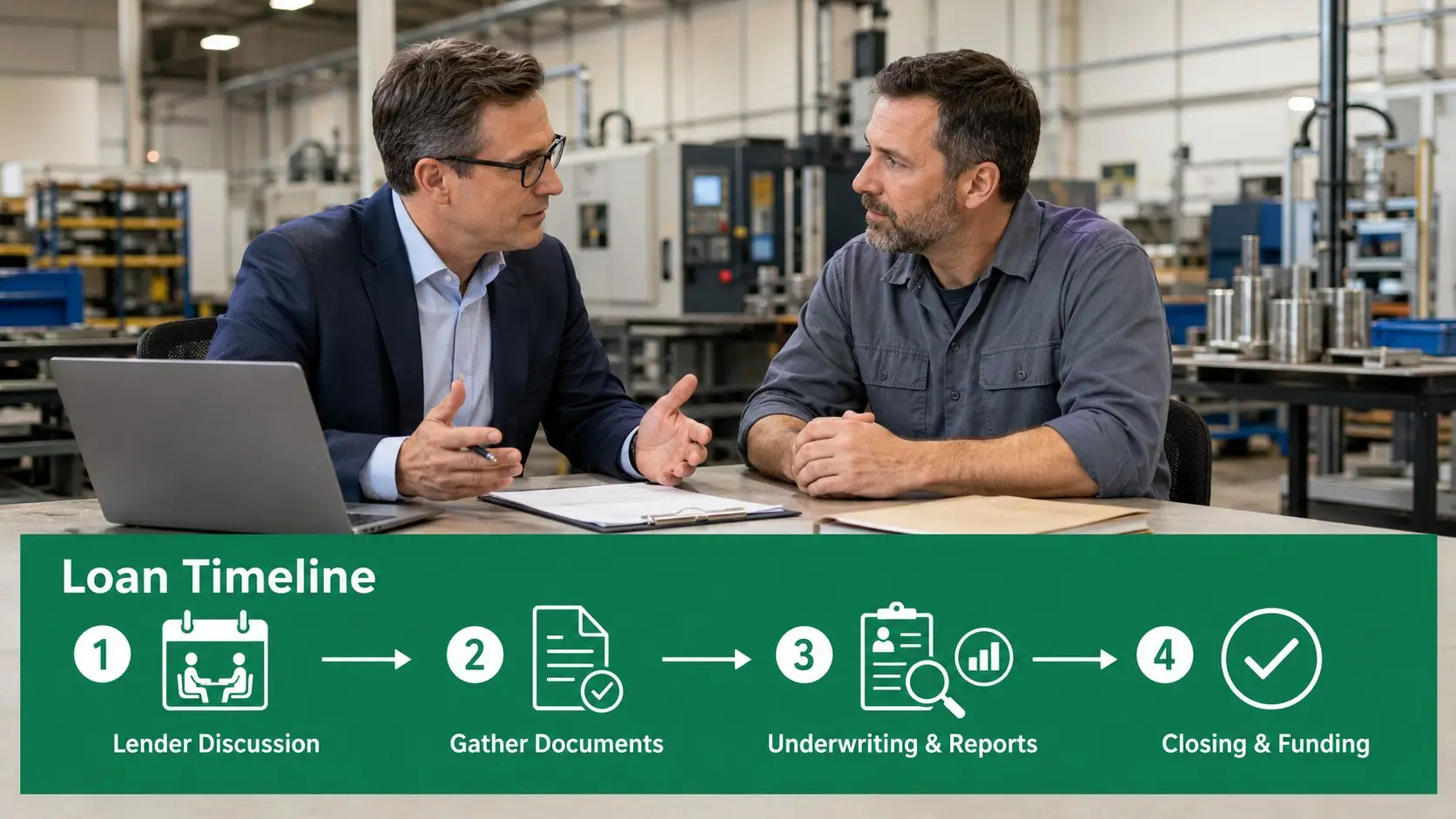
A workable process
Initial lender discussion
Use the first pass to test eligibility, structure, and equity expectations. A good lender will flag deal-killing issues early, before third-party fees pile up.Document gathering and packaging
Tax returns, projections, ownership information, and asset details get assembled into a lender-ready file. The cleaner the package, the less back-and-forth the borrower faces.Underwriting and third-party reports
Appraisal, valuation, and environmental work often become the critical path. In manufacturing, the asset side matters enough that these reports can delay closing even when credit is otherwise sound.SBA authorization and closing
Final approval usually waits on the lender's internal process and the SBA authorization step, then legal docs, conditions, and funding.
A realistic project plan often runs 90 to 120 days from signed LOI to closing, with due diligence taking 30 to 60 days, loan packaging 1 to 2 weeks, lender selection 2 to 3 weeks, underwriting 3 to 6 weeks, SBA authorization 1 to 2 weeks, and closing 4 weeks. Using a PLP lender can trim part of that path, because Preferred Lender Program authority usually shortens the approval handoff. For a timeline reference, the SBA loan timing guide is a practical benchmark.
Underwriting tip: same-day responses to lender requests do more for closing speed than almost any other habit.
Buyers should also build extension options into purchase agreements whenever possible. If a third-party report comes back late or a lender needs extra time to evaluate working capital, the extension clause can save the deal from unnecessary pressure.
Maximizing Your Fundability and Next Steps
The best manufacturing files do three things well. They show the business can produce cash, prove the project fits the asset class, and make the sponsor look capable enough to survive the transition. First-time buyers usually need the most help on management continuity. Existing owners usually need to show that growth capital will increase capacity, not just stretch the balance sheet. Acquisition buyers need to make the equity and seller-note structure feel balanced, not desperate.
Fundability checklist
- Financial readiness. Clean tax returns, stable margins, and believable debt service.
- Operational readiness. Clear management, customer diversification, and documented systems.
- Deal structure. Appropriate equity, sensible valuations, and a clear use of proceeds.
The biggest mistake is shopping for a rate before the structure is ready. A better approach is to pre-qualify the deal, map the capital stack, and only then decide whether 7(a), 504, MARC, or a blended structure makes the most sense. If you're buying, expanding, or refinancing a manufacturing business, the lender will care more about the story in the file than the marketing around the program.
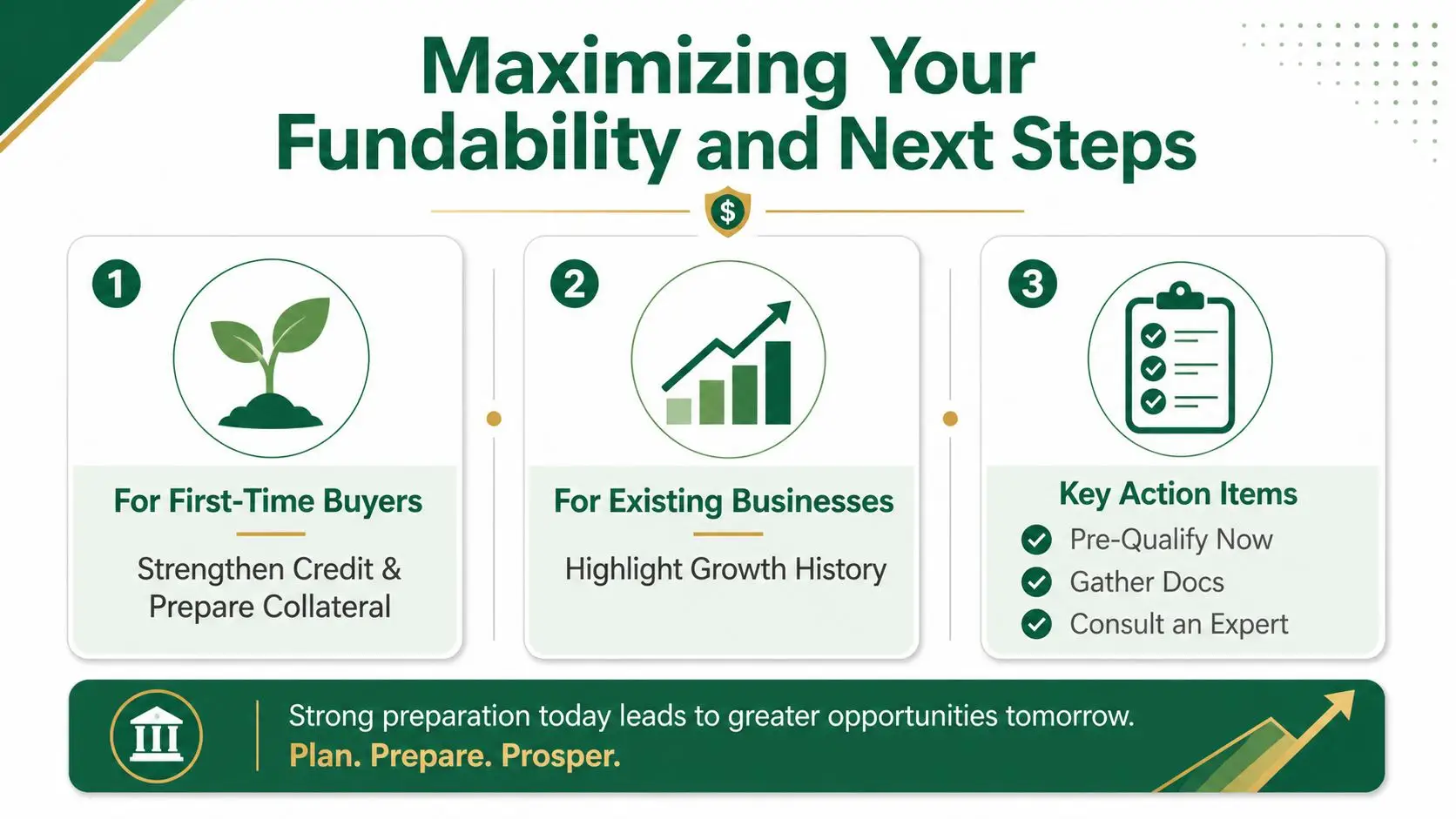
For first-time buyers, the winning move is to document industry experience, build a realistic transition plan, and be honest about equity. For existing manufacturers, the strongest files show why the new capital will expand throughput, improve equipment utilization, or stabilize inventory without overextending cash. For acquisition buyers, the cleanest path is usually the one that keeps seller alignment, lender confidence, and working capital all in the same direction.
If you're looking at a manufacturing acquisition, expansion, or refinance, GoSBA Loans can help you compare the right SBA structure, pressure-test the deal, and line up lender feedback before you commit to a formal application. Visit GoSBA Loans to start a financing conversation that's built around approval odds, not just advertised rates.
