You're reviewing a deal sheet, and one line keeps jumping out at you. The seller says the business is worth $2 million, but the valuation report splits a huge chunk of that price into goodwill. That's the moment most first-time buyers realize they're not just buying equipment, inventory, and a lease. They're also paying for customer loyalty, brand reputation, and whatever future earning power the seller has built into the business.
That line matters even more if you're financing the purchase with an SBA loan. Lenders do not treat goodwill as fluff, but they don't treat it like hard collateral either. They want to know what's behind the premium, whether the business can support the debt, and what happens if the relationship-based value doesn't hold up after closing.
Table of Contents
- Why Goodwill Matters When Buying a Business
- The Core Definition of Goodwill in Business
- Accounting Treatment Versus Economic Reality
- Purchase Price Allocation and How Goodwill Is Calculated
- Impairment Testing and the Private Company Amortization Option
- How SBA Lenders Evaluate Goodwill in Acquisition Deals
- Practical Takeaways for Buyers and Sellers
Why Goodwill Matters When Buying a Business
A buyer can stare at a purchase agreement for hours and still miss the biggest risk in the deal. The business may have solid equipment, a strong lease, and decent inventory, but if the price tag includes a large goodwill component, the buyer is really betting on things that are harder to touch, harder to verify, and harder to resell. That is exactly why goodwill shows up in financing conversations so early.

A practical way to look at it is simple. If you're buying a restaurant, the chairs and ovens matter, but so do the regulars, the neighborhood reputation, and the trained staff that keeps service consistent. Those are the kinds of things buyers pay for when they pay above the fair value of the identifiable assets.
Practical rule: if the goodwill number is large, ask what part of the business makes customers stay after the closing date.
That question matters in underwriting too. SBA lenders focus on repayment capacity, not just the headline purchase price, so a deal that leans too heavily on intangible value needs a stronger story behind it. A helpful companion resource is the due diligence checklist in 10 must-do due diligence checks, because goodwill is only as believable as the facts supporting the purchase.
The issue also shows up in how the transaction is structured. When a buyer pays more than the fair value of the target's identifiable net assets, that premium becomes goodwill on the buyer's books under acquisition accounting, and it sits there as an intangible asset rather than as cash or equipment. If you're working through the steps of an SBA purchase, the overview in how to buy a business with an SBA loan is a useful companion because it connects valuation, financing, and deal structure in one place.
Goodwill is not a side note. It affects how a deal is priced, how much the lender is willing to support, and how much downside the buyer is really taking on if the seller's relationships or reputation don't transfer cleanly.
The Core Definition of Goodwill in Business
Goodwill is the premium a buyer pays over the fair value of a business's identifiable net assets. Britannica's accounting explanation puts the formula plainly, purchase price minus the fair value of the acquired company's net identifiable assets equals goodwill, and that's why goodwill is called a residual value rather than a separately priced asset (Britannica on goodwill in accounting). In practice, it captures the value that can't be neatly split into equipment, inventory, or patents.
What goes into the identifiable side
Identifiable assets are the pieces you can point to and value separately. That includes things like equipment, inventory, contracts, patents, and other measurable assets. Liabilities also matter because they reduce the net value of what's being acquired. In a transaction, the buyer is not paying for the whole business twice, once through the hard assets and again through goodwill. The buyer is paying for the business value that remains after those measurable parts are accounted for.
What ends up in goodwill
The goodwill bucket usually absorbs the harder-to-isolate elements. Brand reputation, customer loyalty, employee relationships, market position, and other competitive advantages often land there because they're real, but not separately transferable in the same way as a machine or a contract. For a first-time buyer, that distinction matters because goodwill is not a vague compliment about the seller's company. It's a financial label for value that exists in the deal price but doesn't attach to a single asset line.
A simple example helps. If a buyer pays $3 million for a business and the fair value of its identifiable net assets is $2.2 million, the remaining $800,000 is goodwill. That residual tells you the buyer believed the business was worth more than the sum of its separable parts, likely because of earnings power, customer retention, or brand strength.
Why it feels intangible and still matters
The label “intangible” doesn't make it meaningless. It means the value can't be separated and sold on its own with the same clarity as inventory or equipment. That's exactly why buyers, sellers, and lenders spend so much time arguing over it. The price premium is real, even if the asset behind it is harder to isolate.
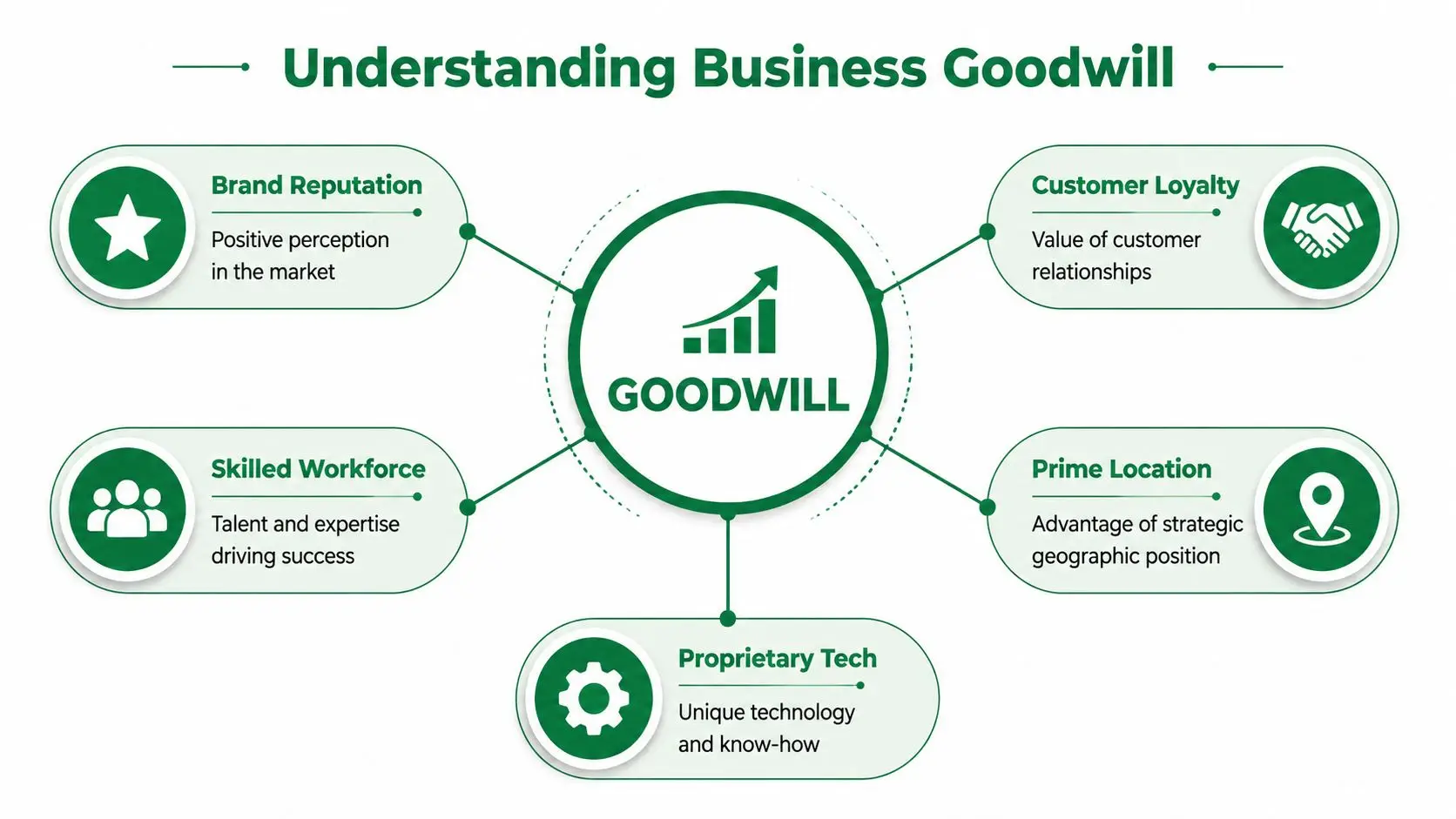
For a deeper valuation lens, the explanation in intangible asset valuation SBA is useful because goodwill often sits alongside other intangibles that buyers need to separate carefully before a lender will underwrite the deal.
Accounting Treatment Versus Economic Reality
A buyer can close on a company and still spend the next year arguing with the lender, the CPA, and the seller over what part of the price was really paid for earnings power versus hard assets. That split matters because accounting rules and deal reality do not use goodwill the same way. Under U.S. GAAP, goodwill sits on the balance sheet as an intangible, noncurrent asset, and public companies test it for impairment rather than amortizing it like a fixed asset (Investopedia goodwill overview). The accounting view is simple, the value stays on the books until evidence says it should not.
What GAAP does with goodwill
Under GAAP, goodwill is not expensed a little at a time the way a truck or leasehold improvement is depreciated or amortized. Instead, it is tested for impairment, and if carrying value is higher than fair value, the company records a write-down (Wikipedia goodwill accounting)). That treatment can make reported earnings jump around after a deal closes, because weak customer retention, integration problems, or lost referrals can show up later as an impairment charge.
What buyers think goodwill means
Buyers usually care less about the accounting label and more about what the premium buys. In a real acquisition, goodwill is the value tied to brand trust, repeat business, customer loyalty, distribution relationships, and a workforce that keeps the machine running after the closing.
That is also why the number matters in underwriting. CFI describes goodwill as the residual premium recorded when purchase price exceeds the fair value of identifiable net assets, and notes that it is treated as an indefinite-life intangible asset under U.S. GAAP and IFRS, which is why it is tested for impairment instead of amortized (CFI goodwill guide).
Why the balance sheet can get heavy with goodwill
The balance sheet can end up carrying a large goodwill balance when a deal is driven by earnings and relationships rather than equipment or inventory. That shows up in acquisition-heavy industries where buyers pay for future cash flow, not just the assets sitting on the books. Analysts at EFRAG found total goodwill recognized across sampled companies rose from €935 billion in 2005 to €1.341 trillion in 2014, an increase of 43%, while MSCI World analysis found goodwill averaging around 7% of total assets in 2003 and rising to over 12% by the end of 2023 (EFRAG quantitative study).
That is the accounting side. On the lending side, a bank still wants to know whether the cash flow can carry the debt service if the goodwill turns out to be more fragile than the seller claimed.
The balance sheet records the premium paid. The business still has to prove that premium can survive after closing.
If you are comparing reported numbers with deal support, the perspective in virtual CFO and accounting helps clarify how financial reporting separates recorded goodwill from the cash flow a lender will underwrite.
Purchase Price Allocation and How Goodwill Is Calculated
The cleanest way to see goodwill is through purchase price allocation. Start with the full purchase price, assign fair values to each identifiable asset and liability, then whatever remains becomes goodwill. Buyers, CPAs, and lenders all work from that same framework, even if each party cares about a different part of the result.
A simple allocation walkthrough
Assume a buyer agrees to pay $3 million for a business. The first step is to value the tangible assets and identifiable intangibles, then subtract the liabilities that the buyer is taking on. The difference between the purchase price and the fair value of those net identifiable assets is the goodwill premium.
| Asset Category | Fair Value | Percentage of Purchase Price |
|---|---|---|
| Cash and working capital items | $250,000 | 8.33% |
| Equipment and furniture | $900,000 | 30.00% |
| Inventory | $300,000 | 10.00% |
| Identifiable intangibles | $350,000 | 11.67% |
| Liabilities assumed | $(800,000) | -26.67% |
| Goodwill | $2,000,000 | 66.67% |
In this example, the net identifiable assets equal $1 million, and the remaining $2 million becomes goodwill. That does not mean the business is “worthless” without goodwill. It means the value the buyer is paying for is mostly tied to relationships, earnings power, and other advantages that do not sit on the asset schedule.
Why this split matters in real deals
This allocation affects more than bookkeeping. Different asset classes can receive different tax treatment, so buyers care about how much of the price lands in depreciable or amortizable buckets versus goodwill. It also matters in underwriting, because an SBA lender wants to see that the deal makes sense on cash flow and identified assets, not just on a large goodwill balance.
For mid-market transaction teams, acquisition accounting for mid-market firms is a useful reference point because it shows how experienced buyers handle allocation when the asset mix is complicated. The same logic shows up in smaller SBA transactions, just with less room to argue over the numbers and less tolerance for soft valuations. If you want the lending side of that valuation question, business valuation for SBA loans and how lenders decide what an acquisition is worth is the right place to compare the accounting result with the underwritten result.
The underwriting implication
A lender is more comfortable when the balance sheet tells a consistent story. Equipment, receivables, inventory, and contracts are easier to evaluate than a premium tied to reputation or customer retention. The goodwill number does not automatically kill a deal, but it does increase the need for documentation, credible financials, and a purchase price that the cash flow can support.
Impairment Testing and the Private Company Amortization Option
Once goodwill is recorded, the number does not just sit there unchanged. Under U.S. GAAP, public companies have to test goodwill for impairment at least annually, and they write it down if the carrying amount is higher than fair value. That is the check that keeps goodwill from drifting too far from economic reality.
How impairment works in practice
The mechanics are practical. If the acquired business performs well, goodwill can stay intact. If the business slips, loses customers, or fails to deliver the premium the buyer justified, the carrying value may become too high. Goodwill is treated as an indefinite-life intangible asset in the public-company model, so it is tested rather than amortized under the normal approach.
The private-company alternative
Private companies under U.S. GAAP have a different path available. Goodwill can be amortized on a straight-line basis over 10 years, with a simplified impairment model often used alongside that treatment. For a smaller buyer, that can cut down reporting complexity and make annual financial statements less jumpy.
That choice comes with a trade-off. Amortization lowers reported earnings over time, but it also avoids the sharp impact of a single impairment charge. Public-company accounting can make one weak acquisition look worse all at once, while the private-company option spreads the cost in a more predictable way. Buyers who expect to own the business privately often prefer the simpler reporting route, but lenders still focus on cash flow and debt service, not just the accounting presentation.
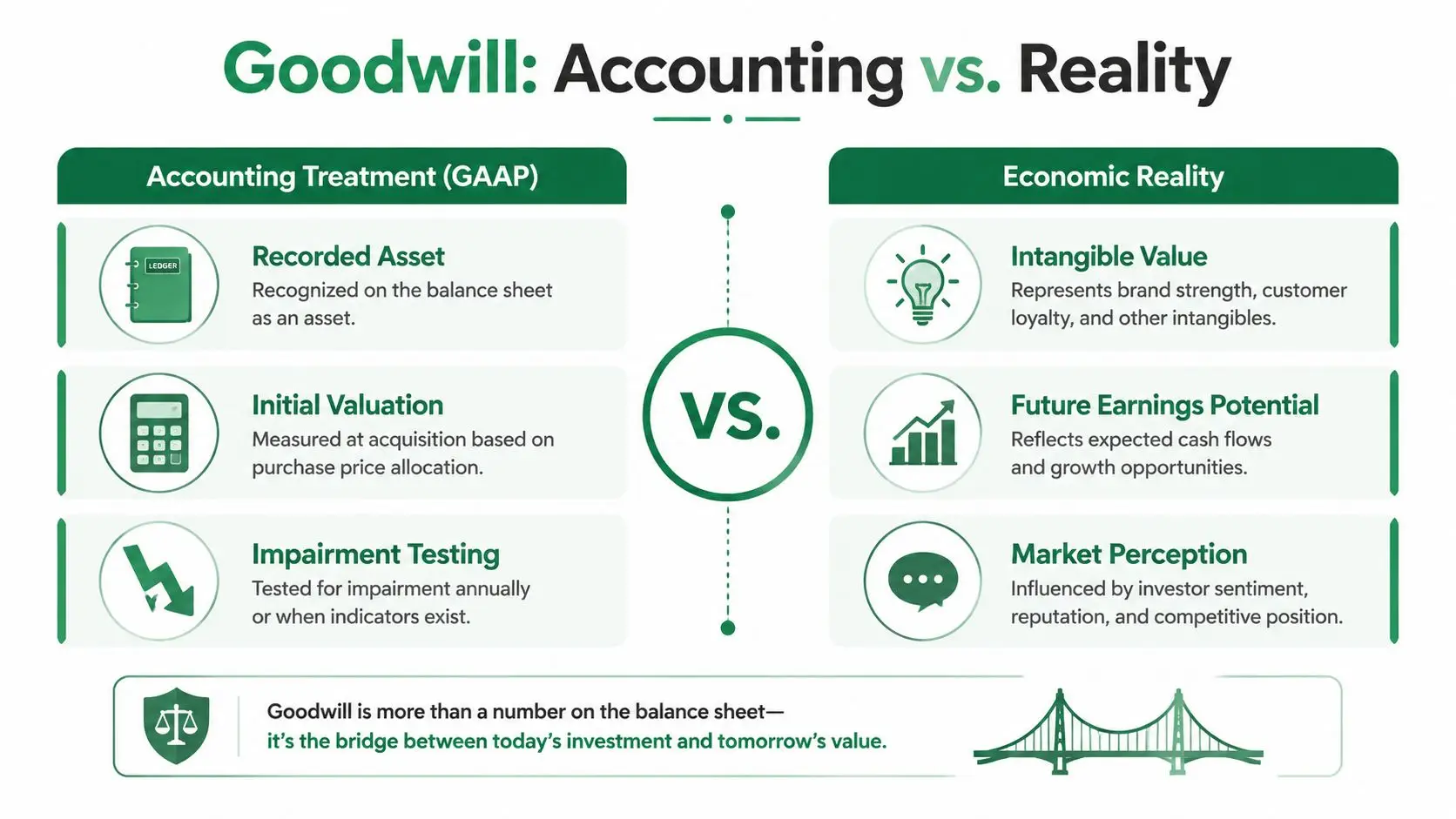
The broader market context helps explain why this matters. Goodwill has taken a larger role on many company balance sheets, so impairment testing remains a useful signal of whether the acquisition premium still holds up. For a buyer financing a deal, that signal matters because the premium may look acceptable in accounting terms and still be hard to support in underwriting if the business does not produce enough cash.
How SBA Lenders Evaluate Goodwill in Acquisition Deals
SBA lenders do recognize goodwill in acquisition finance, but they don't treat it as a standalone source of repayment. Under SBA-related accounting guidance, goodwill is a recognized component of a business acquisition, but it has to be tied to a bona fide purchase and can't be treated like an asset a borrower invents on paper. The focus stays on identifiable assets, liabilities, and cash flow, not vague reputation alone (Deloitte ASC guidance on goodwill).
What underwriters are really checking
The lender's question is not “does goodwill exist.” It's “what supports the premium?” That means they look for verifiable earnings, durable customer relationships, and a business model that can survive ownership change. The underwriting guide in how SBA lenders underwrite your deal is helpful because it frames the deal around repayment capacity instead of just valuation language.
A practical underwriting file usually needs to show:
- Verifiable cash flow, because the loan still has to be repaid from operations.
- Stable customer demand, because goodwill based on one relationship is fragile.
- Reasonable financial backing, because a heavy premium can strain debt service.
- Clear deal structure, so the seller note, equity injection, and asset allocation all line up.
- Supportable purchase price, because lenders want valuation logic, not optimism.
Where buyers get into trouble
Deals break down when goodwill is doing too much work. If most of the price is explained by “brand” or “reputation” but the business has thin margins, concentrated customers, or weak documentation, the lender sees fragility. A strong seller note can help, but it won't rescue a deal that lacks operating support. SBA underwriting still needs a company that can service the debt after closing.
How to position the transaction
Buyers usually have the best results when they present a deal package that separates the story into clear pieces. The seller's legacy value can be recognized, but the file should also show the measurable assets, the debt service capacity, and the transition plan that protects continuity. That's especially important when negotiating with a seller who wants a high headline price. If the premium is justified, the buyer should be able to explain why in terms a lender can underwrite.
If a deal leans heavily on seller confidence, a structured seller note can help bridge the gap, and seller notes in SBA business acquisitions is worth reviewing because it shows how these notes are typically used in acquisition financing.
Practical Takeaways for Buyers and Sellers
A good goodwill discussion makes the deal clearer, not more complicated. For buyers, the key is to separate what you can verify from what you're hoping will transfer after closing. For sellers, the job is to show that the premium is grounded in something durable, not just in a flattering story about the business.
For buyers
Start with the purchase price allocation, then pressure-test the goodwill. If the goodwill number is large, ask what supports it, customer retention, repeat revenue, local reputation, trained staff, or some other real advantage. Then make sure the financing package tells the same story the valuation does.
For sellers
If you want a buyer and lender to accept a premium, document the reasons for it. Clean financials, recurring revenue detail, customer concentration reports, and transition plans all help. A seller who can explain why the business deserves a premium has a much easier time defending the goodwill line than a seller who just points to the asking price.
For brokers and advisors
Structure matters. A deal that looks attractive on paper can still fail if the purchase price allocation creates too much unsupported goodwill. Advisors need to balance seller expectations against what an SBA lender will finance. That means keeping the valuation story and the underwriting story aligned from the start.
Goodwill is accepted more easily when the buyer can point to cash flow, continuity, and a believable transition.
The fastest way to get stuck is to treat goodwill as a cosmetic accounting line. In an acquisition, it is a real part of the price, a real part of the risk, and a real part of the lender's decision. Once those three pieces match, the deal becomes much easier to finance and much easier to close.
If you're buying a business and the goodwill number feels too high, GoSBA Loans can help you pressure-test the deal structure, lender response, and SBA underwriting fit before you spend real money on diligence. Visit GoSBA Loans to compare financing options and get a practical read on whether your acquisition is bankable.
