You're probably looking at a live deal right now. The seller says a stock sale will be easier. Your attorney is asking about liabilities. Your CPA is talking about tax treatment. Your lender wants to know how the purchase will be structured before they'll go too far. For a first-time buyer using SBA financing, this isn't a technical detail. It's the decision that can either keep the deal moving or create problems all the way to closing.
Most buyers start with price. SBA lenders start with structure. That's the right order of operations. If the structure doesn't work, the price almost doesn't matter.
Table of Contents
- The Critical First Decision in Your Business Acquisition
- Understanding the Two Paths to Ownership
- A Head-to-Head Comparison of Key Deal Terms
- Why Buyers and Lenders Champion the Asset Purchase
- The SBA Lender's Deciding Vote and SOP Rules
- Your Acquisition Structure Decision Checklist
- Frequently Asked Questions
The Critical First Decision in Your Business Acquisition
Before you negotiate working capital, transition support, or a seller note, you need to answer one basic question. Are you buying the business's assets, or are you buying the company itself? That choice drives the legal documents, the due diligence scope, the tax outcome, and your SBA lender's comfort level.

In the lower middle market, asset purchases account for approximately 70% of deals, while stock sales make up about 30%, largely because buyers want liability containment and tax advantages, as outlined in this market overview of asset purchase versus stock purchase structures. That preference shows up even more strongly in SBA-financed deals, where lenders care significantly about collateral clarity and hidden risk.
A lot of first-time buyers make the same mistake. They sign an LOI with “purchase of business” language that sounds harmless, but never pin down whether the deal is an asset purchase or stock purchase. Then the lender reviews the file, the seller's attorney pushes for a different structure, and the transaction has to be rebuilt midstream. That slows diligence, changes legal work, and can create avoidable friction with the bank.
Practical rule: If you expect to use SBA financing, the purchase structure should be discussed before the LOI is final, not after underwriting starts.
Experienced deal counsel proves critical. Buyers often need legal support for business owners who understand purchase agreement mechanics, liability allocation, and assignment issues. On the financing side, it also helps to understand how an SBA loan to buy a business is evaluated, because lenders don't treat all structures the same.
What this decision changes immediately
- Loan viability: Some structures fit SBA lender standards much better than others.
- Diligence scope: A stock deal usually requires deeper historical diligence because the entity survives.
- Closing path: Asset deals often need more assignments and consents.
- Risk after closing: The wrong structure can leave a buyer holding liabilities they never priced in.
The structure isn't paperwork. It's the frame the entire acquisition sits inside.
Understanding the Two Paths to Ownership
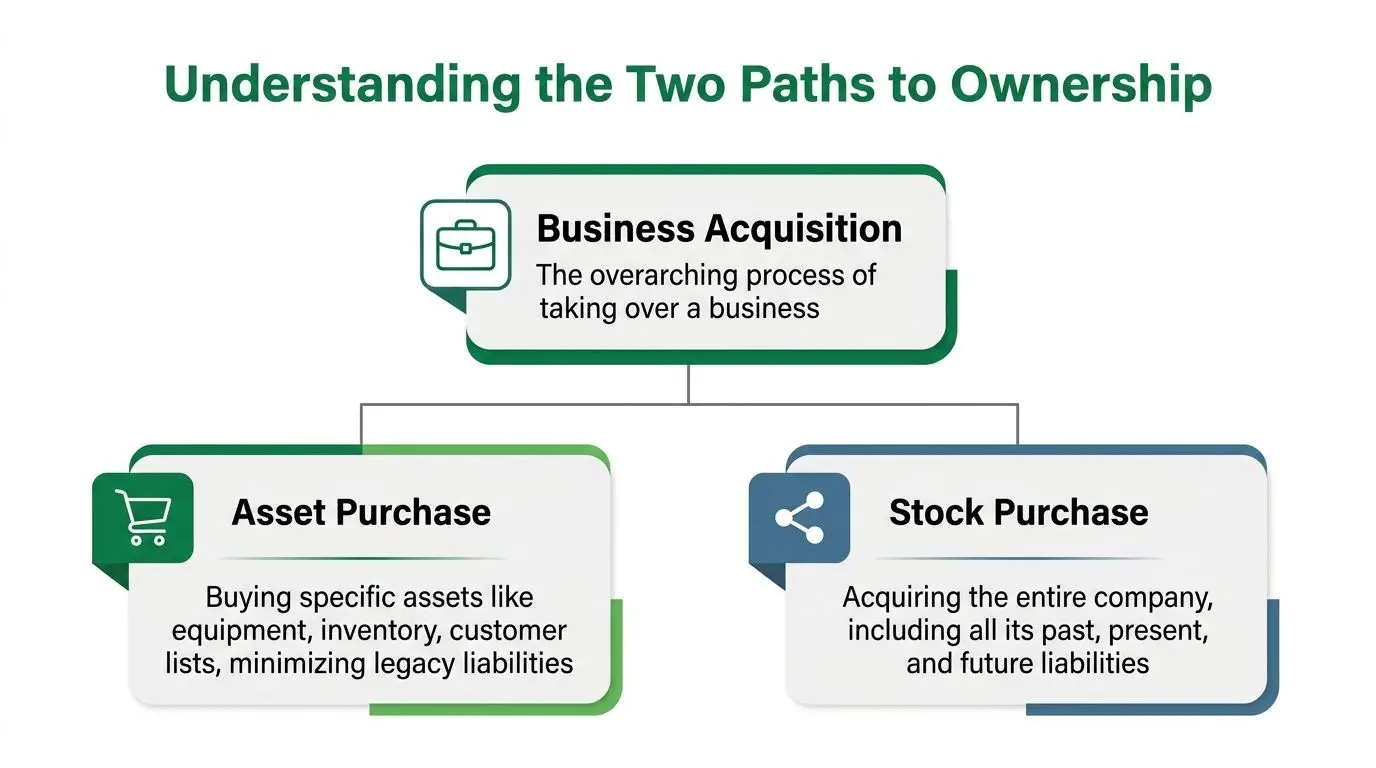
At a practical level, an asset purchase and a stock purchase are two very different ways to take over the same business. They can produce a similar headline result, meaning you control operations after closing, but they do not transfer the same legal package.
Asset purchase
Think of an asset purchase like buying selected contents of a store rather than buying the corporation that owns the store. You choose what comes over. That usually includes equipment, furniture, inventory, intellectual property, goodwill, phone numbers, websites, customer lists, and sometimes specific contracts. The seller keeps the legal entity unless there's a separate wind-down.
In plain English, you're buying a bundle of business assets and only the liabilities you explicitly agree to assume. If a payable, dispute, tax issue, or old obligation isn't part of that agreement, it generally stays behind with the seller's entity.
Stock purchase
A stock purchase is different. You buy the ownership interests in the company. The legal entity remains in place, and you step into ownership of that entity with its history intact. The bank accounts may stay. The payroll system may stay. The contracts may stay. The licenses may stay if they're tied to the entity.
That continuity is the attraction. It can also be the danger.
In a stock deal, you don't just buy what the company owns. You buy what the company is.
What actually transfers
Here's the easiest way to think about the asset vs stock purchase question:
- In an asset deal: individual assets transfer one by one through bills of sale, assignments, and other transfer documents.
- In a stock deal: ownership of the entity transfers, so the assets usually remain where they already are, inside the company.
- In an asset deal: contracts often need review for assignability.
- In a stock deal: continuity is often smoother, but the buyer inherits the company's legacy issues too.
This distinction matters when buyers start asking about licenses, leases, franchisor approval, customer contracts, and payroll setup. It also matters when sellers want to retain some cash, A/R, or non-operating assets. Those carveouts are usually cleaner in an asset deal.
If the seller wants to stay involved through an ownership stake, the structure discussion can overlap with questions about rollover equity. Buyers looking at that issue should understand how an equity roll over can affect negotiations and lender review.
A Head-to-Head Comparison of Key Deal Terms
A buyer can agree on price and still lose weeks at underwriting because the deal structure creates avoidable SBA issues. I see that happen most often when the LOI treats asset vs. stock as a legal detail instead of a financing decision. For an SBA buyer, these terms affect diligence scope, closing documents, lender comfort, and sometimes whether the bank will pursue the deal at all.
| Consideration | Asset Purchase | Stock Purchase |
|---|---|---|
| Liability | Buyer usually assumes only the liabilities listed in the purchase agreement | Buyer acquires the entity and inherits its known and unknown liabilities |
| Tax treatment for buyer | Buyer usually gets a new tax basis in the acquired assets | Buyer usually keeps the company's existing basis |
| Tax treatment for seller | Often less favorable for some sellers, especially certain corporate sellers | Often more attractive to sellers |
| Contracts and licenses | Often require assignment review, consent, or reissuance | Often preserve continuity because the legal entity stays in place |
| Operational setup after closing | More transfer work, new accounts, new registrations, and document cleanup | Less immediate disruption if key relationships stay with the entity |
| Complexity at closing | More documents and more third-party approvals | Fewer transfer documents, but heavier diligence into company history |
| SBA lender view | Usually easier to finance | Usually reviewed more carefully and may require stronger justification |
Liability transfer
This is the term that changes the risk profile fastest.
In an asset deal, the purchase agreement can define exactly which obligations the buyer is taking on. In a stock deal, the buyer owns the company with its full history attached. That includes problems no one found during diligence. Practical Law's summary of successor liability and related deal-risk allocation concepts) explains why asset buyers usually have a better chance to limit exposure, while stock buyers face broader inherited risk.
That difference matters to SBA lenders because old liabilities can hit cash flow after closing. Payroll tax issues, sales tax audits, wage claims, customer disputes, and contract defaults do not stay in the legal file. They become debt service problems.
For buyers negotiating indemnity language, escrow terms, and post-closing recourse, it helps to understand related risk-allocation concepts such as this guide to PEO indemnification terms. Different context, same question. Who pays when a pre-closing issue surfaces after funding?
Tax implications
Taxes often pull buyer and seller in opposite directions.
Buyers usually prefer an asset acquisition because a new tax basis in the assets can create larger depreciation and amortization deductions over time. Sellers often prefer stock treatment because the tax result can be cleaner for them, especially if they have already built the company inside a corporation. The tax gap between those positions shows up in purchase price negotiations, seller note discussions, and allocation fights.
For SBA deals, this also affects how the lender views total project value and repayment strength. A buyer who understands tax basis and purchase-price allocation is better prepared to explain the economics behind the offer. That analysis should line up with the lender's valuation process, including business valuation for SBA loans and how lenders determine acquisition value.
Contracts, titles, and continuity
Stock deals usually look easier on paper.
If the entity stays the same, customer agreements, payroll accounts, permits, and vendor relationships may continue without formal assignment. In an asset purchase, each of those items has to be checked. Some contracts assign freely. Some need written consent. Some licenses must be reissued. Some leases give the landlord a veto.
For a first-time buyer, that can feel like an argument for a stock purchase. Sometimes it is. But from an SBA closing standpoint, continuity only helps if the lender is comfortable that the entity's history has been fully vetted and that no hidden obligations ride along with that continuity. Easier transfer mechanics do not automatically make the file easier to approve.
Transaction complexity
Asset deals usually require more work between signing and closing. Bills of sale, assignment documents, UCC searches, payoff letters, lease consents, franchise approvals, and updated entity formation documents all have to line up. That adds friction, but the work is visible.
Stock deals shift the burden. There may be fewer transfer documents, yet the diligence standard is higher because the buyer and lender have to get comfortable with everything already inside the company. That means more attention to tax transcripts, litigation history, employment practices, prior debt, old balance sheet accounts, and anything else that could survive the closing.
From an SBA perspective, that trade-off is the point. The question is not which structure looks simpler at first glance. The question is which structure gives the lender a cleaner credit story and fewer surprises after funding.
Why Buyers and Lenders Champion the Asset Purchase
A first-time buyer gets a deal under LOI, lines up SBA financing, and expects the hard part to be negotiating price. Then the lender asks a simple question. Are we buying assets or buying stock? That answer can change the approval path, the diligence burden, the collateral package, and the odds of closing on time.
The clean perimeter matters
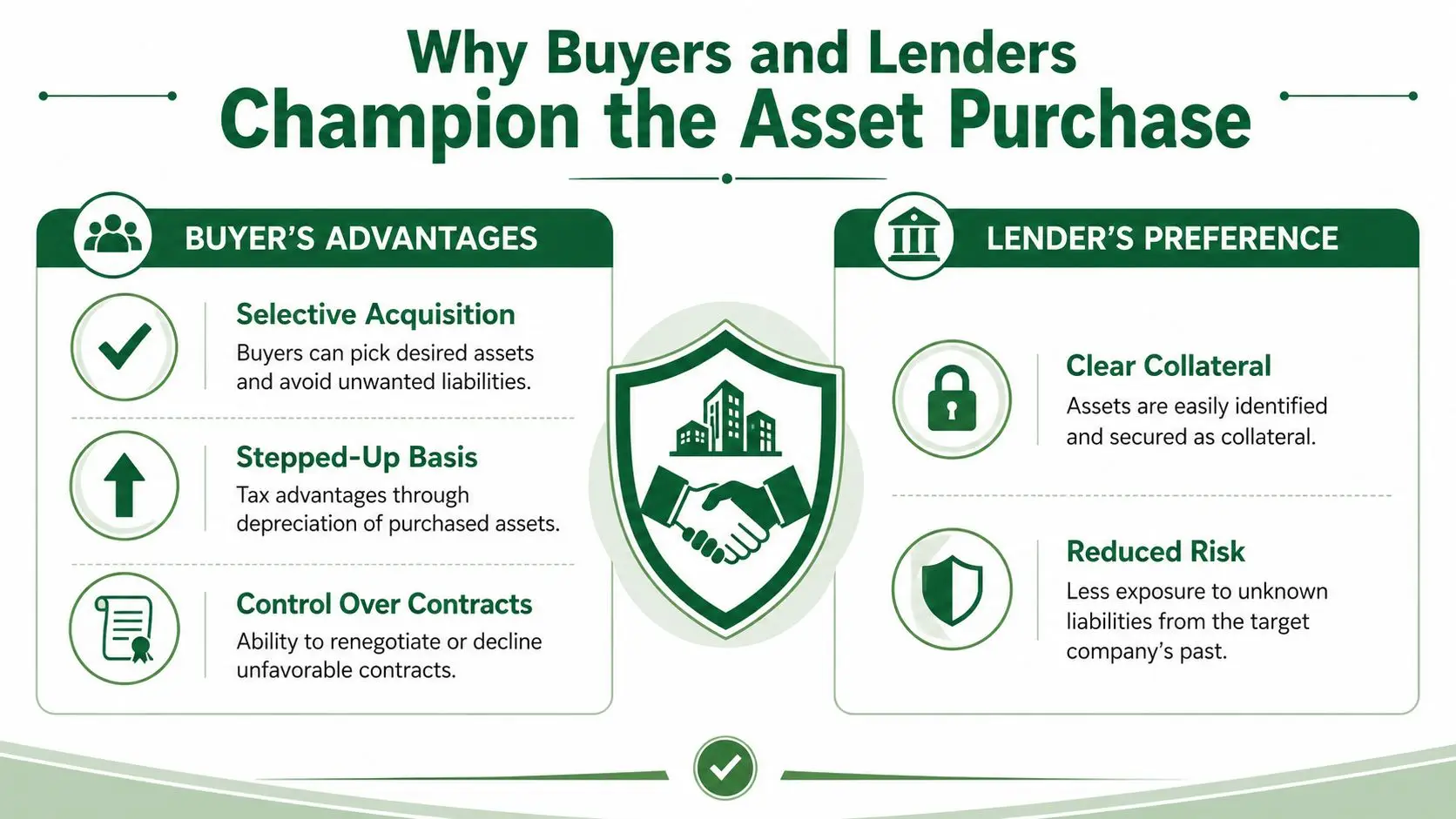
Asset purchases give the buyer a chance to start with a cleaner box. The purchase agreement states which assets transfer and which liabilities, if any, the buyer is taking on. That matters in SBA lending because old tax problems, employee claims, contract disputes, or regulatory issues can hit cash flow after closing. If cash flow gets hit, debt service gets hit.
That is why lenders favor a structure that leaves less room for inherited surprises.
From the buyer's side, the same logic applies. A first-time owner rarely has the time, legal budget, or risk tolerance to investigate every legacy issue sitting inside an existing entity. Buying selected assets is usually the more controlled way to acquire the business you want without also buying every unresolved problem the seller forgot to mention.
The structure fits how SBA loans are underwritten
SBA lenders underwrite repayment first, but they also care about collateral clarity and post-closing balance sheet strength. In an asset deal, the lender can usually see exactly what the new borrower is acquiring, what liens need to be released, and what property will secure the loan. That makes the file easier to underwrite and easier to document at closing.
The tax side helps too. Buyers in asset purchases usually get a stepped-up basis in the acquired assets, which can improve depreciation and amortization deductions after closing. Lenders care about that because better after-tax cash flow gives the business more room to make the loan payment. If you want a clearer view of that credit analysis, review this breakdown of how SBA lenders underwrite your deal.
Buyers focus on what they are acquiring. Lenders focus on what could impair repayment six months after funding.
The seller may dislike it, but the lender often still prefers it
Sellers often push for stock sales because they can be cleaner for them on taxes, contracts, and operational continuity. Buyers need to understand the trade-off. What is convenient for the seller is not always financeable on SBA terms without more scrutiny, more diligence, and more lender hesitation.
I see this in real transactions. A buyer may hear that a stock purchase will avoid contract assignment issues and keep the business running without interruption. True, sometimes. But if the lender believes the entity carries too much unknown history, that convenience does not help the credit file. It becomes one more reason the bank asks for extra diligence, extra legal review, or a different structure altogether.
What buyers should expect in practice
Asset purchases still create work. Lease consents, license transfers, payroll setup, vendor assignments, and state filings can slow the closing. Those are execution issues, and they are visible early.
Hidden liabilities are different. They are harder to find, harder to price, and harder for an SBA lender to accept with confidence.
That is the practical reason asset deals keep winning in SBA-financed acquisitions. They do not remove every closing problem. They usually produce a cleaner borrower, cleaner collateral, and a cleaner approval story.
The SBA Lender's Deciding Vote and SOP Rules
If you're using SBA 7(a) financing, your lender's view usually decides the structure question. You can negotiate with the seller for weeks, but if the lender won't approve the format, the transaction has to change or die. That's why the SBA SOP needs to be the main source of truth.
What lenders want to see
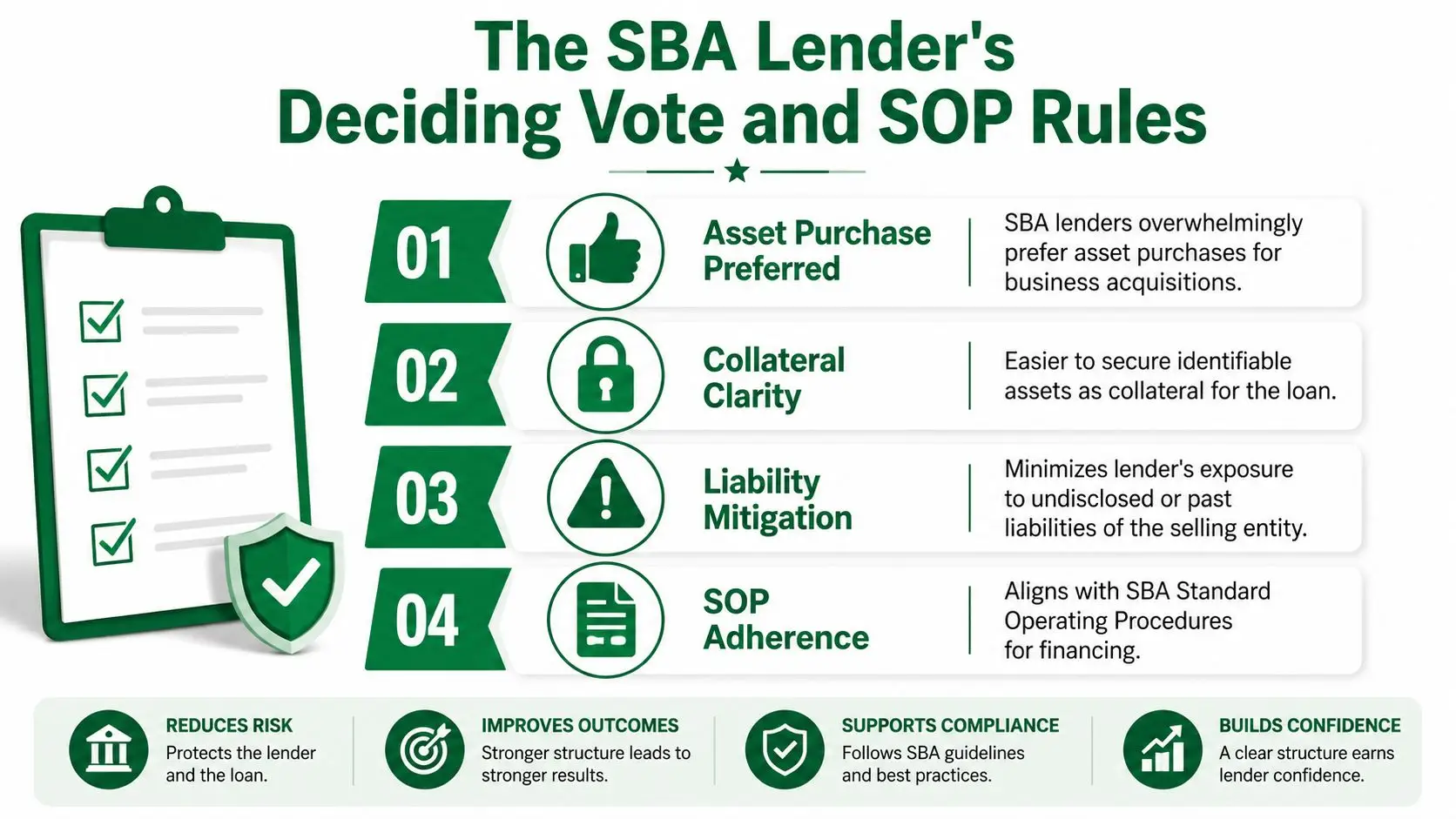
SBA lenders strongly prefer asset purchases over stock purchases because asset deals provide cleaner collateral structures and stronger liability protection, and many lenders require an asset purchase in most acquisition cases unless operational continuity makes a stock purchase necessary, according to this lender-focused explanation of asset and stock structures.
That lines up with what lenders look for in real underwriting:
- A new borrowing entity: Clean ownership, clean obligations, and a clear post-closing balance sheet.
- Identifiable collateral: Equipment, furniture, inventory, and business assets that can be tied directly to the loan.
- Limited legacy exposure: Fewer unresolved questions about prior taxes, disputes, or compliance issues.
- Clean closing documents: A structure that fits lender counsel review without excessive exception requests.
When a stock purchase can work
Sometimes a stock purchase is necessary. The usual reason is continuity. The business may hold a license, permit, franchise right, payer agreement, or contract that is difficult or impossible to assign. In those cases, a lender may consider a stock transaction. But the bar is higher.
One hard rule matters here. Under SBA SOP 50 10 8 Subpart B, Chapter 3, an SBA 7(a) loan may finance a stock purchase only if the transaction results in a 100% change of ownership and control, meaning the buyer must obtain all voting equity and all prior owners must completely divest, as explained in this summary of SBA stock purchase requirements.
A partial stock buyout isn't an SBA 7(a) stock acquisition structure. If the seller keeps control rights, the deal no longer fits that rule.
That requirement catches many first-time buyers off guard. They assume they can buy most of the company now and let the seller retain a small controlling role temporarily. With SBA stock-purchase financing, that can be a problem.
The equity injection and seller note rules
For a complete change of ownership, whether structured as an asset purchase or a stock purchase, the SBA requires a minimum equity injection of 10% of total project costs, and seller debt only counts toward that injection if it is on full standby for the life of the loan and does not exceed 50% of the required 10% amount, according to this guide to SBA acquisition structure and injection rules.
That rule affects more than just capitalization. It affects negotiation strategy. If the seller wants a note, the terms of that note can help or hurt fundability. Buyers who are structuring standby debt should also understand the broader SBA seller financing rules.
In practice, lenders approve stock purchases only when there's a strong continuity reason, clean diligence, and a structure that fits SOP requirements without strain. If that reason doesn't exist, asset purchases usually win.
Your Acquisition Structure Decision Checklist
The best way to decide between an asset purchase and a stock purchase is to force the right questions early. Not after legal drafts. Not after underwriting. Early.

Questions to answer before signing the LOI
Use this list with your attorney, CPA, and SBA loan broker:
- What exactly am I buying? List the assets, excluded assets, assumed liabilities, and excluded liabilities in plain language.
- Are any licenses or contracts non-transferable? If a critical item can't be assigned, a stock structure may need to be considered.
- What is the seller's entity type? The seller's tax posture can shape how hard they push for stock treatment.
- What liabilities could survive closing? Ask specifically about taxes, employee matters, threatened claims, old debt, and compliance issues.
- Will the seller keep the old entity alive? In an asset transaction, that can matter for wind-down planning and lender comfort.
Questions to answer before lender underwriting
Once financing is in play, the checklist changes:
- Will the lender accept the proposed structure? Don't assume. Ask directly.
- Does the stock deal satisfy the SBA ownership-control rule? If not, stop and fix it before deeper underwriting.
- How will the equity injection be documented? Cash, seller standby debt, or a combination all need to fit SBA rules.
- What third-party consents are required? Landlords, franchisors, and key vendors can hold up closing.
- Will the lender require additional diligence because of continuity risk? Stock deals often trigger more review.
The best-structured deal is the one your attorney can document, your CPA can support, your lender can approve, and you can actually close.
A buyer who can't answer those questions clearly is still too early to lock in final economics.
Frequently Asked Questions
Can an SBA loan fund a partial stock purchase
Usually not under the SBA 7(a) rule discussed above. A financed stock purchase must result in a 100% change of ownership and control. If the seller retains voting equity or ongoing control rights, that creates a problem for SBA eligibility in a stock acquisition format.
What if a key license or contract can't be assigned
That's one of the few strong reasons to consider a stock purchase. If the company would lose essential operating rights in an asset transfer, keeping the entity intact may be necessary. In that situation, expect the lender to ask harder questions about liabilities, diligence, and legal documentation.
Can parties use a hybrid structure
Sometimes they try. Tax elections and negotiated compromises can bridge some of the gap between buyer and seller objectives. But hybrid treatment doesn't erase SBA rules, lender overlays, or the need for a clearly documented ownership and collateral structure. Buyers should assume the lender will still focus on what is being financed and what legal risks remain.
Is an asset purchase always better
No. It's usually better for liability control and lender comfort. It is not always better for operational continuity. If a business depends on hard-to-transfer rights, the best structure may be the one that preserves the business as a going concern while still meeting SBA requirements.
Does the seller's preference control the answer
No. The seller can prefer a stock sale, and many do, but the financed structure has to work for the lender and the SBA framework. A seller-preferred structure that can't get approved isn't a real option.
If you're weighing an asset purchase against a stock purchase and want an SBA structure that can be approved, GoSBA Loans can help you pressure-test the deal before you waste time on the wrong path. Their team helps buyers align LOI terms, lender expectations, equity injection rules, and closing strategy so the structure works in practice, not just on paper.
