You're sitting across from a buyer who keeps pointing to a spreadsheet and saying the number is too high. You're pointing to years of hard work, strong customers, and a business that runs well enough to attract interest. The gap between those two positions usually comes down to one thing, the multiple. If you're trying to sell, buy, or finance a business, understanding EBITDA multiples for small businesses can turn a frustrating negotiation into a grounded conversation about value.
Table of Contents
- Introduction to EBITDA Multiples for Small Businesses
- Understanding EBITDA Multiples for Small Businesses
- Adjusted EBITDA and Valuation Base
- Typical EBITDA Multiple Ranges by Size and Industry
- Worked Examples and Calculation Steps
- Drivers of Multiples and Common Pitfalls
- Actionable Strategies for Buyers and Sellers with SBA Considerations
- Putting It All Together
Introduction to EBITDA Multiples for Small Businesses
A seller thinks the company is worth more because the owner has spent years building relationships, systems, and a reputation. A buyer sees risk, asks how much the owner does personally, and wants to know whether the business still works after the owner leaves. That tension is normal, and it's exactly why valuation needs a shared language. In SBA-backed acquisition discussions, lenders also care about whether the price and structure fit the business's earnings and risk profile, which is why a valuation framework matters so much, not just for the seller and buyer, but for the deal itself. For a lender-oriented perspective, see this SBA business valuation guide.
The easiest way to start is to treat the business like an income-producing asset. If the earnings are stable and transferable, the business can support a higher price. If the earnings depend on one owner, one customer, or one fragile process, the price comes down. That's the core of EBITDA multiples for small businesses, and once you understand it, you can read most deal conversations much more clearly.
Understanding EBITDA Multiples for Small Businesses
A buyer and a seller can look at the same company and see two different stories. The seller sees years of work, customer relationships, and systems that took time to build. The buyer looks at whether the earnings can survive after the owner steps away, because that is what the price has to support.
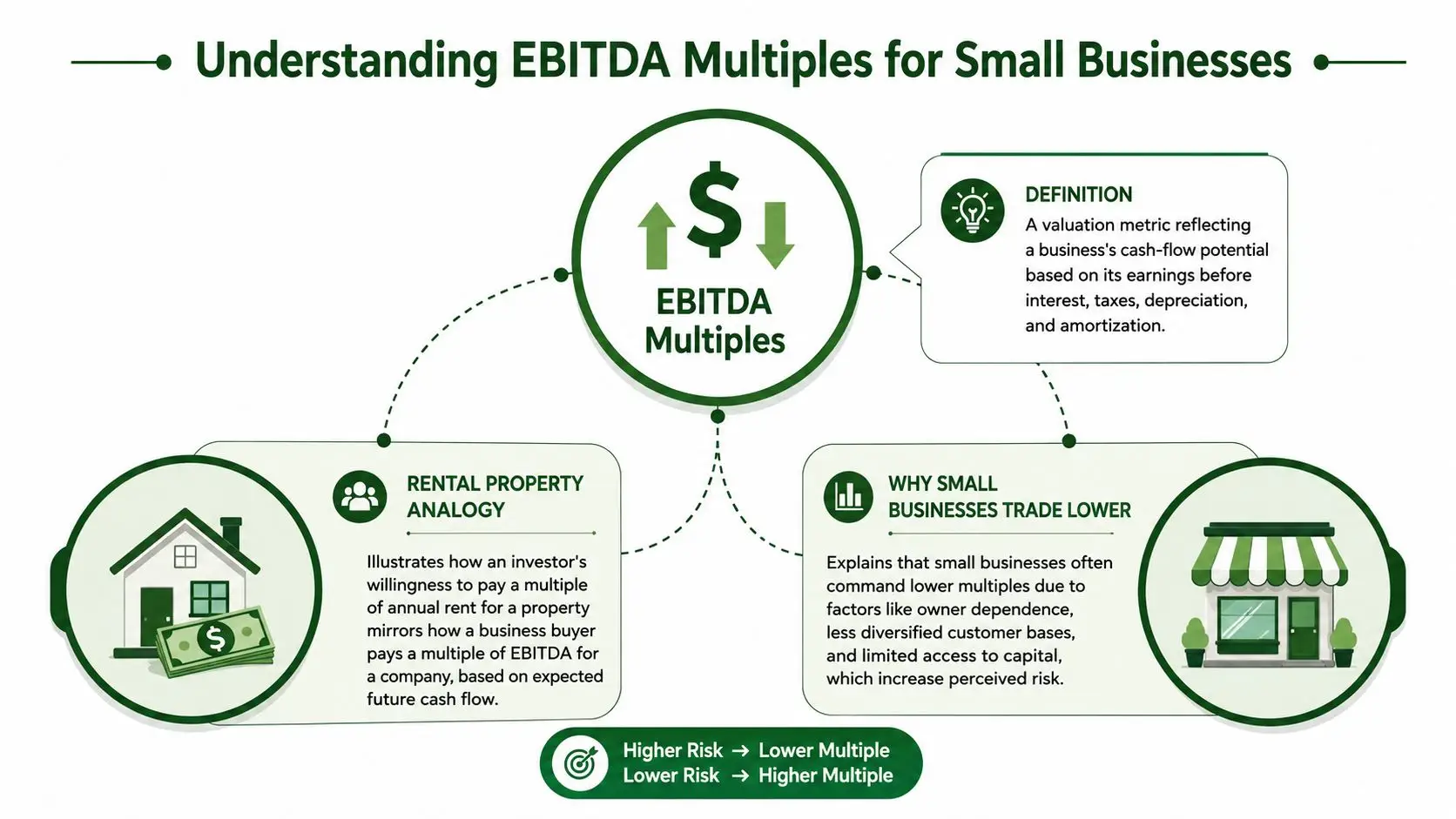
EBITDA stands for earnings before interest, taxes, depreciation, and amortization. In plain English, it shows operating performance before financing decisions and non-cash accounting items affect the picture. The multiple is the price a buyer is willing to pay for each dollar of that earnings stream. The basic formula is enterprise value ÷ EBITDA, so if a company with $500,000 of EBITDA sells for $2,000,000, that implies a 4.0x EBITDA multiple Corporate Finance Institute.
A rental property gives a useful comparison. A buyer pays for the rent the property can reliably produce, not for what the last owner remembers spending on repairs or improvements. If the rent is dependable and the building needs little hands-on attention, the buyer is more willing to pay a higher price. A small business works the same way, except the rent is operating cash flow, and the condition of the building includes customers, management depth, and how much the company depends on the owner.
Why Small Businesses Trade Differently
Small firms usually trade at lower multiples than larger deals because buyers face more owner-dependency, more financing risk, and a thinner buyer pool. That is why a business with the same EBITDA can price very differently depending on whether it behaves like a transferable company or more like an owner-operated asset. For the smallest deals, many buyers still think in terms of SDE, not EBITDA, because the owner's compensation and personal effort are part of the earnings story.
The SBA lens matters here, because valuation base and deal structure need to match the reality of the business. A practical explanation of that framework is available in this SBA business valuation methods guide, which helps connect the number on paper to what lenders and buyers can realistically support.
The size bands in the verified data give a useful anchor. Sub-$1M EBITDA businesses typically trade at 2.0x–3.5x, $1M–$5M EBITDA businesses at 3.0x–5.5x, and $5M+ EBITDA businesses at 4.0x–7.0x CTA Acquisitions. One practical way to read that is straightforward. A business with $500,000 of EBITDA may be worth roughly $1.0 million to $2.75 million depending on how transferable and stable it is.
For a practical companion to valuation thinking, the financial investment guide for startups is useful because it shows how buyers compare cash flow over time rather than staring at one headline number. That shift matters in acquisition talks. It moves the question from what the business cost to build to what cash it can throw off in the future.
Practical rule: if the business only works because the owner is irreplaceable, the multiple will usually look more like an owner-operator asset than a transferable company.
Adjusted EBITDA and Valuation Base
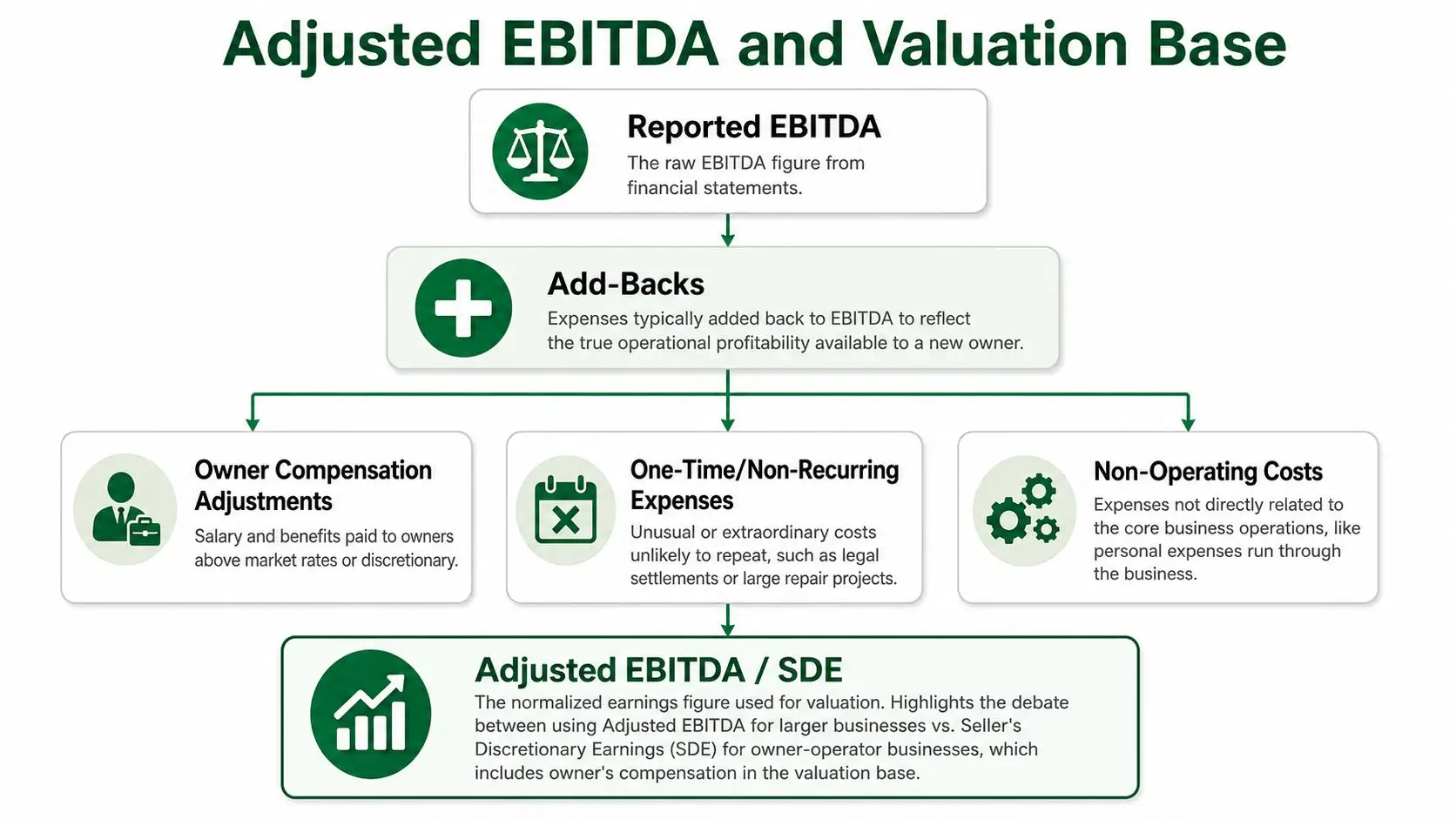
Raw EBITDA rarely tells the full story in a small business sale. Buyers and lenders look for adjustments, also called add-backs, to separate normal operating performance from one-off or personal expenses. The usual categories include owner compensation adjustments, one-time or non-recurring expenses, and non-operating costs Corporate Finance Institute. Those adjustments matter because they change the earnings base, and the earnings base is what the multiple is applied to.
A business with noisy books can look weaker than it really is, or stronger than it really is, depending on how the numbers are normalized. That's why the denominator matters so much in valuation. Many buyers don't argue first about the multiple. They argue about whether the earnings number is real, repeatable, and fairly adjusted.
Why the Denominator Matters More Than the Headline Multiple
The SDE versus EBITDA question becomes central. Many sub-$2M value businesses are still priced on seller's discretionary earnings (SDE), while EBITDA becomes standard only as businesses become less owner-dependent Fisart. A useful way to think about it is that SDE is designed for a business where the owner's labor, salary, and perks still sit inside the economic value of the company. EBITDA starts to make more sense once the company has enough management depth that the owner is no longer the operating engine.
That distinction changes the conversation more than many sellers expect. A “good” multiple is not automatically a good valuation if the wrong earnings base is being used. The same business can look expensive or cheap depending on whether the buyer is valuing it on SDE or EBITDA, which is why the denominator needs to be agreed before anyone celebrates the multiple.
For deeper documentation discipline around adjustments, this SBA add-backs guide is worth reviewing because lender underwriting tends to be much stricter than seller-side storytelling. The best practice is simple. Document every add-back clearly, separate recurring operating costs from personal or exceptional items, and be ready for a buyer to challenge anything that looks subjective.
A clean normalization schedule often does more for credibility than a higher asking price ever will.
Typical EBITDA Multiple Ranges by Size and Industry
A buyer can look at two profitable businesses and value them very differently. One may be a straightforward local service company with steady cash flow, while the other may have recurring revenue, stronger systems, and less owner dependence. The first might trade more like a family business, the second more like a scaled operating platform. Size and industry shape that gap.
Size Tiers and Sector Benchmarks
The size-based ranges in the verified data give a practical starting point. Sub-$1M EBITDA businesses typically trade at 2.0x–3.5x, $1M–$5M EBITDA businesses at 3.0x–5.5x, and $5M+ EBITDA businesses at 4.0x–7.0x. For Main Street firms, the lower end of the market still often behaves differently from the lower middle market, which is one reason the valuation-base question matters so much.
Industry benchmarks add another layer. A benchmark set places many SMEs between 4x and 15x EBITDA, with Construction at 4x–6x, Retail/Distribution at 4x–6x, B2B services at 5x–8x, and Software/SaaS at 8x–15x. These ranges show how business model matters, because recurring revenue and stronger retention usually support a higher multiple than a cyclical or owner-heavy operation.
| Business profile | Typical valuation lens | Practical takeaway |
|---|---|---|
| Small owner-led firm | Often SDE first, EBITDA later | Transferability matters as much as earnings |
| Stable service business | EBITDA multiple in the mid-single digits | Predictability supports a firmer price |
| Recurring-revenue software company | Higher EBITDA multiple band | Growth and retention can lift value meaningfully |
The broad lesson is that similar EBITDA does not produce similar value. A stable service company may clear around 5x–8x, while a recurring-revenue software business can reach 8x–15x or more depending on growth and concentration risk. That is why buyers look past the income statement and examine the business model itself.
SBA underwriting adds a final filter. A price can look reasonable on paper and still fail lender review if the earnings quality does not support the debt. For that reason, GoSBA's SBA loan valuation multiples guide is a useful reference when a deal needs to hold up under financing scrutiny.
Worked Examples and Calculation Steps
A valuation usually becomes clearer once you separate the earnings base from the price multiple. The first step is to clean up normalized EBITDA, then decide what multiple fits the company's risk, transferability, and buyer appeal. Buyers often agree on one part and challenge the other, so the final number is usually a negotiation over both pieces, not a single calculation.
Two Simple Valuation Walkthroughs
Example 1, a smaller business. Suppose the company reports $500,000 of EBITDA. If the buyer and seller agree that the figure is already normalized, and the market supports a 4.0x EBITDA multiple, the implied enterprise value is $2,000,000. If the buyer believes the business depends too much on the owner, the multiple may come down even if the earnings number stays the same.
Example 2, a more mature firm. Suppose the normalized EBITDA is $2,000,000. If the market for that type of business supports a stronger mid-single-digit multiple, enterprise value rises quickly because the earnings base is larger and the company may be easier to transfer to a new owner. The lesson is not that every larger company deserves a higher multiple, but that stronger structure, less owner dependence, and wider buyer interest usually support better pricing.
| Example valuation calculation table | Normalized EBITDA | Multiple Used | Calculated Enterprise Value |
|---|---|---|---|
| Smaller business | $500,000 | 4.0x | $2,000,000 |
| More mature firm | $2,000,000 | Market-based multiple | Depends on buyer and risk profile |
The cleanest way to prepare for these talks is to build the normalization schedule first, then test the result against how a buyer would review the deal. That means separating recurring earnings from personal expenses, unusual costs, and anything that will not transfer to a new owner. If the business is being reviewed for financing, This SBA-focused EBITDA versus SDE guide helps explain why the underwriting lens often demands more discipline than a casual broker discussion.
A useful habit in negotiation is to ask one clear question: is the buyer disputing the earnings base, the multiple, or both? Many valuation arguments become easier to resolve once that distinction is made.
Drivers of Multiples and Common Pitfalls
A lot of owners think valuation is mostly about industry. It isn't. Industry matters, but buyers still pay more for businesses that look durable, scalable, and easy to transition. They pay less when the company feels fragile, too dependent on one person, or too exposed to a handful of customers.
What Pushes a Multiple Up or Down
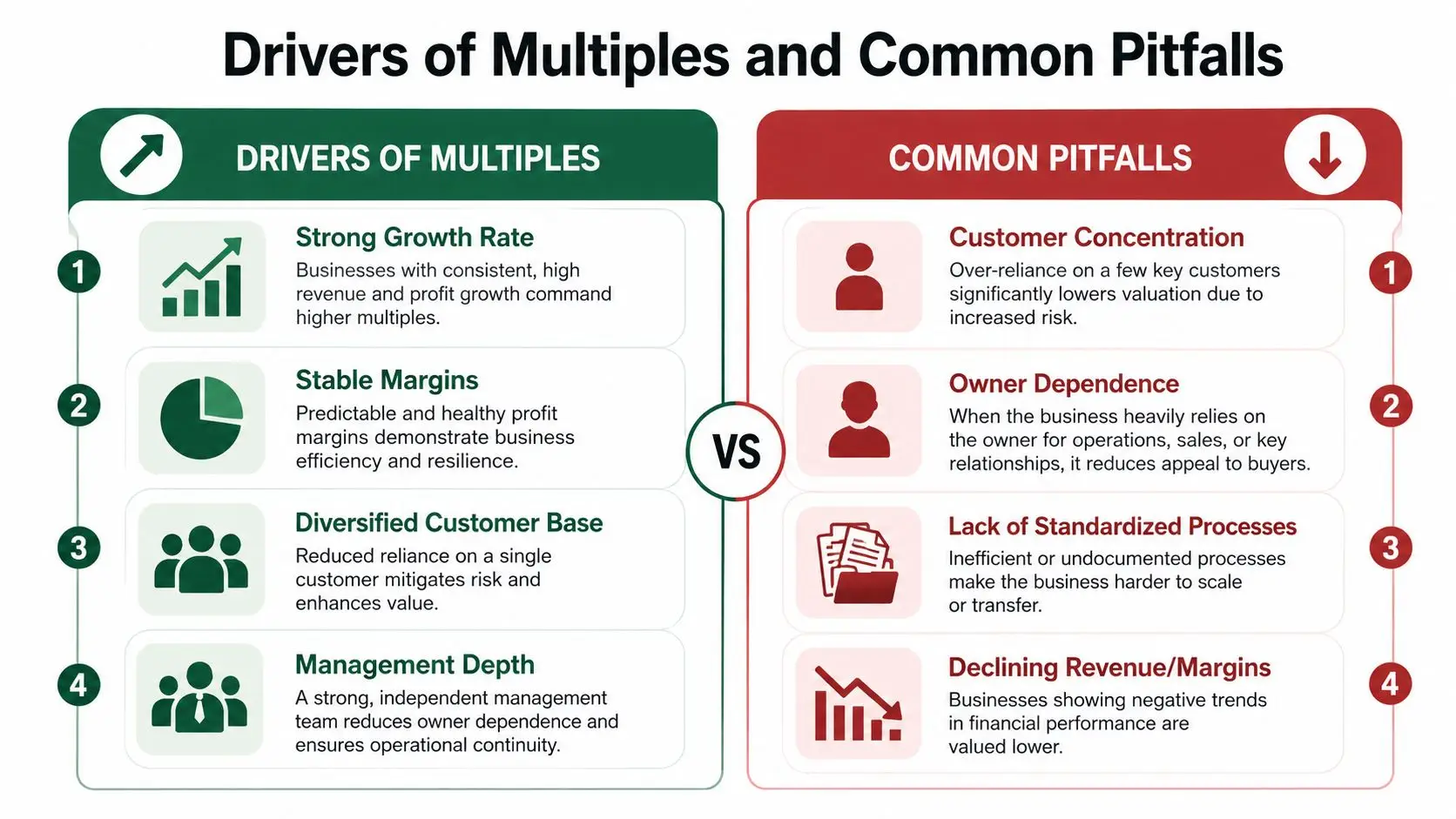
A buyer usually rewards strong growth, stable margins, diversified customers, and management depth because those traits lower the chance of surprises after closing. On the flip side, customer concentration, owner dependence, undocumented processes, and declining performance usually compress the price. These are not abstract concepts, they're practical checks on whether the business can survive contact with a new owner.
The biggest trap is treating historical earnings like a guarantee. Buyers don't pay for last year alone, they pay for a future they can reasonably underwrite. If the business needs the current owner to make every major sale, solve every operational issue, and manage every key customer relationship, the buyer will usually treat that dependence as a real risk and price it accordingly.
Another common mistake is ignoring how the deal itself affects value. A company can look fine on paper, but if the buyer can't finance the acquisition comfortably, the price often has to adjust. That's where precision around earnings quality, customer retention, and management stability matters more than a generic industry benchmark.
Buyer's lens: if the business would wobble the moment the owner steps away, the multiple should reflect that reality.
Actionable Strategies for Buyers and Sellers with SBA Considerations
A better multiple isn't something you demand, it's something you build. Sellers can improve their position by making the business easier to buy, easier to finance, and easier to run after closing. Buyers can improve their position by testing the earnings base aggressively, separating durable value from seller optimism, and matching the offer structure to the risk they discern.
Negotiation Tactics That Actually Change Outcomes
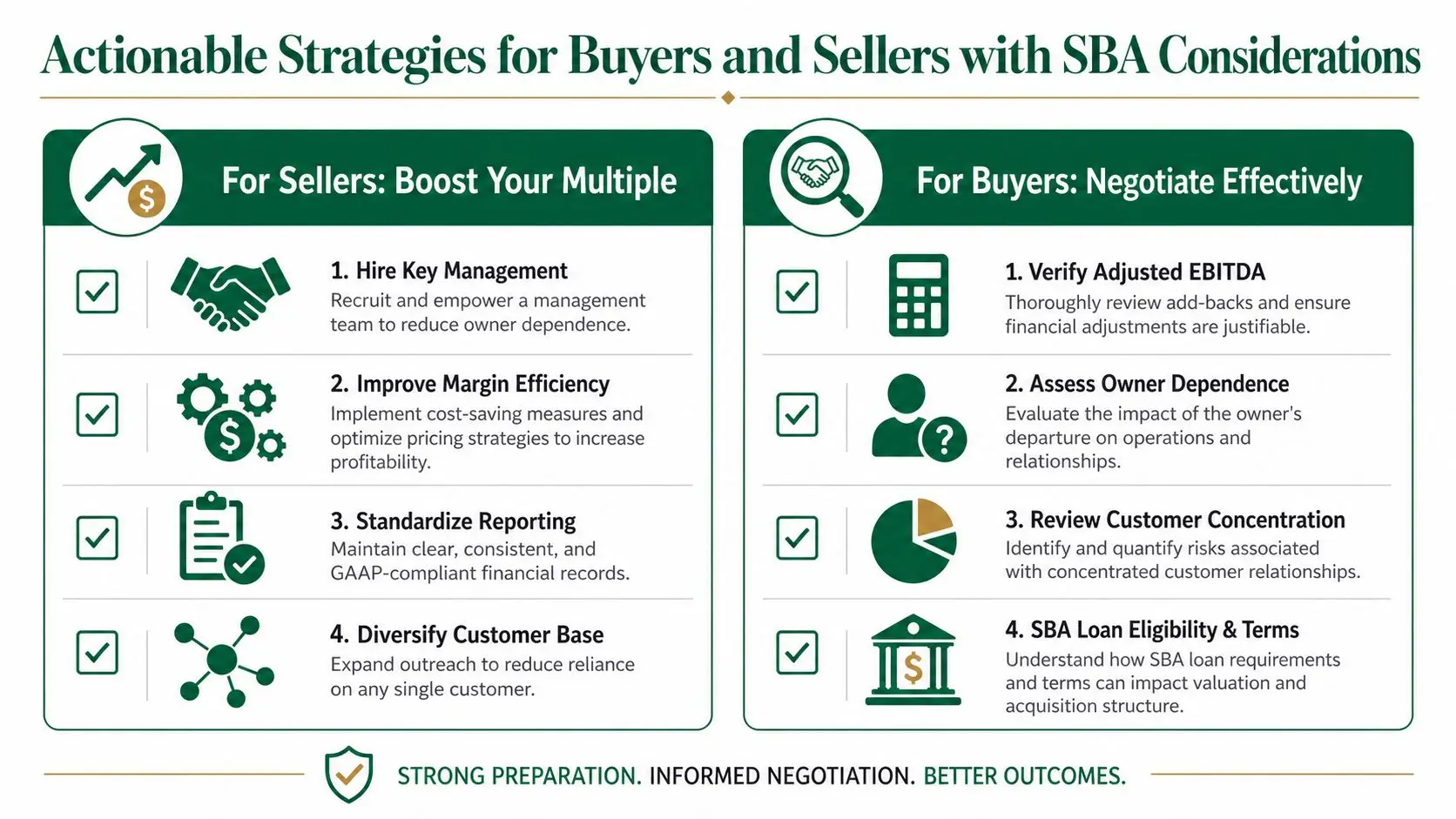
For sellers, the first move is to reduce owner dependence. Hire or promote key management, document the process map, and show that customer relationships don't all live in one inbox. If the business reports cleanly and the margins are understandable, buyers have fewer reasons to shave the multiple.
For buyers, the discipline is different. Verify the add-backs, stress-test the owner's role, and look closely at customer concentration. If a lender is involved, the SBA structure matters because the financing package has to make sense on paper and in underwriting. A transaction advisor can help model those pieces, and one option in that category is Nexist's guide to transaction success in 2026, which is relevant when a deal needs valuation work, lender coordination, and closing support.
Here's a practical checklist:
- For sellers, clean the earnings base: present normalized numbers that a buyer can trace back to support.
- For sellers, de-risk the operation: make sure the company doesn't collapse when one person takes a vacation.
- For buyers, challenge every add-back: personal expenses and one-time items need documentation, not assumptions.
- For buyers, watch the structure: seller notes, standby terms, and loan fit can change what the business is worth to a financed buyer.
The SBA angle is important because a great headline price can still fail if the capital stack doesn't support it. That's why valuation and financing can't be separated in practice. A seller may want the highest price, but the actual number is the one that survives lender scrutiny and deal execution.
Practical rule: if the structure won't close, the valuation doesn't matter.
Putting It All Together
The right way to think about EBITDA multiples for small businesses is not “What number do I want?” but “What earnings base is fair, and what risk should the buyer price in?” For sub-$5M firms, the SDE versus EBITDA question often matters more than the industry label. Once that denominator is right, the multiple becomes a negotiation about transferability, stability, and financing reality.
The cleanest deals are the ones where the seller can explain the earnings, the buyer can underwrite the risk, and the lender can follow the logic. If you're preparing to sell or buy, get the financials normalized, compare them to the relevant size and industry bands, and pressure-test the structure before you anchor on a headline number.
A CTA for GoSBA Loans. If you're buying or selling a small business and need help aligning valuation with SBA financing, reach out for acquisition lending guidance, lender matching, and deal support so you can move from guesswork to a defensible number.
