A 504 loan is an SBA-backed financing program for owner-occupied commercial real estate and other long-term fixed assets, built as a three-part capital stack where a bank funds 50%, a CDC funds 40%, and you bring 10%. In some deals, the borrower contribution rises to 15%, which changes the structure to 50-35-15.
You're usually looking at this program when rent keeps climbing, your current space no longer fits the business, or the next piece of equipment is too expensive to buy outright. That's where the 504 program earns its keep, because it's designed to turn a real estate or equipment problem into a long-term ownership decision instead of a short-term cash squeeze. For broader context on how this product fits into small-business financing, the business lending guides from 24hourEDU are a useful starting point, and the fixed-rate real estate guide at GoSBA's SBA 504 overview is worth reading if you're comparing structures.
Table of Contents
- Understanding the SBA 504 Loan Program
- How the 504 Capital Stack Works
- Comparing SBA 504 Loans to SBA 7(a) Loans
- Eligibility Requirements and Qualifying Uses
- The 504 Loan Application Process and Timeline
- Real Deal Scenarios and Structuring Examples
- Documentation Checklist and Frequently Asked Questions
Understanding the SBA 504 Loan Program
A business owner gets a lease renewal notice, sees rent climbing, and starts comparing the cost of staying put with the cost of buying the building instead. That is usually when the SBA 504 loan enters the discussion. It is designed for companies that want to own the property they occupy, or finance long-life equipment that will keep supporting the operation for years, not months.
The SBA does not lend the money directly. It supports the program, while the actual funding comes through a private lender and a Certified Development Company, or CDC, the nonprofit development organization that handles the SBA portion of the structure. The CDC piece is what makes the product distinct, because it brings government-supported fixed-asset financing to a deal that would otherwise require a much larger bank down payment.
The SBA states that the program's maximum loan amount is $5.5 million, and fiscal year 2023 approvals totaled 5,924 loans and $6.42 billion, with an average loan size of about $1.08 million (SBA 504 loan program data). In that same year, 48.1% of 504 loans fell in the $500,000 to $2 million range, which tells you what this program is built for, mid-sized owner-occupied property and machinery projects rather than day-to-day operating cash.
Practical rule: If the asset does not help the business produce revenue over a long period, it usually does not belong in a 504 structure.
For owners comparing options, the capital stack matters more than the headline rate. A 504 deal can preserve more cash at closing than a conventional commercial mortgage, while still keeping the financing tied to a fixed asset. That matters when the buyer needs liquidity for payroll, inventory, hiring, or expansion after closing.
The coordination piece matters too. A 504 loan is not just one approval sitting on a desk. The bank, the CDC, and the borrower all have to line up on structure, collateral, and timing, which is why experienced SBA lenders spend so much time matching the project size, the equity injection, and the property type before anyone orders appraisal work or legal documents. For a plain-English overview of the structure, see this guide to SBA 504 loans and fixed-rate financing.
If you are comparing financing paths, the loan is often discussed alongside broader business lending guides, but the 504 program stands apart because it is built around owner-occupied real estate and major fixed assets, not working capital.
How the 504 Capital Stack Works
The standard split
The cleanest way to understand the 504 structure is to run the math on a $2 million project. Under the standard 50-40-10 split, the private lender funds $1 million, the CDC funds $800,000, and the borrower contributes $200,000 at closing. That's the whole model in one line.
The lender's money sits in first-lien position, which lowers its risk. The CDC portion is funded through the SBA's debenture process, and the borrower's equity injection gives the deal real skin in the game. That risk allocation is why banks are often comfortable financing a project that would otherwise need a much larger down payment.
The structure also explains why 504 deals can be attractive to growing businesses. You're not trying to finance the entire project with one expensive bank loan. Instead, the capital stack spreads the risk across three parties, each of which is taking a role that matches its position in the deal.
Banks like the 504 because the first mortgage is smaller and cleaner. Borrowers like it because the down payment is often materially lower than a conventional commercial purchase.
A 50-35-15 structure comes into play for certain deals, including new businesses under two years old and special-purpose properties (LiveOak Bank SBA 504 loan basics). On a project where that applies, the borrower has to bring more cash, so the math shifts accordingly. That higher injection is not a penalty, it's the program's way of pricing extra risk into thin-credit or hard-to-sell collateral.
If you want to run your own numbers before calling a lender, a practical SBA 504 loan calculator can help you sanity-check the split, but the approval still depends on how the bank, CDC, and collateral line up.
Why this structure gets approved
The bank wants first claim on the property or equipment. The CDC wants a second-position piece that is supported by SBA program rules. You want the lowest feasible cash requirement without stripping out working capital you still need after closing.
That balance is the entire logic of the 504 model. It's not a flexible operating loan. It's a financing tool for projects where ownership, not liquidity, is the strategic move.
Comparing SBA 504 Loans to SBA 7(a) Loans
The fastest way to get a deal off track is to ask a 504 lender to fund a working-capital need, or to use a 7(a) loan for a pure real estate play without understanding the trade-off. They're both SBA products, but they solve different problems. The 504 is built for fixed assets. The 7(a) is the more versatile general-purpose loan.
| Feature | SBA 504 | SBA 7(a) |
|---|---|---|
| Eligible uses | Owner-occupied commercial real estate, equipment, long-term fixed assets | Broader uses, including working capital, acquisitions, and real estate |
| Rate structure | Fixed-rate portion on the CDC side | Often variable-rate pricing |
| Down payment | Typically lower than conventional commercial financing because of the 50-40-10 structure | Varies by use and lender, often more flexible but not as structurally fixed |
| Best fit | Building purchase, major equipment, expansion tied to hard assets | Business purchase, working capital, refinancing, mixed-use financing |
| Timeline | More coordination, more moving parts | Often simpler from a structural standpoint |
| Prepayment behavior | The CDC debenture side has its own prepayment rules | Terms vary by lender and structure |
That comparison matters because borrowers often focus on rate alone. Rate is important, but it's not the only thing. The key question is whether you're financing a hard asset with a long useful life, or a broader business need that needs more flexibility.
The 504 often works best when the project is clean and asset-heavy. The 7(a) makes more sense when the financing need includes operating funds, acquisition price, seller notes, or other uses that don't fit the 504 box. In some transactions, both programs can be used together, but that takes careful structuring and a lender that understands how to coordinate the pieces.
For borrowers trying to decide between the two, owner-occupied commercial real estate loans are a good comparison point because the loan type should match the asset, not just the rate sheet.
Eligibility Requirements and Qualifying Uses
A 504 lender starts with three questions. Is the business eligible, does the project fit the program, and will the company occupy the property enough to satisfy SBA rules? If the answer to any of those is no, the file usually dies early, which is a good thing because it saves everyone weeks of work.
The occupancy and size tests
The program is designed for owner-occupied properties, not passive real estate investments. For existing buildings, the owner must occupy at least 51%. For new construction, the occupancy threshold is 60%. That rule is what keeps the 504 focused on operating businesses, not landlords.
Size also matters. The SBA requires the business to stay within its small-business standards, and the common practical screen is tangible net worth and prior-year income limits. In plain English, the 504 program is meant for small and mid-sized operating companies, not large enterprises using government-supported debt as a cheap financing tool.
What the money can and can't buy
Eligible uses include buying an existing commercial building, ground-up construction, land acquisition tied to a build, heavy equipment, and renovations that improve a qualifying facility. The project has to create or preserve usable business space or productive capacity.
What doesn't fit is just as important. Working capital, inventory, business acquisitions, debt refinancing, and investment properties don't belong in a 504 structure. If the collateral is an income property you don't occupy, the deal is probably in the wrong program.
If you're gathering the file, it helps to think in lender terms instead of owner terms. A CDC and bank want to see whether the business, the property, and the ownership structure all support the same story. For a practical checklist of what lenders ask for, browse business loan documentation can be useful as a document-organization reference, even though the SBA package has its own U.S. requirements.
Buying commercial real estate with SBA financing usually works best when occupancy, project scope, and business ownership all line up from day one.
The 504 Loan Application Process and Timeline
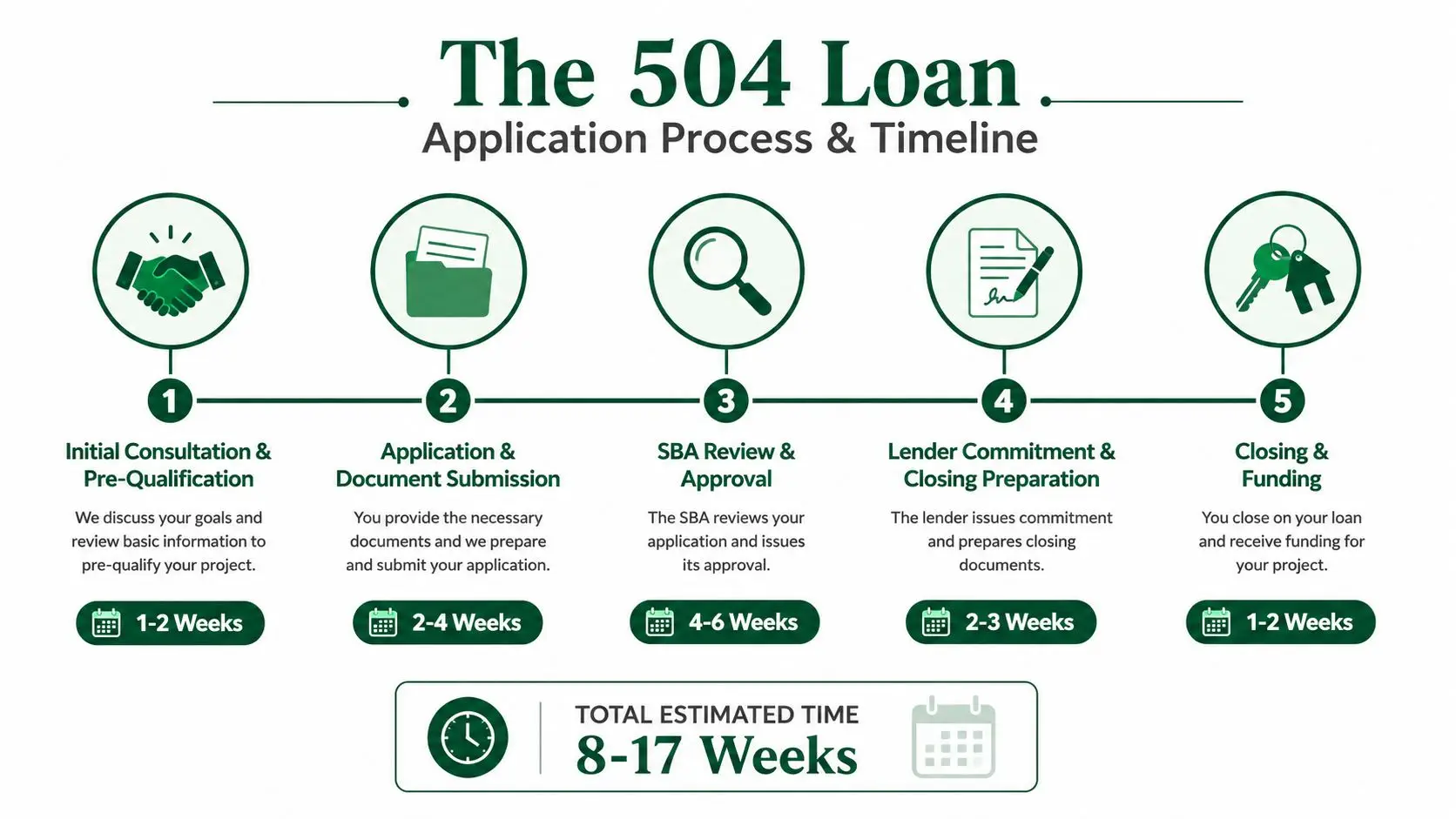
A 504 file usually starts with three people trying to answer the same question at the same time, the borrower, the bank, and the CDC. Can this close without a last-minute scramble? In practice, the answer depends less on the application form and more on whether the file is ready for underwriting before it reaches the lender. That is where most delays start.
The first step is fit and structure. The bank reviews credit, the CDC checks program eligibility, and everyone needs to agree on the project scope before expensive reports are ordered. If the scope keeps changing, the timeline stretches because every change forces a fresh look at the numbers and the capital stack.
After that comes document collection and underwriting. The lender packages tax returns, financial statements, debt schedules, entity documents, and project information. Then the appraiser, environmental consultant, and title company begin their work. Those third-party reports often slow closings, especially if the property has older use history or the project needs construction-related signoffs.
The CDC portion then moves through SBA authorization and the debenture process. That extra coordination is why 504 closings usually take longer than a simple bank loan. A 504 deal has more moving parts, and each one has to be clean before the lender wants to set a closing date.
For buyers who want a realistic planning range, the GoSBA fee guide for SBA 504 loans is a useful follow-up, because fees and timing are tied together in this product. If you are comparing your own file against an application checklist, the more complete the package is at submission, the fewer rework cycles you will face.
Useful habit: lock the purchase contract, occupancy plan, and project budget before you order reports. Moving targets are what slow 504 timelines.
A practical way to pressure-test the file is to ask whether the 50-40-10 split still works after closing costs, soft costs, and project reserves are laid in. In a real deal, the bank is not just looking at the building, it is looking at whether the borrower can cover its piece of the structure without weakening operating cash. That coordination matters as much as the paperwork. The same disciplined approach shows up in understanding owner financed sales, where the structure only works if each party knows exactly what funds at closing and what stays in the business.
Real Deal Scenarios and Structuring Examples
A manufacturing owner buying a $3 million industrial building often wants one thing, enough cash left over to keep operating after closing. Under the standard 504 structure, the bank lends $1.5 million, the CDC provides $1.2 million, and the borrower brings $300,000. That's a manageable equity check for a company that needs real estate ownership without draining operating reserves.
A startup restaurant in a special-purpose property is a different animal. If the file triggers the 50-35-15 structure, the borrower has to put in more cash up front, because the property is harder to repurpose and the business itself is newer. That higher contribution is often the price of getting long-term fixed-asset financing on a project that a conventional lender would view as riskier.
A medical practice buying a $1.5 million office condo with renovations bundled into the project can still fit the 504 model if the project stays within the program's fixed-asset lane. The key is making sure the improvements are part of the qualifying project and the occupancy plan is clear. If the renovation budget is vague, the lender will treat it like a moving target, and that slows both approval and closing.
For a broader financing lens, the concept of understanding owner financed sales can help owners see why structured equity and seller participation matter in real estate transactions, even though a 504 deal is a different product entirely.
The pattern across all three examples is the same. The 504 works best when the property or equipment is central to how the business makes money, the occupancy math is clean, and the borrower can support the deal with enough cash and documentation. It's not a rescue tool for weak projects. It's a disciplined structure for businesses that want to own productive assets without overleveraging day one.
Documentation Checklist and Frequently Asked Questions
A clean 504 file starts with records that line up, not assumptions. If the business financials, personal financials, project documents, and entity paperwork tell different stories, the file slows down before anyone gets to pricing.
What to gather before you submit
Bring the file together before you send it in. The bank and CDC both want enough detail to confirm the borrower, the project, and the source of repayment.
- Business financials: recent tax returns, profit and loss statements, and balance sheets.
- Personal financials: personal financial statement, personal tax returns, and a resume or background summary.
- Project details: purchase agreement, appraisal, environmental report, construction or renovation scope, and any contractor bids.
- Legal documents: articles of incorporation, operating agreement, leases, and entity ownership records.
If one of those pieces is missing, the deal is probably not ready. Underwriters can work through a lot, but they cannot fill in blank spots forever, and the CDC still needs a file that answers the basic questions cleanly.
Four questions borrowers ask most often
Can I refinance my current commercial mortgage with a 504 loan?
The 504 is built for qualifying fixed assets and owner-occupied projects. It is not a general-purpose refinance tool for cleaning up existing debt.
What if I need to sell the property before the loan matures?
You can sell, but the payoff has to cover the outstanding debt and any program-specific requirements tied to the CDC debenture structure. That is a transaction issue, and it needs to be planned before closing.
How are 504 interest rates determined and when do they lock?
The CDC portion follows the debenture market, so the rate mechanics differ from a standard bank loan. The bank first mortgage and the CDC debenture do not move on the same schedule, which is why coordination matters. Before you quote a closing date, review the fee items and timing notes in GoSBA's 504 fee guide.
Can I pay it off early without penalties?
Not always. The CDC debenture side has prepayment rules, so borrowers need to understand the cost of an early exit before they sign.
If you are trying to buy owner-occupied property or finance major equipment and want a clean 504 structure, GoSBA Loans can help coordinate the lender match, CDC process, and closing steps from start to finish. Bring the property details, the budget, and your target timeline, and they can tell you whether a 504 fits before you spend time on the wrong loan.
