Searchfunder is a multi-sided platform connecting searchers, investors, lenders, and brokers, and the search-fund model it serves dates to 1984 at Stanford. If you're trying to buy a business today, that matters because the core work isn't finding a catchy acquisition thesis, it's putting together a deal that an SBA lender and a seller will sign.
You're probably in a familiar spot already. You've got a target in mind, maybe a few investor calls lined up, and a lender asking for a cleaner story than the one in your head. Searchfunder exists for that exact moment, when a buyer needs people who already understand ETA, acquisition financing, and what kills a deal before it gets to closing.
Table of Contents
- What Searchfunder Is and Why Buyers Use It
- History of the Search Fund Model Backed by Stanford Data
- The Three-Layer Cap Table Behind Every Search Fund Deal
- What Search Funders Actually Buy Deal Profile and Screening Rules
- SBA 7(a) Versus Pure Search Fund Financing Compared
- How Investors and Lenders Actually Work Together on Searchfunder Deals
- Why Underserved Markets Are Not Always the Right Answer
- Practical Playbook for First Time Search Funders
What Searchfunder Is and Why Buyers Use It
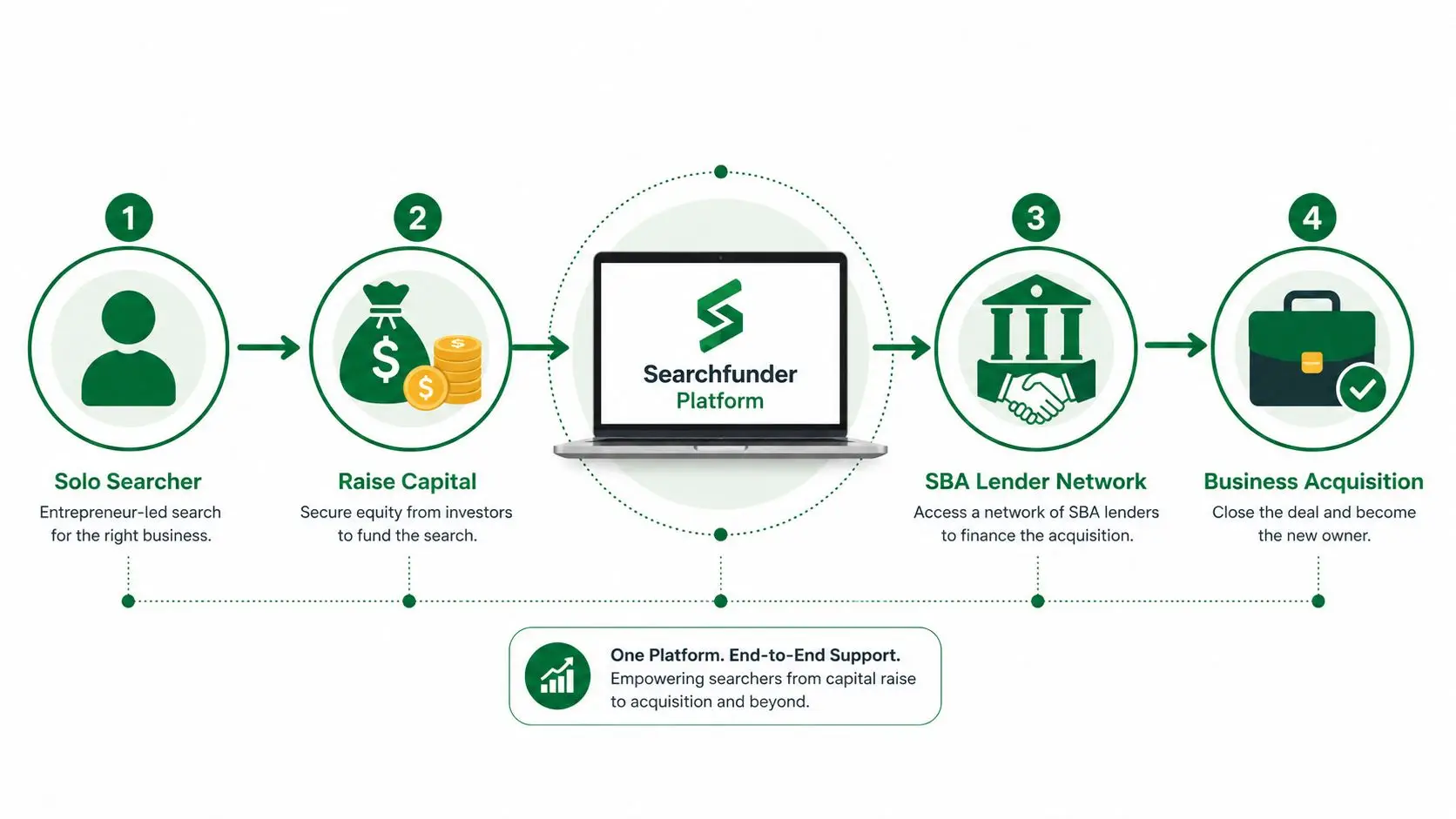
A first-time buyer usually lands here after a rough week of outreach. The searcher has capital calls to make, a broker who wants proof of funds, and a lender who wants to know whether the target can support debt service. That's where Searchfunder is useful, not as a theory site, but as a place where searchers, investors, lenders, brokers, and other acquisition professionals already speak the same language.
What the platform actually is
Searchfunder describes itself as a technology platform for search fund entrepreneurs, and that distinction matters. It's not a fund, and it's not a broker. It's a networked marketplace that connects the people a buyer needs to assemble an acquisition, which is useful because ETA deals depend on repeated coordination across sourcing, diligence, financing, and closing Searchfunder.
The model itself is entrepreneurship through acquisition. One or two individuals raise committed capital, search for a privately held business, buy it, and then operate it. INSEAD's description of search funds makes that structure explicit, and buyers should treat it as an operating model, not a passive investment bucket INSEAD.
Practical rule: if you can't explain who the searcher, investor, lender, and broker are, you're not ready to run a search fund process.
The reason buyers use Searchfunder is simple. It compresses the time it takes to find counterparties who already understand the mechanics of acquisition entrepreneurship. That won't close a bad deal, but it does reduce friction when you need a lender who understands SBA underwriting, an investor who knows what a seller note is, and a broker who won't panic when the process gets technical.
For buyers who are still building a list of acquisition targets, a practical place to start is how to find a business to buy, because a platform only helps once you know what kind of company you're looking for.
History of the Search Fund Model Backed by Stanford Data
The search fund model is older than most of the buyers using it now. It dates to 1984 at Stanford Graduate School of Business, where Professor H. Irving Grousbeck and Charles Holloway developed the idea. That origin matters because it explains why the model still carries institutional weight with lenders and investors who like seeing a long track record behind a niche acquisition strategy Stanford origin reference.
From Stanford experiment to repeatable buyout path
The earliest widely cited proof of concept came from Jim Southern, a Stanford MBA ’83, who reportedly raised about $150,000 to search for a company and then acquired Uniform Printing in 1984. That business had roughly $5 million in revenue, and after scaling it, he later sold it five years afterward and delivered a 24x return to early investors Stanford origin reference.
That early result helped turn a classroom idea into a real acquisition pathway. Today, the market behind it is large enough to track as an asset class. Independent industry reporting based on Stanford GSB's dataset says Stanford has tracked 862 traditional search funds in the United States and Canada since 1984, with formation peaking in 2023 and staying near record highs in 2024 and 2025 CapitalPad statistics.
Why the global rollout matters
The international side is just as important. The same reporting says the first international fund was raised in the United Kingdom in 1992, and the model later moved into Latin America, Europe, Africa, Asia, and Australia from 2003 onward. By year-end 2025, the international universe reached 503 core funds, up from 320 two years earlier and 83 in 2018 CapitalPad statistics.
That history tells buyers something blunt. Search funds are not a quirky academic trend. They're a 40-year-old acquisition pathway with global reach and enough institutional memory that sellers, lenders, and investors can recognize the pattern quickly.
The 2024 Stanford Graduate School of Business Search Fund Study reinforces that point. It reports a 35.1% IRR and 4.5x ROI since 1984, with exited companies achieving a higher 42.9% IRR Stanford GSB search fund study.
For a deeper primer on the academic roots, this Stanford search fund summary is a useful companion read.
The Three-Layer Cap Table Behind Every Search Fund Deal
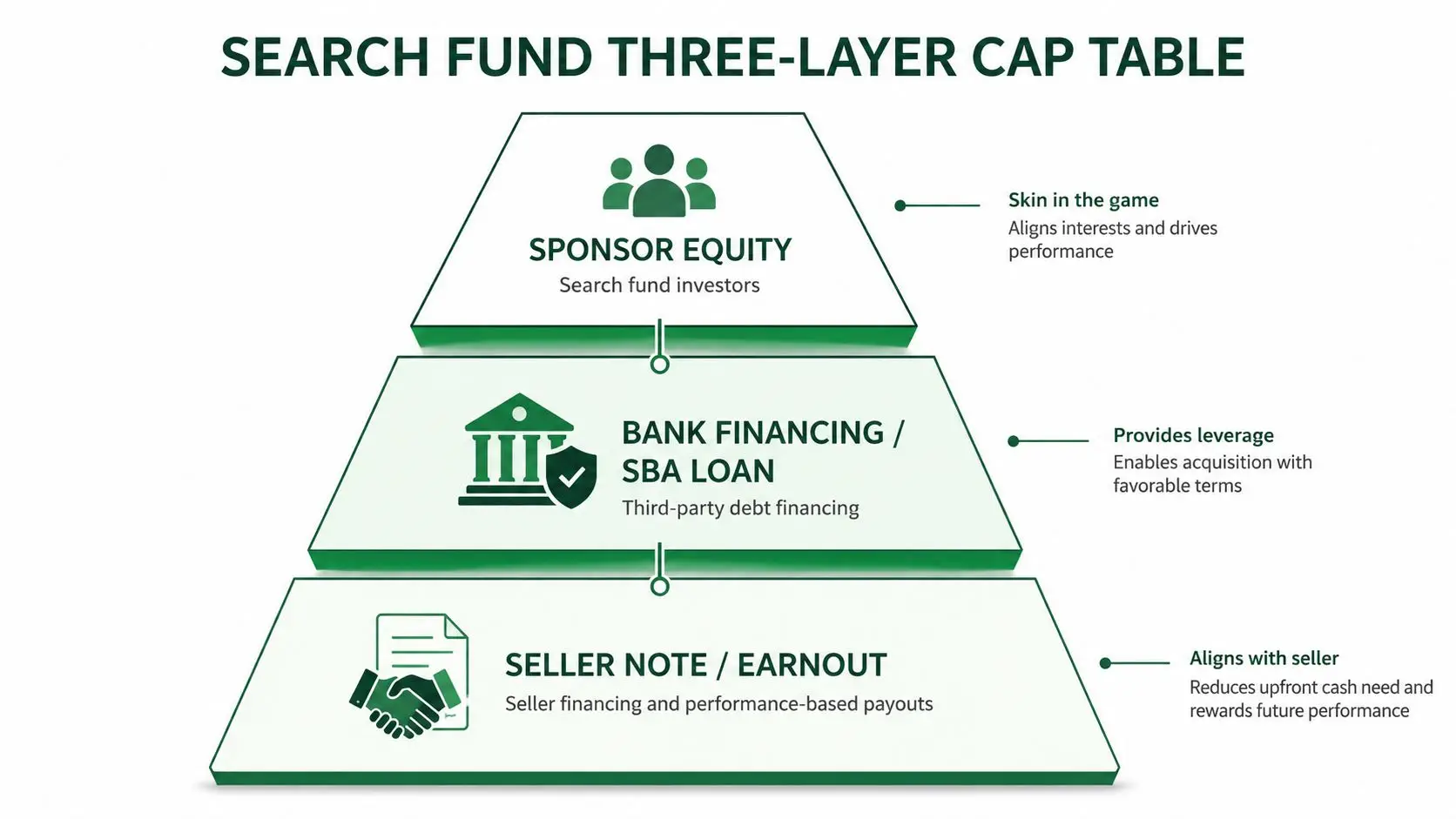
The cleanest way to understand a search fund deal is to stop thinking in slogans and start thinking in layers. Inside the Searchfunder community, the standard cap table is built from equity, bank financing, and a seller note. That structure is not decorative. It is the reason many acquisition deals close at all.
Equity sits on top because the searcher must show commitment
Layer one is the sponsor's equity, which usually includes the searcher's own money plus committed investor capital. That money pays for the search and helps fund the down payment when a target is selected. If that layer is thin or uncommitted, the rest of the stack gets shaky fast.
Buyers make a common mistake here. They treat investor commitments as informal enthusiasm instead of real capital with real timing. Sellers and lenders do not care about optimism. They care about signed support and a clear path to close.
Bank debt does the heavy lifting
Layer two is senior bank financing, usually an SBA 7(a) loan in the acquisition market. That layer brings the largest amount of money to the table, but it comes with underwriting discipline, cash flow tests, and collateral expectations. If the business cannot support debt service, the lender will not care how strong the pitch deck looks.
A search fund buyer also has to understand the practical ceiling here. Bank financing is powerful, but it is not unlimited. The lender will look at cash flow, concentration, and exit risk before approving the structure, which is why the senior debt layer has to match the business instead of the buyer's hope. For a clearer view on how lenders separate earnings measures, this SBA loan guide on EBITDA vs. SDE is worth reading before you start pricing deals.
The seller note is the deal bridge
Layer three is the seller note, which often saves deals. In search fund practice, seller notes often range from 20% to 60% of purchase price, because that subordinated capital helps bridge valuation gaps when senior debt will not stretch far enough Searchfunder offer guidance.
That is also why succession planning matters. Sellers who are thinking ahead about ownership transition often benefit from clear legal documentation around change of control, and a useful resource on that side of the table is business succession planning for Georgia owners.
Bottom line: if you cannot explain how equity, bank debt, and the seller note work together, you do not have a capital stack, you have a hope.
What Search Funders Actually Buy Deal Profile and Screening Rules
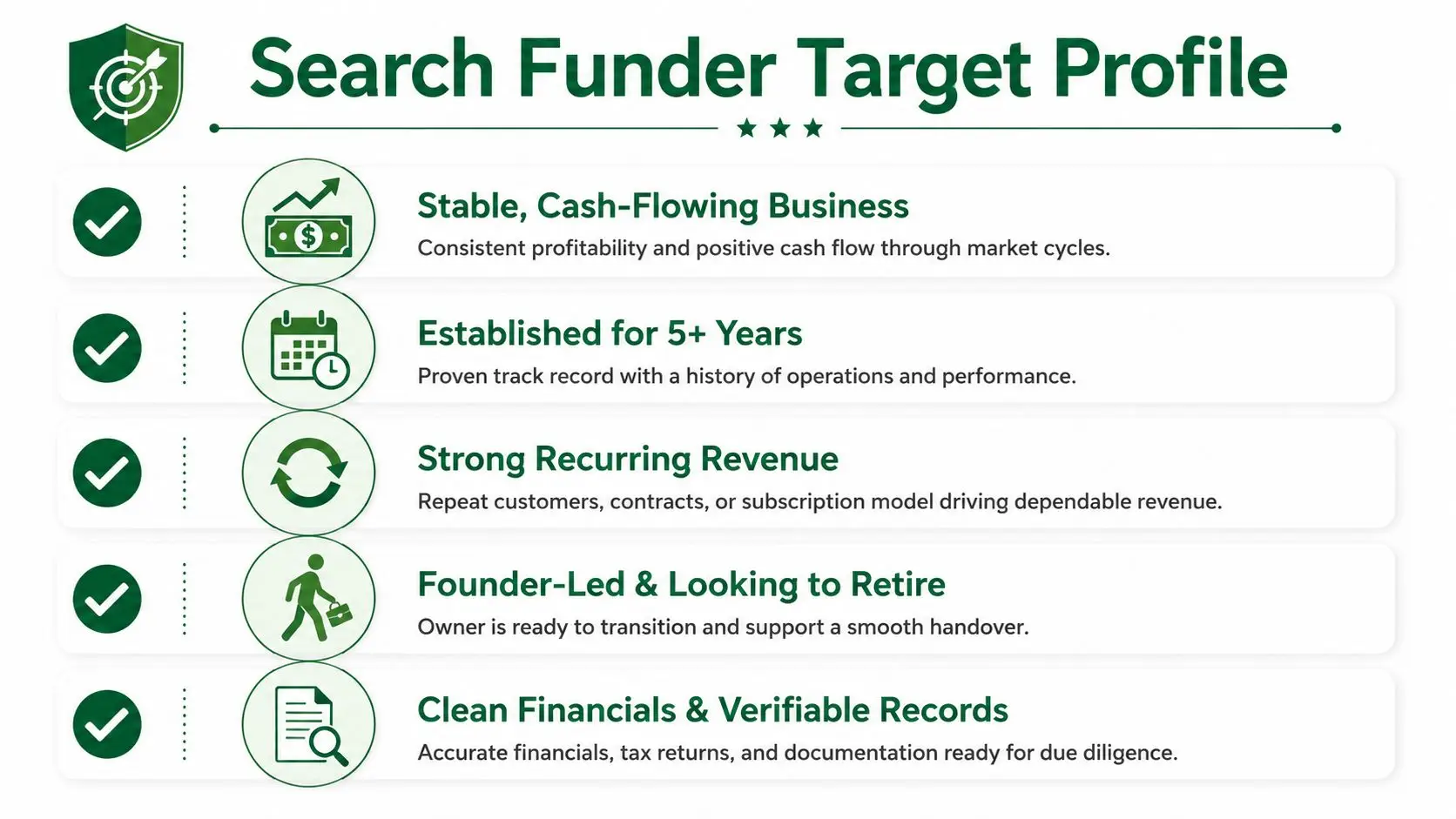
Search funders are not buying sexy startups. They're buying stable, cash-flowing businesses they can operate, improve, and eventually exit. That means the target profile has to be boring in the right ways and disciplined in the wrong ones.
The screen has to filter for predictable cash flow
Community and practitioner guidance repeatedly points to the same kinds of businesses, simple operations, a history of profits and growth, services businesses, EBITDA margins above 15%, EBITDA of at least $2 million, and more than 60% contractual recurring revenue Pacific Lake intro. Those thresholds matter because predictable cash flow makes acquisition debt survivable.
Low maintenance capex matters for the same reason. If the business constantly eats cash just to stay functional, the lender's debt model gets tighter and the buyer's margin for error disappears. Add industry growth of at least 2x GDP, and you get a business that isn't just surviving, it's growing in a market with some tailwind Pacific Lake intro.
A buyer checklist beats a vague mandate
Use the following screen before you waste time on a seller call:
- Business model: Favor services and other simple operating models with limited complexity.
- Cash flow quality: Look for profits, growth, and recurring revenue you can underwrite.
- Margin profile: Push hard on businesses with EBITDA margins above 15%.
- Scale: Stay disciplined around the $2 million EBITDA floor.
- Capital intensity: Avoid targets with heavy maintenance capex.
- Industry trend: Favor markets growing faster than the broad economy.
One of the biggest traps is deal volume blindness. A community post on Searchfunder notes that around 80% of reviewed opportunities will not turn into an LOI, which means consistent prospecting matters more than falling in love with one target Searchfunder offer guidance.
If you want a clean way to think about owner earnings versus lender-ready cash flow, this EBITDA versus SDE guide is worth reading before you start pricing offers.
SBA 7(a) Versus Pure Search Fund Financing Compared
A buyer targeting a business in the $2 million to $5 million range needs to choose the financing stack early, because the structure drives who can close, how much cash is needed at close, and how much pressure lands on the first year of ownership. The question is simple: Do you want a loan-first SBA structure, or a classic search-fund stack built around investor equity and a bigger seller note?
Two paths, two very different capital requirements
Path A is the SBA 7(a) acquisition loan paired with a 5% down seller note on full standby. Under the July 2025 SBA rule change described in the brief, that structure uses a 5% total down payment, with the SBA loan covering 90%, a 10-year term, and the seller note sitting on full standby for the entire SBA loan term, with no payments of principal or interest. SBA lenders also typically require no payments to the seller for 25 months, which puts real strain on cash flow during the first two years. If you want to see the lender side of that framework in plain English, the GoSBA SBA 7(a) guide is the right starting point.
Path B is a more traditional search-fund capital stack. That usually means committed investor equity, a smaller SBA layer or conventional senior debt, and a larger seller note that may be 20% to 60% of price and may or may not be on standby. That structure gives the searcher more room to build the cap table, but it also puts more moving parts on the table and more room for a seller to push back Searchfunder offer guidance.
Compare the two structures side by side
| Criterion | SBA 7(a) + 5% Standby | Traditional Search Fund Stack |
|---|---|---|
| Minimum cash required | Lower upfront cash | More equity capital needed |
| Seller note size and structure | Smaller note, full standby | Larger note, flexible standby or partial standby |
| SBA loan size | Larger senior SBA layer | Smaller SBA layer or conventional debt |
| Equity dilution | Lower immediate dilution | Higher investor equity participation |
| Lender and underwriting complexity | Simpler if the target fits SBA rules | More moving parts and more negotiation |
The difference is not just cost. It is control of the deal. SBA financing rewards a buyer who can document the business, keep the seller cooperative, and get reports lined up before the file goes to underwriting. Traditional search-fund financing gives more flexibility on the cap table, but it also creates more negotiation friction and a higher chance that the deal gets bogged down.
If you are comparing acquisition structures, understanding exit financing for ISPs is a useful way to see how debt terms change risk, control, and repayment pressure. Buyers who also need a clear view of rollover equity should review GoSBA's equity roll-over guidance, because that piece often determines whether the seller accepts the structure or walks away.
How Investors and Lenders Actually Work Together on Searchfunder Deals
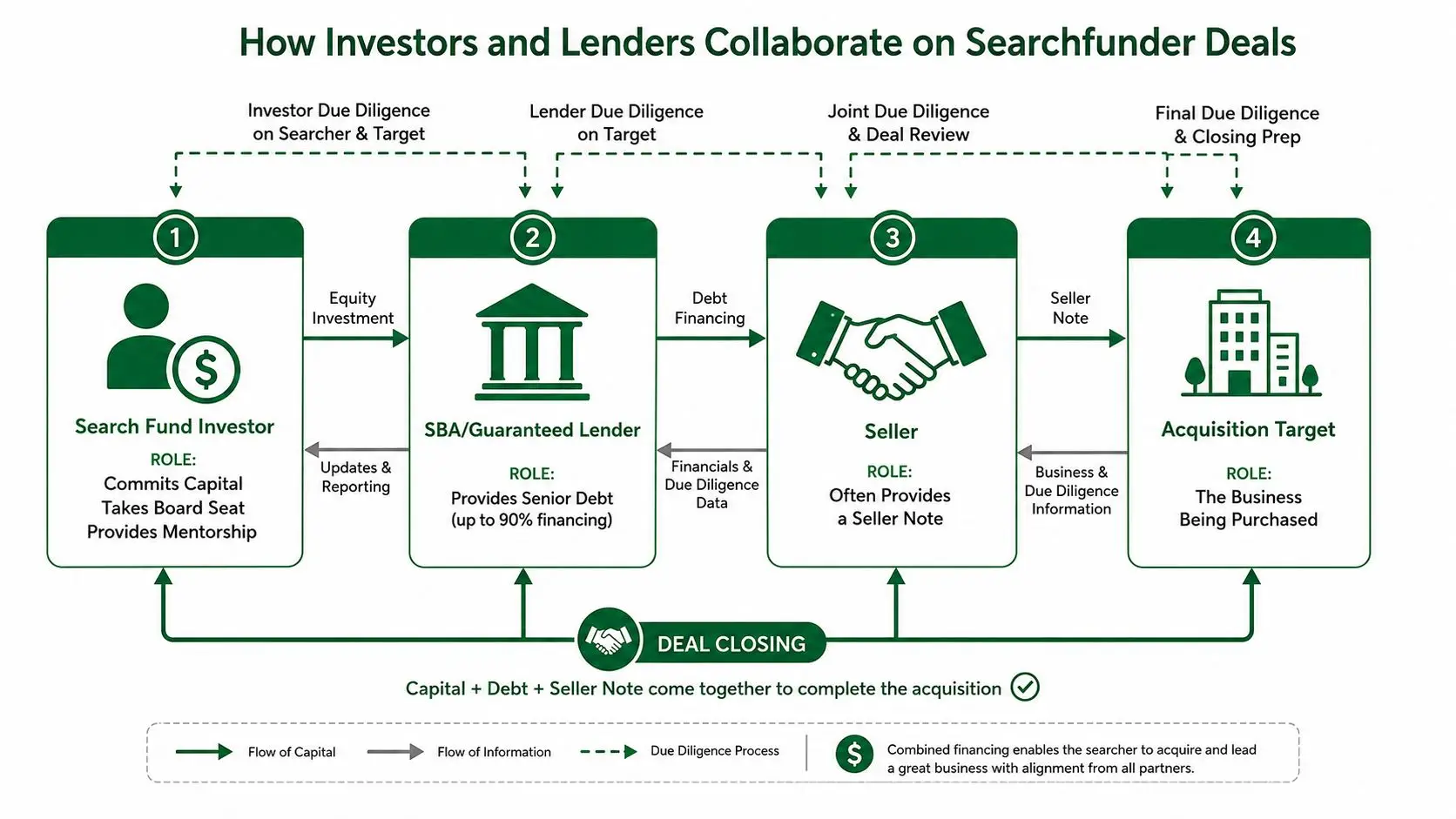
The fastest way to lose a search deal is to assume everyone on the cap table wants the same thing. They don't. Each party has a role, and the buyer who understands those roles keeps the process moving.
Each counterparty does a different job
Investors commit capital, take board seats, and provide advice and networks. Lenders underwrite and fund the senior debt, usually through the SBA channel. Brokers source and package deals, then help coordinate diligence and seller communications. Searchers do the work, finding the business, managing diligence, and operating it after close Searchfunder platform description.
That division of labor sounds obvious until a buyer starts treating investors like operational rescue capital. Neutral research from Yale says investors do not guarantee job security, source deals, run operations, or unconditionally fund acquisitions. They provide support, but they are not a backstop for every problem that shows up after signing CFA Institute blog.
The lender still sets the real underwriting bar
Here's the part many buyers miss. A strong investor syndicate does not replace SBA requirements. The lender still wants third-party valuation work, environmental reports when relevant, and projected financials that make sense. The capital structure can be elegant on paper and still fail if the diligence package is weak.
That's why the handoff has to be disciplined. Investor commitment letters help move the SBA application forward, but the searcher still has to carry the process through underwriting. If the seller's records are messy, or the business can't support the debt, no amount of optimism from the network will save the deal.
Direct advice: treat the lender as the judge of the financing package, not as the final checkbox after you've “gotten the deal done.”
Why Underserved Markets Are Not Always the Right Answer
A lot of search fund content repeats the same line, go find an overlooked market and buy a business nobody else is looking at. That can work, but it's not a strategy by itself. Sometimes a market is overlooked because it's attractive. Sometimes it's overlooked because it's too small, too fragile, or too dependent on one owner's personal relationships.
When the thesis works
Underserved markets make sense when the industry is fragmented, the owners are succession-ready, and the buyer can step in as a natural consolidator. That's especially true when the target lives in the EBITDA band discussed earlier, because a buyer can finance the deal and still have room to improve operations.
The upside shows up when no obvious PE buyer is bidding, the market is too local for a platform roll-up, and the business has clean recurring revenue. In that case, the searcher is solving a succession problem that the market has ignored.
When the thesis breaks
The thesis breaks when the market is too small to support a single acquisition, or when the business only looks cheap because the operating risk is ugly. If the company is overly owner-dependent, the transition can get messy fast. If the industry is structurally stagnant, the discount is probably there for a reason.
Use the screening rules from the earlier section as the test. If you don't see healthy margins, recurring revenue, and a believable scale path, “underserved” is just another word for underpowered.
The blunt lesson is this. Searchers don't win by romanticizing neglected markets. They win by buying businesses that can survive the owner transition and produce cash after closing.
Practical Playbook for First Time Search Funders
A first-time searcher who waits for “the perfect deal” usually misses the market. The essential work is volume and discipline. Most reviewed opportunities never become an LOI, so your process has to be built for repeat screening, not optimism Searchfunder offer guidance. If you are only looking at a few targets each month, you are not seeing enough quality to learn what good looks like.
Most buyers also focus on the seller before they have the financing stack ready. That is backwards. Written investor commitments come first, then a term sheet from an SBA-preferred lender, then diligence, valuation, and environmental work in parallel. If you wait until the end to line up the financing, you will lose time, and deals will slip.
Seller note structure gets mishandled constantly. If the note is not on full standby for the lender's required period, the lender can reject the structure or force changes that break the model. The seller note is not a side item. It sits inside the financing pillar, and it affects whether the acquisition can close at all.
Build the financing stack before you fall in love with the seller
Start with committed equity. Then get a lender term sheet in hand before diligence is nearly finished. Order valuation work and environmental reports alongside diligence, because those items can hold up or kill a close when they are left too late.
That sequence matters because SBA lenders do not finance enthusiasm. They finance a capital stack they can underwrite.
Use a real timeline, not a fantasy calendar
A clean SBA acquisition moves on a fairly tight rhythm. A searcher can often reach term sheet in about seven days, the financing side of closing can take 45 to 75 days, and the full acquisition often lands in 90 to 120 days after the LOI is signed. Plan for that pace from day one.
Several things kill deals again and again:
- Undercapitalized search: not enough committed equity before the LOI.
- Seller resistance: refusal to accept standby or note terms.
- Lender mismatch: trying to force a business through change-of-ownership rules it cannot meet.
- Delayed diligence: treating the SBA layer as a side task instead of a core workstream.
The lender still sets the strictest underwriting bar.
If you want the deal to survive, bring the lender in early and pressure-test the structure before you spend weeks on diligence. Searchers doing cross-border or multi-jurisdiction work should also study an investor in UAE guide when they are comparing capital sources, because the expectations around control, diligence, and close mechanics can differ sharply from a standard domestic search deal.
If you are comparing financing partners or want a lender-side advisor, GoSBA Loans is a practical option. It packages SBA loan requests, matches buyers with lenders, supports underwriting, and coordinates closing steps for acquisition deals. Use it as a process tool, not a crutch, and get the SBA conversation moving before the next LOI gets weakened by avoidable mistakes.
If you are serious about buying through search, do not wait until the deal is half-built to figure out financing. Bring the lender in early, test the seller note, and line up the capital stack before you spend weeks on diligence. Then use GoSBA Loans to keep the SBA side moving with the same discipline you expect from the rest of the deal.
