DSCR means Debt Service Coverage Ratio. In SBA lending, it's calculated as operating cash flow divided by total debt service, where 1.0 means your cash flow exactly matches your required debt payments, and a typical SBA lender wants at least 1.15x so there's a real repayment cushion.
If you're staring at a business deal right now and wondering whether the numbers are strong enough for approval, that ratio is probably the first thing underwriters will test. A borrower can have healthy sales and still fall short if there isn't enough cash left after operating expenses to cover debt, which is why DSCR often matters more than revenue alone.
Table of Contents
- Introduction What DSCR Means for Your Loan Approval
- What DSCR Really Measures and Why Lenders Trust It
- The DSCR Formula Variations and Calculation Details That Affect Your Result
- DSCR Worked Examples From Break Even to Bankable
- How SBA Lenders Interpret DSCR Thresholds and Headroom
- Common DSCR Pitfalls That Make a Passing Ratio Fail
- How to Improve Your DSCR Before You Apply
Introduction What DSCR Means for Your Loan Approval
A first-time buyer often runs into the same question. The business may look healthy on paper, the seller may say the cash flow is steady, and the broker may say the deal should work, but the lender still wants one number that shows whether the loan can stand up under pressure. That number is DSCR, the Debt Service Coverage Ratio.
Lenders use it because it turns a business story into a repayment test. They are not only asking whether sales are strong. They are asking whether the business generates enough operating cash flow to cover debt payments and still leave a cushion. That is why DSCR is a practical measure of repayment cushion, not just profitability.
For buyers, refinancers, and owner-operators, that difference matters. A deal can look fine until debt service, taxes, insurance, and operating costs are all on the table together. DSCR shows what remains after the business handles its everyday obligations, which is why lenders rely on it heavily in acquisition financing and owner-occupied real estate.
Practical rule: if the deal only clears the minimum by a sliver, treat it as fragile, not finished.
A better way to read DSCR is as a stress test with a built-in safety margin. In a commercial loan, cash flow can look adequate in a clean month and still feel tight once a repair, a softer sales period, or a higher payment enters the picture. Lenders want to know whether the business can keep paying when conditions are less ideal, not just when everything goes right.
That is where SBA guidance matters most, including the thresholds and repayment standards lenders use under SOP 50 10. For first-time buyers, that makes DSCR more than a textbook ratio. It is a lender's way of asking how much room the deal has if cash flow gets squeezed, especially after a refinance or acquisition changes the payment. The rest of this guide breaks down how the ratio works, how lenders calculate it, what SBA lenders look for, and how to improve your numbers before you apply.
What DSCR Really Measures and Why Lenders Trust It
A loan can look fine on paper and still feel tight once real life hits. DSCR helps lenders test that risk. It compares operating cash flow with debt service, so they can see whether the business can keep paying after the normal bills are covered. A 1.0 DSCR means cash flow and debt payments are equal. A 1.15 DSCR leaves a modest cushion, while 1.25 DSCR gives lenders more comfort. Chase's DSCR overview explains that basic logic well.
DSCR works more like a bridge's load rating than a simple pass or fail label. A bridge is not judged only by whether one car can cross it on a calm day. Engineers want to know whether it can handle extra weight, wind, and stress without failing. Lenders read DSCR the same way. They want to know whether the deal still holds together if expenses rise, sales soften, or the payment changes.
Why the cushion matters
That cushion matters because loans rarely stay in perfect conditions. Occupancy can drop, insurance can go up, a buyer may find the seller's numbers were optimistic, or a refinance may reset the payment in a higher-rate environment. A ratio above 1.0 tells the lender the business has room to absorb some strain and still pay on time.
This is also why DSCR fits so many types of deals. A restaurant, a service company, and a property-backed acquisition will not show the same revenue pattern, but the ratio gives lenders one clear way to judge whether cash flow is strong enough for the debt load. For borrowers comparing commercial real estate lending standards, this SBA commercial real estate requirements guide is a useful companion.
For first-time buyers, the main point is simple. Revenue alone is not enough, because revenue does not show what is left after operations and debt. DSCR does. That is why SBA lenders treat it as a stress-tested margin of safety when reviewing acquisitions and refinances, especially when they look at repayment standards under SOP 50 10.
The DSCR Formula Variations and Calculation Details That Affect Your Result
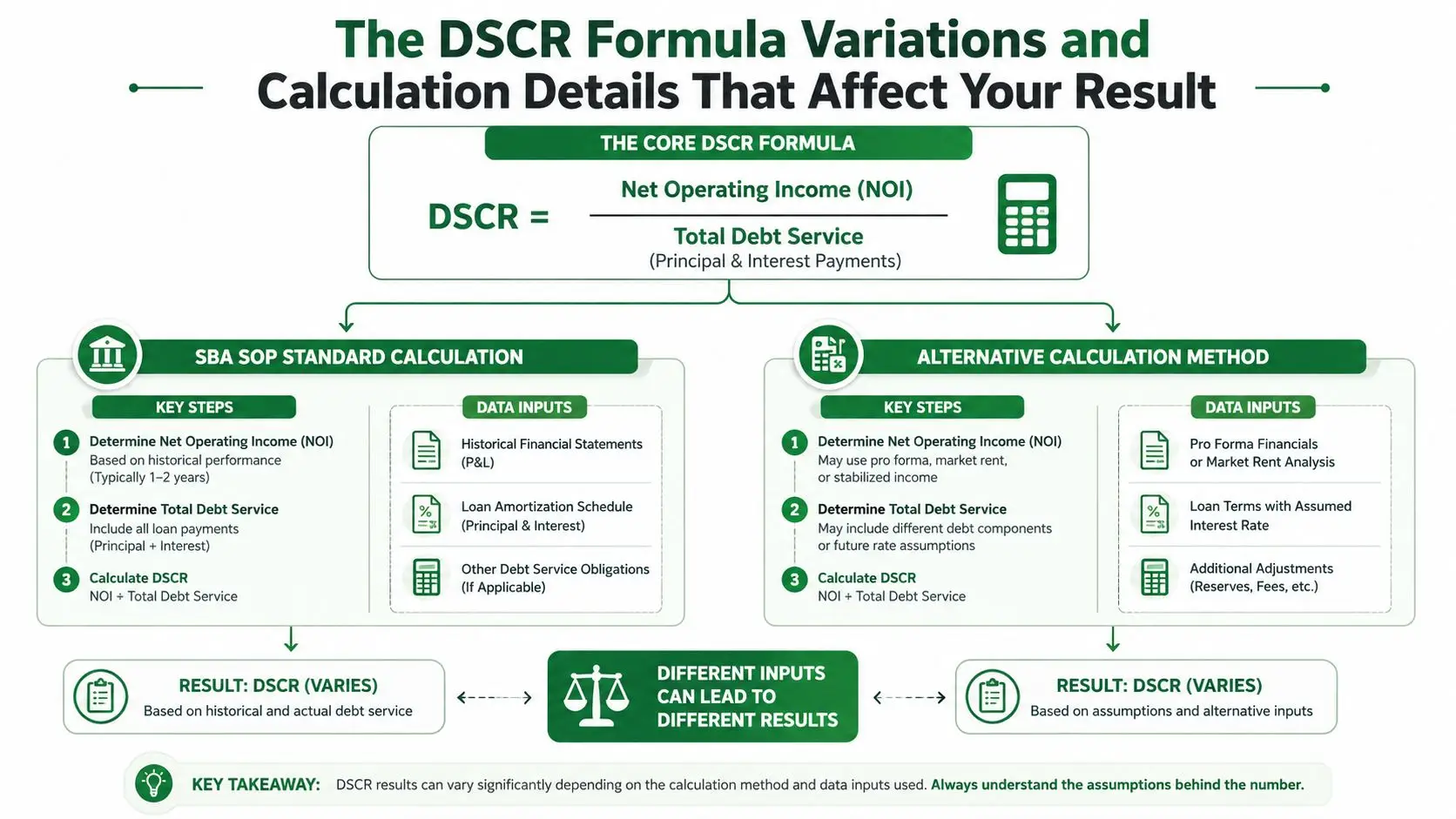
SBA underwriting uses a specific logic for DSCR, and the details matter. The metric is based on operating cash flow divided by debt service, but the exact inputs determine the result. In SBA guidance, debt service means the future required principal and interest payments on all business debt, including the proposed SBA loan proceeds, and the applicant's DSCR must be at least 1.15 on a historical and/or projected basis and 1:1 on a global basis. SBA SOP 50 10 07 is the core reference here.
That creates a common point of confusion. Two borrowers can look at the same company and produce different DSCR results if they use different cash flow definitions or include different debt items. One borrower may focus only on the new loan, while the underwriter is looking at all business debt. One model may rely on history, another on projections, and another on a blended view.
What changes the number
The biggest source of disagreement is the numerator. Some lenders and analysts use income measures that resemble net operating income, while others may adjust for owner add-backs, one-time expenses, or other underwriting adjustments. The denominator matters just as much, because debt service should reflect the actual principal and interest burden the business will carry. If a model leaves out existing debt, the ratio can look stronger than it really is.
Simple check: if your calculation doesn't include every required debt payment, it's not the number the lender will use.
The distinction between historical and projected DSCR also matters. Historical coverage shows what the business has already done. Projected coverage shows what it may do after the transaction closes. SBA lenders care about both because a deal can look fine on past numbers and still struggle once new debt is added. The projected view is especially important for acquisitions and refinance situations where the debt stack changes.
A good borrower-prep tool should let you test both versions before submission, which is why loan calculators and prequalification workbooks can save time. If you're building your own model, this SBA loan DSCR calculator resource is relevant because it reflects the same math borrowers need to understand before talking to a lender.
The main lesson is that DSCR isn't just a single formula, it's a calculation standard with choices inside it. If the inputs are inconsistent, the result will be inconsistent too. That's where many first-time buyers get surprised.
DSCR Worked Examples From Break Even to Bankable
The fastest way to understand DSCR is to see it on paper. The ratio is just cash flow divided by debt service, but the meaning changes a lot as the number moves from barely enough to comfortably above minimum. The table below gives three basic scenarios.
| Scenario | NOI Cash Flow | Annual Debt Service | DSCR Result |
|---|---|---|---|
| Break even | 100 | 100 | 1.0x |
| SBA minimum style pass | 115 | 100 | 1.15x |
| Stronger cushion | 130 | 100 | 1.30x |
In the first case, the business covers debt and nothing more. That can work on paper, but it leaves no room for pressure. One extra expense, one weak month, or one error in the projections could push the deal into trouble.
In the second case, the business produces enough cash flow to clear a common SBA-style minimum. That's better, but it's still not a wide cushion. A lender may approve it if the rest of the file is strong, but the deal can still feel tight if the business is seasonal, volatile, or exposed to rate changes.
In the third case, the borrower has more breathing room. That doesn't guarantee approval, but it gives the lender a more comfortable margin if the business comes in a bit below forecast.
What happens when the numbers move
If debt service rises or cash flow dips, DSCR falls quickly because the ratio is sensitive on both sides. A small increase in debt payments can compress a barely passing file, and a modest drop in operating cash flow can do the same. That's why borrowers should test the numbers under a slightly worse case, not just the best-case close.
A deal that only works at one exact assumption is a fragile deal.
Before you speak to a lender, run your own numbers with the same discipline the bank will use. If you want a structured worksheet to compare your deal against lender expectations, this SBA prequal workbook and DSCR calculator is a practical starting point.
How SBA Lenders Interpret DSCR Thresholds and Headroom
A passing DSCR can still feel tight. Lenders look at headroom, the extra cash flow above the minimum that keeps a deal stable if something changes after closing. A ratio that barely clears the line may satisfy the formula, yet still leave little room for a slow month, a rate increase, or a missed forecast.
SBA lenders do not read every deal the same way. Program rules set the floor, but underwriting judgment decides how much cushion a file really needs. Under SOP guidance, the applicant's DSCR must be at least 1.15 on a historical and/or projected basis, and 1:1 on a global basis. For standard SBA 7(a) loans above $350,000, the minimum DSCR requirement is 1.15x under SOP 50 10 8, while 7(a) Small Loans at or below $350,000 have a lower minimum of 1.10x effective March 1, 2026. SBA 7(a) DSCR threshold requirements by lender tier explains how those levels are applied in practice.
That floor is only the starting point. A lender still asks whether the business can absorb real-world strain after closing. Rate resets, lower occupancy, and seasonal swings can all narrow the cushion. How SBA lenders underwrite your deal shows how that review fits into the larger approval process.
Why headroom matters in refinance situations
Refinances deserve extra attention because the debt service can change quickly. A deal that looks fine on day one can tighten if the new payment is higher than expected or if rates move before closing. The lender is not just checking whether the file passes today, it is checking whether the payment still fits after pressure is applied.
Seller notes can also affect the equity side of the deal. SBA rules treat them carefully. A seller note used as equity injection must be on full standby for the life of the loan to count as equity, and even then it can cover at most half of the required injection. In a standard 10% injection structure, the standby seller note can contribute no more than 5% of total project cost. a detailed guide to SBA standby seller note rules explains the setup.
For borrowers, the goal is a ratio that still works after the deal gets tested. That is the difference between a thin pass and a file a lender can live with.
Common DSCR Pitfalls That Make a Passing Ratio Fail
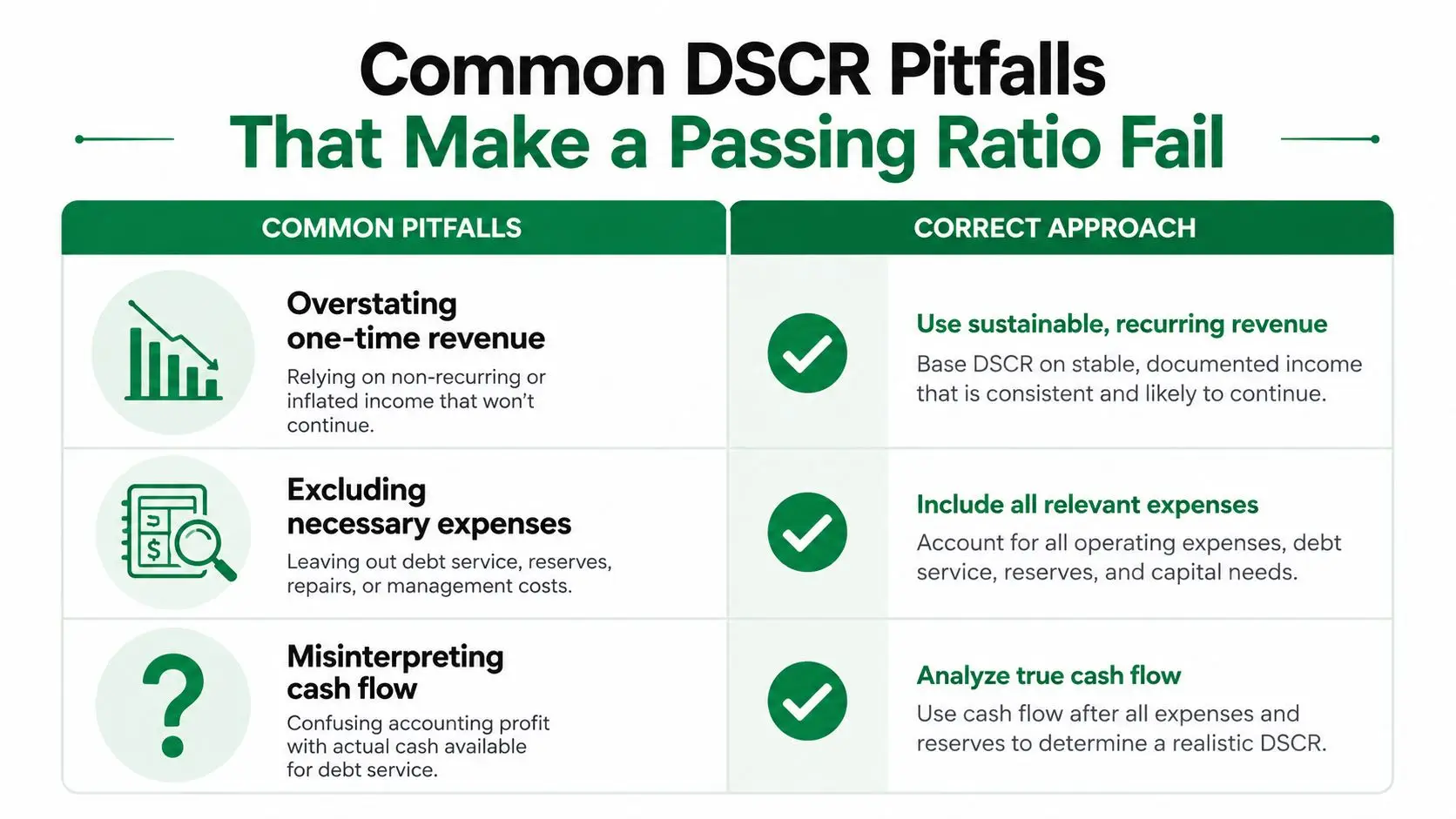
The most common mistake is treating DSCR like a revenue test. Revenue can be strong while cash flow is weak, and lenders care about cash flow because it pays debt. If the calculation starts from the wrong place, the ratio may look better than the actual underwriting result.
Another mistake is forgetting existing debt service. A borrower may model only the new SBA loan and leave out other business obligations, which inflates coverage. That's a problem because the lender is looking at the whole repayment picture, not just one note.
The traps that catch first-time buyers
- Overstating one-time revenue. A spike from a special project or unusual month doesn't belong in a durable repayment model.
- Excluding necessary expenses. If recurring costs are missing, the cash flow number is too flattering.
- Misreading partial-year results. A short operating period can look unusually strong or weak if it isn't normalized correctly.
- Ignoring seller note standby rules. A standby note isn't the same as cash equity, and the SBA treats it carefully.
- Assuming a thin pass stays safe. A 1.15x result can get fragile if occupancy slips or insurance rises.
The longevity of DSCR is part of why lenders are so strict about these details. It has been part of commercial and SBA underwriting for decades, and public reference material has documented its use since at least the early 2000s, with SBA-related guidance clearly discussing the 1.15 standard by 2014 and later. Investopedia's DSCR reference shows how established the concept has become in mainstream finance.
If the deal only works after generous assumptions, the lender will usually find that out before you do.
A barely passing ratio can still fail under stress because underwriting isn't judging the file at its happiest moment. It's judging whether the business can keep paying when things get less comfortable. That's why a careful borrower audits the calculation before the lender does.
How to Improve Your DSCR Before You Apply
Improving DSCR always comes back to one of two levers. You either raise operating cash flow or reduce debt service. Everything else is just a variation on those two moves.
If the business has room to increase recurring cash flow, start there. Tighten pricing where the market allows it, clean up expenses that don't directly drive revenue, and separate one-time noise from ongoing performance. Underwriters don't reward optimism, they reward repeatable cash flow.
On the debt side, lower required payments if you can. Paying down existing debt, refinancing terms, or avoiding unnecessary short-term obligations can make a measurable difference in the denominator. A strong borrower package also makes it easier for the lender to follow the logic of the deal.
A simple pre-application checklist
- Increase operating cash flow by improving net income or trimming recurring costs.
- Reduce debt service by refinancing expensive obligations or paying down balances.
- Document add-backs carefully so one-time expenses aren't mixed with recurring ones.
- Keep records consistent across tax returns, internal statements, and projections.
- Stress-test projections so you know what happens if rates rise or income softens.
If you're relying on add-backs, make sure they're documented cleanly. This SBA add-backs guide is useful for separating real operating performance from one-time adjustments lenders may review.
A seller note can help with structure, but only if it fits SBA rules. It can't be treated like a casual equity substitute, and it won't solve a weak cash-flow story on its own. The underwriting still circles back to whether the business can support the debt.
The best move before applying is to model the deal with realistic assumptions, not hopeful ones. If you can show solid coverage under a sober forecast, you're giving the lender exactly what they want, a business that can carry its obligations without strain.
GoSBA Loans helps business buyers, owners, and real estate borrowers model SBA loan numbers before they submit a package, including DSCR review, lender matching, and underwriting support. If you want a clearer read on your repayment cushion before you apply, visit GoSBA Loans and compare your deal against real SBA lending expectations.
