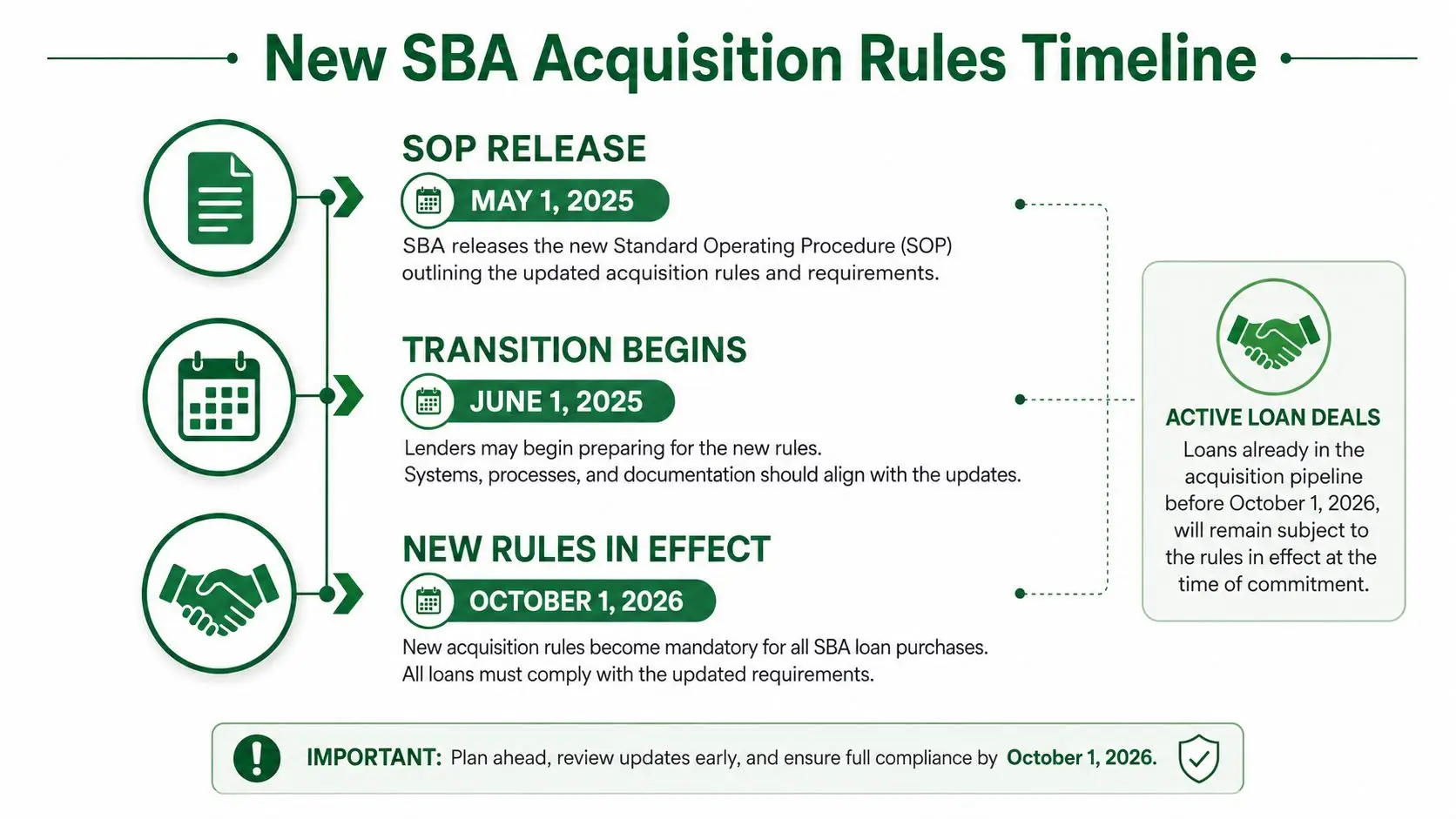
The new SBA acquisition rules took effect on June 1, 2025, restored the 10% buyer equity injection, capped seller standby notes at 5% of project cost, and the October 1, 2026 rule set raises acquisition DSCR to 1.25x on historical cash flow only. That means the deal that looks fine on projections can still fail when the SBA loan number gets assigned after the transition date.
Most buyers are still asking the wrong question. They're asking whether the rules are “harder,” when the core question is whether their deal survives the transition rule, the equity test, and the historical cash-flow test without a late-stage re-trade.
Table of Contents
- What Buyers Need to Know About the New SBA Acquisition Rules
- What Changed on June 1, 2025 Under SOP 50 10 8
- What Will Change on October 1, 2026 Under SOP 50 10 8.1
- Who the New Acquisition Rules Affect
- Deal Structures That Work Under the New Rules
- Checklist for Borrowers Brokers and Lenders
- Why These Rules May Favor Better Deals and What to Do Next
What Buyers Need to Know About the New SBA Acquisition Rules
The new SBA acquisition rules create two decision points, and missing either one can derail a deal late. SOP 50 10 8 has been in force since June 1, 2025, and it restored the hard 10% equity injection for startup projects and full changes of ownership while limiting seller financing that counts toward that equity to 50% of the required buyer injection, or 5% of total project cost at most. The June 2025 rule summary states that plainly, and buyers should underwrite to that floor, not treat it as a target.
SOP 50 10 8.1, effective October 1, 2026, changes the underwriting test again. Industry summaries say the SBA will require 1.25x DSCR for initial acquisitions, measured on historical or adjusted historical cash flow, not on optimistic month-one projections. That underwriting shift matters because a buyer can have a signed LOI, a lender package, and internal approval, then lose the deal once the SBA loan number is assigned on or after the effective date.
Why the transition rule matters more than the LOI date
The transition trigger is the SBA loan number assignment date. That is where late-stage deals get re-traded. A buyer deep in diligence can suddenly face a different rule set than the one the broker modeled at the start.
Underwrite the deal as if SOP 50 10 8.1 already applies if the SBA loan number will be assigned on or after October 1, 2026.
That is why file control matters. Use acquisitions workflow software to track when each file becomes exposed to the new standard, then lock the capital stack before the lender starts asking for revised cash-flow support. Keep the SBA loan to buy a business guide close as a process reference.
What Changed on June 1, 2025 Under SOP 50 10 8
June 2025 changed acquisition deals in three direct ways. The SBA brought back the 10% minimum equity injection for acquisition-style transactions, narrowed how seller notes count toward that injection, and forced buyers to rely on real cash instead of structures that only looked strong in the file.
Equity moved back to real money
Buyers can no longer fill most of the injection with seller paper or temporary flexibility. On a $2,000,000 acquisition, the buyer needs at least $200,000 in qualified injection. The seller note portion that can count toward that injection is still capped at 5% of total project cost, so the standby note can cover only part of the requirement. That structure is summarized here.
Standby means full-term standby
The seller note only counts if it stays on full standby for the entire SBA loan term. No principal. No interest. No partial standby that a lender hopes will pass review. Multiple summaries of the updated SOP describe this as a life-of-loan rule, not a short grace period.
The old 24-month mindset is gone. Industry commentary on the old versus new structure notes that the former standby window was shorter, while the revised rule requires standby for the full SBA loan life, usually around 10 years for a standard 7(a) maturity.
| Rule | Before SOP 50 10 8 | Effective June 1, 2025 |
|---|---|---|
| Buyer equity injection | Flexible pandemic-era treatment | 10% minimum for acquisition-style ownership changes |
| Seller standby note counted toward equity | Broader temporary use | Capped at 5% of project cost |
| Standby period | Shorter temporary standby | Full SBA loan term standby |
That change matters because seller paper is now support, not the plan. A broker who still builds the file around standby notes as the main source of injection will waste time and invite re-trades. Buyers need cash, clean source documentation, and a lender that can underwrite to the rule without trying to stretch it. For a practical look at how acquisition financing gets assembled, the SBA acquisition financing guide is worth keeping open while you model the capital stack.
What Will Change on October 1, 2026 Under SOP 50 10 8.1
The upcoming October 2026 change is about underwriting discipline. SOP 50 10 8.1 tightens acquisition deals by requiring 1.25x debt-service coverage based on historical or two-year average cash flow only, so buyers cannot rely on optimistic projections to make a weak target work. That is the core change described here, and it is the part many buyers still miss.
Projections stop doing the heavy lifting
If a deal only works because the buyer expects cost savings, cross-selling, or synergies after close, that story carries far less weight under the new standard. The SBA is pushing lenders to ask whether the business already produces enough cash flow, not whether the buyer can make it produce enough later. Buyers can still explain add-backs, but the support has to be documented and tied to the historical file, not wishful thinking.
That changes how you price and structure the deal. A file that clears on a projected basis but misses on trailing performance is a problem file now, not a closeable one. Expect more conservative pricing, more equity, and cleaner diligence.
Lenders will pre-underwrite to the harder number
Good lenders are already treating the 1.25x test as the number that matters on any file that could close after the October 2026 rule date. That is the right move. No lender wants committee approval on one standard and an SBA review under a stricter one.
Cash flow that is not already visible in the historical record will not clear the new coverage test.
For buyers, that means re-underwrite early. For brokers, it means killing fantasy deals before they burn a month of diligence. For lenders, it means stopping the projection fight before it turns into a closing-day reset. The SOP 50 10 8.1 guide is a useful reference if you want to pressure-test a file before it reaches credit.
| DSCR Factor | Prior SBA Standard | SOP 50 10 8.1, Oct 1, 2026 |
|---|---|---|
| Minimum acquisition DSCR | Lower historical standard described in industry summaries | 1.25x |
| Measurement basis | More room for projected support | Historical or two-year average cash flow only |
| Projection reliance | Often used to support approval | Not enough by itself if historical coverage fails |
Who the New Acquisition Rules Affect
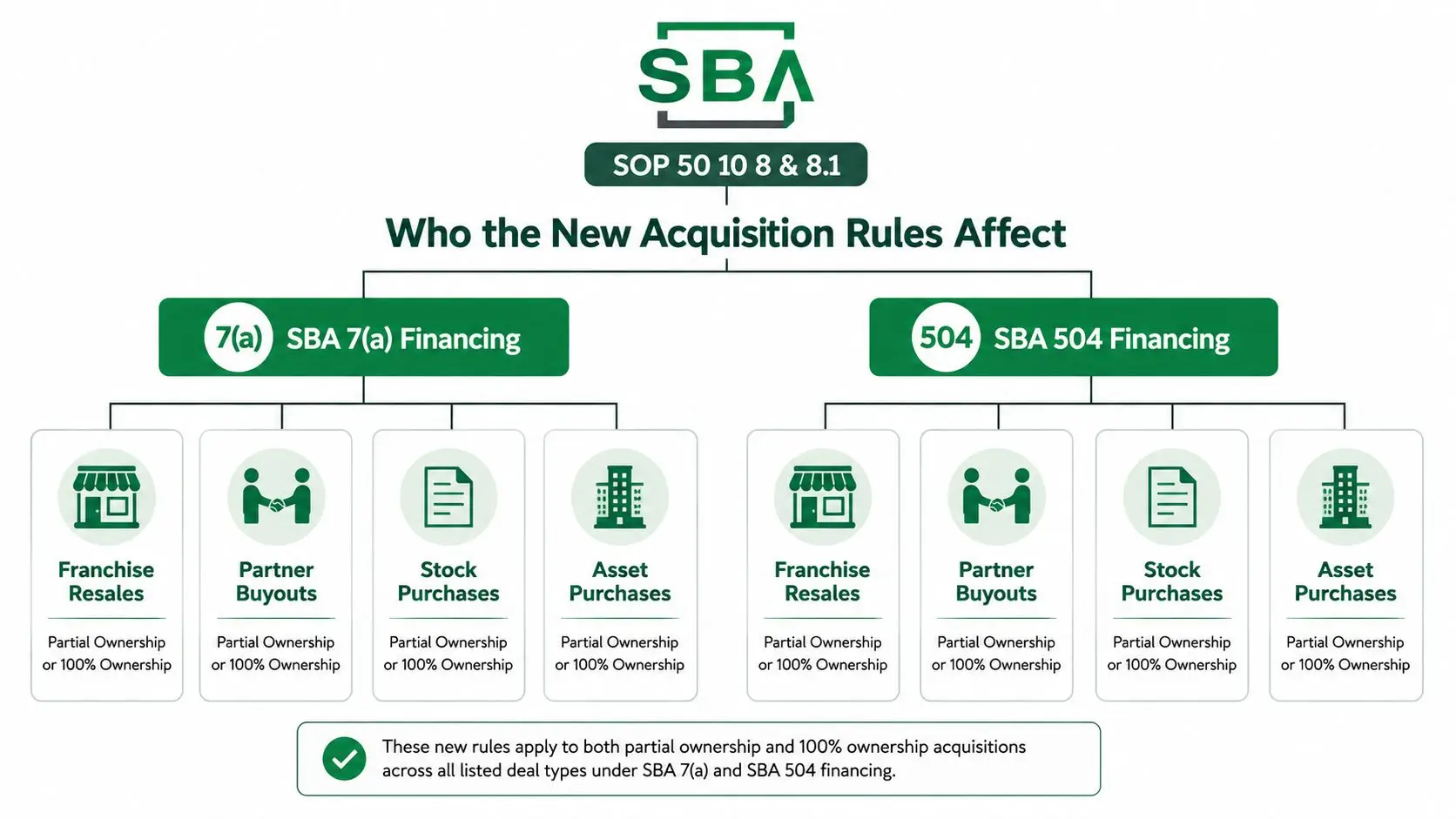
These rules reach more deals than many buyers expect. They apply to SBA 7(a) acquisition financing, and they also affect 504 structures whenever ownership changes, acquisition financing, or guaranty eligibility come into play. If the deal transfers control, the SBA will examine the capital stack and the borrower's real coverage.
The deals that need a fresh look
Owner buyouts are in scope. So are stock purchases, membership-interest acquisitions, asset acquisitions tied to a control transfer, and franchise resales. The 100% ownership and control rule for stock or membership-interest deals matters because partial control does not satisfy the eligible change-of-ownership framework for the proceeds. This stock-purchase summary is a useful reminder that the buyer has to receive all voting equity in the operating company.
The same logic catches hidden edge cases. A buyer who already holds a minority stake and rolls into the deal can be treated differently than a pure outside buyer, and retiring owners who want to leave some paper in place cannot assume that paper will fix the injection requirement. The seller-note cap is doing real work here.
Who is exempt or less affected
Refinancing without a change of ownership, working-capital-only requests, and debt restructuring do not carry the same acquisition-specific pressure. The transition issue is also much less of a problem where no ownership transfer occurs, because the SBA loan number date does not create the same acquisition-rule conflict. For buyers who want to compare financing paths, the US government investors database can surface related federal capital sources when SBA acquisition financing is not the cleanest fit. If citizenship is part of the file, review the SBA's citizenship requirement guide before you assume the borrower is eligible. Different capital sources solve different problems.
Deal Structures That Work Under the New Rules
The right structure under the new SBA acquisition rules is boring, and that is a compliment. It means the buyer brought real cash, the seller note is limited and properly standby, and historical cash flow already supports the debt. If the deal depends on heroic cleanup after closing, it is fragile.
A clean $2 million deal structure
Start with the version that clears underwriting without drama. On a $2,000,000 purchase, the buyer brings $200,000 of genuine equity, the seller puts $100,000 on full standby, and the rest of the stack is sized so the lender can defend historical coverage. That gives the lender a file that fits the current injection rule and keeps the seller note in its proper lane.
The primary concern is coverage. If the business only clears 1.15x on historical cash flow, projections will not save it. The lender has to repair the structure, usually by adding equity, reducing debt, or tightening the seller support so it stays within the SBA limits. If you are still modeling seller paper, seller note guidance is worth keeping close while you shape the stack.
Use the capital stack to solve the problem, not decorate it
The best acquisition files follow the same pattern. Buyer cash comes first. Seller standby paper fills a limited gap. The acquisition note stays sized to what the business can support. In some structures, a seller carryback still helps, but only if the note fits the SBA limits and the lender accepts the term and amortization profile.
A 504 file works differently, but the discipline is the same. The borrower injection has to be real, the project has to fit the asset mix, and the real estate side has to stay inside the program structure. Buyers leaning on property-heavy acquisitions should test whether a 504 path creates cleaner financing than forcing the whole deal through 7(a).
Broker rule: if the deal only closes after you fix the projections, it probably was not a strong acquisition to begin with.
| Source | Qualifying Deal | Marginal Deal |
|---|---|---|
| Buyer equity | 10% cash injection from non-seller funds | Less than required, or dependent on weak seller paper |
| Seller standby note | Up to 5% of project cost on full standby | Larger than allowed, or not full standby |
| Historical DSCR | 1.25x or better on real trailing cash flow | 1.15x and reliant on projections |
| Result | Defensible SBA structure | Re-trade, restructure, or decline |
For sellers and brokers modeling note-heavy transactions, keeping the stack realistic before term sheet day saves a lot of wasted negotiation.
Checklist for Borrowers Brokers and Lenders
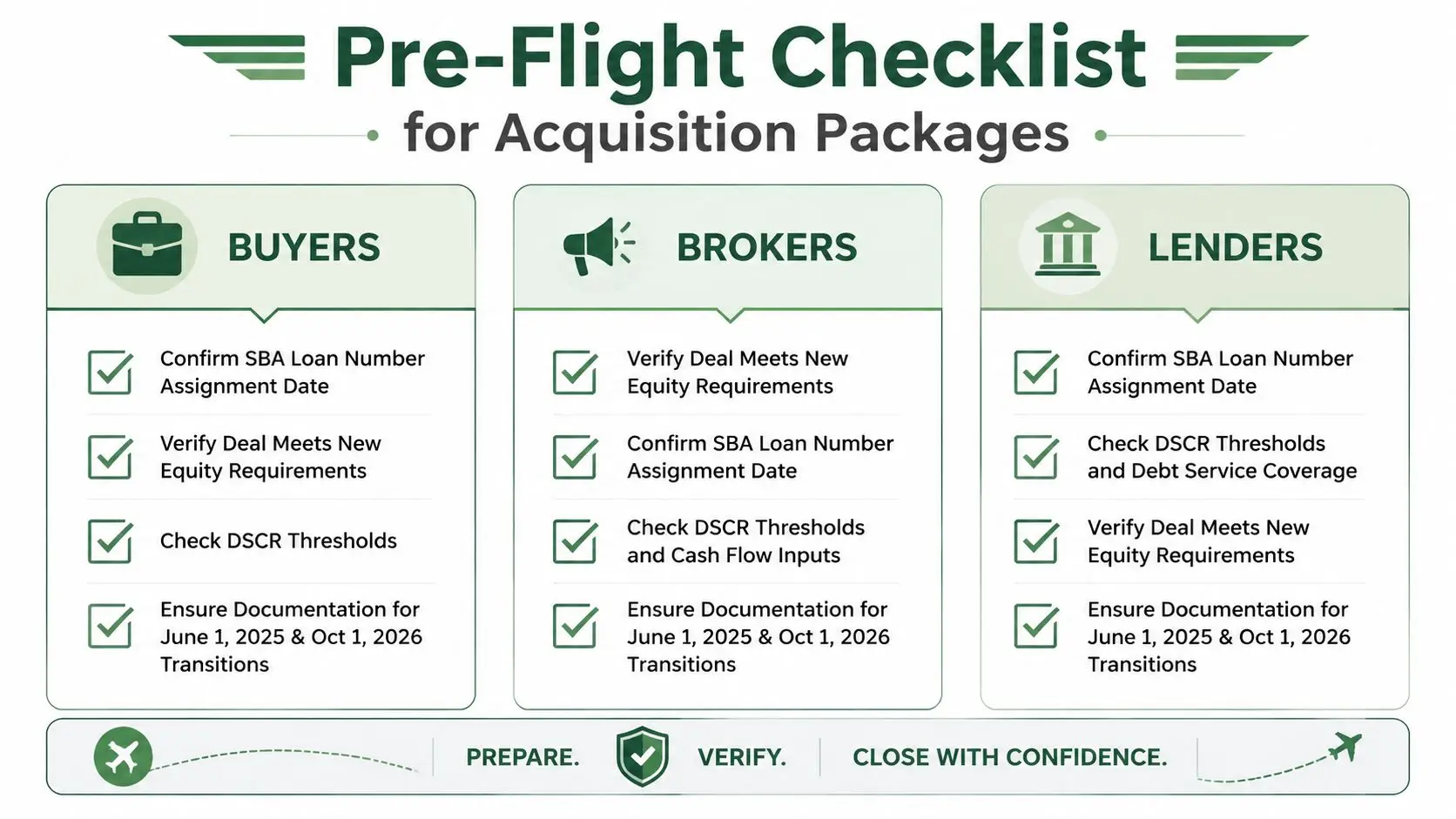
Treat every active file as if the lender will re-underwrite it under the stricter standard. Start with the loan number date, then confirm the buyer's cash source, then pressure-test historical DSCR. If any of those items are fuzzy, the deal is not ready for a final structure.
The pre-flight checks that matter
- Confirm the SBA loan number assignment date. If it falls on or after October 1, 2026, the tighter acquisition standard applies.
- Verify the equity source. The buyer's injection should come from non-seller funds, with seller paper counted only where standby rules allow it.
- Recalculate DSCR on history, not hope. Use the relevant historical basis and test the file against 1.25x.
- Document add-backs with tax support. If an add-back is real, it should tie back to the returns or accounting record.
- Match the program to the deal. A straight 7(a) acquisition and a real-estate-heavy 504 transaction need different underwriting treatment.
- Use a clean file checklist before submission. A focused SBA loan application checklist from GoSBA Loans keeps the package tight before it goes to committee.
A strong acquisition package starts early. Weak files get dragged into committee with thin support and then spend diligence trying to invent certainty. For a broader transaction lens, the 2026 M&A checklist guide is the right companion reference.
Why These Rules May Favor Better Deals and What to Do Next
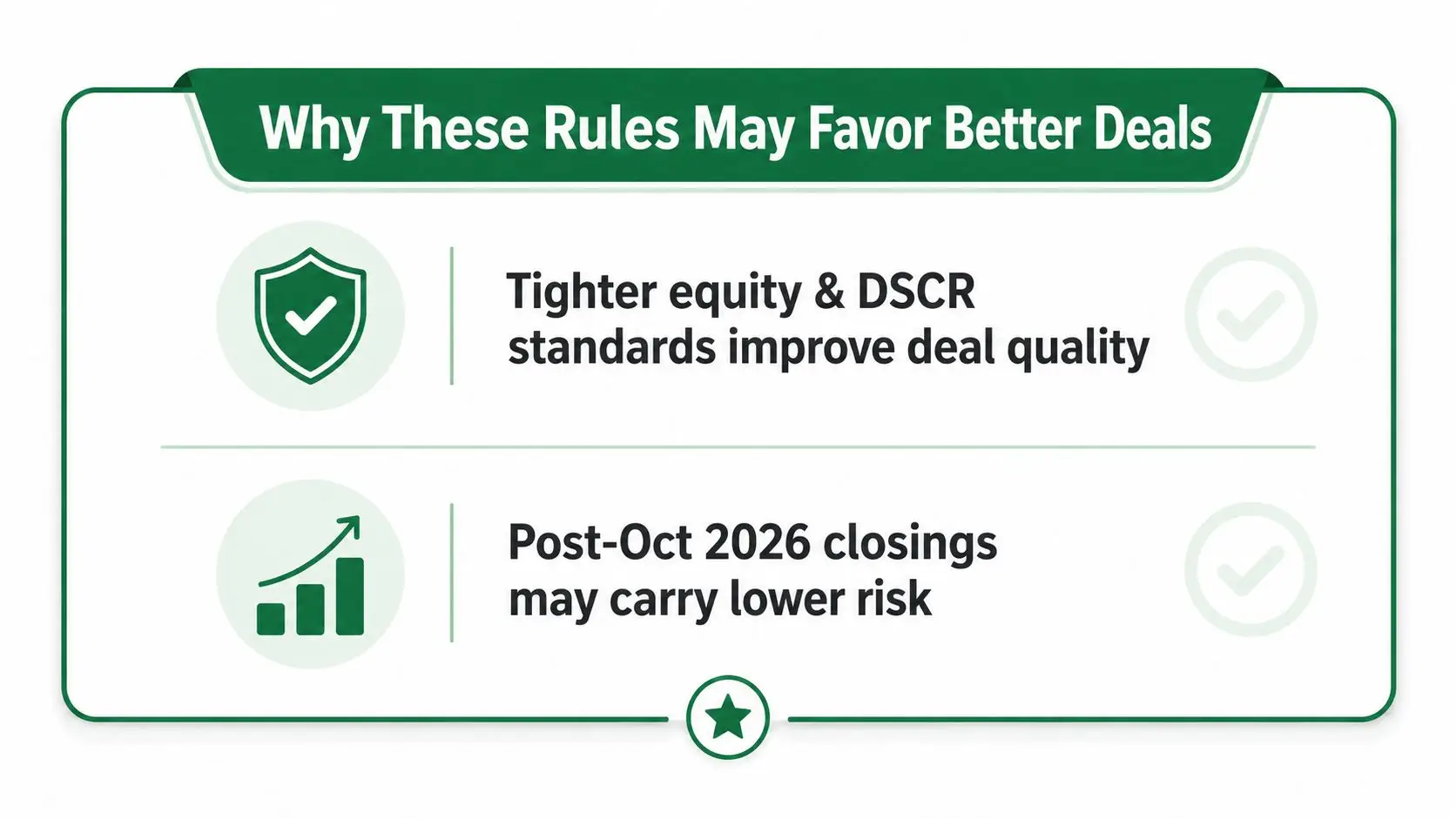
The contrarian read is the right read. These rules are painful for weak deals, but they're useful for good ones. Strong historical cash flow, conservative debt-to-equity ratios, and clean diligence now matter more than optimistic underwriting, which is exactly how a healthier SBA acquisition market should work.
Quality will matter more than cleverness
Tighter equity and DSCR standards filter out undercapitalized buyers and thin targets. That doesn't make acquisitions harder in every case, it makes sloppy structures harder. The businesses most likely to close after October 1, 2026 should be the ones with better trailing performance, cleaner add-backs, and lower default risk after closing.
Brokers will feel the pain first, because pipeline deals that depended on projection-heavy approval will get re-traded. Buyers with real liquidity will gain an advantage, because they can move decisively when a file is clearly fundable under the historical standard. Lenders will also have less reason to stretch.
What to do right now
- Pull the SBA loan number date for every active file today. If you don't know the assignment date, you don't know which SOP controls the deal.
- Run a historical-cash-flow DSCR recalculation on every 7(a) acquisition. If the file can't defend 1.25x, fix the structure or walk away.
- Stage buyer equity in a verified account early. Don't wait until the last week of closing to prove the cash is real.
If you want a clean read on whether your acquisition survives the June 2025 and October 2026 rules, GoSBA Loans can help map the capital stack, pressure-test the historical DSCR, and coordinate lender options before you lose time in diligence. Visit GoSBA Loans to review your file and see whether your deal still works under the new SBA acquisition rules.
