You can be deep into an SBA deal and still get stopped cold. The lender liked the borrower, the numbers worked, the acquisition made sense, and then underwriting hit a rule that never bends. That's the part SBA ineligible businesses aren't rejected because the deal is ugly, they're rejected because the program itself won't touch certain business types, ownership structures, or character issues.
That's why smart borrowers check eligibility before they spend money on packaging, appraisals, or third-party reports. The SBA's own lender guidance says the business must be small under SBA size requirements and not be a type of ineligible business. It also must be located in the U.S. and unable to get the same credit on reasonable terms from non-federal, non-state, or non-local sources, according to the SBA's lender-facing eligibility page (SBA lender eligibility guidance). If you fail the baseline screen, no amount of optimism fixes it.
Table of Contents
- The Moment You Discover SBA Is Off the Table
- The Core SBA Ineligible Business Categories
- How SBA Lenders Actually Verify Eligibility
- Real Examples of Businesses That Get Declined
- Character, Criminal, and Prior-Loss Screens That Catch Eligible Businesses
- A Self-Screening Checklist Before You Spend Another Dollar
- Financing Alternatives When SBA Is Closed
- Your Next Move Based on Where You Are Right Now
The Moment You Discover SBA Is Off the Table
The usual story goes like this. A borrower finds a target, signs the LOI, starts collecting tax returns, and assumes the SBA lane is open because the business is profitable and the bank seems interested. Then the lender asks one blunt question about the business model, the ownership chain, or a prior federal loss, and the file stops moving.
That stall is predictable. SBA eligibility is not a soft judgment call, it is a hard screen. Lenders are required to check the exclusion rules in 13 CFR 120.110 before they waste time underwriting a deal that cannot close (13 CFR 120.110). A business can show strong revenue and still be dead on arrival if the structure, ownership, or activity falls into a barred category.
Practical rule: if you need a waiver, an exception, or a creative argument just to get past the first eligibility screen, the SBA route is already slipping away.
The first job is to identify whether the business itself is excluded. The second is to check whether the ownership chain, character issues, or revenue mix creates a hard stop. The third is to decide whether a different capital structure makes more sense before anyone spends another dollar on SBA packaging.
A broker who knows this screen does not guess. They start by checking the business model against the SBA requirements, then they look at ownership and prior-loss issues, and only then do they decide whether the file belongs in an SBA lane or belongs somewhere else. For a straight reference point on the basic requirements, use this SBA loan requirements guide. Running the eligibility screen first prevents wasted spend on packaging a file the program will not touch.
The Core SBA Ineligible Business Categories
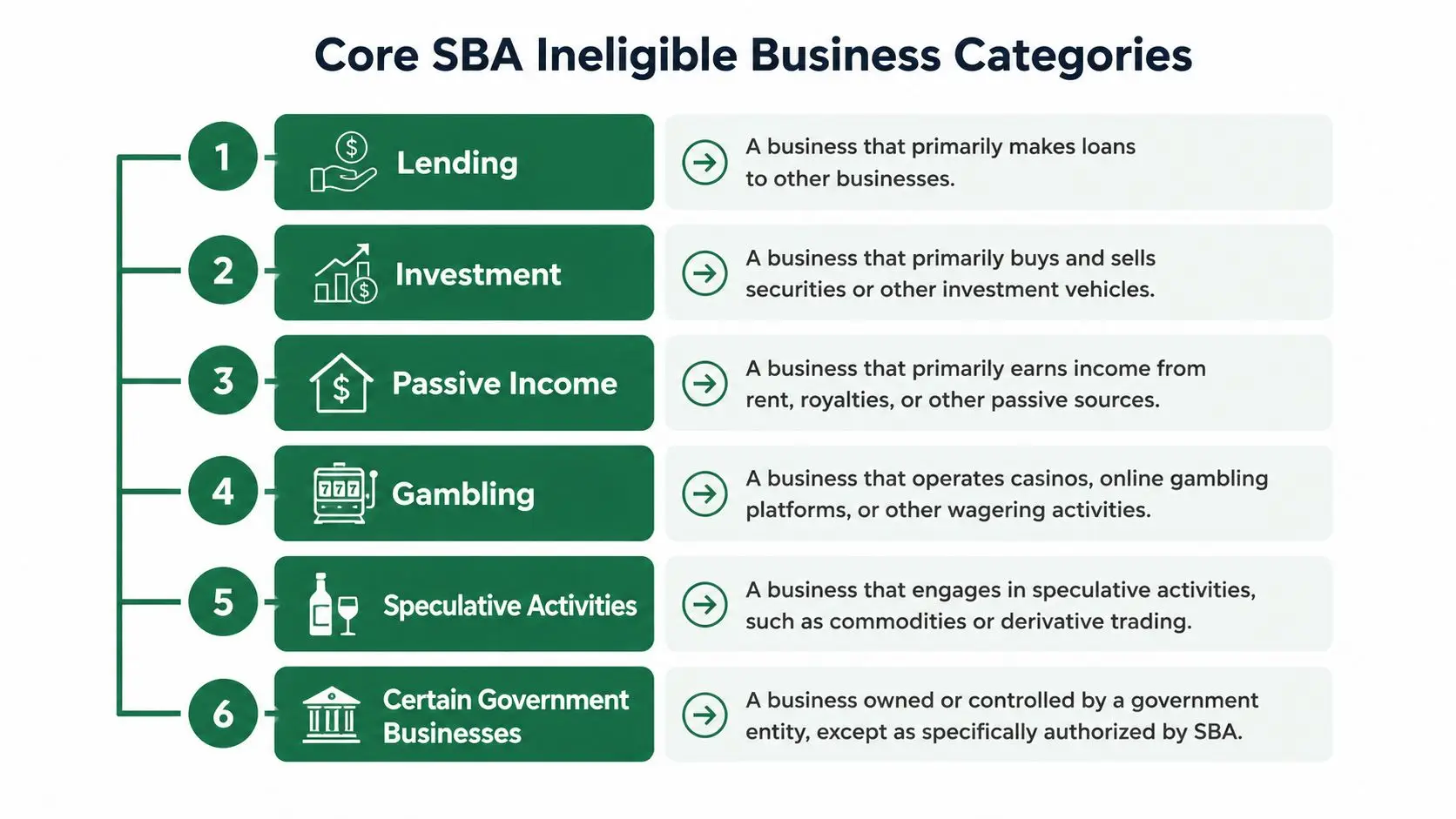
Borrowers often assume the SBA only rejects obviously risky deals. That is wrong. The agency draws hard lines around specific business types, and lenders have to spot those lines before they spend time on full underwriting. If the company falls into one of those excluded categories, the SBA path is closed.
The categories that trigger an automatic stop
A non-profit does not qualify. If the applicant is not operating for profit, the SBA will not back the loan. A financial business primarily engaged in lending is also out, so a firm whose main business is making loans to others cannot use SBA financing.
A passive business owned by landlords or developers is another common trap. The classic example is a holding company that collects rent or holds property without real operating activity. A life insurance company is excluded too, along with any business located in a foreign country.
Foreign ownership structures can still create trouble even when the operating company looks domestic on paper. Lenders care about the entity itself, where it is organized, and how the ownership chain is built.
The rule also excludes pyramid sale distribution plans, businesses deriving more than one-third of gross annual revenue from legal gambling activities, businesses engaged in any activity illegal under federal, state, or local law, government-owned entities, and loan packagers earning more than one-third of revenue from packaging SBA loans.
Why the gambling rule matters
The gambling exclusion uses a quantitative threshold. Once more than one-third of gross annual revenue comes from legal gambling, the business is ineligible. Lenders will ask for enough revenue detail to see whether that line has been crossed.
That matters because the SBA screen is not limited to the business description. Underwriters also look at the entity, the ownership structure, and the revenue source mix before they decide whether the file can stay in the SBA lane.
If you are still trying to figure out whether your deal belongs in that lane, use a plain-English SBA loan requirements guide before you spend money on packaging.
How SBA Lenders Actually Verify Eligibility
SBA lenders do not wait until the end of underwriting to find an ineligible business. They screen for it early because a file that fails a hard rule wastes time for everyone involved. Strong cash flow does not rescue a borrower that is off-limits.
What gets checked first
The lender starts with the basics, whether the applicant is an operating business, whether it is located in the U.S., whether it is small under SBA size requirements, and whether it is not an ineligible business (SBA lender eligibility guidance). Then the lender reviews the ownership chart, the revenue mix, and the activity description to see whether any exclusion applies.
Associates matter here. If an associate has a disqualifying legal issue, a prior-loss issue, or another ownership conflict, the lender does not brush it aside because the business has good cash flow. The underwriting team asks for ownership documents, background details, and enough clarity to confirm who controls the company and what each person brings to the deal. That review usually runs through the lender's delegated underwriting process, which is why brokers compare the file against a practical guide to how SBA lenders underwrite a deal before they spend time packaging it.
Bottom line: eligibility is a gate, not a scoring model. You do not outscore a disqualifier.
Why delegated lenders still say no
Preferred Lender Program participants still have to follow the same rules. Delegated authority changes process, not law. A PLP lender can move faster on documentation and approval mechanics, but it cannot approve a borrower that fits an excluded category under the SBA's rules.
The practical effect is simple. If the business model raises a hard question, the lender either declines it or asks for enough proof to remove the doubt. If the doubt remains, the file dies. When a question is borderline, lenders slow down and escalate instead of pretending the issue is not there.
For deeper packaging expectations, brokers usually compare the file against an SBA application checklist and the lender's underwriting stack, not just the borrower's operating story. That is where the deal stays clean or gets exposed.
Review the SBA loan application checklist before you submit a file.
Real Examples of Businesses That Get Declined
These deals fail in plain sight once an SBA lender starts underwriting. The business may look legitimate on the surface, but one line in the revenue mix, ownership structure, or operating model is enough to end the process. Brokers see the same pattern over and over. The file gets screened, the issue gets confirmed, and the answer becomes no.
Gambling revenue crosses the line
A bar and grill operator with slot machine income can run into the gambling rule fast. If legal gambling activity produces more than one-third of gross annual revenue, the business is ineligible under 13 CFR 120.110. The lender will not spend time arguing with clean math.
The usual outcome is a straight decline. If the borrower still needs capital, the file often moves to conventional lending, equipment finance, or a structure that does not depend on SBA eligibility. Borrowers in volatile revenue businesses also get screened against broader underwriting risk, and this SBA default-rate breakdown by industry gives useful context, even though eligibility and default risk are separate screens.
Passive real estate ownership gets flagged
A holding company that owns rentals but does not actively operate a business gets caught by the passive-business rule. Property ownership alone is not the issue, the lack of active operating substance is what triggers the passive-business flag. If the lender sees a landlord-style entity instead of an operating company, the file gets flagged.
That structure looks fine to a founder and dead on arrival to an SBA underwriter. The borrower's next move usually means conventional real estate debt, a different entity structure, or active operating income that changes the eligibility picture.
Foreign-country operations create trouble
An e-commerce seller routing part of the business through a Canadian subsidiary can trigger the foreign-country rule. The SBA exclusion is aimed at businesses located in a foreign country, but the lender will look hard at where the operating activity sits. A holding structure that looks domestic on one page and foreign on another is a red flag.
The problem here is jurisdiction. Once the lender decides the eligible operating business is not really the applicant, the deal slows or stops.
Prior SBA loss can poison a purchase
If a buyer is acquiring a business whose seller previously caused a federal loan loss without a waiver, the eligibility issue can follow the deal into underwriting. The lender will ask whether the loss has been resolved, waived, or documented. If not, the application can stall hard.
A non-profit community development corporation is simpler. It is not eligible. If the entity is not operating for profit, SBA financing is not available. That is a program rule, not a judgment on mission.
Public-record checks can surface character issues fast
Some files fail for reasons that never show up in the operating model. A clean business can still hit a wall if an owner, officer, or other associate raises a character issue during review. Lenders run these checks early because they know one unresolved problem can kill the deal after months of work.
That is where public-record screening matters. A lender can surface issues through court filings, federal debt history, and Sex-offender registries, then decide the file is not worth pushing forward. Strong revenue does not fix a bad character screen. Eligibility and default risk are separate screens, and a strong default profile does not override a hard exclusion rule.
Character, Criminal, and Prior-Loss Screens That Catch Eligible Businesses
The hardest files aren't always the obvious ineligible industries. A perfectly normal operating company can still fail because of who's involved or what happened before. A lot of borrowers get blindsided this way.
The associate screen is a real gate
Under SBA policy, a business is ineligible if an associate is under indictment or incarcerated for certain crimes, if the business previously caused a federal loan loss without a waiver, or if it is engaged in illegal, political, lobbying, or speculative activities (Cornell's text of 13 CFR 120.110). That's a hard screen. Strong revenue does not cure it.
An associate isn't just the signer on the loan. It can include people tied closely enough to the company that their conduct matters in the eligibility review. Lenders usually dig into ownership history, control rights, and federal debt status early because they know one unresolved issue can block the whole file.
Waivers are not a strategy
Waivers exist, but borrowers shouldn't build a deal around hoping for one. If the prior federal loan loss is the issue, the lender will want documentation, context, and proof that the loss doesn't bar the transaction. If the underlying facts are messy, the waiver path gets slow and uncertain.
If a background issue is involved, borrowers should also understand where public-record checks can surface. For example, a resource like Sex-offender registries is one of several places a diligence team may use to confirm a person's record status when the loan file requires a full character review.
A waiver is a rescue tool, not a plan. If your file needs one, expect delay.
The practical lesson is blunt. Character screens are binary. A lender can love the deal and still refuse it because the file has a disqualifying person, a prior loss without a waiver, or an activity mix that fits the exclusion list. That's why brokers press for full disclosures before they package anything.
A Self-Screening Checklist Before You Spend Another Dollar
Before you spend money on packaging, run the file through a hard yes-or-no test. Do not ask whether the deal is attractive. Ask whether the business is eligible.
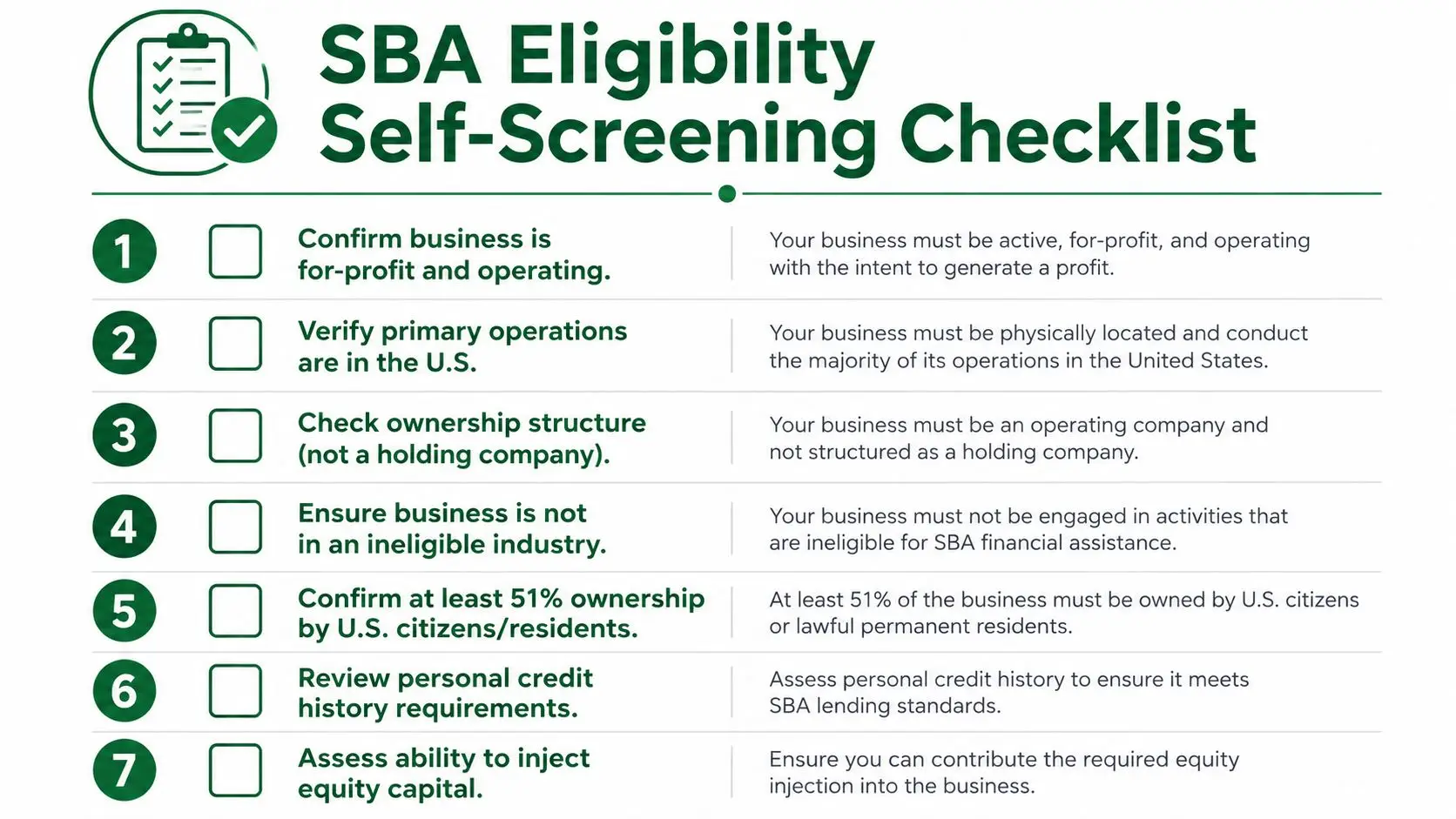
Seven questions to answer now
- Is the business for-profit and operating? If it is a non-profit or just a shell, stop there.
- Is the primary business located in the United States? If the operation is abroad, SBA financing is usually off the table.
- Is the ownership structure active, not passive? If it is only a holding company collecting income, that creates a problem.
- Does any revenue come from an excluded activity? If gambling or another excluded line is part of the mix, the lender will measure it closely.
- Is the business clearly outside excluded industries? Lending businesses, pyramid plans, and similar categories do not qualify.
- Does any associate have a disqualifying character or prior-loss issue? If yes, stop and clean that up before you pay for a package.
- Are there foreign-ownership or foreign-operation flags anywhere in the structure? If the answer is unclear, the lender will treat it as a risk.
A quick file review usually exposes the truth. Compare the entity documents, tax returns, and ownership chart against the lender's checklist. If the story changes from one document to the next, the underwriter will catch it fast. That is how a file that looks workable on the surface gets shut down.
Use the SBA application checklist as the packaging benchmark before you call a broker. A clean file usually shows itself. A bad one does too.
If a criminal record issue is part of the picture, a cleanup resource such as the georgia criminal record expungement guide can help you see whether the problem is fixable before you waste time on financing.
Financing Alternatives When SBA Is Closed
When the SBA door is shut, stop trying to force it open. The right alternative depends on what the business needs, how fast you need the money, and what assets or cash flows you can pledge.
Match the capital to the problem
If you need a plain-vanilla working capital loan and the business is bankable, conventional bank term loans or lines of credit can work. They're usually the cleanest substitute for borrowers who don't fit SBA rules but still look strong to a local bank.
If the business has predictable receivables or inventory, asset-based lending can fit better than unsecured debt. That structure puts the lender behind the collateral, not behind the SBA guarantee, which is exactly why it still works for some ineligible borrowers. Equipment financing is also a strong fit when the purchase is tied to hard assets rather than general business goodwill.
For acquisitions, seller financing often becomes the pivot point. A seller note can replace part of the SBA loan and make a deal bankable even when the buyer or target doesn't fit the program. You can also pair it with conventional debt or investor capital if the valuation and cash flow support the structure.
When the deal is more of a growth story
Revenue-based financing fits businesses with recurring revenue and a tolerance for faster amortization tied to collections. Private equity, search-fund capital, and mezzanine-style structures fit buyers who can tolerate higher cost in exchange for closing certainty and speed. That's not cheap money, but it's often the only money available when SBA is closed.
For founders looking at growth capital outside a government program, fundraise without venture capital is a useful way to think about non-SBA capital paths that don't depend on venture funding.
GoSBA Loans also packages SBA-compliant deal structures and can advise on seller notes, but if the business is ineligible under the program, that's not the lane. In that case, use the right non-SBA structure and move on.
See how seller financing works in acquisition deals.
My opinion is simple. If the issue is gambling revenue, passive ownership, or a foreign structure, start with seller financing or conventional debt. If the issue is collateral-rich equipment or invoices, use asset-based or equipment financing. If the business has strong recurring revenue but fails SBA for structural reasons, revenue-based or mezzanine capital may be the cleaner fit.
Your Next Move Based on Where You Are Right Now
If you haven't applied yet, stop guessing. Run the self-screening checklist, then get a broker or attorney involved if any item is unclear. That's cheaper than packaging a file you already know is shaky.
If you already applied and got declined for an ineligible-business reason, don't burn weeks chasing a waiver that probably won't change the underlying fact pattern. Pivot to conventional or alternative financing and keep the transaction alive.
If you're mid-deal and the seller keeps pushing SBA, pressure-test the structure now. Sometimes the business is fine, and the entity setup is what's broken. Sometimes the structure is fine, and the business itself is outside the program. Either way, don't keep feeding a dead file.
If you're buying a business with a seller who has a prior SBA loss, pull the SBA history early and assess waiver odds before you commit. That issue can surface late and ruin a deal that looked ready to close.
Ineligibility usually isn't the end of the road. It just means the SBA route is closed, and the right capital structure has to do the work instead.
If you're stuck on whether an SBA file is ineligible, GoSBA Loans can help you pressure-test the deal structure, identify the issue fast, and point you toward the financing path that fits. Visit GoSBA Loans to review your situation and move forward with a clearer capital plan.
