Debt refinancing replaces an existing loan with a new one, and it only makes sense when the new loan gives you a real cash-flow win after fees, prepayment penalties, closing costs, and any longer term. In the low-rate boom, U.S. mortgage refinance originations reached about $2.8 trillion in 2021, then fell hard as rates rose, with Freddie Mac reporting only $75 billion and $80 billion in refinance originations in Q1 and Q2 2023, respectively, the lowest quarterly volumes since 1995 after inflation adjustment. Those numbers tell you the whole story, refinance is not a magic trick, it's a math problem.
A borrower usually starts looking at refinancing when the current payment feels out of step with reality. Maybe the note is chewing up monthly cash, maybe a fixed rate looks old and expensive, or maybe the debt stack doesn't fit the business anymore. In practice, a refinance is about swapping an old obligation for a new one to change rate, term, collateral, or payment structure, not just about “getting a new loan” for the sake of it. The hard part is deciding whether the swap improves the business.
Table of Contents
- What Is Debt Refinancing and Why Business Owners Care
- How Debt Refinancing Actually Works
- Common Types of Business Debt Refinancing
- The Break-Even Test and Hidden Cost of Refinancing
- SBA Refinancing Rules Every Borrower Should Know
- Two Refinance Stories From Real Small Businesses
- Eligibility, Step-by-Step Process, and How a Broker Helps
- Frequently Asked Questions and Your Next Step
What Is Debt Refinancing and Why Business Owners Care
A restaurant owner staring at a balloon payment has one question, not ten. Can this debt be reshaped so the business breathes again, or is the refinance just a prettier version of the same problem? Debt refinancing is the replacement of an existing loan with a new one, usually to improve terms, stretch maturity, or reset repayment structure. That's the working definition that matters when cash is tight.
Refinancing is often confused with adding more debt. It's not the same thing. A refinance pays off the old obligation and replaces it, while a second loan or top-up usually layers on new debt without extinguishing the original instrument. If you want a broader comparison of funding choices, debt vs equity for banks is a useful framing piece because it shows how lenders think about repayment and control.
Practical rule: If the new loan doesn't lower stress, improve runway, or clean up a broken debt structure, it's probably not worth doing.
Business owners should ask three questions before they chase a refinance. First, does the deal clear the break-even point after fees and penalties. Second, does it fit the program or lender rules that control approval. Third, will the new payment help cash flow, or just move the pain farther down the road?
GoSBA's own debt refinancing guide is useful here because it pushes the conversation away from rate-chasing and back toward execution. That's the right order. Most bad refinances happen because someone focuses on the headline rate and ignores the full cost of changing loans.
A refinance can be smart, but only if it solves a real problem. If the current debt is tolerable and the new one only looks cheaper on paper, you're not getting a solution. You're buying a reset button.
How Debt Refinancing Actually Works
Refinancing works by using the proceeds of the new loan to pay off the old one. Once that happens, the old instrument is extinguished and the new terms take over, including the rate, amortization, collateral package, and covenant set. That legal reset matters because a refinance is not just a bookkeeping move, it changes how the debt exists on the balance sheet and how the lender underwrites it.
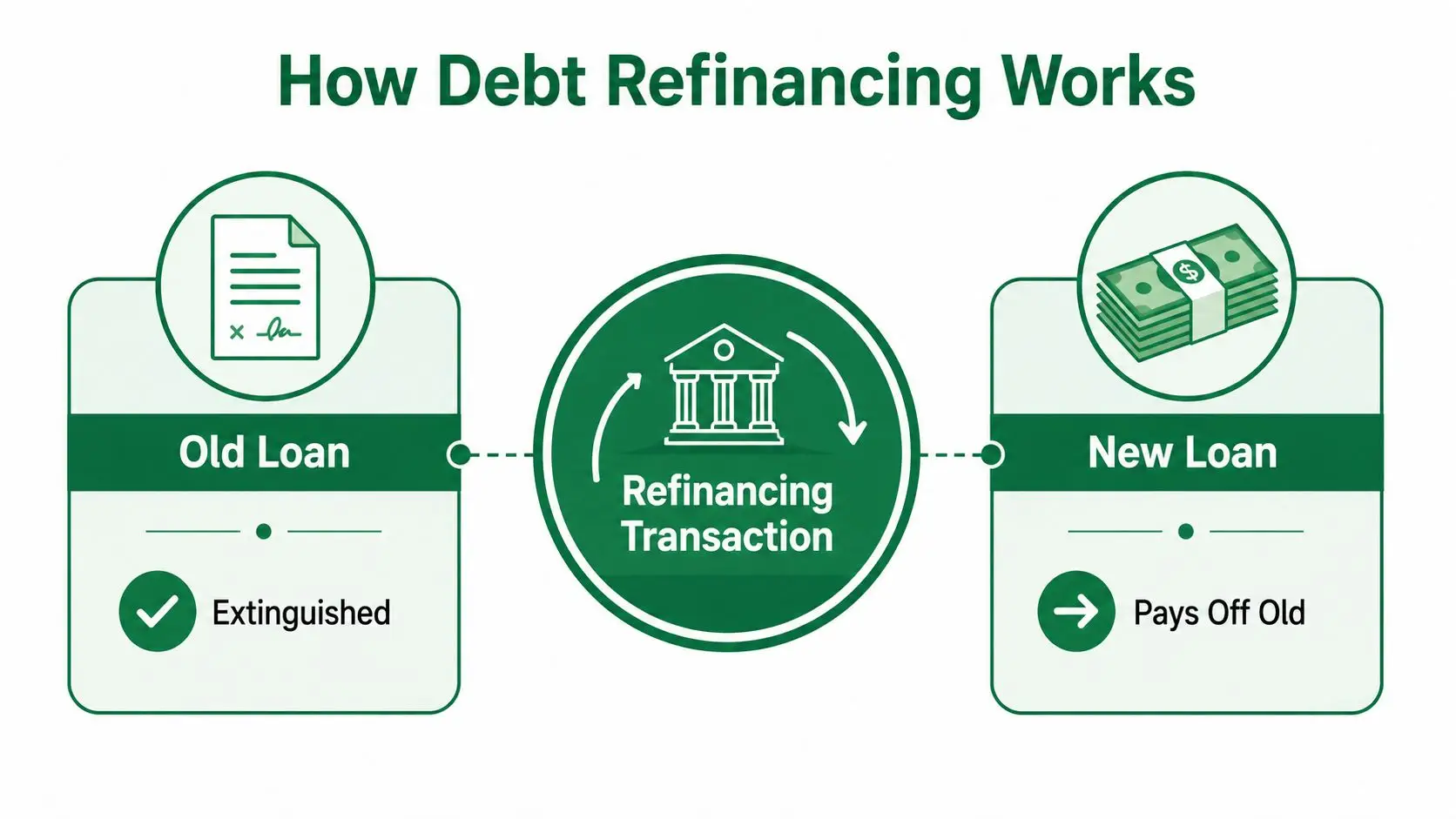
A second lien is different. A top-up loan leaves the original obligation alive, while the refinancing structure replaces it. That distinction is why accountants, tax advisors, and lenders treat refinances carefully. The IMF's debt reorganization guidance describes refinancing as replacing the original debt instrument, including arrears, with new instrument(s), and UN ESCWA treats a change in debt terms as creation of a new instrument and extinguishment of the old one, which is the cleanest technical way to think about it. IMF debt reorganization guidance
The three situations that drive most refinances
An owner usually lands here for one of three reasons. The first is opportunistic rate shopping, where the market offers better pricing and the borrower can lock it in. The second is balance-sheet cleanup, where several obligations get rolled into one cleaner payment.
The third is the ugly one, survival refinancing. That's when a business has debt maturing into a tougher market and needs new financing just to keep operating. Deloitte's ASC 470-10 guidance makes the liquidity side of this very clear, because long-term classification of a short-term obligation depends on demonstrated intent and ability to refinance, often with commitments or facilities that satisfy specific criteria. Deloitte ASC 470-10 refinancing arrangements
Owners get themselves in trouble. They assume all refinancing is elective, but some refinances are forced by timing, covenant pressure, or maturity walls. If you can name which bucket you're in, you're already ahead of most borrowers.
Common Types of Business Debt Refinancing
Not every refinance solves the same problem. A bank refinance, an SBA refinance, a cash-out refinance, and a rate-and-term refinance all look similar from far away, but lenders underwrite them differently. The right choice depends on what's broken, what you want fixed, and what the lender is willing to fund.
| Type | Primary Purpose | Typical Use | Eligibility Anchor |
|---|---|---|---|
| Bank refinance | Replace existing bank debt with new bank debt | Lower payment, reset covenant terms, simplify facilities | Credit quality, collateral, global cash flow |
| SBA refinance | Replace qualifying business debt with SBA-backed financing | Consolidate expensive business debt or restructure acquisition debt | SBA program rules and documented use of proceeds |
| Cash-out refinance | Pull equity out while replacing existing debt | Fund expansion, working capital, or a defined project | Equity in the asset and lender approval of proceeds use |
| Rate-and-term refinance | Change rate and repayment terms without taking extra cash | Lower payment, adjust amortization, or extend maturity | Payment capacity and acceptable risk profile |
A bank refinance is usually the most straightforward. If the borrower has decent credit, clean books, and enough collateral, a bank may replace the old note with a better one. The tradeoff is that banks can be conservative when the borrower's business model looks choppy.
An SBA refinance is different because the eligibility rules matter as much as the credit file. If you're looking at program-backed debt, GoSBA's commercial real estate refinance guide is a practical reference because it shows how property, occupancy, and loan purpose drive the structure.
Cash-out refinance is the most misunderstood version. Owners like the idea of extracting equity, but the question is whether that cash creates a return bigger than the cost of the new debt. Rate-and-term refinance is simpler. It's the version you use when the business doesn't need more capital, it just needs better debt physics.
The Break-Even Test and Hidden Cost of Refinancing
The first mistake owners make is asking whether the new rate is lower. That's the wrong question. The right question is whether the savings exceed the cost of getting the new loan in place, and whether the payback happens fast enough to matter.
A break-even test is simple. Add up fees, prepayment penalties, closing costs, and any cost created by extending the term, then divide that total by the monthly payment savings. The result is the number of months it takes to recover the refinance cost. GoSBA's guide to SBA loan closing costs is a good reminder that the cost stack is usually wider than borrowers expect.
A refinance that takes too long to pay back is not a savings event. It's a delayed expense.
Here's the trap most owners miss. A lower monthly payment can still mean more total interest paid if the new loan stretches amortization. A business that has five years left on an existing term and refinances into a fresh ten-year schedule may feel relief immediately, but the longer runway can cost more over the life of the debt even if the rate drops. That's why the headline payment is never enough.
A simple decision rule
Use this filter before you talk yourself into a deal. If the refinance recovers its cost quickly and the new term doesn't add unnecessary interest burden, it may be worth pursuing. If the only win is a smaller monthly bill and the lender is stretching the debt out, you need to be skeptical.
That caution matters more in business lending than in consumer lending because working capital, equipment notes, and acquisition debt often have real transaction friction. If the savings are thin, the refinance can destroy value while looking responsible on the surface. Don't confuse liquidity relief with economic improvement.
SBA Refinancing Rules Every Borrower Should Know
SBA refinancing is not a generic commercial refinance with a government label slapped on top. It's a program-specific underwriting question, and that means the lender has to prove the existing debt qualifies, the payoff source is documented, and the new proceeds are used exactly the way the program allows. GoSBA's SBA debt refinancing rules guide is the kind of reference borrowers should keep open while they gather documents.

The main thing to understand is that SOP 50 10 is the rulebook, not a suggestion box. Lenders look at the existing debt, the payoff trail, and the reason the refinance fits the program. If those pieces aren't documented cleanly, the deal stalls even if the borrower looks strong on paper.
This is also where outside context helps. A resource like helping clients through SBA default is useful because it shows how default, workout pressure, and refinance logic overlap. Once a business gets into distress, the refinance question changes from “Can we improve terms?” to “Can we restructure the debt in a way the program will support?”
What usually makes or breaks the file
The lender wants a clear debt story. What existed, what is being paid off, and how the new proceeds are used all have to line up. If the old obligation is sloppy, undocumented, or mixed with unrelated obligations, the file becomes harder to close.
SBA refinance decisions are therefore not just credit decisions. They're also compliance decisions. That's why a generic lender quote can look attractive while still being useless for SBA execution. A borrower needs a lender who understands the program mechanics, not just the rate card.
Two Refinance Stories From Real Small Businesses
A service company with steady contracts carried two expensive obligations, a working capital balance and an equipment note that was chewing through monthly cash. The owner didn't need more debt, he needed breathing room. An SBA 7(a) refinance bundled the debt into one longer-tenor loan, the payment became manageable, and the company stopped raiding reserves just to stay current.
That's the kind of refinance that works. The debt got simpler, the cash flow improved, and the business had room to reinvest instead of merely servicing old mistakes.
A restaurant operator took a different path. The owner saw a lower headline rate and moved fast, but the new loan stretched the repayment period enough that the total cost went up. The monthly payment looked cleaner, which made the deal feel smart in the moment. Over time, though, the business paid for the privilege of temporary relief.
Practical rule: If the refinance only looks good because the payment got smaller, check the full amortization before you sign anything.
Those two outcomes show the difference between a useful refinance and a cosmetic one. In the first case, the owner used the new loan to stabilize operations. In the second, the owner bought a smaller monthly bill and paid for it later. That's why experienced lenders focus on the whole structure, not just the note rate.
Eligibility, Step-by-Step Process, and How a Broker Helps
A refinance starts with a simple question, can the business support the new debt and can the file be documented cleanly. Lenders look for time in business, global cash flow, collateral support where relevant, clear records on the existing debt, and a plain explanation of how the proceeds will be used. If those pieces do not line up, the deal slows down and the lender has less room to be flexible.
The process usually follows a familiar order. The borrower gets an initial quote or lender review, then a term sheet, then the package goes into underwriting, third-party reports get ordered, and closing happens after the payoff and documentation are aligned. Borrowers who arrive prepared move faster because the lender does not have to rebuild the story from scratch.
Cash flow is the key test. A refinance that trims the payment but stretches the debt so far that total cost climbs is a bad trade, even if the monthly number looks cleaner on paper.
GoSBA Loans works as the brokerage layer in that process. The firm gathers competitive proposals from 50+ SBA lenders, packages the file to strengthen fundability, and stays involved through underwriting and closing. Its published timeline guidance points to about seven days to term sheet and 45 to 75 days to close, which is the pace borrowers should plan around when they have payoffs or maturity dates coming due. If you want a separate borrower-side checklist for rate expectations, refinance approval credit guide keeps the focus on lender readiness instead of wishful thinking.
What to gather before you apply
- Existing debt statements: Lenders need a clean record of balances, maturity, and payoff amounts.
- Use-of-proceeds detail: If the refinance includes consolidation or cash-out, the purpose has to be explained plainly.
- Cash flow records: Tax returns, financials, and debt service evidence matter more than a pretty pitch deck.
- Collateral information: If the deal is asset-backed, the lender will look at what secures the obligation and whether the structure makes sense.
Brokers prove their value on complex files, tight timelines, or when borrowers need multiple term sheets to compare. A good one brings the right lenders into the same conversation, then forces them to price the same story against the same facts. That is also where how an SBA loan broker helps becomes practical, because the brokerage layer is what turns a messy refinance request into a file lenders will review.
Frequently Asked Questions and Your Next Step
Does SBA refinancing require a down payment? Usually not in the way a purchase loan does, but the structure still has to fit the lender's and program's requirements. What happens to prepayment penalties? They don't disappear just because you refinance, so they need to be included in the break-even math.
Is a cash-out refinance taxable? Tax treatment depends on how the funds are used and how the deal is structured, so that's a tax advisor question, not a guess. How long does the process take? A realistic refinance often takes weeks, not days, because payoff documentation, underwriting, and closing coordination all have to line up.
The decision rule is simple. Run the break-even math, list every existing obligation, and compare the new structure against what the business needs, not what the rate sheet promises. If the numbers still work after fees and term extension, the refinance may be worth pursuing. If not, keep the current debt and wait for a better fit.
GoSBA Loans helps borrowers compare SBA refinance options, package the file, and match the request to lenders that fund that kind of debt. If you're trying to figure out whether a refinance will create net value at current market pricing, visit GoSBA Loans and ask for a side-by-side term sheet comparison before you sign anything.
