EBITDA is earnings before interest, taxes, depreciation, and amortization, and it shows how much cash a business earns from operations before financing and accounting choices affect the bottom line. For a first-time buyer reviewing a deal or an owner preparing for an SBA refinance, that makes EBITDA one of the first numbers lenders and advisors want to see.
You may be looking at two businesses that seem profitable on paper but feel impossible to compare. One carries heavy debt, another owns expensive equipment, and a third has a tax structure that makes net profit look oddly low. EBITDA helps cut through that noise, which is why it shows up so often in acquisition files, lender conversations, and valuation discussions.
Table of Contents
- What EBITDA Means for Your Business
- The EBITDA Formula Step by Step
- Understanding EBITDA Margin
- How EBITDA Compares to Net Income and Cash Flow
- Adjusted EBITDA and Common Add-Backs
- Why EBITDA Matters for SBA Loans and Valuation
- Common EBITDA Pitfalls and Tips to Improve Yours
- EBITDA Questions Business Owners Ask Most
What EBITDA Means for Your Business
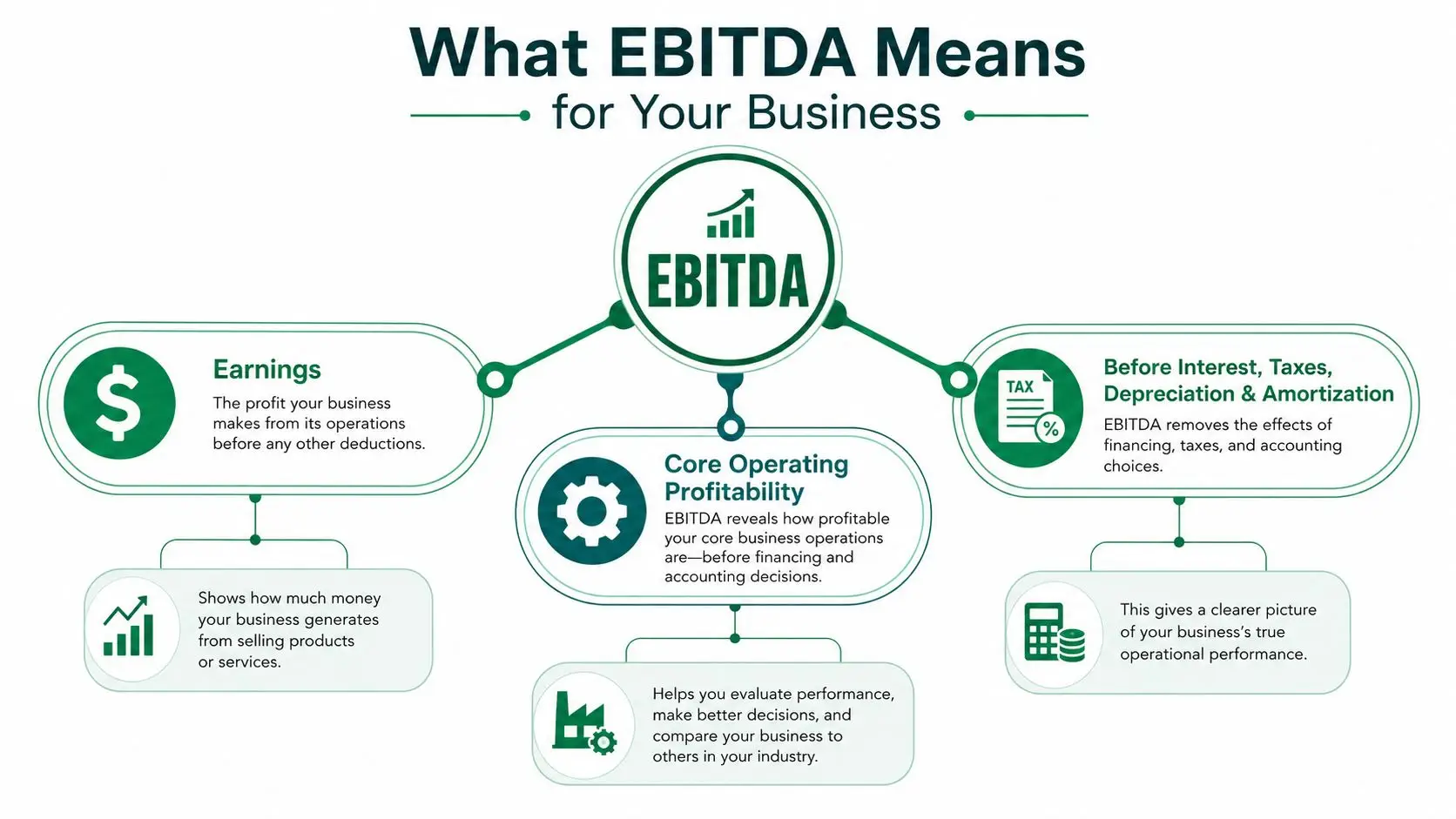
A buyer may focus on whether a company can support debt. An owner may focus on whether the business can be refinanced without strain. A broker may focus on whether the number will hold up in lender review. EBITDA gives all three a shared operating baseline, because it means earnings before interest, taxes, depreciation, and amortization and can be calculated as net income + interest + taxes + depreciation + amortization or operating profit + depreciation + amortization BDC glossary.
That baseline matters because financing structure, tax treatment, and accounting choices can make two similar companies look very different on the bottom line. EBITDA removes those items so lenders and buyers can focus on core operating performance, which is why it has become common language in deal work and lending discussions Chase.
Why small business buyers keep coming back to EBITDA
A first-time buyer reading a profit and loss statement often sees revenue, expenses, and net income before seeing the business's operating engine. EBITDA helps separate that operating engine from bookkeeping effects, and a practical companion is the guide to reading profit and loss statements, especially if you are tracing where revenue turns into profit.
For SBA buyers, the same logic shows up in valuation and debt review. A lender does not only want to know whether the business looks healthy today, it wants to know whether the business can keep paying debt after ownership changes. That is why EBITDA often sits near the center of the file review, and why a business valuation guide for SBA loans from GoSBA Loans focuses on normalized operating earnings.
Practical rule: if two companies have similar operations but very different debt loads or tax bills, EBITDA gives a cleaner comparison than net income alone.
The EBITDA Formula Step by Step
A buyer reviewing an SBA file often finds EBITDA buried inside a profit and loss statement, even though it drives a lot of the conversation about value and repayment. The formula looks technical at first, but it is really just a clean way to strip away financing choices, tax treatment, and noncash accounting entries so the operating picture is easier to see. A simple reference for the underlying concept is QuickBooks.
Bottom-up and top-down routes
There are two common ways to arrive at the same answer.
The bottom-up route starts with net income and adds back the items EBITDA removes:
Net income + interest + taxes + depreciation + amortization = EBITDA
The top-down route starts with operating profit and adds back noncash operating charges:
Operating profit + depreciation expense + amortization expense = EBITDA
Both routes should lead to the same number. The first path is often easier for a first-time buyer because it begins with the bottom line on the tax return or financial statement and works upward. The second path is useful when you are already looking at operating profit and want to see how much of the gap comes from accounting allocation rather than core operations. The CFI explanation lines up with that same logic.
| Line Item | Amount |
|---|---|
| Revenue | $1,200,000 |
| Operating expenses before D&A | $900,000 |
| Depreciation | $60,000 |
| Amortization | $40,000 |
| Operating profit | $200,000 |
| Interest | $30,000 |
| Taxes | $20,000 |
| Net income | $150,000 |
| EBITDA | $300,000 |
How the sample works on a lender file
In this sample, the bottom-up route is $150,000 + $30,000 + $20,000 + $60,000 + $40,000 = $300,000. The top-down route is $200,000 + $60,000 + $40,000 = $300,000. A lender, buyer, or broker would treat that $300,000 as the starting operating figure before looking at add-backs, owner compensation adjustments, and debt service.
Depreciation is the accounting spread of a long-lived asset's cost over time. Amortization does the same thing for intangible assets. In an SBA underwriting file, those entries matter because they reduce reported profit without necessarily reducing the cash the business generates in day-to-day operations. If you have ever asked what net profit margin means, the difference becomes easier to see, because EBITDA is trying to isolate operating performance before financing and noncash accounting effects.
SBA file habit: lenders want the trail from revenue to EBITDA to be clear, because they will compare that operating number against debt service and ownership changes later in underwriting.
A buyer doing a close read of the file often benefits from a second set of eyes on the assumptions behind the numbers. The small business financial intelligence review and custom financial modeling guide fits that kind of review, especially when you want to test whether the EBITDA figure still holds under different ownership or compensation scenarios.
Understanding EBITDA Margin
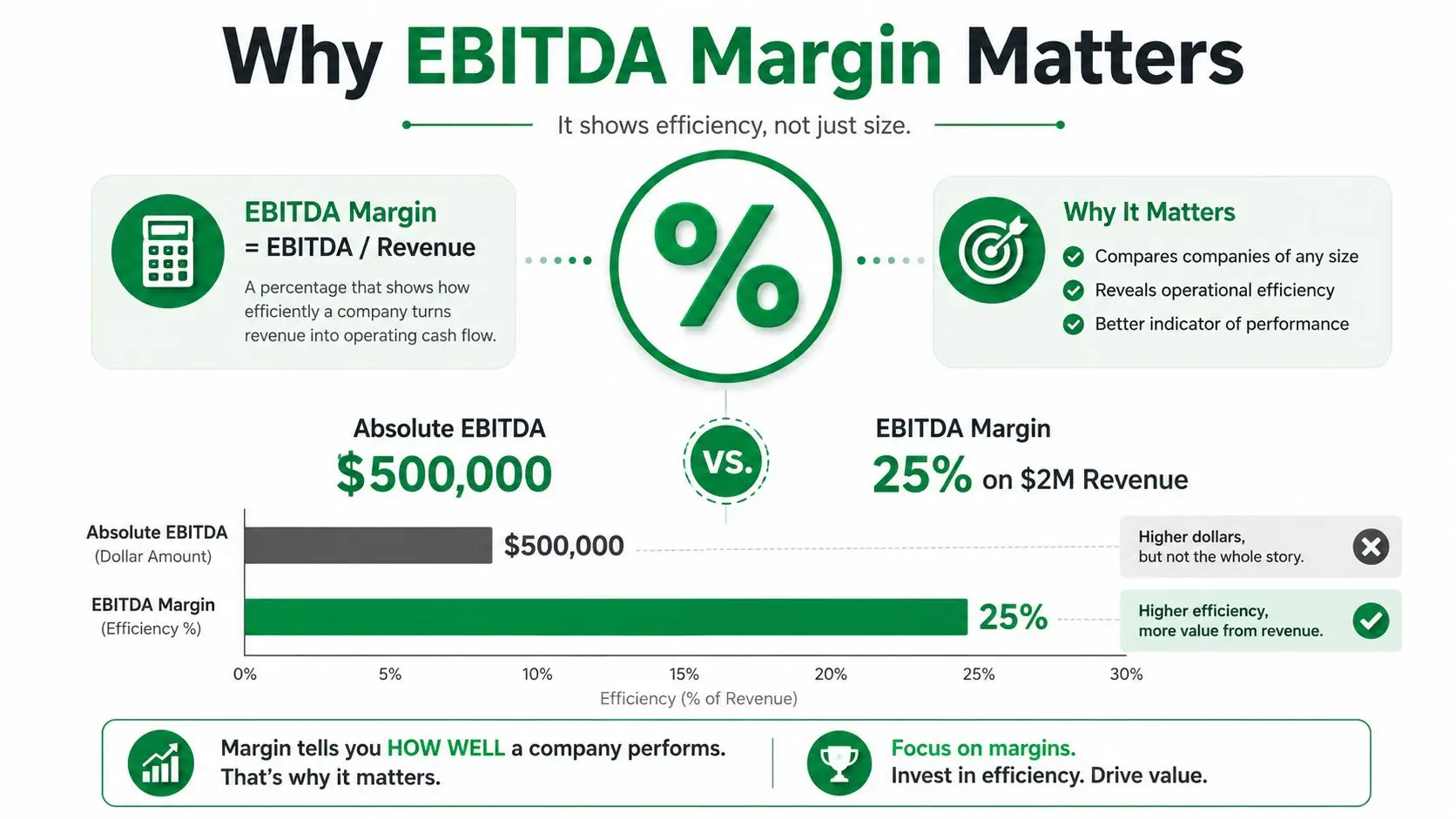
EBITDA margin is EBITDA divided by revenue. That makes it a more useful comparison tool than raw EBITDA when you want to compare a small company with a larger one, or a service business with a capital-intensive one. A business with higher absolute EBITDA is not automatically more efficient if it also needs much more revenue to get there.
Why margin beats raw dollars
If one company produces $500,000 of EBITDA on $2 million in revenue, its margin is 25%. If another business produces the same $500,000 on $5 million in revenue, its margin is much thinner even though the absolute EBITDA is identical. That's why buyers and lenders often look at margin first, then dollar amount.
A plain way to compare performance is to ask how much operating profit the business keeps from each revenue dollar before financing and accounting effects. That is the value of the margin lens, not the raw headline number.
What to expect by business type
Service-heavy businesses often show stronger margins because they don't carry the same equipment burden as asset-heavy manufacturers. Manufacturers and other capital-intensive firms may show lower margins because facilities, machinery, and maintenance eat into operating profit. That doesn't make them weak, it just means the comparison needs context.
For a broader profit lens, a helpful companion is what net profit margin means. Net profit margin looks further down the income statement, while EBITDA margin stays closer to operating efficiency.
Benchmarking tip: compare margin against businesses with similar operating models, not just similar revenue.
How EBITDA Compares to Net Income and Cash Flow
A seller can point to a strong EBITDA number and still show a smaller bottom line on the tax return. That is normal, because EBITDA, net income, cash flow, and EBIT answer different questions about the same business. Net income asks, “What is left after everything is paid?” Cash flow asks, “What cash moved through the account?” EBIT asks, “What did operations earn before financing, taxes, and depreciation or amortization?” EBITDA asks, “What did operations earn before financing, taxes, depreciation, and amortization?” As noted in this SBA loan approval guide comparing EBITDA and SDE, the right earnings measure depends on how the deal will be reviewed.
The same business, four different views
Use the sample business from the formula section. EBITDA is $300,000 and EBIT is $200,000, because EBIT includes depreciation and amortization but still leaves out interest and taxes. Net income is $150,000 after interest and taxes are removed. That gap is why EBITDA can look healthy even when the final profit line feels much tighter.
Operating cash flow is a different view again, because it starts to show real cash movement rather than accounting presentation. EBITDA does not include principal payments, working-capital swings, or the cash needed for equipment replacement. A lender reviewing an SBA file knows that a business is not paying bills with EBITDA alone, so the number has to be read alongside the cash story CFI.
| Metric | What it helps judge |
|---|---|
| EBITDA | Operating performance for buyers and lenders |
| EBIT | Operating profitability before financing and tax effects |
| Net income | Final profitability after all expenses |
| Operating cash flow | Cash available for bills, payroll, and short-term obligations |
A simple way to separate them is to think about layers. EBITDA sits near the top of the operating statement, EBIT sits one layer lower after non-cash asset cost allocation, net income sits at the bottom after interest and taxes, and cash flow looks at actual money movement through the business.
Why the distinction matters in lending
A lender can like EBITDA and still worry about liquidity. A business may show solid operating earnings but still run short if inventory builds up, customers pay late, or equipment needs to be replaced. That is why EBITDA helps with comparison, but it cannot answer every credit question on its own.
The same file can trigger different concerns for different people. A lender may focus on repayment ability, a buyer may focus on valuation, a tax advisor may focus on net income, and a cash manager may focus on bank balance movement and due dates. Each one is looking for a different answer from the same set of statements.
The structure becomes clearer when you compare earnings measures the way SBA underwriters do, with EBITDA near the center of the file and cash flow close behind it.
Adjusted EBITDA and Common Add-Backs
Adjusted EBITDA is the negotiated version of EBITDA that lenders, buyers, and sellers use to normalize earnings. The point is to remove items that do not reflect ongoing operations, but only when those items are credible, documented, and easy to defend in an SBA file. The British Business Bank explains EBITDA as an operating measure, and adjusted EBITDA builds on that idea by stripping out costs that distort the business's recurring earning power.
A simple SBA example helps. If a seller paid a family member for a role the new owner will not keep, or if the company had a one-time settlement tied to a closed dispute, underwriters may review those costs as possible add-backs. The question is always the same, would this expense still exist after the closing, or was it tied to the prior owner, a special event, or a temporary disruption?
Common add-backs that show up in SBA files
The add-backs underwriters see most often are owner compensation normalization, one-time legal or settlement costs, non-recurring restructuring expenses, and other expenses tied to the former owner rather than the business itself. A recurring expense dressed up as an add-back usually draws pushback, because the lender assumes the new owner may still have to pay it. A monthly expense for software, rent, or labor rarely becomes a valid add-back just because the seller wants a higher number.
Credible add-backs usually have three traits. They are documented in the books, they are clearly non-recurring, and they can be explained to a lender without hand-waving. Aggressive add-backs fail one of those tests, often because they rely on projected savings, soft synergies, or expenses that have not disappeared.
Underwriting reality: if you cannot explain an add-back with supporting statements, a lender may treat it as wishful thinking instead of normalized earnings.
The rules around normalization matter because even small changes in the adjusted EBITDA line can change valuation meaningfully. That is why deal teams spend so much time on the add-back schedule before a lender sees the file, and why the schedule has to match the story in the tax return, profit and loss statement, and supporting documents.
A quick self-check before you claim any add-back
- Owner pay: Is the compensation clearly above or below market for the role?
- One-time event: Can you prove the cost will not repeat after closing?
- Documentation: Do the tax return, P&L, or support schedule back it up?
- Business necessity: Would a buyer likely keep or replace the expense?
A good test is to ask whether an SBA underwriter would accept the item after reading the file cold. If the answer depends on a verbal explanation alone, the add-back is weak. If the answer is clear from the records, the item has a better chance of being included in normalized earnings.
For a lender-facing checklist, GoSBA's SBA add-backs guide is a useful reference when you are preparing the normalized earnings section of the file. For a valuation point of view, Action Accountants Limited's SME valuation shows how adjusted earnings can affect the way a business is priced and reviewed.
Why EBITDA Matters for SBA Loans and Valuation
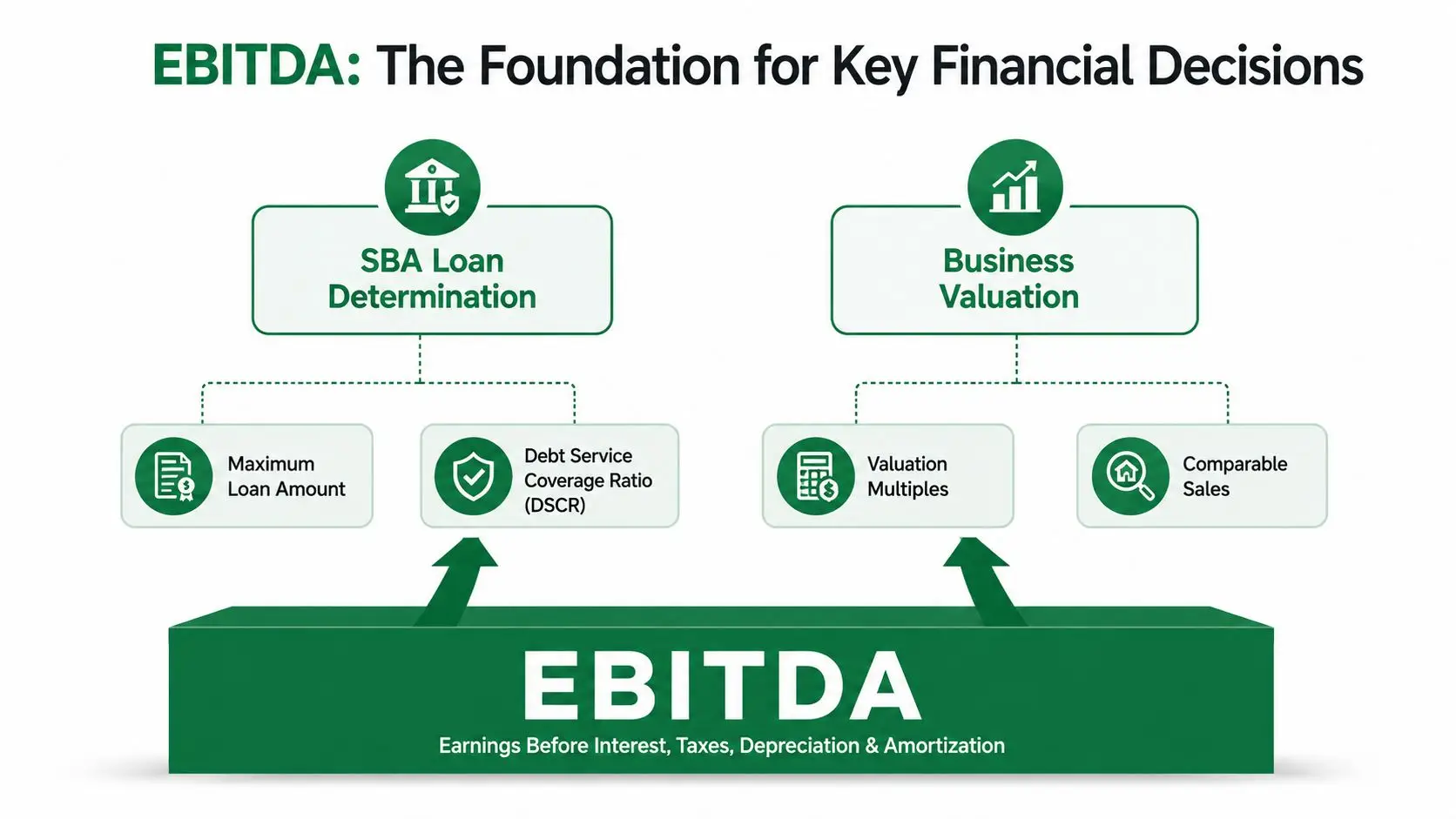
EBITDA sits at the center of many SBA loan and valuation conversations because it helps answer the question every lender cares about, can the business support debt after closing? In practice, buyers and brokers use EBITDA as the starting point for sizing debt capacity, while lenders use it as part of the broader underwriting picture.
How it shows up on a real deal file
A clean SBA package usually starts with trailing twelve-month financials, then adds a clear normalization schedule, then shows how the buyer's debt will be serviced after closing. That structure helps the lender separate the business's ongoing earnings from temporary distortions in owner pay or unusual expenses. EBITDA is the anchor point because it gives the file a common operating baseline.
The valuation side works the same way. Sellers want a credible earnings base, buyers want to know what they're really buying, and lenders want to see whether the cash flow can support repayment. The EBITDA multiples guide for small businesses is useful because it connects the operating number to deal pricing and financing discussions.
Why buyers and lenders like the same baseline
When a seller, buyer, and lender are all looking at the same normalized earnings figure, negotiations get clearer. That doesn't mean they'll agree on every add-back or multiple, but it does mean they're arguing from the same starting point.
For a broader business appraisal perspective, Action Accountants Limited's SME valuation resource can help you see how earnings, risk, and market context come together in valuation work. EBITDA is one input in that larger picture, not the whole picture.
One practical advantage for first-time buyers is that EBITDA gives them a way to compare opportunities across industries without getting trapped in different tax or financing structures. A business broker can package that comparison for a lender, but only if the numbers are clean and the add-backs are defensible.
Common EBITDA Pitfalls and Tips to Improve Yours
A borrower can look strong on paper and still run into trouble in an SBA file if EBITDA is treated like the full story. It leaves out capital expenditures, working-capital swings, and principal repayment, so a company can show healthy operating earnings while still feeling tight on actual cash.
Where owners get tripped up
Asset-heavy businesses show the issue quickly. A shop that depends on equipment, vehicles, or machinery needs ongoing replacement spending, and EBITDA does not show that future cash need. Businesses with heavy debt face the same problem, because EBITDA strips out financing costs even though the lender still expects principal and interest payments. That is why SBA lenders use EBITDA alongside debt-service and debt-level analysis before they approve a 7(a) or 504 file.
Aggressive add-backs can also weaken the file. If ordinary recurring costs are labeled as one-time adjustments, an underwriter will usually question them. The result is a harder review and, in many cases, a smaller normalized number than the seller expected.
A simple example helps. If a business shows strong EBITDA but the tax return, debt schedule, and cash flow support tell a different story, the lender will rely on the numbers that can be defended. That is why the file has to be clean before it reaches credit review.
How to clean up reported EBITDA before a deal
- Normalize owner pay: bring compensation to a supportable market level and document why the adjustment is fair.
- Separate one-time costs: keep legal, restructuring, and settlement items in a clearly labeled schedule.
- Support every add-back: tie each item to a statement, invoice, or return.
- Review recurring expenses: if the new owner will still pay them, do not treat them as add-backs.
- Recheck debt service: make sure the post-close structure still works after taxes, capex, and principal payments.
Timing matters: start the cleanup work well before a refinance, acquisition, or sale process begins, because lenders trust organized files more than rushed explanations.
For deal prep, a broker or advisor can help package the numbers into a lender-ready format, and GoSBA Loans is one option for borrowers who want SBA loan support tied to acquisition underwriting and file preparation.
EBITDA Questions Business Owners Ask Most
Can a small business with under $1 million in EBITDA still qualify for SBA financing? Yes, if the rest of the file supports the deal. Lenders care about repayment capacity, not just the earnings label.
What counts as a credible add-back? Usually a cost that is clearly non-recurring, documented, and unlikely to continue after closing. A recurring expense hidden as an add-back usually gets challenged.
How do lenders handle negative EBITDA? They usually look deeper at the story, because a negative number can mean early-stage investment, temporary disruption, or a more serious operating problem. The key is whether the business can support debt after normalization.
How does EBITDA interact with owner compensation on a sale? Buyers often normalize owner pay to a replacement-market level, because the new owner may not draw the same salary or benefits. The lender will want that adjustment explained cleanly.
If you're comparing a purchase, refinance, or partner buyout, bring the trailing twelve-month P&L, debt schedule, and any add-back support to GoSBA Loans and ask for an SBA lending review before you go to market. That one step can save you from pricing a deal off a number the lender won't accept.
