You've toured the business, reviewed the seller's story, and started picturing yourself running the operation. Then the seller asks for a letter of intent before releasing confidential financial statements, customer information, or tax returns. You're ready to show serious interest, but you also need room for lender underwriting, due diligence, valuation, and negotiation.
That's where the LOI earns its place. In an SBA-financed acquisition, it's more than a polite expression of interest. It establishes the transaction roadmap, identifies the terms that need early agreement, and can affect how the SBA lender evaluates the proposed acquisition. Buyers who treat it as a casual form often create avoidable problems. Buyers who make it too definitive can create legal and affiliation risk.
By the end of this guide, you'll know what an LOI does, what belongs in it, how it differs from a purchase agreement, and how to shape it for an SBA closing. The same discipline applies to other ownership arrangements, including partnership compliance for Australian businesses, where documenting responsibilities and intentions early can prevent later disputes.
Table of Contents
- The Moment a Deal Becomes Real
- What an LOI Actually Is and What It Is Not
- The Key Components Every LOI Should Include
- How SBA Loans Change the LOI Equation
- A Real Deal Worked Example and Sample Language
- LOI vs Purchase Agreement and Why the Distinction Matters
- Negotiation Tips and Common Contingencies to Plan For
- From Signed LOI to Funded Deal With GoSBA Loans
The Moment a Deal Becomes Real
A first-time buyer often reaches the LOI stage after an emotional shift. The business has stopped being a listing and started feeling like a possible future. You've met the owner, walked through the operation, and discussed price. The seller now wants something in writing before opening the data room.
Signing immediately can feel like the natural next step. It isn't. Before you sign, you need clear answers to four practical questions:
- What does the LOI accomplish?
- Which terms should it contain?
- How is it different from the final purchase agreement?
- What must change because the acquisition will use SBA financing?
An LOI is a preliminary document that sets out the principal terms of a proposed transaction before the definitive contract is signed. It signals that both parties want to continue toward a deal, but it usually leaves the final legal obligations for the purchase agreement.
Why the document matters to both sides
For the buyer, the LOI can secure access to information and establish a diligence process. It can also give you a period of exclusivity, so the seller isn't actively negotiating with competing buyers while you spend time and money on lender work.
For the seller, the LOI tests whether the buyer has a credible plan. An SBA buyer may need to demonstrate that the proposed price, structure, seller note, and financing contingency can survive underwriting. A vague expression of interest doesn't give the seller much confidence. A carefully drafted LOI does.
Practical rule: Treat the LOI as a transaction-control document, not as a ceremonial signature page.
The strongest LOIs create momentum without pretending that diligence is complete. They identify the economics, set the process, and preserve the buyer's ability to withdraw if financial, legal, valuation, or financing facts don't support the proposed deal.
What an LOI Actually Is and What It Is Not
A letter of intent, or LOI, is a preliminary document that outlines the main terms of a proposed business transaction before the parties sign a final contract. In acquisitions, it commonly addresses price, transaction structure, due diligence, exclusivity, confidentiality, and closing conditions. Legal and commercial guidance on LOIs describes the document as a pre-contractual instrument rather than the final deal itself.
An LOI is usually nonbinding, or only partly binding. That doesn't mean every sentence is harmless. Parties can expressly make specific provisions binding, and courts may look at the wording and the parties' conduct to determine whether they intended to be bound.
Think roadmap, not deed
A useful analogy is a house purchase. The LOI is the roadmap that says which property is being considered, what the parties expect to pay, what inspections must occur, and when they hope to close. The purchase agreement is the deed-level commitment, containing the detailed legal promises, remedies, representations, warranties, indemnities, and closing mechanics.
The analogy has limits, but it captures the key distinction. An LOI helps the parties decide whether to proceed on an agreed framework. A purchase agreement is intended to govern the completed transaction.
Typical LOI language should distinguish clearly between:
- Nonbinding business terms, such as proposed price and structure, subject to diligence and definitive documentation.
- Binding protection terms, such as confidentiality, exclusivity, expense allocation, governing law, or restrictions on conduct.
- No-obligation language, confirming that neither party must close unless and until a final agreement is signed.
An LOI can still become dangerous when it reads like a complete contract. If the document contains sufficiently specific terms and shows a clear intent to be bound, a court may enforce some or all of it. That's why legal review matters even when everyone casually calls the document “nonbinding.”
The LOI sits between initial discussions and definitive agreements. It narrows the negotiation, gives the lender a transaction framework, and creates the conditions under which diligence and drafting proceed. Buyers who want a practical overview of the document's moving parts can also review these LOI essentials for business buyers.
The Key Components Every LOI Should Include
A useful acquisition LOI doesn't try to replace the purchase agreement. It puts the right issues on the table early enough for the buyer, seller, attorney, and lender to identify conflicts before drafting becomes expensive.
Business-acquisition guidance commonly places LOIs at 3–8 pages, depending on deal complexity and the number of negotiated protections (business purchase LOI guidance). Length isn't the objective. Clarity is.
Start with the economics
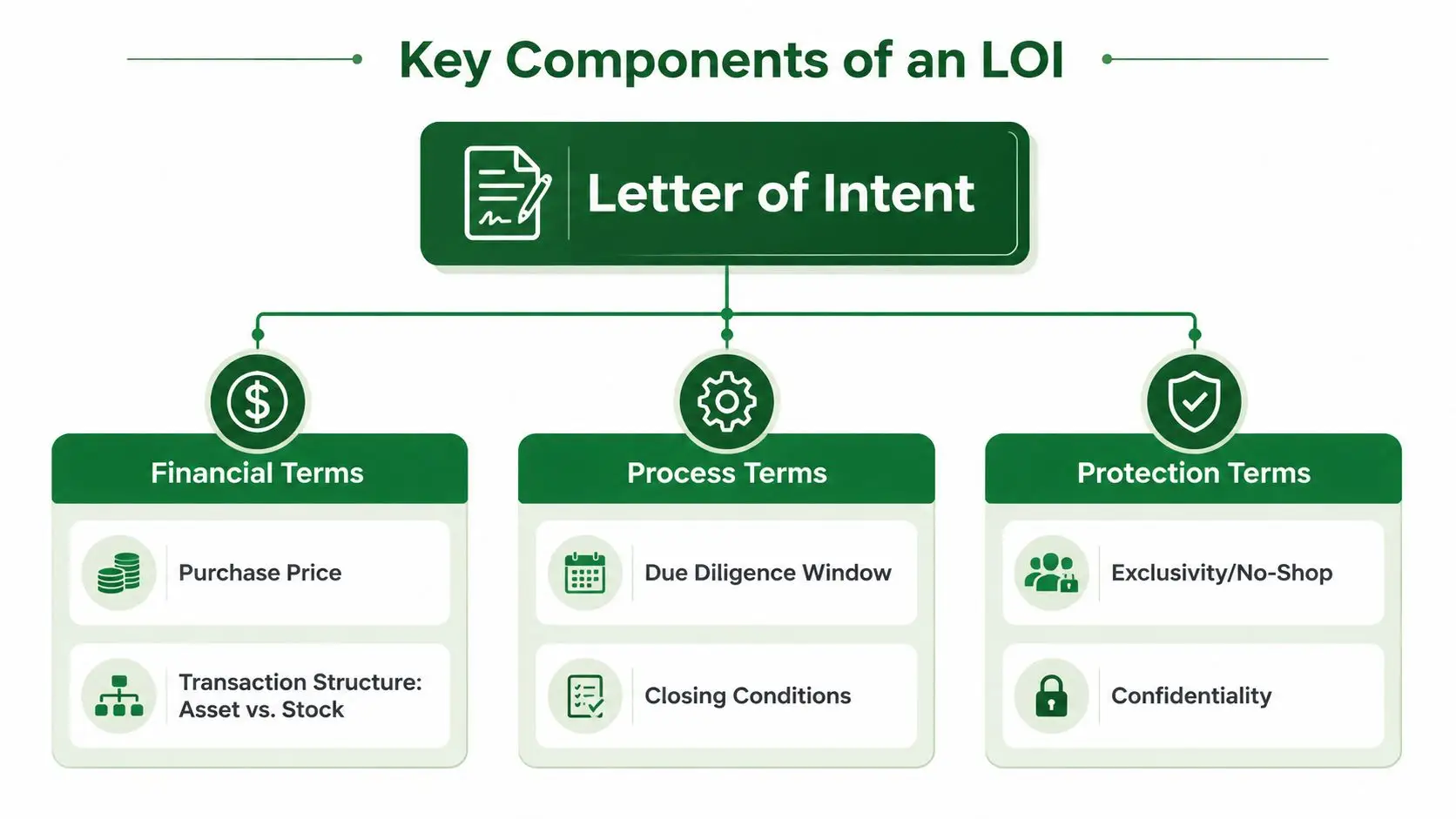
The purchase price should state the proposed consideration and explain what the price includes. If the parties haven't settled every adjustment, the LOI should identify the mechanism for resolving working capital, inventory, assumed liabilities, or other items rather than hiding the uncertainty.
The transaction structure is equally important. State whether the buyer intends an asset purchase or stock purchase. That choice affects liabilities, tax treatment, lender review, contracts, licenses, and the documents required before closing.
Set the process in writing
The due diligence window should define when the buyer receives access to financial, legal, operational, and commercial records. It should also connect to the financing timeline. If the lender needs valuation work, environmental review, insurance documentation, or additional tax records, the LOI should give the buyer enough time to obtain and evaluate them.
Exclusivity, often called a no-shop clause, prevents the seller from soliciting or accepting competing offers during the agreed period. Sellers may resist a broad restriction, while buyers need enough protection to justify diligence costs. The workable compromise is a clearly defined period, covered conduct, permitted exceptions, and a stated remedy if the seller breaches it.
Confidentiality protects the seller's sensitive information and can protect the buyer's financing discussions. The LOI should also explain who may receive the information, such as attorneys, accountants, lenders, and valuation providers.
Separate binding from nonbinding terms
The LOI should contain a section identifying exactly which provisions are binding. Common examples include confidentiality, exclusivity, expenses, access obligations, governing law, and dispute provisions. The proposed price, structure, and closing terms generally remain subject to diligence, lender approval, and definitive documentation unless the drafting says otherwise.
Closing conditions should identify the events that must occur before either side is obligated to close. For an SBA acquisition, that may include lender approval, acceptable valuation, satisfactory diligence, required third-party reports, contract assignments, and execution of the final purchase agreement.
A strong LOI also names the parties, identifies the target business, states the proposed closing process, and provides an expiration date for acceptance. Buyers should use the document to negotiate the issues that can kill the deal, not to polish minor language while leaving core assumptions unresolved.
For valuation-specific considerations, buyers should review this business valuation guide for SBA loans before finalizing the price language.
How SBA Loans Change the LOI Equation
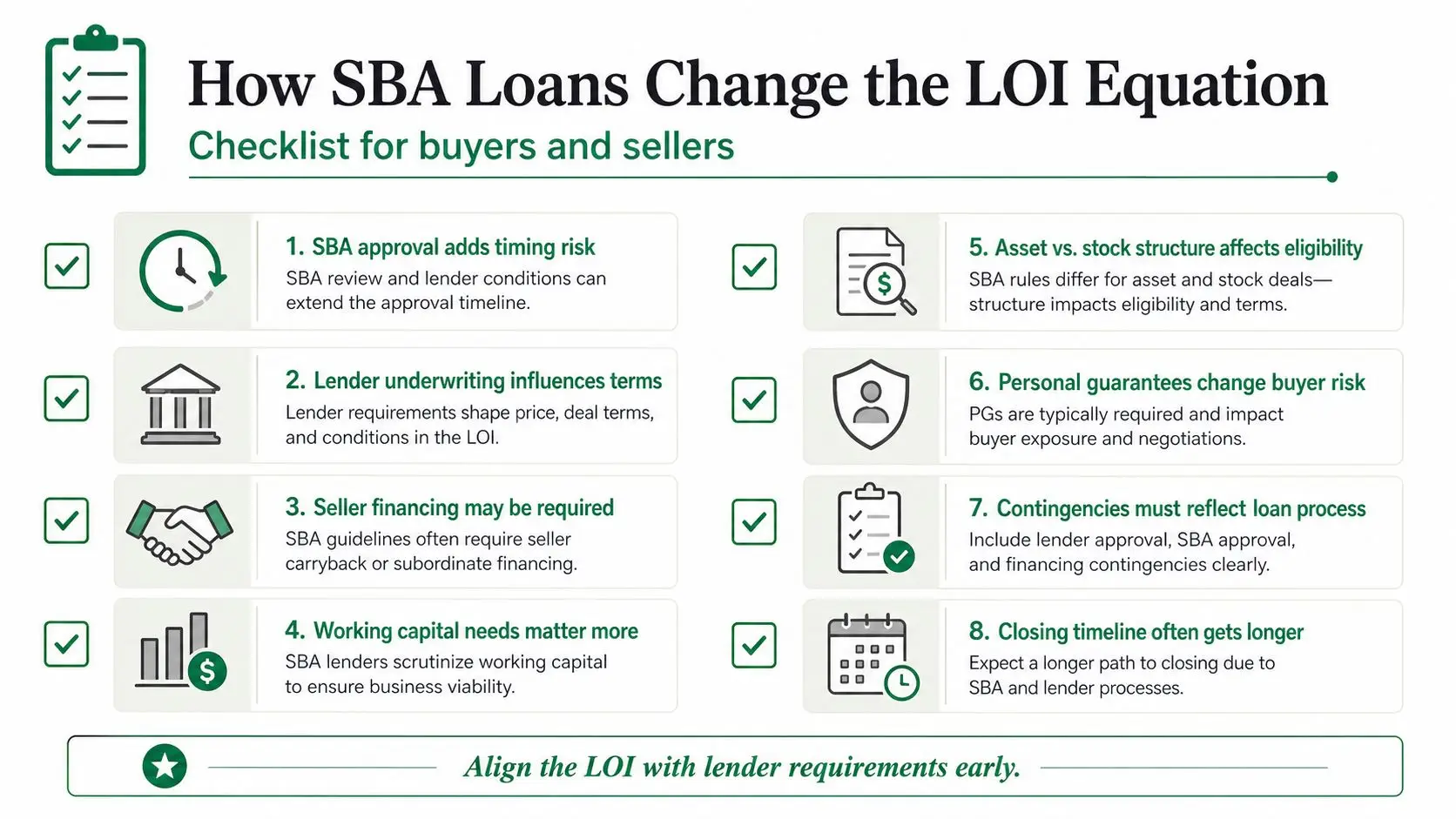
An SBA-financed acquisition has another decision-maker at the table, the lender. The seller and buyer may agree on a price, but the lender still has to determine whether the business can support the proposed debt and whether the structure complies with SBA policy.
The SBA's loan-program operating manual is SOP 50 10, which contains origination policies and procedures for the 7(a) and 504 loan programs. The SBA later issued SOP 50 10 8.1, reinforcing the importance of using the applicable SOP as the controlling policy source for lender and borrower requirements (SBA information notice on SOP 50 10 8.1).
Put the capital stack in the LOI
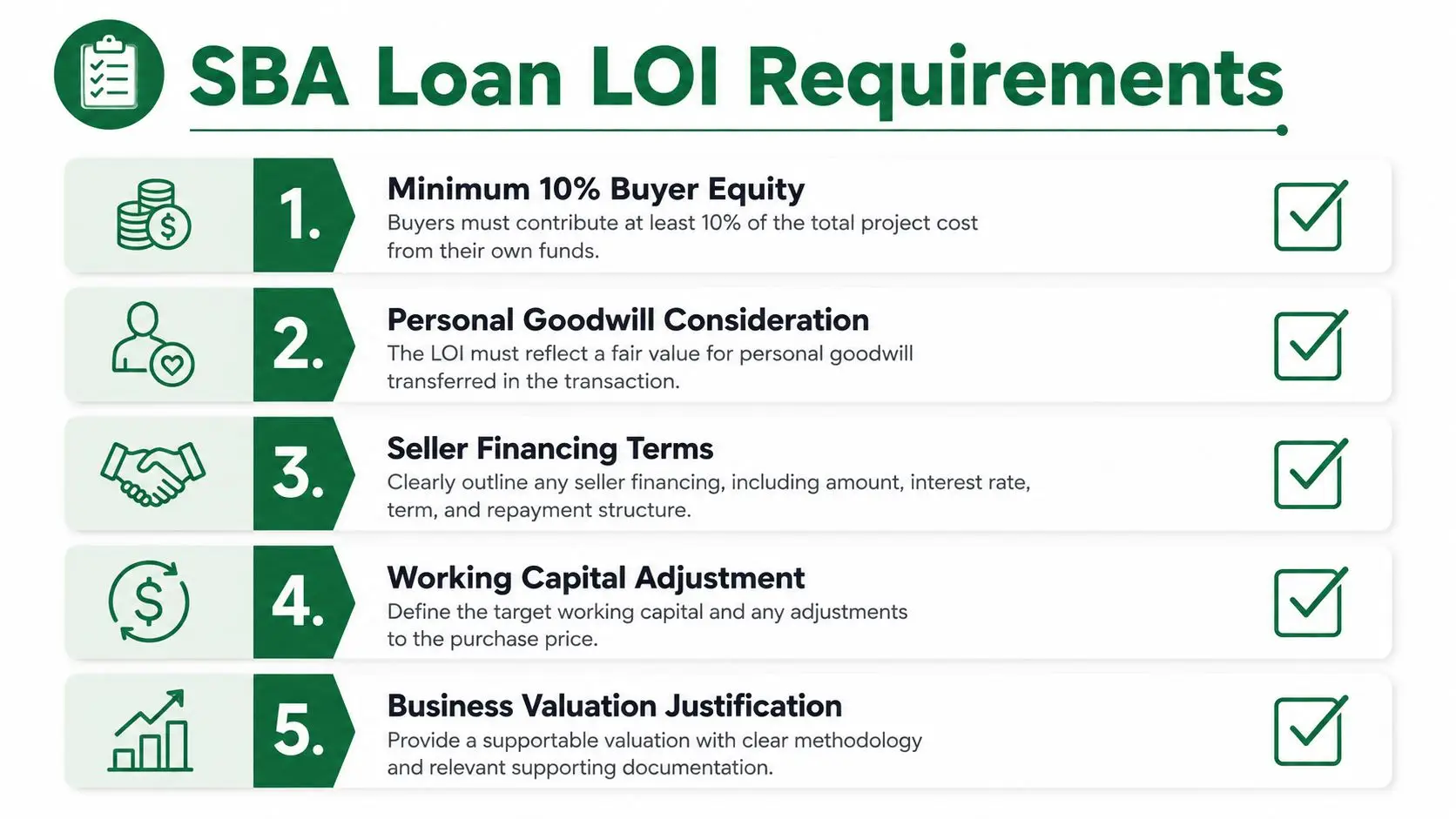
SBA acquisition guidance commonly requires a minimum 10% buyer equity injection. A seller-financed portion can sometimes count for up to half of that required injection when it remains on full standby, which can reduce the buyer's immediate cash contribution to 5% (SBA acquisition LOI guidance).
That structure must be drafted carefully. The LOI should state the seller note amount, interest terms, maturity, payment status, standby requirement, and the condition that the lender and SBA accept the structure. A seller note that looks available for immediate repayment may not receive the same underwriting treatment.
Lenders commonly look for a 1.25:1 debt-to-earnings ratio benchmark and often prefer three years of tax returns, according to SBA acquisition financing guidance (SBA LOI financing guidance). The LOI doesn't prove that the business meets those tests, but it should avoid terms that make meeting them impossible.
Avoid an incomplete acquisition structure
SBA acquisition guidance commonly favors a complete acquisition of the business rather than a partial transfer. The LOI should identify what the buyer is acquiring, whether the transaction is an asset or stock purchase, how the purchase price is allocated, and whether any ownership interest remains with the seller.
The most overlooked risk is affiliation. In SBA-serviced acquisitions, an LOI can have present legal effect if it amounts to an agreement in principle. SBA-affiliation case law discussed by Pillsbury's analysis of LOIs and SBA affiliation explains that serious negotiations and sufficiently specific terms may lead the SBA to treat parties as affiliated before a final purchase agreement is signed.
That doesn't mean buyers should make the LOI vague. It means the document should accurately state which terms are preliminary, which clauses are binding, and what remains subject to lender approval, diligence, and definitive documentation. Buyers can use SBA lender underwriting guidance to prepare the financial and structural questions that should be answered before signing.
A Real Deal Worked Example and Sample Language
Consider a proposed $2M acquisition. The buyer wants to purchase the operating business through an SBA-backed structure, use 5% cash down, and have the seller finance the remaining portion of the required equity injection on full standby. The buyer also needs time for diligence, lender underwriting, valuation, and closing documentation.
A practical LOI might state the principal terms in language similar to this:
Purchase price and structure: Buyer proposes to acquire substantially all operating assets of the business for $2M, subject to confirmation of assets, liabilities, inventory, working capital, and other terms in the definitive asset purchase agreement.
Financing contingency: Buyer's obligation to proceed is conditioned on obtaining acceptable SBA financing and lender approval of the proposed transaction structure, valuation, equity injection, and seller financing terms. If acceptable financing isn't obtained despite commercially reasonable efforts, buyer may terminate without liability, except for obligations expressly stated as binding.
Seller financing: Seller will provide a standby seller note in an amount and on terms acceptable to the SBA lender. No principal or interest payments will be made during the required standby period unless the lender authorizes otherwise.
Exclusivity: For the agreed exclusivity period, seller won't solicit, encourage, or accept competing proposals for the sale of the business, subject to the remedies and exceptions stated in this LOI.
Closing target: The parties will work toward closing within a 90–120 day period after execution, subject to diligence, lender approval, documentation, and satisfaction of closing conditions.
The financing-out clause is the buyer's most important protection. Without it, the buyer may face pressure to close or renegotiate after discovering that the lender won't support the proposed structure. Sellers will focus on the definition of “acceptable financing,” the buyer's efforts, and the length of the contingency.
The seller note deserves separate attention. Review SBA seller note guidance before writing terms that could conflict with lender requirements.
| Dimension | Letter of Intent | Purchase Agreement |
|---|---|---|
| Purpose | Outline principal terms and process | Finalize and govern the transaction |
| Binding scope | Usually nonbinding except stated clauses | Generally legally binding |
| Detail level | Economics, diligence, protections, conditions | Representations, warranties, indemnities, covenants, closing mechanics |
| Financing role | Establishes proposed structure and contingencies | Implements approved financing structure |
| Exit rights | Usually preserves the ability not to proceed | Creates contractual default consequences |
This is starting language, not legal advice. An acquisition attorney must adapt it to the transaction, jurisdiction, lender requirements, and negotiated risk allocation.
LOI vs Purchase Agreement and Why the Distinction Matters
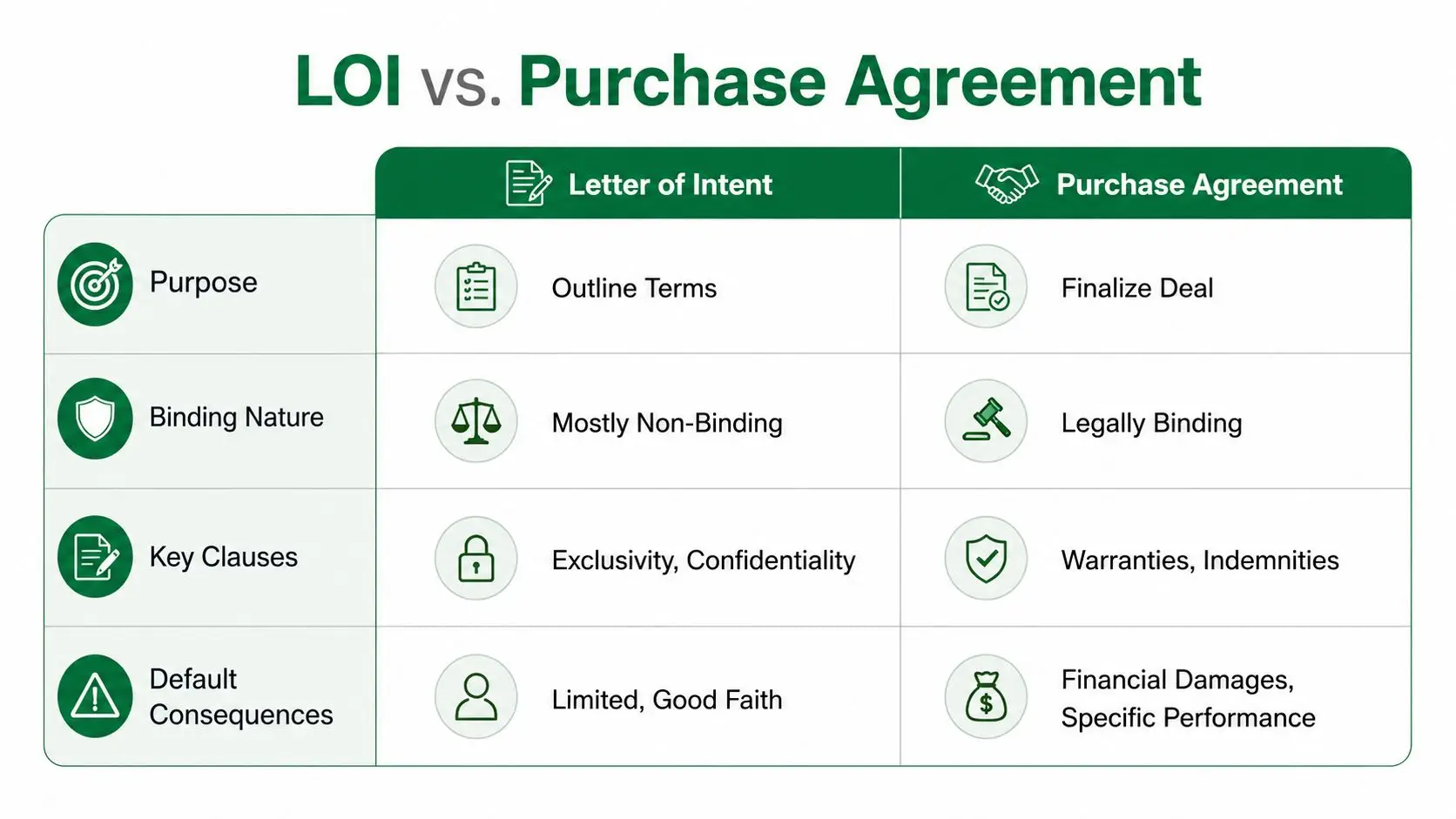
The LOI and purchase agreement answer different questions. The LOI asks, “Do we agree on the basic path and the principal terms?” The purchase agreement asks, “What exactly will each party do, what are they promising, and what happens if they don't?”
The practical dividing line
An LOI usually works as a term sheet with legal protections around the negotiation. It captures the proposed price, structure, diligence process, exclusivity, confidentiality, financing contingency, and closing conditions. It should also identify which provisions survive even if the deal doesn't close.
The purchase agreement absorbs the detailed legal work. It addresses representations and warranties, indemnification, covenants before closing, employee and contract matters, liability allocation, conditions to closing, post-closing obligations, and remedies for default.
The transition from LOI to purchase agreement isn't always a clean copy-and-paste exercise. Diligence can change the working capital assumption, asset list, liabilities, price allocation, or financing structure. The buyer should expect the definitive agreement to refine or revise the LOI where new facts justify doing so.
Why SBA buyers need extra care
A buyer may think the LOI is nonbinding and therefore harmless. SBA affiliation guidance creates a more complicated picture. If the LOI functions as a sufficiently specific agreement in principle, the SBA may consider the parties affiliated before the final agreement is signed, particularly when negotiations are serious and the document reflects a clear commitment.
That risk is separate from the ordinary difference between a preliminary document and a final contract. It means the drafting must preserve flexibility without concealing the core transaction. A lawyer should review the language before signing, and the lender should understand the proposed structure early enough to identify eligibility or underwriting concerns.
The LOI establishes the commercial roadmap. The purchase agreement becomes the enforceable operating manual for closing and post-closing obligations. Confusing those roles creates risk for both sides.
Negotiation Tips and Common Contingencies to Plan For
Good LOI negotiation isn't about making the buyer win every point. It's about putting the right uncertainty in the right place. The seller wants confidence that the buyer is serious. The buyer needs protection against facts that only emerge through diligence and underwriting.
Negotiate the pressure points
- Exclusivity: Ask for enough time to complete lender work, but define the restriction narrowly. A seller may accept exclusivity more readily when the buyer commits to prompt diligence and regular status updates.
- Financing contingency: Tie the buyer's obligation to acceptable SBA financing, valuation, lender approval, and the agreed capital stack. Avoid a clause so open-ended that the seller believes the buyer can walk away for any reason.
- Access to records: Specify the records the seller will provide and the people the buyer may involve, including attorneys, accountants, lenders, and valuation professionals.
- Structure: Resolve asset versus stock treatment before drafting advances. Leaving this open can affect taxes, contracts, liabilities, and lender eligibility.
- Seller note: State whether the note is on full standby and make payment rights subject to lender approval. Don't rely on a later handshake to fix an incompatible repayment schedule.
The due diligence process should cover tax returns, financial statements, bank records, customer concentration, contracts, licenses, leases, payroll, litigation, insurance, and operational liabilities. SBA buyers should also plan for valuation and other third-party reports where applicable. This SBA acquisition due diligence checklist helps organize the information request.
Negotiation insight: Sellers usually respond better to a specific financing contingency than to a vague promise that the buyer will “seek funding.”
Don't let the LOI accidentally bind the parties to close. Use explicit language for nonbinding terms, list binding provisions separately, and avoid describing the document as a final agreement. At the same time, don't make the document so thin that it fails to protect confidential information or prevent the seller from shopping the transaction.

From Signed LOI to Funded Deal With GoSBA Loans
Signing the LOI starts the execution phase. The buyer must turn the proposed economics into a lender-ready file, confirm that the business supports the debt, collect diligence materials, obtain required reports, and keep the seller aligned while attorneys prepare definitive documents.
The publisher's stated SBA workflow averages seven days to a term sheet and 45–75 days to close (LOI-to-closing SBA acquisition timeline). Those figures are not a promise for every transaction. The actual timeline depends on the business, the quality of the records, lender responsiveness, valuation, third-party reports, seller cooperation, and the complexity of the purchase agreement.
What to do immediately after signing
- Send the executed LOI and financial records to the financing team.
- Confirm the capital stack, including buyer equity, seller standby financing, working capital, and any financing contingency.
- Match the deal with appropriate SBA lenders instead of waiting for a single lender to reject an unsuitable structure.
- Build the business plan and projections around the actual purchase price, debt service, operating assumptions, and buyer experience.
- Start diligence and third-party reports early, because missing documents can delay underwriting and closing.
- Keep the seller informed about lender requests and expected decision points.
GoSBA Loans offers a no-cost brokerage workflow that can review the LOI, assess financing fit, coordinate proposals from SBA lenders, and support underwriting, third-party reports, and closing coordination. Its stated service also includes free business plans and financial projections for borrowers who need to convert a signed LOI into a lender-ready acquisition file.
The LOI works best when the buyer, seller, attorney, and lender rely on the same transaction assumptions. Before signing, have counsel review the binding language and have an SBA financing professional test the proposed price, structure, equity injection, seller note, and timeline.
If you're evaluating an SBA-financed acquisition, send the signed or draft LOI to GoSBA Loans for a financing-fit review, lender matching, and support turning the transaction terms into a bank-ready plan. Start before you commit to a structure that could create underwriting delays or limit your financing options.
