Most advice about term sheets starts with the phrase “non-binding” and ends with the suggestion that you can fix the details later. That's dangerous advice for a business buyer. A term sheet may leave the final loan agreement open, but it can still determine how much cash you need, which assets secure the loan, whether the seller's note supports the transaction, and whether you're free to pursue competing financing.
In practical terms, what is a term sheet? It's a concise written summary of the principal commercial terms proposed for a transaction before the parties draft definitive legal documents. In SBA acquisition lending, it's the lender's early blueprint for loan amount, pricing, repayment structure, collateral, guarantees, fees, and closing requirements. The document deserves a business and legal review before you sign it, not after problems appear during underwriting.
Table of Contents
- Why a Term Sheet Is More Than Just a Draft
- Core Components Every Term Sheet Contains
- How Term Sheets Differ Across Deal Types
- Reading a Sample SBA Term Sheet Line by Line
- Negotiation Strategies and Red Flags to Watch
- The Binding Clauses Hiding in Non-Binding Documents
- From Term Sheet to Closing and What Happens Next
Why a Term Sheet Is More Than Just a Draft
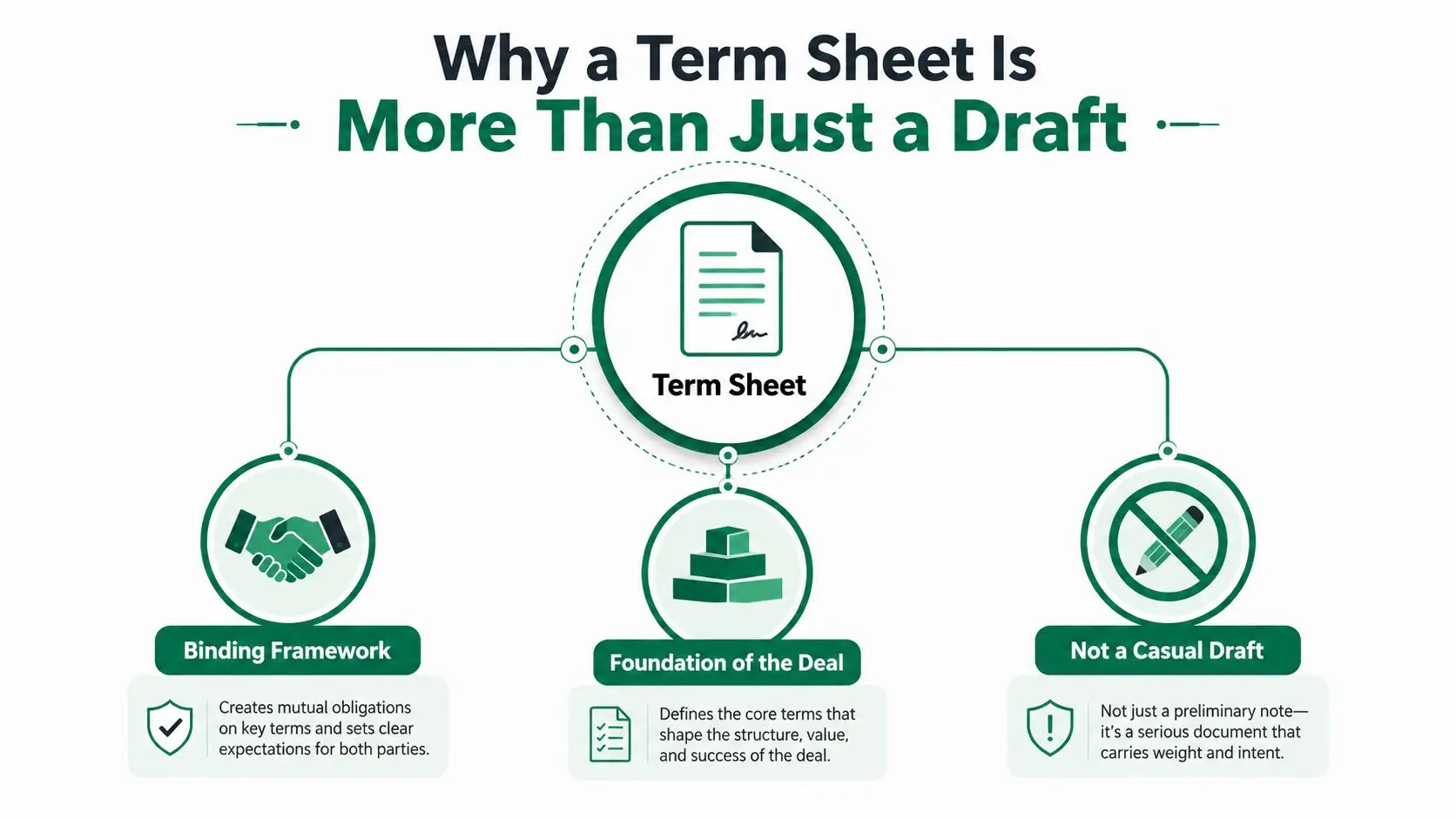
A term sheet isn't merely an informal outline that can be corrected without consequence. It's the document where the lender, buyer, investor, or seller first records the economic assumptions that will guide the rest of the deal. Once everyone starts working from those assumptions, changing them can require new approvals, revised projections, and renewed negotiations.
That matters in SBA acquisitions because the term sheet often becomes the reference point for the purchase price, debt structure, buyer contribution, seller financing, collateral expectations, and closing conditions. The final loan documents still control the completed transaction, but the term sheet can shape the path to those documents and reveal what the lender is willing to support.
The non-binding label has limits
Most commercial terms are usually subject to definitive documentation. That doesn't mean every sentence is harmless until closing. Term sheets commonly separate proposed economics from provisions that can bind immediately, including:
- Confidentiality: The parties may have to protect financial records, customer information, and deal discussions.
- Exclusivity or no-shop: A buyer or borrower may agree not to solicit competing offers or negotiate with other financing sources.
- Governing law and dispute resolution: These provisions can establish the legal framework for disputes.
- Expense allocation: One party may agree to pay diligence, legal, appraisal, or other transaction expenses.
- Breakup fees: Certain transactions may impose a payment obligation if a party walks away under specified circumstances.
The practical risk is selective enforceability. A court may treat the financing proposal as non-binding overall while enforcing a confidentiality or exclusivity clause. Practical Law's guidance on term sheets) reflects that distinction, and it's the distinction buyers often miss when they focus only on the proposed interest rate.
Practical rule: Read the binding provisions first, then evaluate the economics. A favorable rate won't help if the document quietly removes your ability to compare alternatives.
A large venture-capital sample demonstrates that term sheets aren't limited to small startup rounds. A survey of 245 term sheets covered investment sizes from £0.5 million to £50 million or more, with £2.7 billion in total underlying investment, according to the SVB Venture Capital Term Sheets report. The same report found a distribution across seed, Series A, Series B, and later-stage transactions, showing how the document functions across different deal sizes and stages.
For an acquisition buyer, the right mindset is simple: signing a term sheet creates momentum and may create obligations. Before signing, identify every clause that limits optionality, ask what remains subject to approval, and compare the proposed structure with your purchase agreement and financing timeline. The complete SBA business acquisition timeline from LOI to closing is useful because the term sheet doesn't sit alone. It interacts with diligence, lender underwriting, seller negotiations, and the eventual closing documents.
Core Components Every Term Sheet Contains
A lender term sheet should let you answer a basic question: What exactly is the lender proposing to fund, on what terms, and subject to which conditions? If the document doesn't answer that clearly, ask for clarification before relying on it in negotiations with the seller.
The core elements are consistent across many debt transactions, although the details vary by lender and transaction. A venture debt term sheet walkthrough describes the standard financing blueprint as covering the loan amount, pricing, structure, security, covenants, reporting, fees, and closing steps. SBA acquisition term sheets use the same broad architecture, with additional attention to program eligibility and guaranty requirements.
Financial terms drive the purchase math
Loan amount and use of proceeds come first. The term sheet should identify whether proceeds cover the business purchase, eligible expenses, working capital, refinancing, real estate, or another approved use. A headline loan amount means little if the permitted uses don't match the purchase agreement.
Interest rate and pricing structure determine the borrower's debt-service burden. Confirm whether the rate is fixed or variable, what benchmark or adjustment mechanism applies, when the rate becomes effective, and whether the quoted pricing is conditional on final underwriting.
Repayment, amortization, and maturity show how quickly principal comes due. A payment that looks manageable under one amortization structure can become restrictive under another. Look for payment frequency, maturity date, interest-only periods if any, required principal reductions, and prepayment language.
Fees and closing costs should be itemized rather than buried in a general estimate. Ask who pays lender fees, third-party reports, legal work, filing charges, and other transaction expenses. SBA guaranty fees are a separate consideration because they're charged as a percentage of the guaranteed portion of the loan, not the full loan balance. The SBA's March 2025 fee notice%20Fees%20(including%20the%207(a).pdf) states that short-term 7(a) loans with maturities of 12 months or less carry a 0.25% fee on the guaranteed portion.
Legal and operating terms affect control
Collateral and security interests identify the assets the lender expects to encumber. In an acquisition, that may include the purchased business assets and available real estate, along with liens required by the lender's underwriting.
Personal guarantees define who stands behind the debt and whether the guarantee is unlimited, limited, or tied to a particular ownership interest or collateral position. Don't assume the guarantee language will be narrower than the lender's initial summary.
Covenants and reporting establish what the borrower must do after closing. Financial reporting, tax filings, insurance, restrictions on additional debt, distributions, ownership changes, and other operating requirements may all appear in the final documents.
Conditions precedent are the items that must be completed before funding. They can include satisfactory diligence, final credit approval, appraisals, environmental work, insurance, entity documents, leases, licenses, and executed seller-financing documents.
A term sheet should distinguish standard policy requirements from terms the lender is willing to negotiate. That distinction saves time and prevents a buyer from treating every line as equally flexible. For example, the legal structure of liens may be driven by collateral policy, while fee allocation, reporting cadence, or certain commercial conditions may offer more room for discussion. If another lender will share collateral with the SBA lender, understand the consequences of a pari passu structure before accepting language that affects priority.
How Term Sheets Differ Across Deal Types
A startup founder, a business buyer, and an acquisition seller can all receive a term sheet, but they aren't reading the same document in substance. The document's purpose changes with the capital structure.
In venture capital, the focus is equity economics and governance. The parties discuss valuation, ownership, liquidation preferences, voting rights, board representation, and future participation rights. In an SBA acquisition, the buyer isn't primarily negotiating dilution. The buyer is negotiating debt capacity, repayment, collateral, personal guarantees, required cash, and conditions that determine whether the lender can close.
Traditional M&A term sheets sit between those frameworks. They may address purchase price, asset versus stock structure, escrow, indemnification, closing conditions, and exclusivity. The central issue is often transaction risk allocation rather than loan repayment.
| Deal Type | Primary Focus | Key Terms | Binding Risk |
|---|---|---|---|
| Startup equity financing | Ownership and investor control | Valuation, investment amount, equity rights, liquidation preferences, governance | Confidentiality, exclusivity, and selected governance provisions may bind |
| SBA acquisition lending | Debt repayment and credit support | Loan amount, use of proceeds, rate, amortization, collateral, guarantees, equity injection, closing conditions | Exclusivity, confidentiality, expense allocation, and lender-specific commitments require careful review |
| Traditional M&A | Purchase structure and allocation of transaction risk | Price, asset or stock purchase, indemnities, escrow, closing conditions, exclusivity | No-shop, confidentiality, fees, breakup provisions, and governing law may bind |
Why the lender document can control the acquisition
An SBA lender term sheet can be more decisive than the buyer's equity or purchase-price proposal. If the lender requires more buyer cash, additional collateral, a different seller-note structure, or conditions the loan on an issue the seller can't satisfy, the acquisition may not close on the original terms.
The buyer should therefore compare the term sheet with the purchase agreement, not review each document in isolation. A proposed seller note might appear to reduce cash at closing, but the lender may require it to remain on standby under specific terms. The seller financing guide for business acquisitions can help buyers understand how seller debt interacts with the senior loan and the transaction's overall capital stack.
The key question isn't, “Is this a good rate?” It's, “Can this entire structure close, operate, and remain serviceable after closing?”
Reading a Sample SBA Term Sheet Line by Line
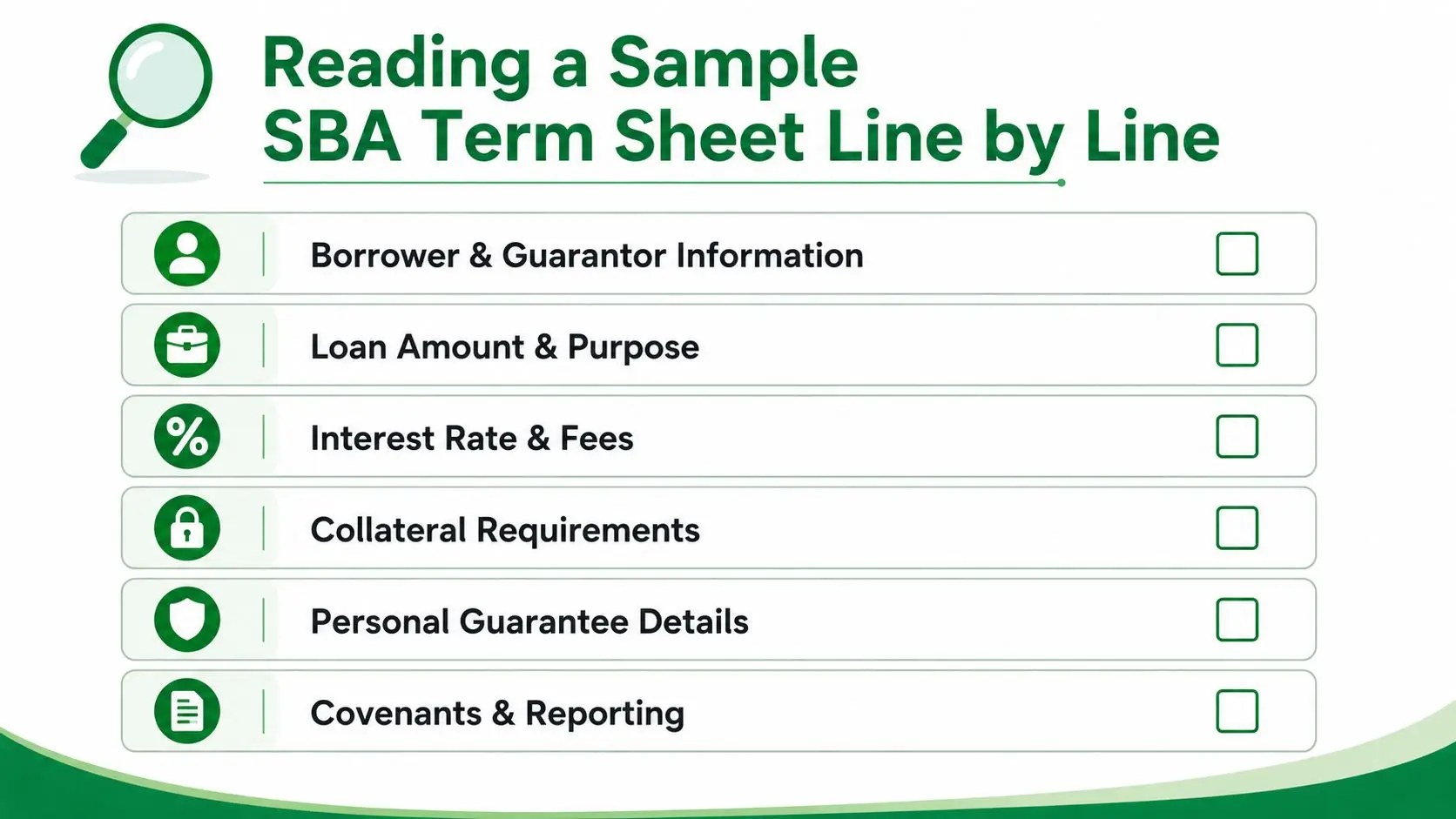
A sample SBA term sheet usually begins with identification details and then moves from the proposed credit structure to the conditions required for funding. Read it in that order, but don't treat the first page as more important than the attachments or binding provisions.
Start with the parties and purpose
Borrower and guarantor information: Confirm the legal name of the operating company, ownership entities, individual guarantors, and any seller or affiliate included in the structure. A mismatch between the term sheet and the purchase agreement can create avoidable documentation problems.
Loan amount and purpose: Check the exact proposed amount and each permitted use. If the acquisition includes working capital, real estate, equipment, debt refinancing, or transaction expenses, make sure the term sheet reflects the intended allocation.
Rate and fees: Identify whether the rate is fixed or variable, how adjustments work, and which charges are included or excluded. SBA 7(a) guaranty fees depend on the guaranteed portion. SBA lender guidance states that loans of $150,000 or less may receive a guarantee of up to 85%, while loans above $150,000 may receive a guarantee of up to 75%, as described in the SBA lender guidance. That percentage affects the portion on which the guaranty fee is calculated and can influence how the lender assesses risk.
Repayment and maturity: Review the payment schedule, amortization assumptions, maturity, and prepayment provisions. Don't rely on an estimated monthly payment unless the rate and amortization mechanics are stated clearly.
Then examine credit support and closing conditions
Equity injection: This line can reshape the entire purchase structure. SBA SOP 50 10 8 reinstated a minimum 10% equity injection for startup businesses and complete changes of ownership financed with a 7(a) loan, measured against total project cost, according to Lender Analyzer's explanation of SBA equity injection requirements. Confirm how the lender calculates total project cost and whether the proposed buyer contribution includes eligible sources.
Seller note and standby terms: A seller note may help bridge the gap between purchase price and available buyer cash, but the lender may require the note to remain on standby and restrict payments until certain conditions are met. Review payment rights, subordination, maturity, and whether the seller can accelerate the note.
Collateral and personal guarantees: Identify business assets, real estate liens, pledged investments, and guarantor obligations. A lender may distinguish between available collateral and required collateral, so ask what happens if an appraisal or lien search changes the assumptions.
Conditions to closing: Look for final credit approval, satisfactory diligence, lease assignments, insurance, licenses, tax documents, appraisals, environmental reports, and executed legal documents. For professional practice buyers, resources on cash-flow friendly loan structures for vets can offer useful context for matching repayment design to the acquired practice's operating cash flow.
Negotiation Strategies and Red Flags to Watch
Negotiate the terms that affect cash flow, flexibility, and closing certainty. Don't spend weeks arguing over language the SBA or lender policy largely controls while overlooking a broad personal guarantee or an undefined closing condition.
A strong negotiation starts with a written comparison. Put the proposed term sheet beside the purchase agreement, seller note, projections, and competing financing proposals. Then classify each item as policy-driven, lender-specific, or commercially negotiable.
Push where the structure allows movement
Interest rate flexibility: Ask whether the lender can offer a fixed or variable structure that better matches the business's cash flow. Clarify the adjustment mechanics rather than comparing only the initial rate.
Prepayment structure: Review any penalty, lockout, or required notice. A lower rate may not compensate for a structure that limits your ability to refinance or retire debt when the business performs well.
Covenant thresholds: Request precise definitions for financial tests, reporting dates, cure rights, and default triggers. A covenant should be measurable and operationally realistic, not a vague promise that creates uncertainty.
Fee allocation: Confirm which party pays each cost and whether a fee is due if the loan doesn't close. Ask for estimates in writing and identify expenses that could increase after third-party diligence.
The cheapest term sheet isn't always the least expensive financing. Total cash required, flexibility after closing, and certainty of execution matter just as much as the quoted rate.
Treat these warning signs seriously
- Broad personal guarantees: Understand whether every guarantor is exposed across all obligations or only a defined portion of the credit.
- Aggressive financial covenants: Test the covenant against conservative projections, seasonal weakness, and unexpected working-capital needs.
- Vague closing conditions: “Satisfactory to lender” language may be normal in part, but ask which objective documents and events can still stop funding.
- Exclusivity that blocks alternatives: A no-shop clause can prevent you from pursuing another lender while the first lender continues underwriting.
- Seller-note ambiguity: If standby terms aren't explicit, the seller and lender may later disagree about payment rights.
SBA policy requirements generally aren't bargaining points, but lenders can differ in how they package, explain, and execute them. Use an SBA M&A due diligence checklist to test the transaction before you ask a lender to approve a structure that depends on unresolved facts.
The Binding Clauses Hiding in Non-Binding Documents
The most important words in a term sheet may appear under a heading that receives little attention: binding provisions. The document may say that the proposed transaction isn't binding until definitive agreements are signed, while separately stating that confidentiality, exclusivity, governing law, dispute resolution, expense reimbursement, or breakup fees are immediately effective.
That split changes the buyer's negotiating position. If you sign an exclusivity clause, you may lose the ability to shop another lender or invite a competing proposal during the period when the first lender is still completing diligence. The main loan economics may remain open, but your alternatives become narrower.
Read the clause as an operating restriction
For each binding provision, ask four questions:
- What conduct does this restrict?
- Who benefits from the restriction?
- How long does it last?
- What ends it if the transaction stalls?
A reasonable exclusivity provision should define the scope, duration, permitted exceptions, and termination events. It should also address what happens if the lender declines the loan, changes material economics, or fails to meet an agreed process milestone. Confidentiality language deserves the same attention, especially when the buyer must share employee, customer, financial, or proprietary information with advisors and lenders.
Governing-law and dispute provisions can look like boilerplate, but they determine where and how disagreements are handled. Expense provisions can also create obligations before closing, particularly when the buyer has agreed to reimburse legal or diligence costs.
Electronic signatures can make execution fast, but speed doesn't reduce the need to understand what has been signed. A guide for legal professionals on electronic signatures provides useful context for document execution practices. For a transaction with meaningful exclusivity or expense exposure, have transaction counsel review the binding section before you execute it.
The term sheet should support a disciplined move into the LOI, underwriting, and definitive documents. It shouldn't remove your ability to protect the deal while the lender's most important conditions remain unresolved.
From Term Sheet to Closing and What Happens Next
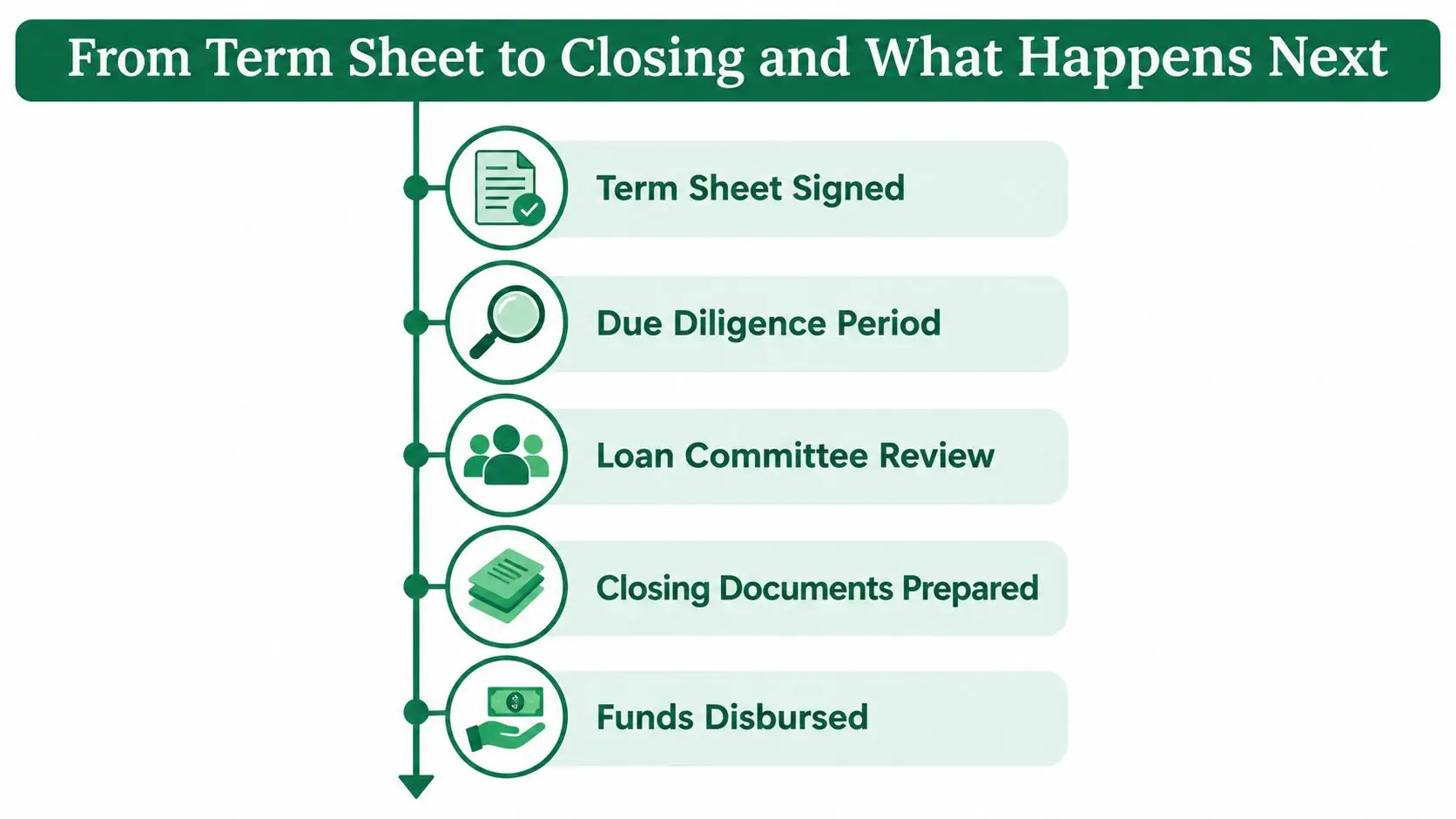
A signed term sheet starts the most demanding part of an SBA acquisition. The lender still needs to validate the borrower, business, collateral, cash flow, purchase structure, and closing conditions before funds can be disbursed.
Run the financing and diligence tracks together
After signing, the buyer should finalize the LOI or purchase agreement, deliver a complete loan package, and open the lender's diligence requests immediately. The lender may request personal financial information, business financial statements, tax returns, projections, ownership documents, leases, licenses, insurance details, and explanations for unusual transactions.
Third-party work can become a bottleneck. Order appraisals, environmental reports, equipment assessments, franchise reviews, and lease documents as soon as the lender confirms they're required. Waiting until underwriting is nearly complete can force the buyer to repeat work or delay the closing date.
A well-managed SBA acquisition often moves from term sheet to closing in 45 to 75 days, according to GoSBA Loans' stated process information. The actual schedule depends on borrower responsiveness, seller cooperation, diligence complexity, lender workload, third-party reports, and whether the SBA authorization and closing package are ready.
Use a written closing tracker
Track each item by owner, due date, status, and dependency:
- Borrower package: Financial statements, tax returns, personal documents, entity records, and required explanations.
- Seller package: Business records, purchase-price allocation, contracts, employee information, leases, and transition details.
- Lender review: Credit analysis, underwriting questions, loan committee approval, and SBA authorization.
- Third-party reports: Appraisal, environmental review, insurance, lien searches, and other required reports.
- Closing documents: Loan agreements, guarantees, security instruments, seller-note standby documents, purchase documents, and final settlement figures.
Keep the SBA loan closing checklist beside your transaction tracker, and ask the lender to identify which items are approval conditions versus final closing conditions. That distinction helps you prioritize work and prevents a technically approved loan from stalling at the finish line.
The day you receive a term sheet, calculate total cash to close, mark every binding clause, reconcile the loan structure with the purchase agreement, and request competing proposals if you haven't signed exclusivity. GoSBA Loans helps acquisition borrowers compare SBA lender term sheets covering loan amount, rates, amortization, and collateral, while supporting packaging, underwriting, third-party reports, and closing coordination. Visit GoSBA Loans to discuss your proposed structure and determine which lender terms fit the acquisition before you commit.
