You've likely lived some version of this already. You found a business worth buying. The seller is engaged, the broker is pushing for momentum, and you can already see how you'd run it better. Then financing starts, and the deal that looked straightforward turns into a maze of lender questions, changing requirements, and timeline pressure.
That's where most first-time buyers make a costly mistake. They judge a loan broker by one thing only: whether the broker says the deal is “financeable.” That's too shallow. In acquisition lending, especially SBA lending, the true test is what happens when the first path breaks. A weak lender match can burn weeks, trigger new diligence costs, and put your purchase agreement at risk. A strong broker doesn't just shop rates. They protect the deal when it gets stressed.
That distinction matters more now because the field is crowded and uneven. The U.S. loan brokers industry includes 18,807 businesses as of 2026, up 3.5% from 2025, while industry market size has declined at a 17.1% CAGR since 2021, which points to a fragmented market where expertise can be hard to find, according to IBISWorld's loan brokers industry profile. In plain English, there are plenty of people calling themselves brokers. Far fewer know how to structure and recover an acquisition loan under real-world SBA rules.
Table of Contents
- Introduction The Crossroads of Opportunity and Capital
- What Is a Business Loan Broker
- Analyzing the Pros and Cons of Using a Loan Broker
- When a Loan Broker Is Essential for Your Deal
- Navigating SBA Loans and Seller Financing Structures
- How to Choose the Right Business Loan Broker
- Your Next Step Toward a Successful Acquisition
Introduction The Crossroads of Opportunity and Capital
A buyer signs an LOI on a good business and feels like the hard part is done. It usually isn't. The hard part is getting from “seller agreed” to “funds wired” without the transaction dying in underwriting.
Business acquisitions create a specific kind of pressure. You're not just proving that you can repay a loan. You're proving that the business will keep performing through ownership transfer, that the deal structure fits lender policy, and that your cash injection, seller participation, and documentation all line up. One weak assumption can stall everything.
Why buyers hit the financing wall
Most first-time acquirers start with confidence and then run into a lender's internal credit box. The issue may be industry concentration, customer concentration, debt service coverage, management experience, lease term, or the way add-backs were presented. None of those problems are solved by enthusiasm.
A capable loan broker acts like a guide through lender fit, documentation, and timing. Not a magician. Not a lender. A guide who knows where deals usually break and how to prevent that break early.
Practical rule: The broker's first job isn't finding a lender. It's deciding which lenders should never see your deal.
That matters in a fragmented market. Plenty of brokers can collect documents and forward a package. Fewer can look at a business acquisition and tell you, before submission, whether the seller note needs to move, whether your equity is being sourced properly, or whether your background will satisfy a credit committee.
If you're trying to understand how financing strategy affects a growing company beyond the acquisition itself, this guide on business expansion financing options is a useful companion read.
What good guidance feels like
Good brokerage work is calm, specific, and unspectacular from the outside. The buyer gets a clean document list. The seller gets clear expectations. The lender gets a package that answers obvious questions before they ask them.
Bad brokerage work feels reactive. Terms keep changing. The borrower hears “that should be fine” too often. A lender decline arrives late, and nobody has a recovery plan.
That's the crossroads. Opportunity is in front of you. Capital is the gatekeeper. The right loan broker helps you cross. The wrong one adds friction at every step.
What Is a Business Loan Broker
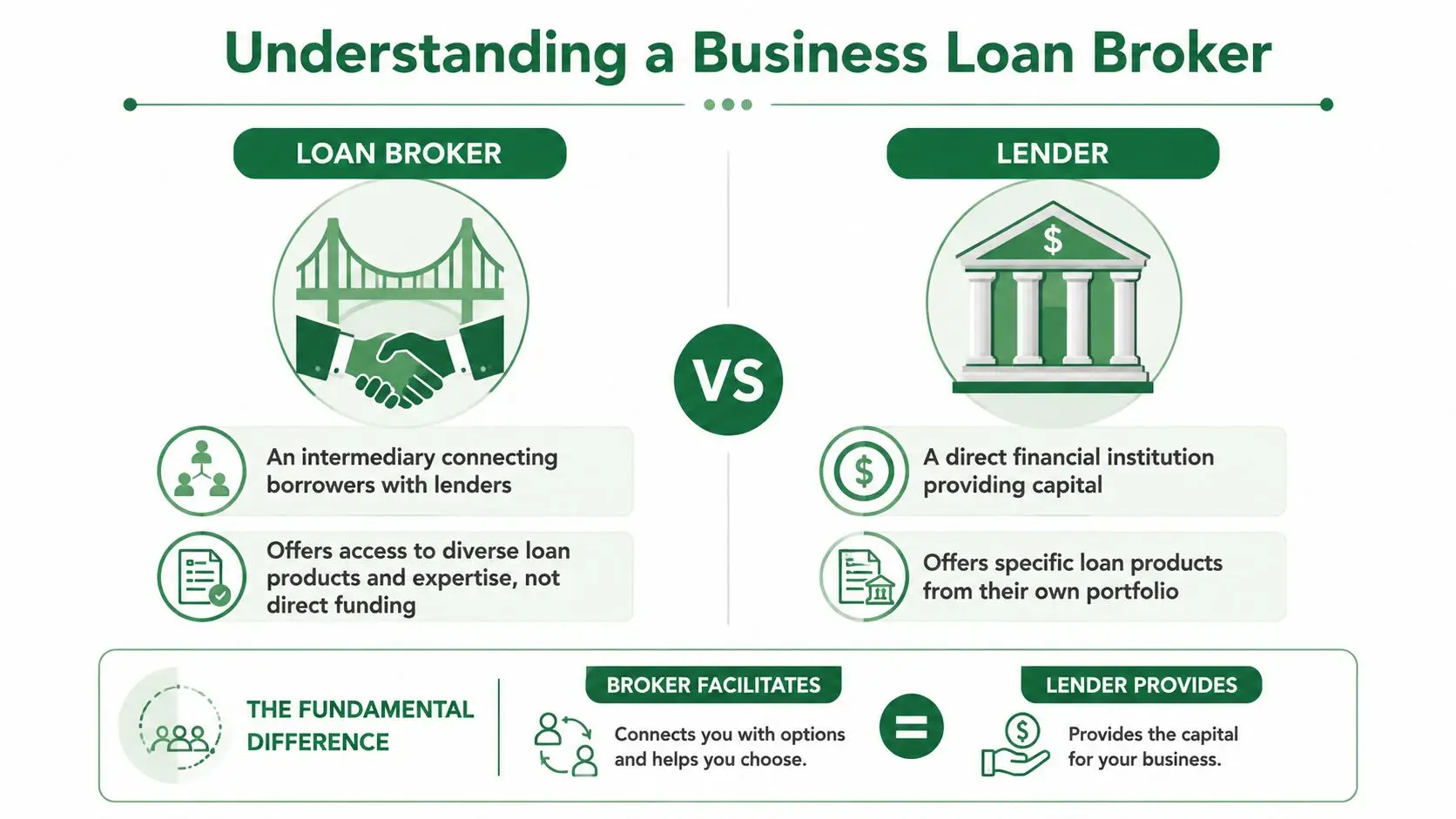
A business loan broker is an intermediary who helps a borrower find and secure financing from lenders. The broker doesn't lend their own capital. Their job is to understand the transaction, identify realistic lender matches, package the request properly, and manage the process until closing.
For a business buyer, the closest analogy is a strong buy-side advisor in real estate. You can walk into one bank and ask for a loan, just like you can call one listing agent and hope for the best. Or you can work with someone whose value comes from market knowledge, lender access, and process control.
Broker versus lender
A lender offers its own credit products, under its own policy, through its own credit team. If your deal doesn't fit that lender, you start over somewhere else.
A broker works across multiple lender relationships. That changes the conversation from “Can this bank do my deal?” to “Which lender is built for this deal?” That's a major difference in acquisition finance, where structure often matters as much as borrower quality.
If you want a focused explanation of the broker's role in SBA transactions, this breakdown of what an SBA loan broker does gets into the day-to-day mechanics.
How a broker gets paid
The economics matter because incentives matter. Loan brokers generate revenue through commission or fee structures tied to loan origination volumes, and their profitability is directly linked to getting the loan closed because commissions are calculated on the settled dollar value of each loan, according to the OSHA SIC manual entry for mortgage and loan brokers.
That alignment is real, but it isn't perfect. A broker wants a closing. You want the right closing. Those aren't always the same thing. A disciplined broker will tell you when a lender's term sheet looks attractive on the surface but creates problems in diligence, collateral, guaranty scope, or timeline.
What a good broker actually does
A serious broker doesn't just circulate your tax returns. They shape the transaction into something a lender can approve.
That usually includes:
- Pre-screening the story: They identify weaknesses before a lender does.
- Selecting lender fit: They match the deal to credit appetite, loan size, and structure tolerance.
- Managing submission quality: They assemble a package that anticipates underwriting questions.
- Controlling communication: They keep borrower, seller, lender, and closing parties moving in the same direction.
A loan broker earns their keep before the term sheet and after the first problem.
If a broker can't explain why a deal fits a specific lender, they're not brokering. They're forwarding email.
Analyzing the Pros and Cons of Using a Loan Broker
Using a loan broker can make an acquisition easier, but it can also make it messier if you pick the wrong one. The trade-offs are real. Buyers should look at this the same way they look at the target business itself. What advantage are you buying, and where can execution fail?
Where a broker helps
The strongest argument for using a broker is lender access combined with structuring judgment. That matters more as lending channels shift. In the U.S. mortgage and loan broker market, brick-and-mortar brokers held 48.15% of revenue share in 2025, while online brokers are projected to expand at a 4.90% CAGR through 2031, and non-qualified mortgages and business loans are projected to grow at a 4.75% CAGR, according to Mordor Intelligence's U.S. mortgage brokers market report. The practical takeaway is simple: financing options are changing, products are getting more specialized, and borrowers often need help navigating that complexity.
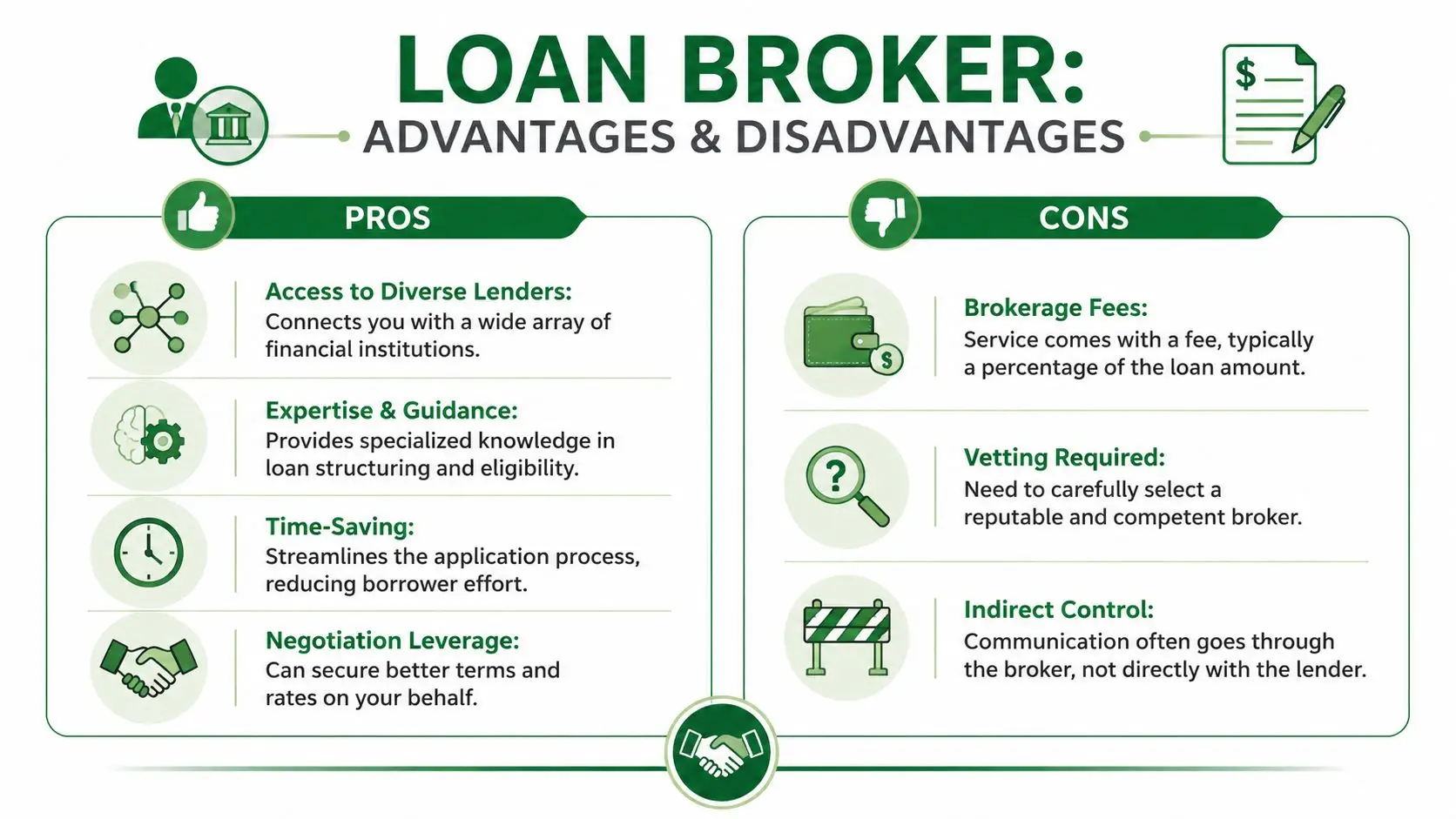
A good broker can help in ways a direct lender usually won't:
| Advantage | Why it matters in an acquisition |
|---|---|
| Broader lender reach | One decline doesn't force a complete restart |
| Better initial fit | The deal goes to lenders whose policy and appetite actually match it |
| Sharper structuring | Seller notes, equity sourcing, and collateral issues get addressed earlier |
| Process management | Buyers avoid getting trapped between seller pressure and lender silence |
For buyers weighing direct applications against broker-led execution, this comparison of a business loan broker vs direct lender is worth reading.
Where a broker can hurt the process
Not every broker improves outcomes. Some add a layer without adding judgment.
Common problems include:
- Weak lender matching: A broker blasts the deal too widely or sends it to the wrong lenders.
- Shallow SBA knowledge: They know generic commercial lending but not the policy details that govern acquisition loans.
- Communication drag: The borrower, seller, and lender hear different versions of the same story.
- Incentive drift: The broker pushes the easiest closing, not the best structure.
A poor broker can also damage lender confidence. When a package is sloppy, the lender doesn't just blame the broker. They assume the borrower is disorganized too.
The real decision standard
The question isn't whether a broker charges for value. The question is whether the broker reduces avoidable risk.
If your deal is simple, your banking relationship is strong, and the lender already knows your industry, a direct path can work well. If your transaction includes seller financing, a first-time buyer, a tight close date, or any unusual underwriting issue, broker expertise becomes far more valuable.
The best brokers reduce friction. The wrong ones multiply it.
When a Loan Broker Is Essential for Your Deal
Some deals can survive a clumsy financing process. Business acquisitions usually can't. The purchase agreement has a clock. The seller has a backup plan. Due diligence expenses start stacking up. Once that machinery starts moving, a weak financing strategy becomes expensive fast.
A loan broker becomes essential when the transaction has little room for lender mismatch. That's especially true for first-time buyers using SBA debt, deals with seller participation, or acquisitions where the business story is solid but not perfectly conventional.
The hidden cost of rejection
Most buyers obsess over approval odds. They ask a broker, “What's your success rate?” That's not the best question.
A better question is what happens after a rejection. Existing industry advice often ignores the hidden cost of rejection, even though a broker's true value lies in avoiding weak lender matches and recovering a deal after an initial decline so the borrower doesn't waste time and money on a dead end, as discussed in this analysis of questions borrowers should ask a loan broker.
If the first lender says no for a structural reason, the problem usually follows you to the next lender unless someone rewrites the structure.
That's why experienced brokers spend so much time on pre-submission screening. They're not being slow. They're protecting the only asset a live acquisition deal can't easily replace, which is time.
Situations where a broker moves from helpful to necessary
Here are the situations where I'd treat broker involvement as a practical requirement, not a convenience:
- First-time business buyers: You may understand the target company but still miss what a lender cares about in transfer risk, post-close liquidity, or guarantor strength.
- Seller-financed transactions: These deals can work well, but only if the note terms support the loan structure instead of colliding with it.
- Credit story with nuance: A past issue doesn't always kill a deal, but it must be framed correctly and matched to the right lender.
- Industry-specific underwriting: Some lenders are comfortable with one business model and cautious with another, even if both look attractive to a buyer.
- Tight closing windows: Every unnecessary submission or revision burns days you probably don't have.
What deal recovery looks like in practice
When a lender declines, a strong broker doesn't just forward the decline notice and say they'll “shop it around.” They diagnose why the file failed. Was it debt levels? Experience? lease term? customer concentration? cash flow treatment? citizenship eligibility? seller note terms?
Then they decide whether the deal is recoverable and how. Sometimes recovery means changing lenders. Sometimes it means changing the structure. Sometimes it means telling the buyer to renegotiate the purchase terms before going back out.
That's the part most buyers never see coming. The value isn't only in finding capital. It's in preserving a good acquisition when the first version of the financing plan doesn't hold.
Navigating SBA Loans and Seller Financing Structures
A capable loan broker proves whether they know acquisition finance or just know how to collect files. SBA deals don't reward improvisation. The structure has to work under current policy, and the current public source of truth is the SBA SOP and the lender's application of it.
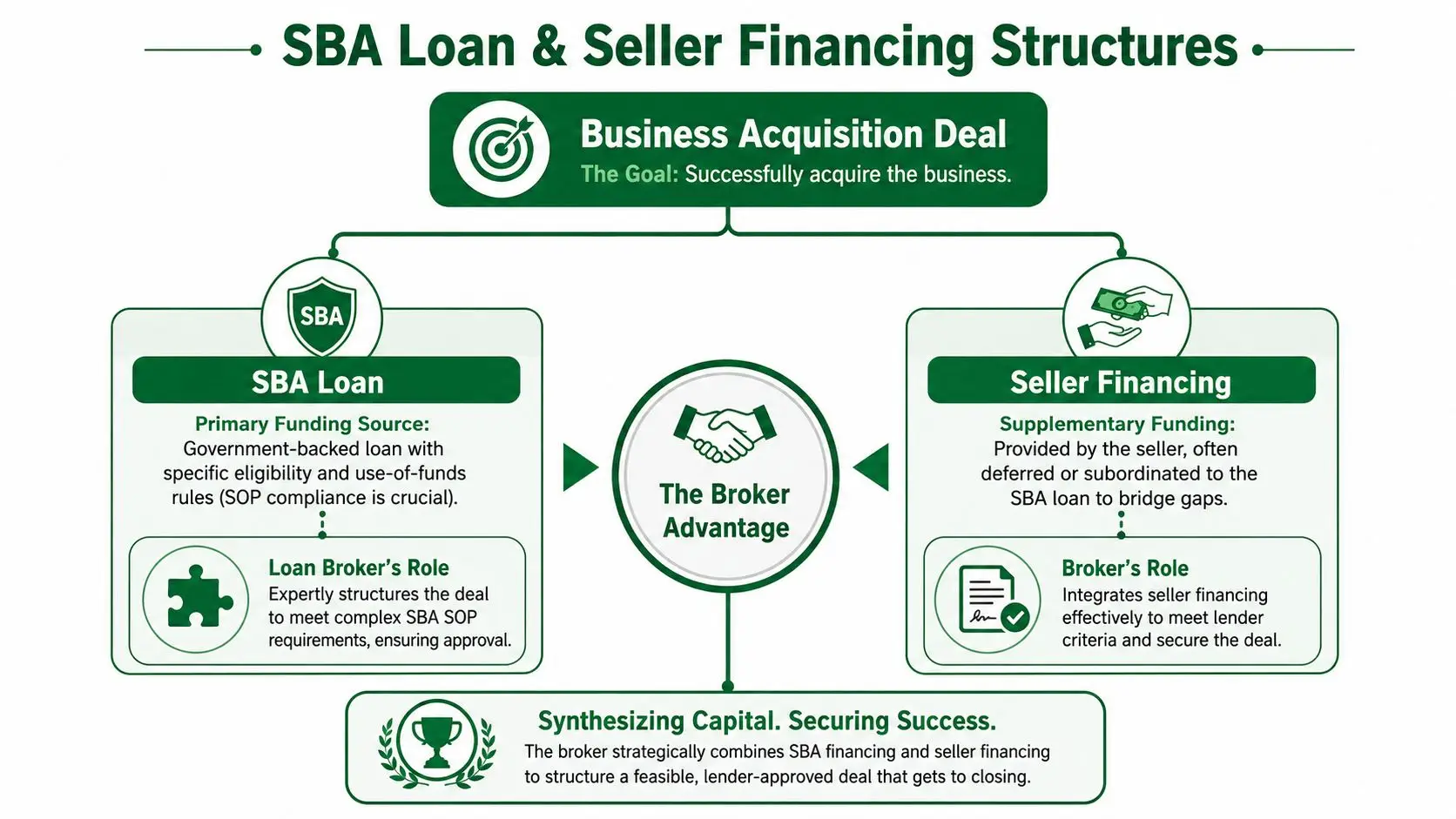
For change-of-ownership transactions, SBA SOP 50 10 8 requires a minimum equity injection of exactly 10%, and if a seller note is used to cover up to 5% of that requirement, it must be on full standby with no payments for the entire term of the SBA loan, as summarized in Live Oak Bank's review of SBA SOP 50 10 8. That single rule shapes a huge number of acquisition structures.
What the equity injection rule means in plain English
Many buyers hear “seller note” and assume the seller can finance whatever gap exists. That's not how a compliant SBA acquisition structure works.
Under current policy, the buyer must satisfy the required equity injection with acceptable sources. If part of that injection is being supported by a seller note, the note has to be drafted and positioned correctly. “Full standby” means no principal or interest payments for the life of the SBA loan. Buyers often miss that. Sellers often dislike it when they hear it late.
A broker who understands this rule will address it early, not after the lender issues a conditional approval.
Where seller financing helps and where it doesn't
Seller financing is useful, but only when it solves the right problem. It can bridge a valuation gap, support buyer liquidity, or help align the seller with a successful transition. It does not excuse sloppy underwriting or replace required policy compliance.
For buyers who want a broader grounding in how seller carry structures work outside the SBA frame, this explanation of owner financing for investors is a helpful reference.
A strong loan broker will usually pressure-test these points before circulating a deal:
- Standby terms: Does the seller understand what they're agreeing to?
- Documentation: Are note terms consistent with lender and SBA requirements?
- Use of proceeds: Is everyone clear on what the SBA loan can and can't fund?
- Buyer liquidity: Is the injection being sourced in a way the lender can verify cleanly?
If you want a deeper look at how these pieces interact in acquisition lending, this guide on seller financing for business acquisition deals is useful.
Other SBA rules that can change the deal
Eligibility rules can kill a transaction even when cash flow looks fine. As of March 1, 2026, SBA Policy Notice 5000-876441 requires 100% of all direct and indirect owners of a business applying for SBA financing to be U.S. citizens, U.S. nationals, or lawful permanent residents, with no allowance for any ownership by non-citizens, according to Lendio's summary of SBA loan requirements. That means ownership structure has to be reviewed carefully before anyone assumes SBA financing is available.
SBA guaranty mechanics matter too. For most 7(a) loans, the SBA guarantees up to 85% of loans of $150,000 or less and up to 75% of loans above $150,000, with a maximum guaranteed exposure of $3.75 million, while standard 7(a) loans cap at $5 million total principal, based on the SBA's 7(a) terms, conditions, and eligibility page. Those figures shape lender appetite, especially on larger acquisition requests.
A clean SBA structure isn't just about getting approved. It's about avoiding a late-stage policy conflict that forces the whole deal back into negotiation.
You'll also hear terms like pari passu in more layered transactions. In practice, that refers to parties sharing a collateral position or repayment priority in a way the lender and counsel have to document properly. It's not a phrase buyers need to master on day one, but it is a sign that the capital stack has moved beyond simple bank debt.
This is why buyers shouldn't DIY the structure from forum posts and half-remembered deal anecdotes. Acquisition lending gets technical fast. The broker's value is in keeping the structure both financeable and compliant.
How to Choose the Right Business Loan Broker
A broker earns their keep when the deal stops being clean.
The true test usually shows up after LOI, when underwriting finds a customer concentration issue, questions add-backs, pushes back on a seller note term, or declines the file outright. At that point, a weak broker has already burned time, seller trust, diligence dollars, and sometimes the buyer's credibility with the next lender. A strong broker protects against that damage early and has a recovery plan if the first path fails.
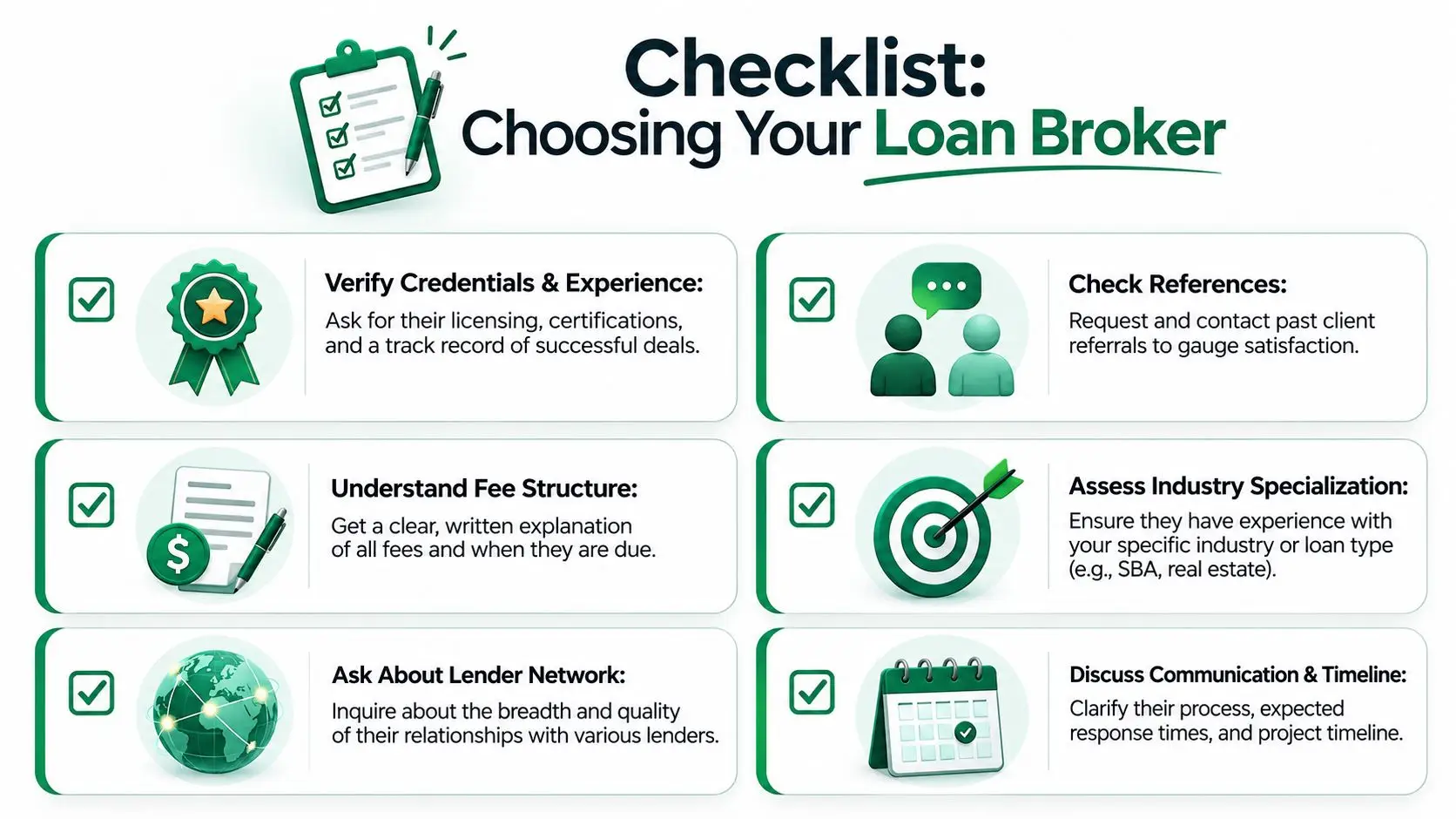
Questions that reveal competence
Ask questions that expose judgment under pressure, not just sales polish.
- What happens if the first lender declines? Good answers include a specific recovery process, what feedback they expect to get from credit, and how they reposition the file without starting from zero.
- How do you choose lender fit for my deal? They should talk about industry exposure, debt service coverage, buyer experience, collateral, loan size, and any structure points that could trigger credit resistance.
- What would make this deal hard to place today? An experienced broker should identify weaknesses before underwriting does.
- Who pays your fee, and when is it earned? Fee timing matters. So does whether the broker gets paid for a closed loan or for generating activity.
- What documents do you review first, and what are you trying to rule out? The right answer shows they know how to kill a bad path early and protect the timeline.
For a more detailed buyer-side checklist, this guide on how to choose an SBA loan broker is practical.
If the target is a software company, financing and valuation should be checked together. Buyers who overpay create financing problems that no broker can fix later. This guide on how to value SaaS businesses is a useful reference before lender discussions harden around a purchase price.
Red flags that should end the conversation
Some problems show up on the first call. Others only become obvious after the broker has already sent your deal into the market.
| Red flag | What it usually means |
|---|---|
| They guarantee approval | They are selling confidence, not underwriting judgment |
| They cannot explain why a lender would decline the deal | They do not understand credit well enough to protect the process |
| They push for broad submissions before diagnosing the file | They are increasing exposure and reducing your recovery options |
| They avoid clear fee terms | Expect friction once the deal gets serious |
| They cannot describe a failed deal they helped salvage | They may only be useful when the transaction is easy |
Ask the broker to walk through a real decline, what caused it, what changed, and whether the deal closed. Recovery skill matters more than a polished approval story.
What good looks like in practice
A capable broker can explain your deal in lender language, identify the likely objections, and tell you what gets fixed now versus what can wait for underwriting. That is different from saying the business has strong cash flow or a good story. Credit committees do not lend on adjectives.
I look for brokers who know the hidden cost of a bad first submission. A careless package can label the deal as weak, create inconsistent explanations across lender calls, and force the buyer to spend the next few weeks repairing preventable damage. In acquisition lending, recovery is part of execution.
GoSBA Loans is one example of a firm operating in this category, working on SBA acquisition financing, working capital, and owner-occupied real estate, and coordinating lender proposals with post-LOI underwriting support. Whether you use that firm or another, use a simple standard. Can the broker screen the deal accurately, place it with a suitable lender, and keep it recoverable if the first answer is no?
If the answer is unclear, keep looking.
Your Next Step Toward a Successful Acquisition
A business acquisition rarely fails because the buyer wanted the wrong thing. It usually fails because the financing path was weaker than the buyer realized. A strong loan broker helps by doing three jobs well: matching the deal to the right lender, structuring it within real SBA rules, and keeping the transaction recoverable when something goes sideways.
That last point matters most. Buyers tend to focus on approval. Experienced deal people focus on resilience. Can this transaction survive a lender question, a documentation issue, a seller note revision, or a policy conflict without collapsing? That's where broker quality shows up.
If you're still underwriting the target itself, valuation discipline matters too. For software and recurring-revenue companies, this guide on how to value SaaS businesses is a useful framework before you lock in financing assumptions.
The next step isn't to spray your deal across the market. It's to get a serious assessment of fundability, structure, and likely lender objections before the clock runs out. If the transaction is strong, that process gives you speed. If the structure is weak, it gives you a chance to fix the problem while the deal is still fixable.
The buyers who close consistently aren't the ones who sound most confident at LOI. They're the ones who build a finance strategy that can survive underwriting.
If you're evaluating an acquisition and want a clear read on whether the structure is workable under SBA rules, GoSBA Loans can help assess lender fit, seller note treatment, equity injection issues, and the likely path from LOI to closing before you lose time on the wrong submission.
