You're staring at an LOI, the seller says they “prefer a stock sale,” and your lender is already asking questions about collateral, equity injection, and how the structure changes closing mechanics. That's a normal moment in a business acquisition, and it's exactly where buyers lose negotiating power if they treat structure like a legal detail instead of a deal-defining decision. Asset sale vs. stock sale is not a wording choice, it determines what you buy, what liabilities come with it, how the SBA lender underwrites it, and how much flexibility you have at closing.
| Decision area | Asset sale | Stock sale |
|---|---|---|
| What you buy | Selected assets and assumed liabilities | The entire legal entity |
| Liability exposure | Usually narrower | Usually broader |
| Buyer tax basis | Often stepped up | Usually preserved |
| Closing friction | Higher | Lower |
| Continuity | Can be disrupted | Usually cleaner |
| SBA posture | Often easier to isolate collateral | Often easier for continuity and assignment |
If you want the acquisition-finance angle in plain English, the GoSBA Loans guide to buying a business is worth reading before you lock in structure. I also tell buyers to compare their operating reality against their billing and contract workflow, because businesses with complex recurring relationships can create transfer friction that changes the deal, not just the paperwork. A useful example is the way subscription-heavy businesses have to think about assignment, invoicing, and continuity, which is why resources like SaaS billing insights can be surprisingly relevant when you're evaluating whether the company can move cleanly into a new entity.
Table of Contents
- Two Structures One Decision
- What Each Structure Actually Transfers
- Buyer and Seller Trade-offs Side by Side
- Tax Consequences Buyer and Seller Both Feel
- How Structure Affects SBA Acquisition Financing
- Three Real Deal Scenarios That Pick Different Structures
- Decision Checklist and Negotiation Levers
- Choosing Your Structure and Next Steps
Two Structures One Decision
You can get halfway through diligence and still be underestimating the power of this choice. A first-time buyer often starts with valuation, walks into the seller's banker call, and hears, “We're really looking for a stock deal.” That's the moment to slow down, because structure controls far more than who signs the closing docs. It changes tax treatment, liability exposure, transfer friction, lender posture, and the time it takes to get to fundable closing.
Start with what you're really buying
In a stock sale, you buy the equity of the company, and the entity keeps operating as the same legal person. In an asset sale, you buy the pieces you want, equipment, inventory, intellectual property, goodwill, and maybe certain contracts or licenses if they can be assigned. The distinction matters because the buyer in an asset deal can leave behind unwanted liabilities more cleanly, while the buyer in a stock deal is usually taking the whole legal shell with its history intact, subject to negotiated protections.
That's why I push buyers to stop saying, “Which structure is normal?” and start asking, “Which structure fits the risk I'm taking?” The answer depends on whether you care more about clean separation or smooth continuity. If you're still at the stage of framing the acquisition, the SBA loan process for buying a business gives you a practical view of how lenders react when structure is part of the underwriting story, not just the purchase agreement.
Practical rule: If the seller's preferred structure makes your lender nervous, you do not ignore it and hope it disappears later. You solve it before the LOI hardens.
For a buyer, that mindset keeps you from treating deal structure like an afterthought. It's the foundation. Everything else, price, escrow, seller notes, due diligence scope, and closing speed, sits on top of it.
What Each Structure Actually Transfers
The cleanest way to think about the difference is simple. An asset sale transfers selected business assets and only the liabilities specifically assumed in the purchase agreement. A stock sale transfers the whole legal entity, with assets and liabilities generally staying inside that entity. That's not just a legal nuance, it's the operating reality you'll live with after closing.
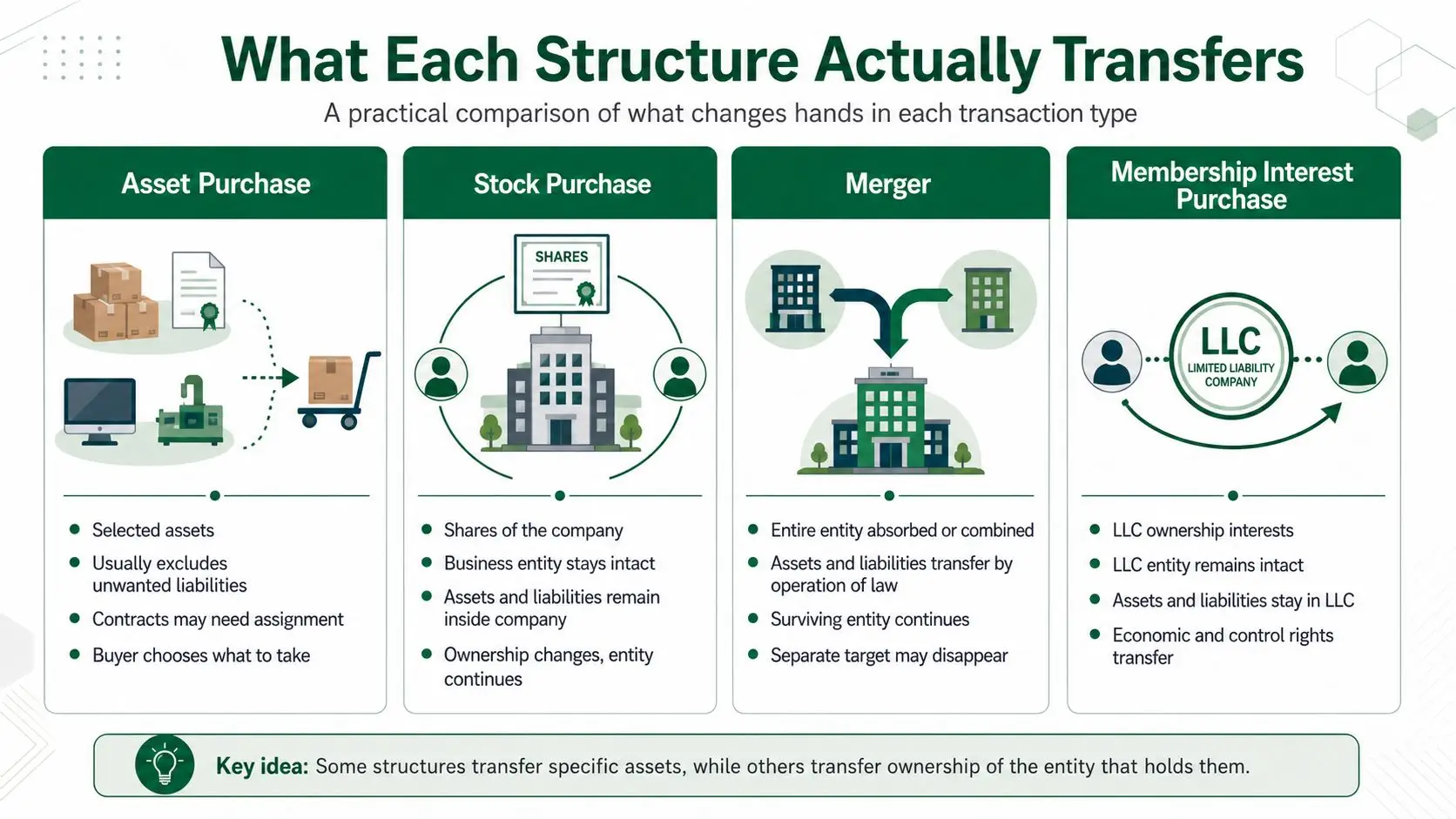
Visualize the transfer, not the label
In an asset deal, you can think in terms of picking up the assets that matter and leaving the rest behind. That can include tangible items like equipment and inventory, and intangible items like goodwill or intellectual property. In a stock deal, you're buying the company itself, so the contracts, permits, employees, and operating history usually remain attached to the same entity.
That difference becomes important fast. If the business has regulatory permissions, customer agreements, or vendor contracts that can't move easily, the buyer in an asset deal may have to chase assignments or re-paper approvals. In a stock sale, the legal wrapper survives, which can preserve continuity and reduce operational disruption. For a deeper legal framing, LifeBack Law Firm explains corporate structure in a way that helps buyers understand why the entity itself matters so much in a stock transaction.
A stock sale is often the faster path when the business runs on relationships, licenses, and continuity. An asset sale is often the cleaner path when the business carries baggage you don't want.
The SBA diligence process makes this even more practical, because your lender will want to know what is moving, what is being retained, and whether the deal leaves you with a financeable operating company. A solid business acquisition due diligence checklist for SBA loan buyers keeps you from missing asset-transfer friction that can blow up a closing later.
If you remember one thing, remember this. An asset sale lets you choose. A stock sale makes you inherit. Buyers need to know which problem they're solving before they accept either structure.
Buyer and Seller Trade-offs Side by Side
The right structure depends on what you're trying to protect. Buyers usually care about liability containment, basis step-up, and control over what comes over the fence. Sellers usually care about tax outcome, simplicity, and how likely the deal is to close without a messy rework. The tension is real, and it shows up in the exact points below.
| Criterion | Better in an Asset Sale | Better in a Stock Sale |
|---|---|---|
| Liability exposure | Buyer can usually isolate selected liabilities | Entity history stays intact, so continuity comes with broader exposure |
| Continuity of operations | Only if transfers are clean and approvals are easy | Usually stronger because the entity survives |
| Contract assignments | Buyer can reset relationships where needed | Existing contracts often stay in place |
| Employee transition | Can require more re-onboarding and admin work | Often smoother for payroll and continuity |
| Closing complexity | Higher, because assets, permits, and approvals must move individually | Lower, because the entity changes hands more directly |
| Post-closing flexibility | More room to leave problem items behind | More room to preserve the business as-is |
Which side wins depends on the business
If you're buying a company with murky historical liabilities, the asset sale usually gives you the cleaner starting line. If you're buying a business whose value sits in ongoing relationships and continuous service delivery, the stock sale often protects the operating machine better. That's why you can't reduce the decision to “buyers like assets, sellers like stock,” even though that's the default pattern.
The seller's motivation matters too. A stock sale can be far more attractive to an owner who wants a simple exit and doesn't want to reassign every agreement one by one. An asset sale can still win when the buyer is willing to pay for the certainty of leaving liabilities behind. If you need a lender-oriented valuation lens while you negotiate structure, the business valuation for SBA loans guide helps you think about what the bank will treat as supportable value.
Buyer's edge: if a seller insists on stock, ask which contracts, liabilities, or transition issues make that structure important. The answer usually reveals where your real negotiation leverage sits.
My opinion is blunt. If the business has any meaningful uncertainty around liabilities, an asset sale deserves serious default consideration. If the business lives or dies on continuity, a stock sale may be the more sensible operational choice, even if the buyer gives up some tax advantages.
Tax Consequences Buyer and Seller Both Feel
Tax is where structure debates usually get serious. In an asset sale, the buyer generally gets a step-up in basis, which means the acquired assets are revalued to fair market value for tax purposes. That can increase future depreciation and amortization deductions, which is one reason buyers like asset deals when the business has meaningful tangible assets, intangibles, or goodwill. In a stock sale, the buyer usually keeps the target's historic tax basis, so the future tax shield is less attractive.
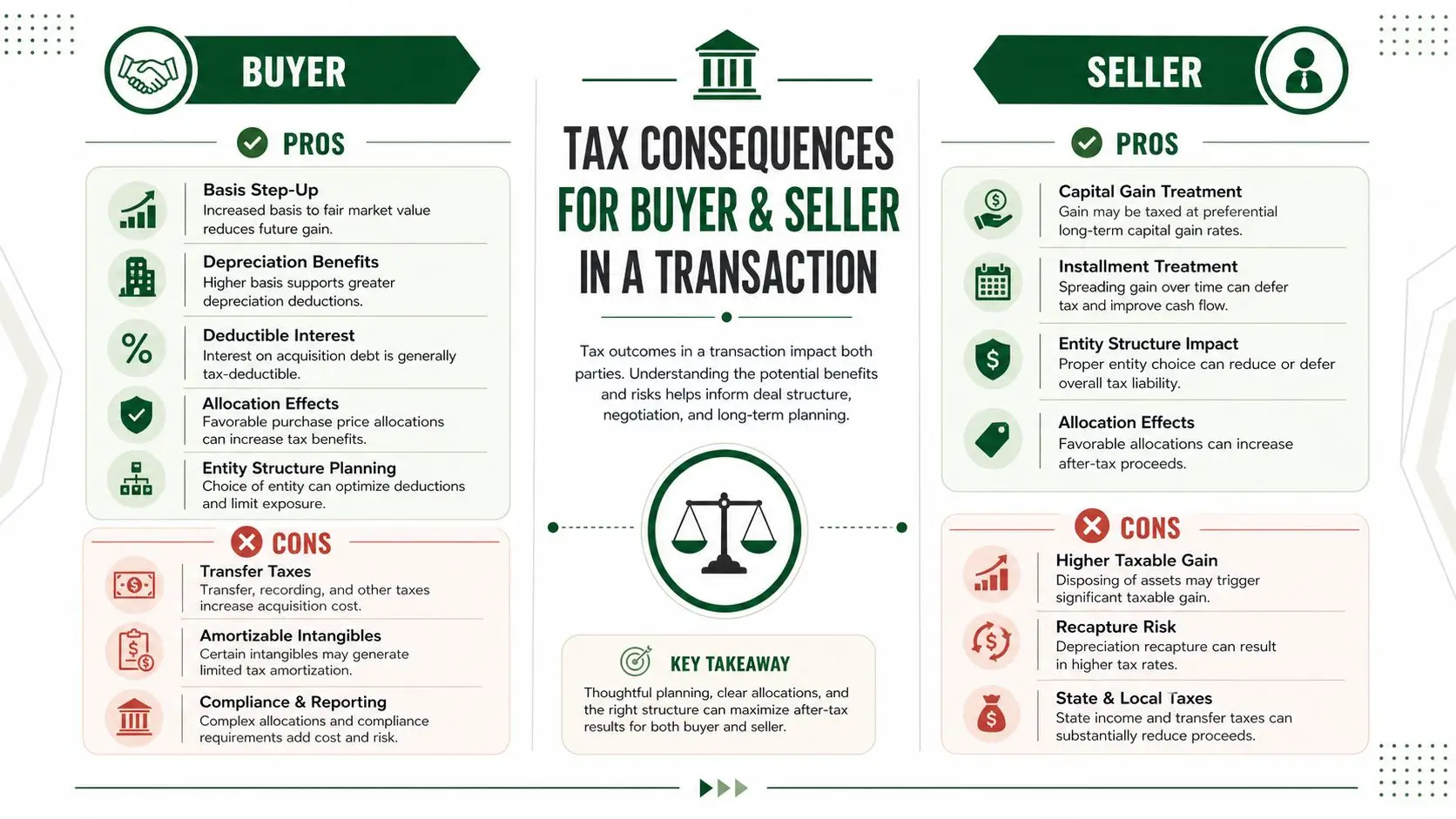
The buyer's math and the seller's pain are linked
From your side as the buyer, the tax step-up can improve post-closing cash flow because you may recover more basis over time. That matters most when the purchase includes equipment, amortizable intangibles, or goodwill that can be allocated in a way that supports future deductions. The seller, on the other hand, often sees the opposite pressure. Asset sales can create a mixed tax result, including ordinary income on depreciation recapture, while stock sales more often produce a cleaner capital-gains result.
That mismatch is why structure negotiation is really a pricing conversation in disguise. If the seller hates the tax bill from an asset sale, they may demand a higher price. If the buyer wants the basis step-up from an asset sale, that advantage can justify some of the premium. I see buyers make the mistake of arguing structure in a vacuum, when the core issue is after-tax net proceeds for both sides.
For a related ownership-transfer angle, the equity roll-over guide is useful because it shows how ownership economics can be reshaped without pretending the tax effects disappear.
Bottom line: if the seller's after-tax result gets much worse in an asset sale, expect that pain to show up in the purchase price or in their resistance to the structure itself.
My recommendation is simple. Model both structures before you negotiate final economics. If you don't know the seller's tax pain point, you're negotiating blind. And if you do know it, you can often use that information to bridge the gap without giving up the structure you need.
How Structure Affects SBA Acquisition Financing
SBA lenders don't treat structure as cosmetic. They care about what they are financing, what collateral they can attach, how the business will continue after closing, and whether the deal fits the SBA change-of-ownership rules. In practice, the structure can determine whether a lender views the transaction as clean and financeable or as something that needs extra work, extra documentation, and extra conditions. The wrong structure can slow the file down even when the business itself is solid.
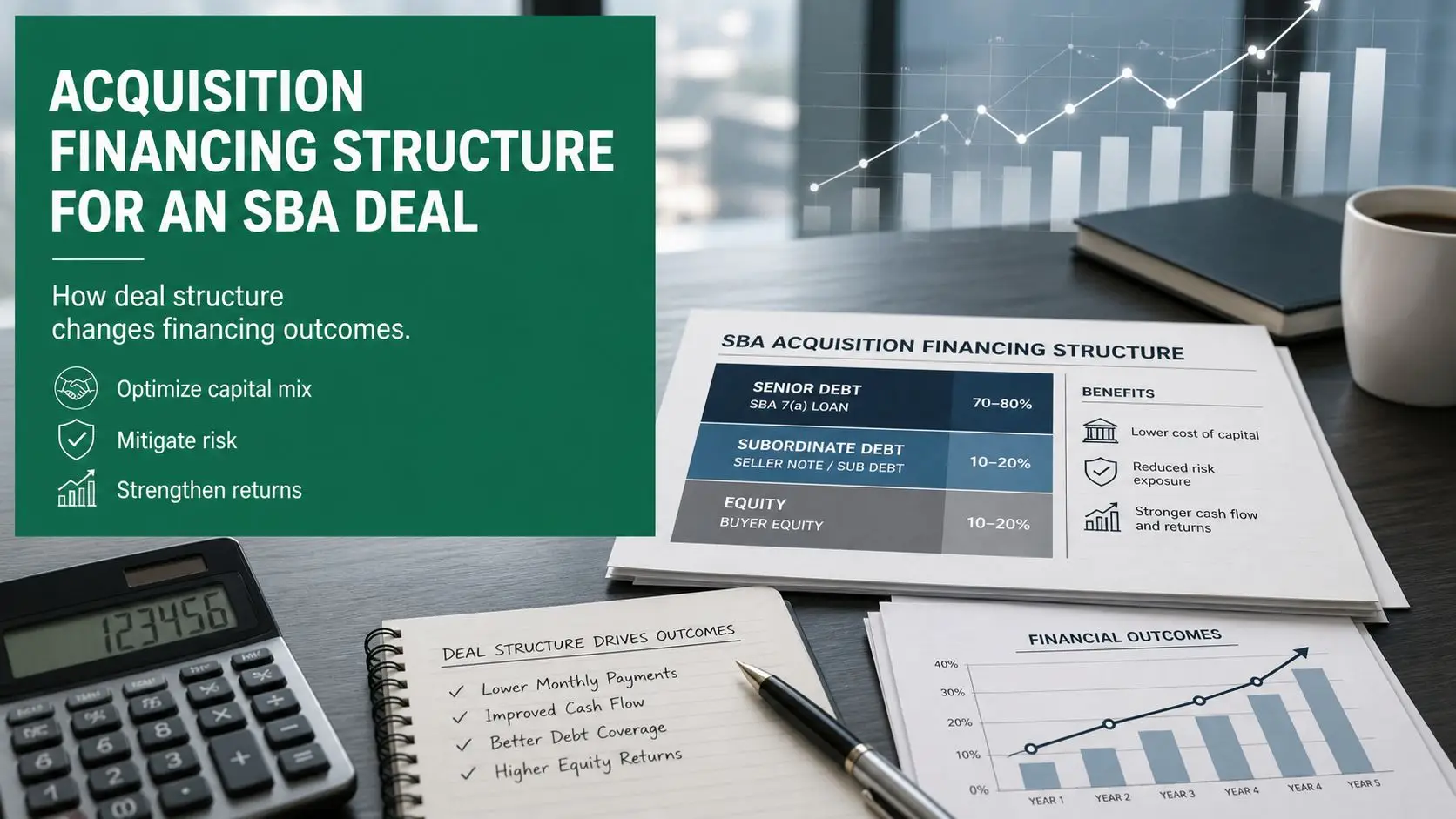
Why lenders look harder at structure than most buyers do
A lender funding an asset sale is usually focused on the business assets being pledged and the liabilities left behind. A lender funding a stock sale is looking at the continuing entity and whether the operating business stays intact enough to satisfy underwriting. That difference affects collateral assignment, closing documentation, and how much friction the lender expects around contracts, licenses, and approvals.
The other issue buyers need to understand is equity injection. Under the July 2025 change, the 5 percent minimum buyer equity injection became part of the acquisition conversation, and seller notes on full standby can be used in the equity stack in the right structure. That matters because a seller note on standby can help bridge the gap when the buyer is trying to reduce cash out of pocket, but the lender will still care about how cleanly the deal is documented and whether the note sits in the capital stack the way the SBA expects.
This is also where collateral posture gets real. An asset deal can make collateral easier to understand because the lender can tie the loan to identifiable assets. A stock deal can make continuity easier, but the lender still wants assurance that the business entity remains strong after closing. If you're negotiating seller financing alongside the structure, the seller financing for business acquisition guide is a good reference point for how standby treatment can affect the capital stack.
Practical rule: don't ask only whether the seller will accept stock or asset treatment. Ask whether the structure makes the SBA file cleaner or harder to underwrite.
My view is direct. If the lender is already wary, don't force an elegant legal theory that creates operational drag. Choose the structure that closes with the fewest unanswered questions, then negotiate the economics around it.
Three Real Deal Scenarios That Pick Different Structures
Manufacturing with environmental risk points to assets
A buyer looks at a small manufacturing shop with expensive equipment, some environmental history, and a few contracts that matter but aren't impossible to replace. Here, an asset sale usually wins. The buyer can take the equipment, inventory, and operating goodwill, while leaving behind legacy liabilities that don't belong in the new ownership plan. That's the kind of deal where clean separation matters more than preserving every old agreement.
My recommendation in that setup is asset structure, plain and simple. The buyer wants to control liability exposure and preserve only the parts of the business that drive future value.
Service business with recurring contracts points to stock
A second buyer looks at a service company whose value lives in recurring client contracts, trained employees, and a brand that customers already trust. If those agreements are hard to reassign, a stock sale often makes the most sense. The company keeps the same legal shell, which helps contracts, payroll, and day-to-day continuity stay intact.
That's the right answer when operational interruption would hurt more than the tax drag from a stock purchase. In this case, I'd usually advise the buyer to protect themselves through diligence, reps, warranties, and indemnification rather than try to force an asset structure that creates re-papering headaches.
High-goodwill business favors asset basis step-up
A third buyer is looking at a high-margin business where the intangible value is substantial and the tax benefits from basis step-up matter a lot. In that case, an asset sale can create meaningful tax shelter for the buyer over time. If the seller resists, the buyer needs to decide whether the tax advantage is worth paying for in the purchase price.
The right answer isn't universal. It's business-specific, financing-specific, and seller-specific.
My recommendation here is conditional. If the business has significant goodwill and the buyer plans to hold it long enough to benefit from the tax basis, the asset sale is often the smarter buyer-side move. If continuity matters more than deductions, don't overpay to chase a tax position you won't fully use.
Decision Checklist and Negotiation Levers
Before you sign an LOI, run the structure through a hard checklist. Start with liability exposure, because that tells you whether you need the clean break of an asset sale. Then test employee transition, contract assignment friction, tax posture for both sides, and whether your SBA lender will be comfortable financing the structure without extra conditions. If any one of those fails, the structure deserves to be challenged before price gets locked in.
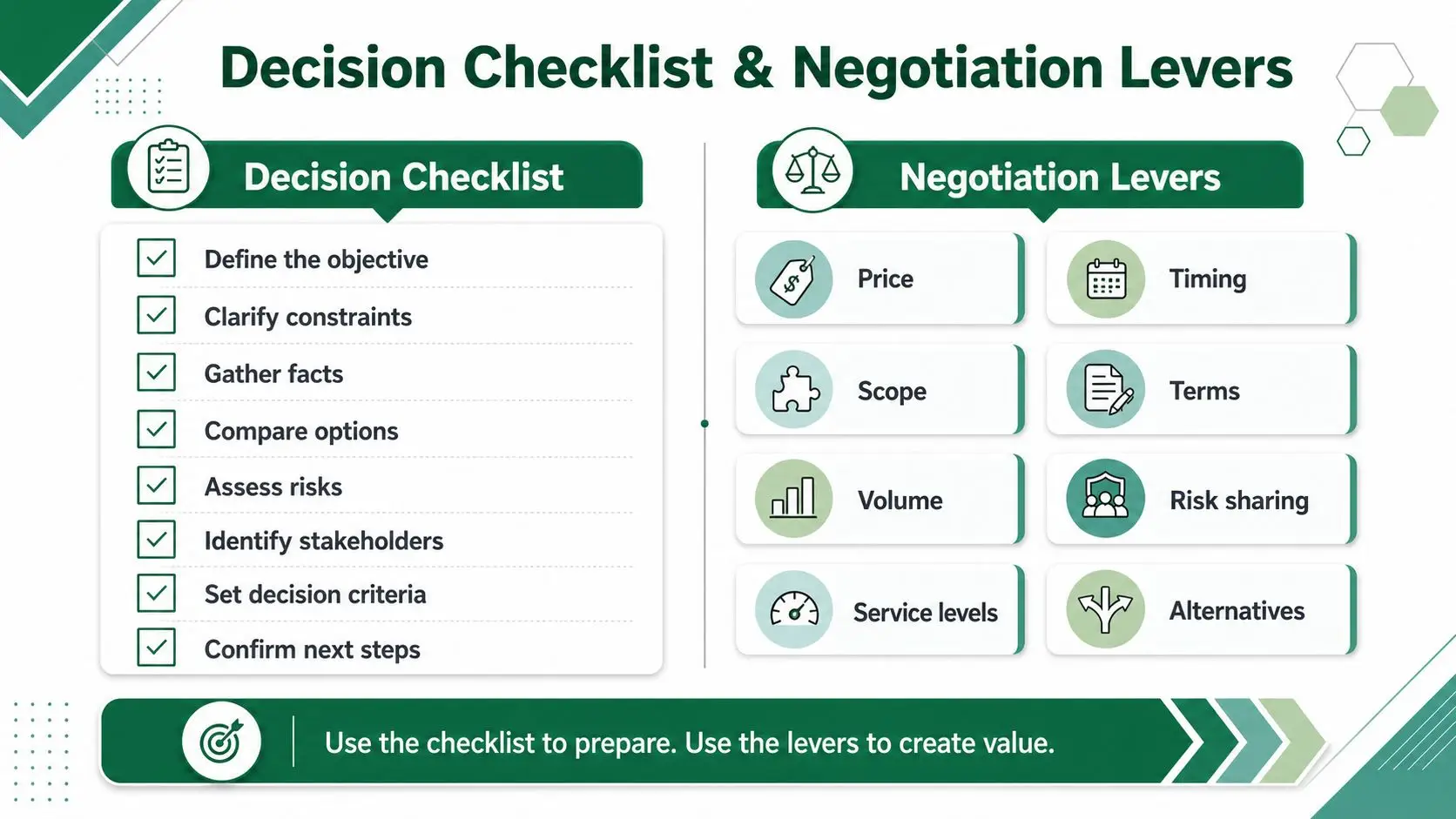
The levers that actually move a deal
- Price adjustment: If the seller strongly prefers a stock sale, you can sometimes trade structure for price. The point is not to “win” the argument, it's to keep the after-tax economics fair.
- Seller note on standby: A standby note can help support the equity stack and reduce your cash need if the lender accepts the treatment.
- Indemnification scope: In a stock deal, wider indemnity language often becomes a substitute for the liability protection you'd have gotten more naturally in an asset deal.
- Escrow: Escrow gives you a practical cushion when you inherit a broader liability profile or when transition risk is higher.
If the business has clean operations and the seller wants stock only to make their own tax result better, push for a price adjustment or stronger indemnities. If the business has messy contracts or historical exposure, push harder for an asset structure. If the structure choice is mostly about closing friction rather than real risk, negotiate the economics instead of forcing a rewrite.
A buyer shouldn't pretend every seller will budge on structure. Sometimes the right move is to accept the seller's preferred structure and make the price or protection package do the heavy lifting. That's not surrender, it's disciplined dealmaking.
Choosing Your Structure and Next Steps
Start with one question. What does the seller want, and why? If the answer is tax efficiency, continuity, or ease of execution, you can pressure test whether that goal aligns with your own financing plan and risk tolerance. If the answer is vague, treat that as a warning sign and dig deeper before the LOI gets too far along.
The next step is not to argue structure in the abstract. It's to tie structure to your lender conversation, your diligence plan, and your closing timetable. If the file needs a stock sale to preserve continuity, say so early. If you need an asset sale to control liabilities, say so before the seller anchors the process around their preferred form. For broader planning around ownership transition, business exit planning strategies can help you think about how structure affects the seller's exit path and why they may resist one form more than the other.
Structure should be decided before price is finalized, because structure changes what price means. A number that looks good in a stock sale can be the wrong number in an asset sale once taxes, liabilities, and SBA mechanics are all in the frame.
If you want help pressure-testing a deal structure before you sign, GoSBA Loans works with buyers on SBA acquisition financing, lender matching, and closing coordination for business purchases. Visit GoSBA Loans to get the structure, financing, and lender strategy aligned before the LOI turns into a problem.
