You're probably at the point where the bank likes your business, likes your numbers, then tells you the structure doesn't fit. Maybe you're buying a company, maybe you're expanding, maybe you just need working capital and the first round of lender feedback keeps circling back to the same problem, too much risk for the bank to carry alone. That's where the California Guarantee Program starts showing up in deal conversations, and that's also where most buyers get the wrong idea about what it does.
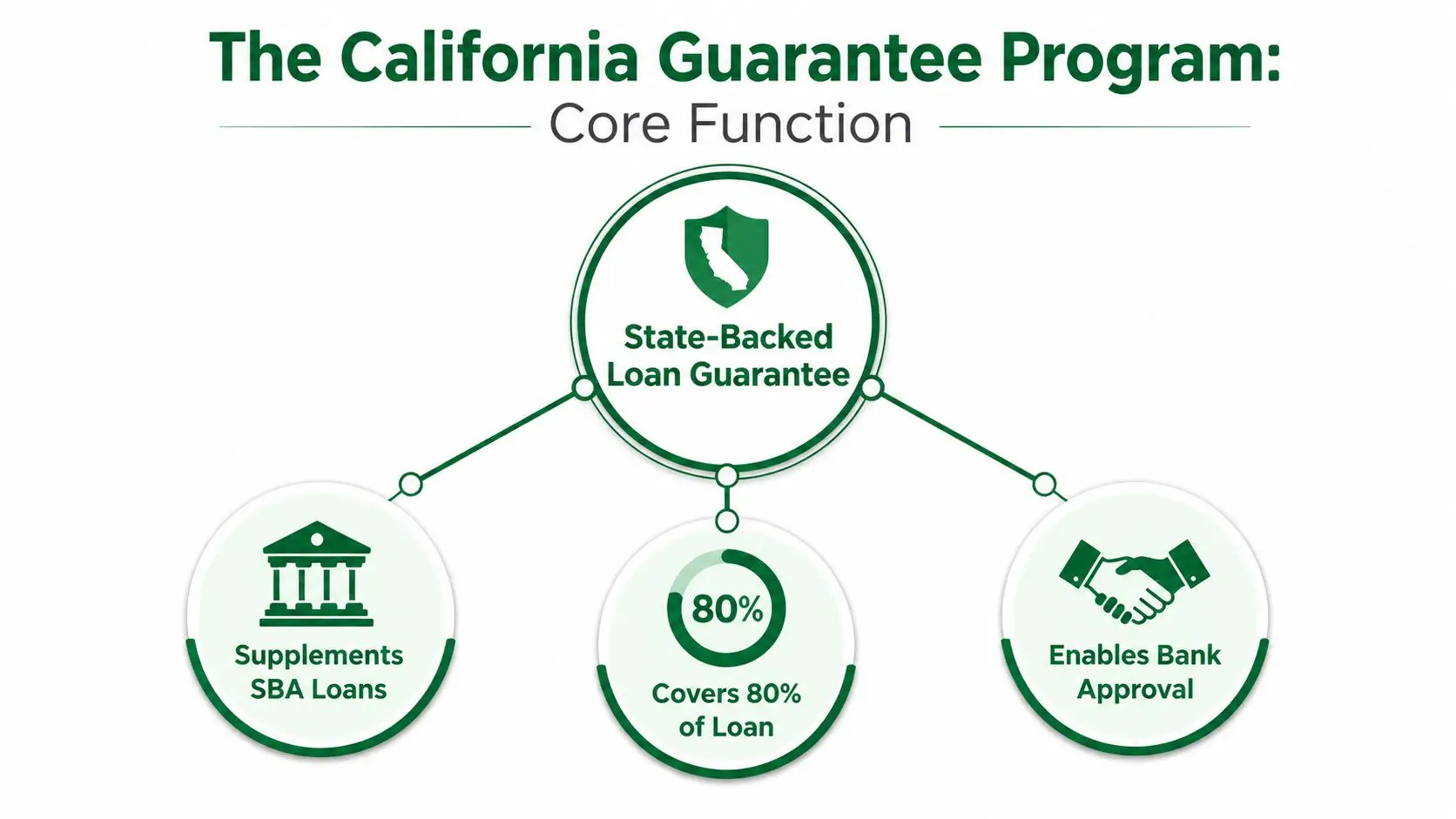
The short version is simple. This is a credit-enhancement program, not a direct lender. The state does not write you a check, it supports a participating lender by guaranteeing part of the loan, which can make approval more realistic when the bank wants protection on the downside. California's Small Business Finance Center reported that in fiscal year 2020 to 2021 it guaranteed 1,978 loans, generated more than $184.7 million in loan guarantees, and supported more than $241 million in small-business loans, with more than $228 million in overall capital injected into California's small-business community in that same year (California Small Business Finance Center annual report).
That scale matters, but the structure matters more. The program's real value is not hype around a headline guarantee percentage, it's the way the guarantee changes lender behavior, underwriting, and the borrower's odds when the deal is otherwise sound. If you understand the channels, the nonprofit FDC layer, and the eligibility filters, you'll know whether this is the right lane or just a shiny distraction.
Table of Contents
- What the California Guarantee Program Does
- How the Guarantee Mechanics Work
- Who Qualifies and Who Gets Rejected
- Comparing California Guarantee Program to SBA Options
- When This Program Makes Sense for Business Buyers
- Application Process and Required Documentation
- Next Steps and Decision Framework
What the California Guarantee Program Does
A buyer gets turned down twice on a conventional acquisition loan. The business is real, cash flow is present, and the seller is cooperative, but the bank still wants less exposure than the deal can support. The California Guarantee Program can turn that kind of file from a flat rejection into a live conversation because it reduces lender risk without taking lender judgment out of the process.
The program is a backstop, not a bank
The state guarantees part of the loan made by a participating lender. It does not originate the debt, it does not underwrite like a retail bank, and it does not work like a direct lending fund. The lender still makes the credit decision, but the guarantee can make the file workable when the lender is weighing downside risk against a borrower with a solid profile.
That distinction matters because this program sits beside federal SBA lending, not inside it. California built its own credit-enhancement channels to support small businesses in the state, especially where traditional bank appetite is thin. Borrowers need to ask a lender whether the guarantee fits the deal structure, not whether the state will hand over money on its own.
Practical rule: If the deal only works when someone ignores underwriting, the guarantee will not save it. If the deal works but the lender wants more protection, this program becomes useful.
The program also sits inside a wider financing stack that includes federal SBA products and state-specific channels. The business expansion financing framework helps show why the guarantee should be treated as one piece of capital, not the entire answer. For borrowers building an acquisition plan or expansion budget, that separation matters because the paperwork, lender selection, and local delivery network all affect whether the file moves.
The state's annual report shows the program is large enough to matter, but not so broad that it becomes automatic. The policy manual sets the operating terms, and the county-level delivery system creates another layer of review before a lender treats the guarantee as real support. One channel can be routed through nonprofit FDCs, which is exactly where many borrowers get surprised. They expect a simple state program. They get a lender, a local intermediary, and a county-specific process that all have to line up before the deal is cleared.
That is why headline guarantee numbers mislead borrowers. The number matters, but eligibility, structure, and delivery channel matter more. The right question is not how large the guarantee sounds in a brochure. The right question is whether the lender, the local administrator, and the program rules all accept the same file. That is the difference between a program that looks generous on paper and one that funds a business.
How the Guarantee Mechanics Work
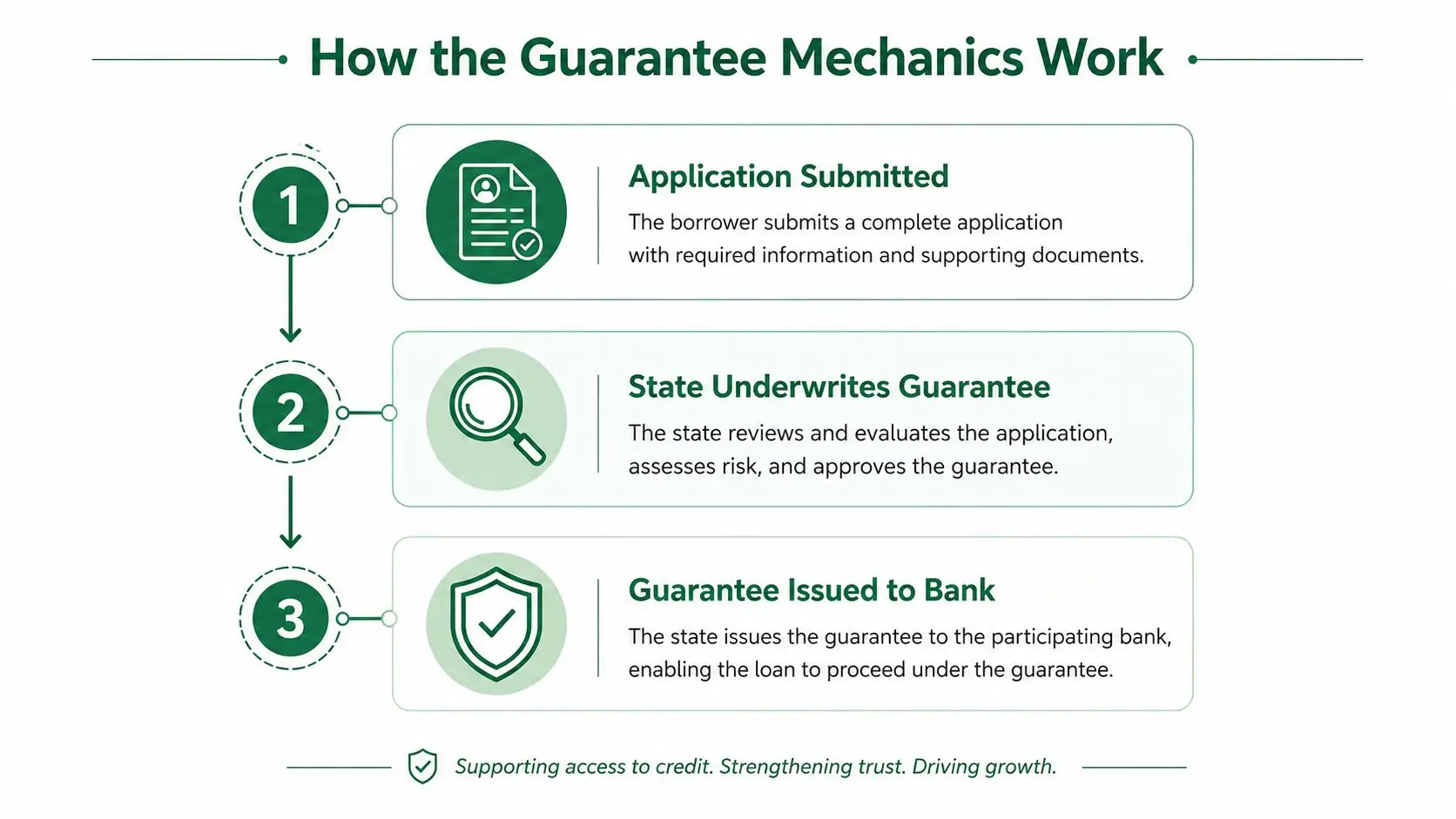
The mechanics are simple once you stop reading the brochure and start reading the credit file. The guarantee shifts part of the lender's loss exposure to the state, which gives the bank room to approve a deal that fits the business but might fail under a straight balance-sheet review.
Step 1, know the exposure the lender is taking
California Infrastructure and Economic Development Bank materials say the Small Business Loan Guarantee Program can cover up to 80% of eligible loan amounts, with a maximum guarantee of $1 million in one reported structure, while program policy materials also describe guarantees up to 80% or $5 million, whichever is less, with a loan amount cap of $20 million and proceeds required to be used in California for an eligible business purpose (IBank annual report; SBLGP policy manual). That range matters because the headline guarantee is only part of the decision. The question is which program channel your file fits, and which cap the lender can use on your transaction.
Seasoned borrowers do not ask for a vague answer on size. They ask which track, which lender, and which guarantee ceiling applies to their deal. If your banker cannot answer that cleanly, the file is not ready.
Step 2, understand loss-sharing
If the borrower defaults, the guarantee only matters when the lender has followed the program rules and the structure qualifies for claim treatment. The lender still has credit discipline because it still keeps skin in the game. That matters on acquisitions, commercial real estate, and working capital lines where the bank wants repayment capacity, collateral logic, and a clean use of proceeds.
The state's design rewards underwriting, not shortcuts. That is why fixed or variable rates, secured or unsecured structures, and flexible amortization appear in the program framework. The lender can shape the deal around cash flow instead of forcing every borrower into a rigid box.
Step 3, know who administers the file
The program runs through 11 nonprofit Small Business Financial Development Corporations according to the state profile, and other California summaries describe nonprofit FDCs as part of the issuing network as well (U.S. Treasury SSBCI program profile; California SBLGP overview). That is where the process gets messy for borrowers. Your experience can change based on which FDC is handling the file, how that FDC reads the program lane, and how much support you get through underwriting.
County-level administration adds another layer. Two borrowers can walk in with similar balance sheets and get different answers because the local intermediary, the lender, and the program rules do not line up the same way on every file. That is the practical gap most guides miss, and it is why borrowers should read the SBA 7(a) guide alongside the state rules, since guarantee math alone does not close a deal.
Who Qualifies and Who Gets Rejected
A buyer calls a lender after getting turned down twice on a conventional acquisition loan. The business is real, the cash flow is there, the seller is cooperative, but the bank wants less exposure than the deal can support. The California Guarantee Program can move that deal from a hard no to a real conversation, because it is built to reduce lender risk, not to override lender judgment.
The business has to fit the program lane
California IBank says eligible applicants include small businesses with 1 to 750 employees, and proceeds can be used for start-up costs, construction, inventory, working capital, business expansion, agriculture, and lines of credit (IBank small business loan guarantees). That employee range tells you the program is built for small-business finance, not middle-market lending, and the allowed uses tell you the file has to fit a clean business purpose.
The deeper filter is channel and geography. The state profile points to nonprofit development corporations as part of the delivery structure, and the program is aimed at investment in low- and moderate-income areas (Treasury SSBCI profile). If the deal is outside the service area or misses the community target, strong financials will not fix it. I see borrowers lose time here because they focus on the headline guarantee and ignore the local intermediary that controls how the file is presented.
A file can look solid and still miss the program if the location, purpose, or FDC channel does not line up.
Don't confuse the channels
Confusion kills momentum. California materials and state-profile summaries show variation in guarantee percentage and maximum loan size depending on the channel, structure, and funding source. Some versions are described at 75% guarantees and $500,000 maximums, while other California program materials describe 80% guarantees and higher maximums, including up to $2.5 million in some structures (California state guarantee overview).
That mismatch is the trap. Borrowers read one summary, a lender describes another lane, and nobody is talking about the same structure. Start with the lender and the nonprofit FDC, then get the exact program lane in writing before you spend time on packaging. Use SBA loan requirements as a documentation benchmark, because the files that close are the ones with clean tax returns, debt schedules, source-of-cash detail, and a tight explanation of use of proceeds.
Rejection usually happens for practical reasons
The fastest denials come from weak documentation, a use of proceeds that does not match the lane, or a borrower asking the guarantee to cover a deal the lender already sees as stretched. Size, geography, and purpose drive most outcomes. If the business is too large, the location is off target, or the request falls outside program use, the file dies early.
That is the part many guides miss. The program is not a blank check, and the nonprofit FDC route adds another layer of screening before the bank ever feels comfortable. A strong borrower still gets rejected when the structure is wrong. I would rather clean up the file first than argue about the guarantee later.
For borrowers comparing state and federal paths, the structure matters more than the headline promise. The same discipline that keeps a bank file clean also helps on other public credit programs, including the VA loan guaranty for Charlotte.
Comparing California Guarantee Program to SBA Options
A business buyer can lose time chasing the wrong program if the lender and the nonprofit FDC are not talking about the same credit box. That is the difference here. The California Guarantee Program can make sense for a local deal, but only when the file fits the channel, the borrower fits the county-level process, and the lender is willing to work inside that structure. SBA options still matter because they are better known and easier to compare across lenders. If you are buying a business, start with SBA loan to buy a business so you can judge whether the state route is solving a real problem or just adding another layer.
| Feature | California Guarantee Program | SBA 7(a) |
|---|---|---|
| Guarantee structure | State-backed credit enhancement through participating lenders and nonprofit FDC channels | Federal guarantee through approved SBA lenders |
| Guarantee percentage | Can be structured up to 80% in some program lanes, with other channels described at 75% | Tiered federal structure, with a useful benchmark from USDA public credit programs showing that guarantee percentages often vary by loan size (USDA Business & Industry guarantees) |
| Maximum loan size | Reported program structures range up to $2.5 million in some channels and up to $20 million in IBank policy materials | Often used for broader nationwide small-business financing and larger capital needs |
| Geographic reach | California-focused, with target emphasis on local small-business communities | Nationwide through SBA lenders |
| Structure flexibility | Can support term loans, lines of credit, commercial real estate, and flexible amortization | Broadly flexible, but lender and SOP structure still drive execution |
| Best fit | Deals where a California lender needs local credit support and the borrower fits the state channel | Borrowers who want the most established federal path and broad lender access |
On paper, the California program can look stronger because the guarantee can be higher in certain lanes and the lender may have more room to structure the debt. That headline only matters if the borrower clears the nonprofit review and the county-level administration does not slow the file down. A deal that is slightly off target on geography, use of proceeds, or borrower profile can stall even when the guarantee looks generous.
SBA still wins on familiarity. Lenders understand the playbook, brokers know how to package it, and the approval path is easier to explain to a buyer who wants a plain answer. The state program can beat SBA when the lender wants local credit support and the structure needs to fit a California transaction more tightly. It can also lose to SBA when the borrower wants the widest lender search and the fewest moving parts.
For a business acquisition, I judge the choice by execution, not by the headline guarantee. If the seller note, equity injection, and debt service all line up cleanly, either path can work. If the deal already needs aggressive stretching, the guarantee will not fix the math. That is the same lesson you see in other guaranteed-credit programs, including the VA loan guaranty for Charlotte, the guarantee changes lender risk, but it does not make a weak file strong.
When This Program Makes Sense for Business Buyers
Use this program when the deal is solid but the lender wants more protection than a straight conventional loan will give. That's the sweet spot. It's especially useful when the transaction sits in California, the borrower is operating inside a targeted market, and the structure needs room for cash flow rather than a hard-edged repayment schedule.
The best fits are specific
A buyer purchasing a local service company, a light-manufacturing operation, or an owner-occupied facility can benefit when the lender wants shared downside protection and the borrower wants a more customized amortization structure. The same is true for working capital needs where the loan does the job, but the bank wants comfort around collateral and repayment timing. The program's structure is built for these situations, not for borrowers who are already easy approvals.
The best use cases usually share three traits.
- The lender likes the business but wants risk sharing. The file is close, not impossible.
- The borrower's location fits the California channel. Geography isn't cosmetic here.
- The repayment story is real. Cash flow can support the debt, even if the bank wants a stronger backstop.
If you're shopping a business acquisition, the program becomes more attractive when the seller note, equity injection, and debt service all line up cleanly. If the deal already needs aggressive stretching, the guarantee won't fix the math. It might get a lender to look twice, but it won't make a weak structure strong.
The program rewards clean files. It does not reward hope, loose projections, or seller-friendly terms with no bankable exit.
When to skip it
Skip it when you need nationwide lender competition, when the business sits outside the relevant California target area, or when your deal is large enough that you're better off pursuing a more established federal option. Skip it too if your lender can't explain which FDC handles the file or which guarantee track applies. Ambiguity in the early conversation usually becomes delay later.
The same caution applies to borrowers who think a guarantee means easier underwriting. It doesn't. It means a lender may say yes to a deal that already makes sense, with better risk-sharing on the back end. That's a big difference.

Application Process and Required Documentation
A file gets approved on paper before it gets approved in underwriting. Lenders and FDCs want proof of ownership, cash flow, use of proceeds, and program eligibility, with no gaps that force them to chase missing documents.
Start with the lender, then build the file backward
Start with a participating lender or FDC, not a broad online search. The lender decides whether the deal belongs in the California guarantee channel, and the FDC layer handles the program mechanics from there. If the first conversation is fuzzy, the file slows down fast.
The strongest applications usually come in with a business plan, tax returns, financial statements, a debt schedule, and a clear source-and-use of funds package. If the transaction includes a valuation, that valuation has to match the purchase price and the lender's repayment view. In a business acquisition, weak transition assumptions or missing transition assumptions can stop the file even when the borrower looks strong on paper.
Here's what moves the file faster:
- Current financials. Year-end statements, interim statements, and business tax returns.
- Deal summary. Purchase price, seller financing terms, equity injection, and collateral details.
- Use of proceeds. Spell out exactly what the loan will cover.
- Entity documents. Ownership records, operating agreements, and organizational paperwork.
- Personal support. Buyer financial statements and a clean explanation of liquidity.
The broker, accountant, and lender need to tell the same story. If the accountant gives one EBITDA number and the lender underwrites another, the file stalls. If the broker pitches aggressive assumptions that the lender cannot support, the result is the same.
Expect the file to move in stages
The process usually runs from pre-application cleanup to lender submission, then FDC review, then final approval. File quality and channel complexity drive the timeline. A disciplined checklist like the one in SBA loan application checklist keeps the package organized and cuts down on back-and-forth.
The common stall points are predictable. Missing tax returns, weak buyer liquidity, unclear collateral descriptions, and vague explanations of how the proceeds will be used all slow the file. If you want approval, remove the lender's guesswork.
Next Steps and Decision Framework
Your decision should be simple, not emotional. If the California Guarantee Program fits your location, your deal size, and your lender's appetite, push it hard. If the program lane is unclear, or the lender can't explain the FDC path and guarantee cap in plain English, move on.
Ask every lender the same three questions. Which FDC handles this file, what guarantee percentage applies, and what exact use of proceeds is eligible under this channel. If the answers drift, the file is probably not ready.
Then compare the offer on more than rate. Look at amortization, prepayment terms, cash injection, collateral requirements, and how much personal guaranty exposure you're taking. A cheap loan that closes badly is still a bad loan.
If you're buying a business in California and need help sorting the right lender lane from the wrong one, GoSBA Loans can help you compare options, pressure-test the structure, and package the file before the bank starts asking for fixes. The right financing partner doesn't just chase approval, it helps you choose the deal that deserves to close.
