Pari passu means equal footing. In lending, it means two or more debts rank equally without preference, so recoveries are shared proportionally rather than one lender getting paid first.
You'll usually meet the term in a term sheet, an intercreditor agreement, or a seller note draft right when a business acquisition is getting real. That's when a buyer starts asking the right question, because the words look small, but the deal effect isn't.
Table of Contents
- Why Pari Passu Matters When Buying a Business
- The Origin and Literal Meaning of Pari Passu
- How Pari Passu Works in SBA Lending and Co-Lending
- Pari Passu vs Senior and Subordinated Debt
- Drafting and Negotiating Pari Passu Clauses
- Pari Passu in Acquisition Capital Stacks
- Frequently Asked Questions About Pari Passu
Why Pari Passu Matters When Buying a Business
A first-time buyer gets the term sheet, sees a seller note or second lien that says it will rank pari passu with the SBA loan, and usually pauses. That pause is healthy. In a real acquisition, ranking language affects who gets paid first if cash flow breaks, who shares collateral proceeds, and how much pressure sits behind the borrower's personal guarantee.

In SBA deals, the clause matters because capital stacks are rarely simple. A seller may want continued exposure. A co-lender may want equal footing. The lender may use pari passu language to signal that it doesn't want a hidden preference buried in another piece of paper, especially where repayment depends on the business's performance and not just on the borrower's willingness to write a check.
Practical rule: if the ranking changes, the economics change, even when the payment schedule looks the same on paper.
Buyers often assume the issue is only about default. It's broader than that. Pari passu affects liquidation order, negotiation power, and how much certainty each lender has about recovery if the deal goes sideways. If you're reviewing an acquisition structure, it's worth reading how an equity roll-over works alongside the debt documents, because equity, seller paper, and loan priority can all move together.
The main takeaway is simple. Pari passu isn't boilerplate you skim past. It's a structural term that tells you whether the parties are sharing risk side by side or hiding a preference inside the stack.
The Origin and Literal Meaning of Pari Passu
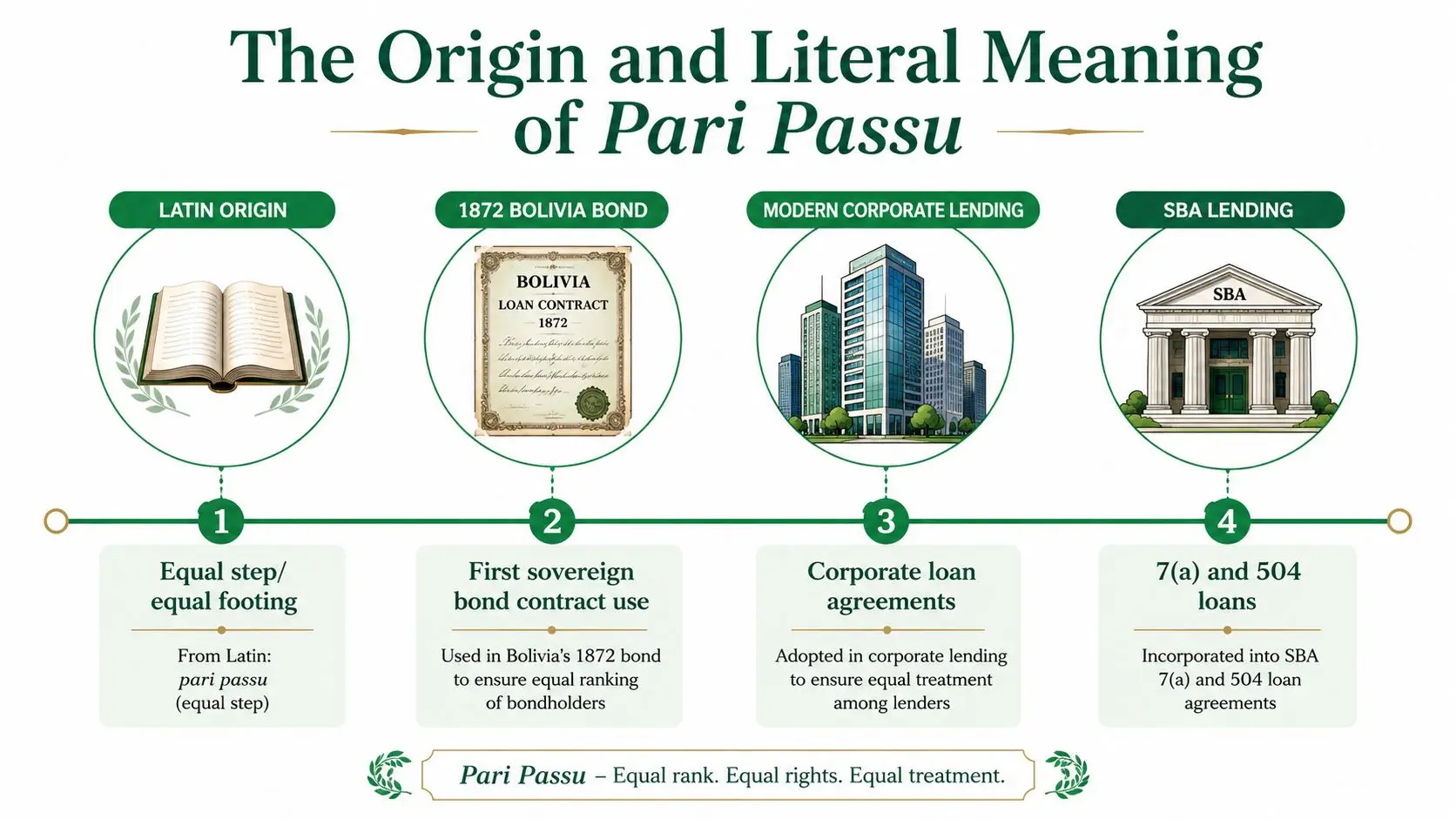
A buyer may hear the term in a closing call and assume it is just legal filler. It is not. Pari passu comes from Latin and means equal step or equal footing, and in finance that language becomes a ranking rule. Claims in the same class stand together, and if there is not enough value to pay everyone in full, the remaining proceeds are shared pro rata rather than by preference.
In deal work, that is the difference between a lender being paid alongside others and a lender being paid after everyone else has taken their cut. The label matters because the ranking drives the recovery outcome, especially when the business underperforms and the balance sheet gets tested.
How the phrase moved into debt markets
Historical scholarship traces debt-market use of the phrase to the 19th century, when secured creditors used it to make sure collateral would be shared ratably. One review also notes that modern sovereign-bond language was already common in the mid-1980s and early 1990s (LawTeacher's review of pari passu in international finance law).
Another key point for lawyers and lenders is the older sovereign-bond record. Academic review places the first appearance of the pari passu concept in a sovereign bond contract in 1872 for Bolivia, which means the clause's global finance history stretches back at least 154 years from 2026 (Arnold & Porter's discussion of pari passu meaning). The same scholarly line of development also ties the modern legal controversy to sovereign debt language in the 1930s, including the Dawes and Young Loans, where parity across creditor groups mattered.
Why the wording still matters in modern lending
In modern loan documents, pari passu usually shows up as a statement that one obligation ranks pari passu with other unsecured obligations. That means the debts sit in the same ranking as other unsecured creditors, not ahead of them. The same basic concept carries over into corporate lending, SBA financing, and intercreditor agreements, where a borrower's capital stack depends on who gets paid first and who shares the downside. For a plain-language check on the accounting side, how par value works in bookkeeping helps separate face-value accounting from payment priority.
SBA buyers run into this in acquisition structures more often than they expect. A seller note, a co-lender, and the senior lender can all sit in the same transaction while still carrying different rights if the paper is drafted that way. Underwriting review matters here too, so it helps to read how SBA lenders underwrite your deal alongside the debt documents, because the ranking language can affect how each source of capital is treated if the deal tightens up.
A borrower does not need the Latin to close a deal. The borrower does need the legal effect, equal rank, equal footing, and no hidden preference.
How Pari Passu Works in SBA Lending and Co-Lending
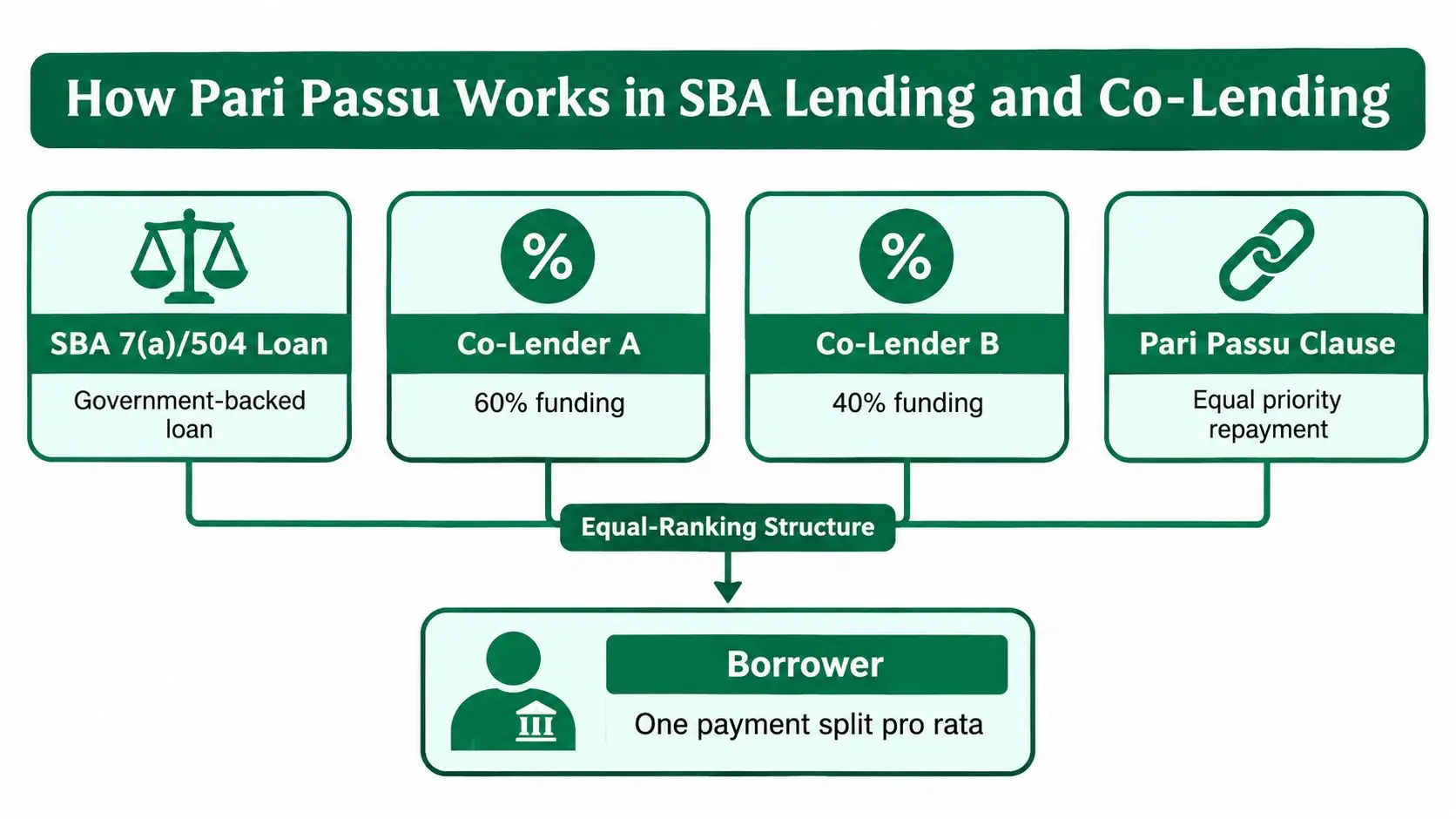
In SBA lending, pari passu turns into deal mechanics fast. It is not just a term of status among lenders. It controls who gets paid, and in what order, if the loan runs into trouble. The British Columbia Development Bank describes pari-passu co-lending as repayment shared equally and proportionally, based on how much each lender is owed, with realization proceeds allocated pro rata to the balance due to each creditor (BDC pari-passu glossary).
What equal ranking really means in a loan structure
If Co-Lender A funds more of the facility than Co-Lender B, pari passu does not force an equal dollar split. The lenders share recovery by outstanding balance, not by seniority. Equal rank and equal economics are separate ideas, and loan documents need to keep them separate.
In sovereign bond work, the BIS sovereign bond paper explains the classic pari passu wording as a shared rank among unsecured obligations. In a business acquisition financing stack, the same basic point applies. If collateral value is thin, a pari passu clause decides whether the lenders share the remaining pool or whether one lender takes priority ahead of the others.
In SBA transactions, the documents have to say that clearly. An intercreditor agreement should spell out whether the lenders are equal only in a default waterfall, or whether payment mechanics are also shared during normal operations. Borrowers get caught here when seller paper, third-party debt, and lender guarantees sit in the same structure and the paper does not match the economics.
Equal rank in the document can still hide unequal control in the enforcement process if the intercreditor language is vague.
A buyer who is comparing funding sources should read the SBA lender underwriting process alongside the term sheet and the intercreditor paper. Underwriters look at the whole capital stack, not just the headline rate, and they care where each claim sits before they agree to a structure with multiple sources of capital.
The guarantor side matters too. Ranking terms and guarantee terms often travel together, so the guide to guaranty agreements for businesses helps when you are checking whether a lender's recovery rights are backed by personal or third-party guarantees. In a real closing, those pieces do not stay separate.
Pari Passu vs Senior and Subordinated Debt
The easiest mistake is treating pari passu as if it means everyone gets the same check. It doesn't. It means everyone in the same class gets the same rank. The amount each party receives can still differ based on how much principal they put in, how the collateral pool is sized, and what the intercreditor agreement says.
| Feature | Pari Passu | Senior Debt | Subordinated Debt |
|---|---|---|---|
| Recovery order | Equal rank within the same class | Paid first | Paid after senior claims |
| Risk profile | Shared with peers in the same tier | Lower relative credit risk | Higher relative credit risk |
| Borrower flexibility | Can preserve multiple funding sources | Often simpler to manage | Can add flexibility if structured carefully |
| Typical use in SBA deals | Seller note or second lender may share rank | SBA lender often occupies the lead position | Junior capital sits behind the main facility |
| Economic result | Pro rata sharing, not automatic equal dollars | Priority can improve recovery | Recovery depends on value left after seniors |
SBA lenders typically want a senior position because seniority gives them clearer recovery rights. Pari passu shows up when a seller note, second lien lender, or co-lender agrees to stand on the same rung rather than be pushed behind the main facility. That can make a deal feasible, but it also adds documentation work and can narrow flexibility.
Why equal rank is not equal split
A seller note and an SBA loan can be pari passu in rank while still producing very different outcomes. If one note is much smaller, that party may receive less overall, even though it is treated equally within the class. That is why borrowers should not hear “equal” and assume “identical.”
For seller note structures, a focused review of SBA seller notes is worth the time before anyone signs. The agreement may look cooperative on paper, but the payment waterfall, standby terms, and enforcement rights can change the economics in a big way.
Bottom line: pari passu changes priority, not math by itself.
Drafting and Negotiating Pari Passu Clauses
The drafting question is usually more important than the label. A clause can say obligations rank pari passu, but the issue is whether that language covers just ranking or also payment mechanics, collateral proceeds, voting rights, and enforcement timing. If those points aren't spelled out, the parties may think they agreed to the same thing while meaning different things.
What to read before you sign
Start with scope. Does the clause apply to all creditors, or only to a named tranche? Then check whether it speaks to payment priority only, or to distribution of liquidation proceeds as well. Those details matter if the borrower defaults, because equal rank in theory can become a fight over control in practice.
The debate isn't academic. A 2024 Oxford Law Blog post describes the pari passu principle as “mysterious,” which reflects the ongoing question of whether it should be read narrowly as equal ranking in insolvency or more broadly as a payment-equality concept (Oxford Law Blog on pari passu). That ambiguity is exactly why lenders prefer precise drafting and why borrowers should ask for plain English definitions in the document set.
What to ask your lawyer or broker to clarify
- Scope of the clause: Ask whether it covers only the named debt or any future advances, side letters, or guarantees.
- Default mechanics: Confirm how collateral proceeds are divided if there isn't enough value to pay everyone in full.
- Intercreditor control: Check who can block enforcement, foreclose, or direct remedies.
- Standby issues: If a seller note is involved, confirm whether standby status changes the note's effective position.
If a clause sounds broad but the remedy section is silent, the document usually deserves a second look.
For buyers working through diligence, the M&A due diligence checklist helps keep the financing review connected to the business review. Pari passu language is one of those terms that hides inside the closing stack until it becomes a problem. Counsel should review it before the borrower treats it as settled.
Pari Passu in Acquisition Capital Stacks
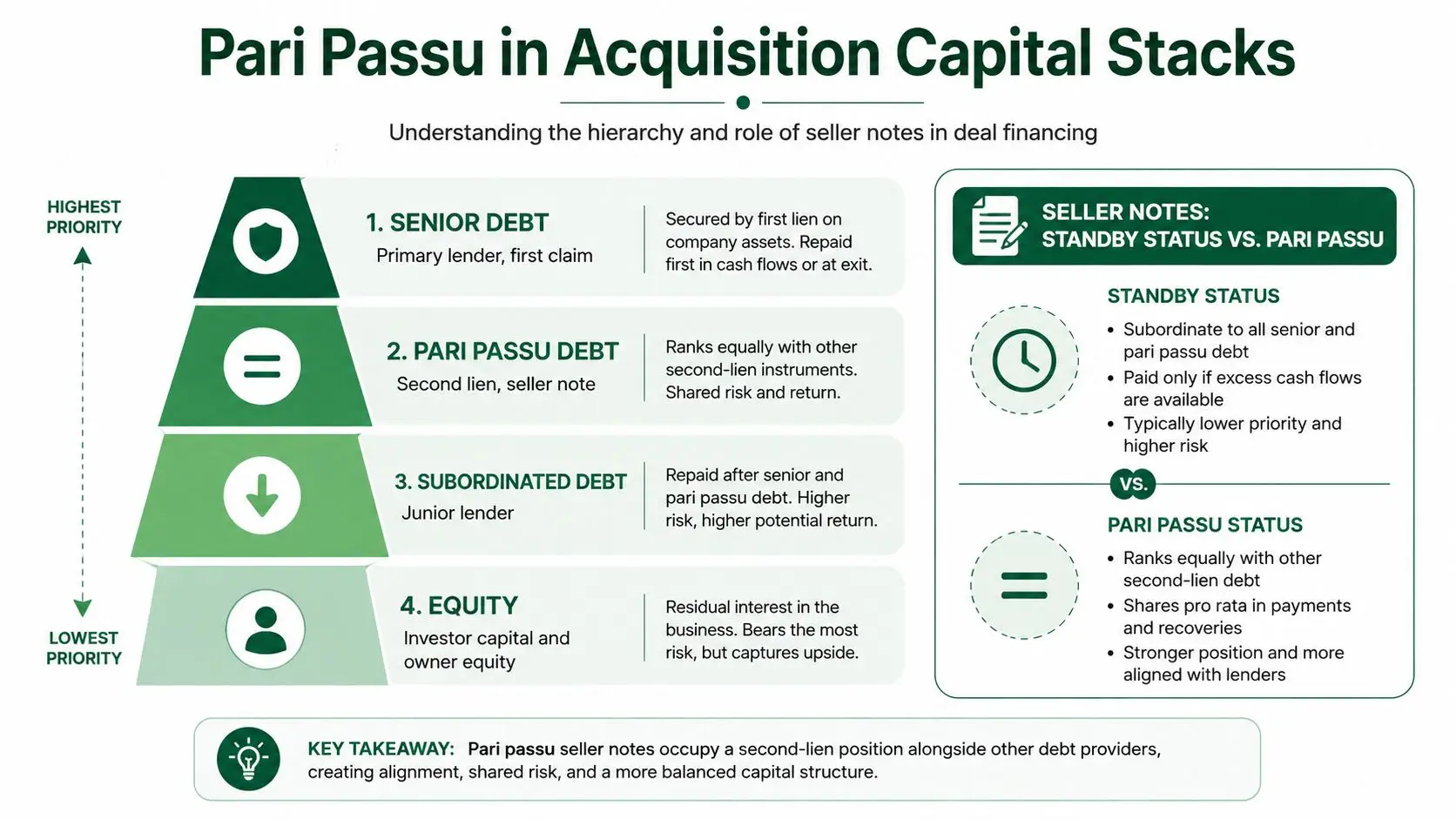
A buyer can close a business acquisition with senior debt, seller paper, investor equity, and sometimes a second lender in the mix. Pari passu matters because it determines how those pieces behave if the business misses plan and the capital stack has to be sorted out. In real SBA and co-lender deals, that ranking affects who gets paid first, who shares collateral proceeds, and who has room to push back when a deal starts to weaken.
Where equal rank fits in a real acquisition
A pari passu debt layer can sit between senior debt and pure equity, or it can run alongside another lender that agrees to share recovery at the same level. In practice, that can help a buyer reduce the cash needed at closing while still giving each capital provider a defined place in the stack. The trade-off is straightforward. More equal ranking usually means more documentation, more lender coordination, and more attention to default remedies.
Equal rank can still sit on top of very different economics. Investor-heavy cap tables, preferred-stock waterfalls, and seller notes can change who benefits at exit, even if the instruments share the same rank inside their own class. A borrower can have two claims that are pari passu on paper and still see very different outcomes once distributions, covenants, and consent rights are applied.
For buyers looking at larger acquisition financing, the GoSBA guide on pari passu loans for business acquisitions over $5 million is useful because it shows how lenders structure equal-priority capital when one source is not enough on its own. That kind of structure comes up when the buyer needs multiple funding sources without creating an accidental senior-junior split.
How seller notes and equity fit around the clause
Seller notes on standby can help the capital stack work, but standby status and pari passu status are different concepts. Standby affects timing and enforcement. Pari passu affects rank. If those concepts get blurred, the buyer may think the seller is junior when the document gives the seller more influence than expected.
That is why acquisition finance feels different from textbook debt theory. The buyer is not just choosing a coupon. The buyer is choosing how losses, proceeds, and control rights move across the stack if the business misses plan. That choice matters in SBA closings, co-lender structures, and any deal where more than one creditor expects to recover from the same collateral.
Pari passu language also matters when the seller note, bank debt, and investor equity all sit close to one another in the capital stack. A buyer can be comfortable with the headline economics and still run into friction if the documentation does not say clearly how enforcement, payment sharing, and consent rights work in a downside case.
In acquisitions, the cleanest structure is not always the simplest one. It is the one where every lien, note, and class knows its place before closing.
Frequently Asked Questions About Pari Passu
Does pari passu mean all lenders get the same payment amount?
No. It means they have the same rank. The amount each lender receives depends on how much it is owed and what the document says about recovery, so two pari passu lenders can end up with different dollar amounts while still sharing the same priority class.
Can an SBA loan be pari passu with a seller note?
Yes, if the deal documents are drafted that way and the lender is comfortable with the structure. In practice, that usually requires careful intercreditor language so the seller note does not create an unexpected senior position or an enforcement conflict.
What happens if one pari passu lender wants to foreclose but the other does not?
That depends on the intercreditor agreement. The agreement should say who can act, who can block action, and how proceeds are shared if collateral is liquidated. Without that language, the parties can end up in a control dispute instead of a clean recovery.
Does pari passu affect my personal guarantee?
It can, indirectly. Pari passu doesn't erase a guarantee, but it can affect who benefits from it and how recovery is allocated if multiple creditors have claims against the same borrower or guarantor. That's why guarantee language should be read together with the ranking language.
Is pari passu the same as subordinated debt?
No. Subordinated debt is behind the senior claim. Pari passu debt sits at the same rank as another obligation, so it shares priority rather than trailing it.
Do I need legal counsel for this?
If there's more than one lender, a seller note, or a disputed lien position, yes. The clause is simple to read and easy to misunderstand, which is exactly why borrowers should get the document set reviewed before closing.
GoSBA Loans helps buyers structure SBA acquisitions, seller notes, and multi-lender capital stacks so the documents match the deal economics. If you're comparing pari passu options or trying to keep a closing clean, visit GoSBA Loans and talk through the structure before you sign the term sheet.
