You're probably looking at a business listing, a broker teaser, or a seller's financial packet and trying to answer one hard question, what is this company really worth if I buy it and step into the owner's shoes? That's where Seller's Discretionary Earnings, or SDE, comes in. For a first-time SBA buyer, SDE is the number that turns a messy tax return into something a lender can underwrite, because it tries to show the full financial benefit available to a single owner-operator.
Table of Contents
- What Is Seller's Discretionary Earnings
- How to Calculate SDE with a Real Example
- Common SDE Add-Backs and Documentation Tips
- SDE vs EBITDA What Business Buyers Must Know
- The Role of SDE in Business Valuation and SBA Loans
- Practical Guidance for All Parties in a Transaction
- Conclusion Your Path to a Fundable Deal
What Is Seller's Discretionary Earnings
Seller's Discretionary Earnings is the standard profitability metric for a small, owner-operated business because it shows the earnings available to one full-time owner-operator after the books are normalized. The International Business Brokers Association defines it as earnings before taxes, depreciation, amortization, interest, non-operating items, nonrecurring items, and one owner's entire compensation, including benefits and personal expenses run through the business. In SBA deals, that definition is the cleanest way to think about the number (MidStreet explanation of SDE).
Why lenders and buyers use it
SDE exists because reported profit can hide the true picture. A seller may pay themselves a large salary, run a personal vehicle through the company, or book one-time spending as a business expense. SDE adds those items back so the buyer and lender can compare businesses on a like-for-like basis instead of being skewed by tax choices or compensation structure.
Practical rule: if the business depends on one owner to make the numbers work, SDE is usually the first lens a lender will use.
For a lender, the question is simple. How much cash flow should carry the debt after the sale? That is why SDE matters in SBA lending, because the lender is underwriting cash flow, not accounting optics. If the earnings base is inflated by personal spending, the deal may look stronger than it really is.
SDE is especially common in businesses typically below about $5 million in revenue, where owner labor and personal expenses can materially distort reported profit (MidStreet explanation of SDE). The lender's review focuses on whether the add-backs are ordinary for the business, whether they are supported by records, and whether they would disappear after closing. Personal auto expenses and one-off owner perks may be easy to understand. Discretionary travel, family payroll, and other harder-to-verify items get more scrutiny.
For a broader acquisition framework that connects SDE to deal structure, see this SBA loan acquisition guide.

How to Calculate SDE with a Real Example
Start with pre-tax profit, then add back the costs that don't have to remain in the business after the sale. That includes owner compensation, interest, depreciation, amortization, and legitimate discretionary or nonrecurring items, which is why SDE is a normalized cash-flow proxy rather than a GAAP profit measure (MNApedia SDE definition).
Sample SDE Calculation
| Line Item | Amount | Adjustment (Add-Back) | Normalized Amount |
|---|---|---|---|
| Pre-tax profit | |||
| Owner compensation | Add back | ||
| Interest expense | Add back | ||
| Depreciation | Add back | ||
| Amortization | Add back | ||
| Discretionary and non-recurring items | Add back | ||
| SDE |
A simple way to read the table is this, the profit line is your starting point, and each valid add-back moves you toward the business's normalized earning power. The math is straightforward. The underwriting challenge is not the formula, it's whether each adjustment is defensible.
Underwriting reality: a lender does not care whether an add-back helps the asking price. The lender cares whether that item can survive verification.
If you want a second pass on the mechanics after filling out your own P&L, use this quality of earnings guide for SBA loans as a checklist for what usually gets tested.
A real-world calculation often starts with a seller's tax return, then gets rebuilt from the P&L and supporting statements. The owner's salary is added back because the buyer may not take that same compensation structure. Interest is added back because the metric is focused on operating earnings, not financing structure. Depreciation and amortization are added back because they're non-cash accounting charges. The remaining discretionary and one-time items are the part that usually decides how strong the final SDE really is.
That last point matters. Two businesses can show similar reported profit and still produce very different SDE if one has cleaner books and fewer controversial add-backs. In SBA acquisitions, that difference often shows up later in underwriting rather than in the teaser.
Common SDE Add-Backs and Documentation Tips
The add-backs are where SDE either becomes a useful lending tool or turns into a broker's wish list. Lenders will usually accept clear, ordinary adjustments faster than vague, poorly documented ones, because SDE's reliability is questioned when a business has heavy add-backs or weak bookkeeping (Wall Street Prep on SDE).
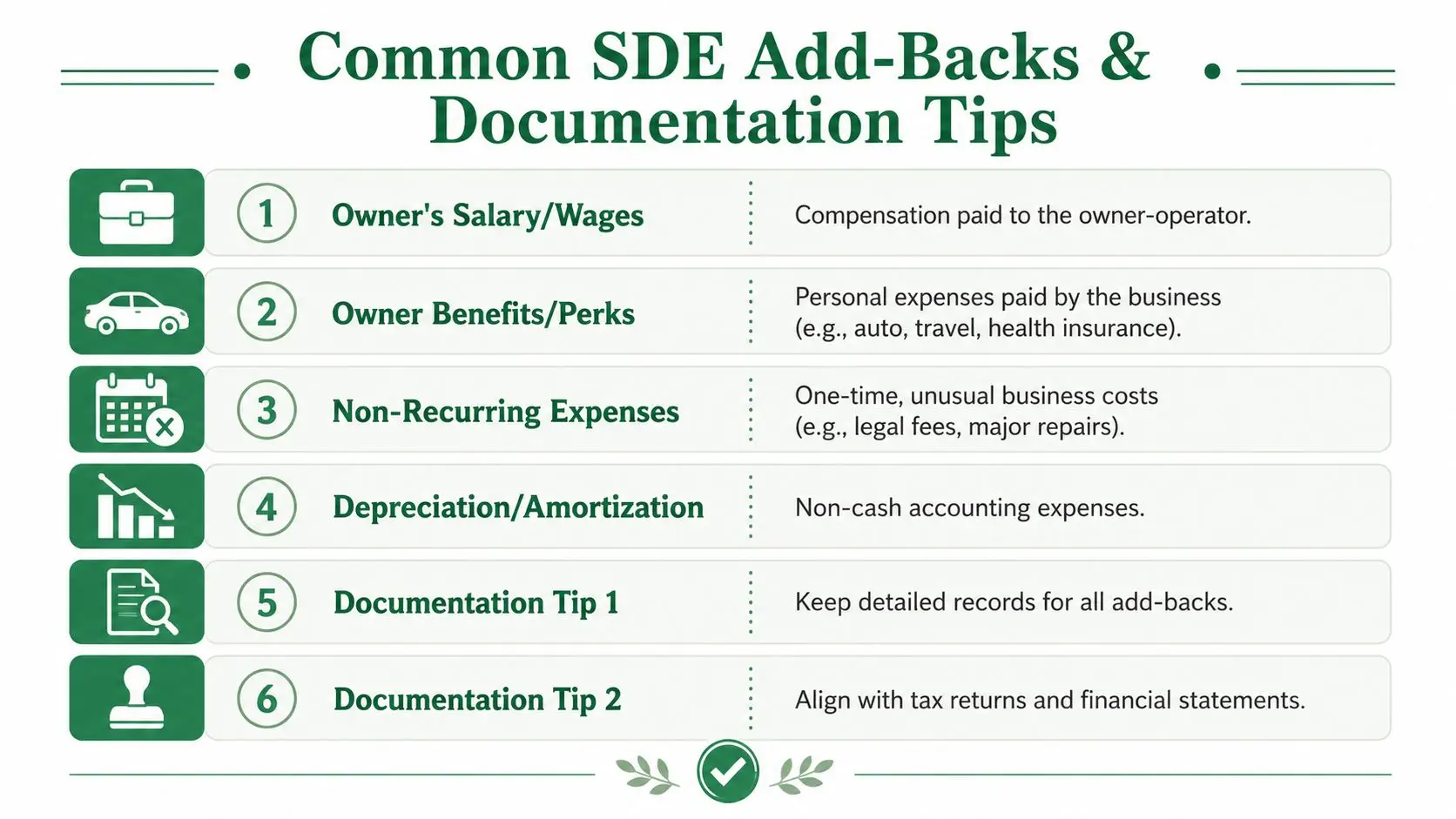
The add-backs lenders usually review first
The easiest category to understand is owner compensation. If the seller paid themselves a salary or took wages through payroll, that compensation is usually part of the add-back logic because the buyer won't automatically carry the same pay structure. Personal health insurance paid by the business can also be a valid add-back when it's clearly tied to the owner and documented in payroll or expense records.
Family payroll is another area that gets attention. If a spouse, child, or relative is on payroll but won't remain after closing, lenders will want proof that the role was real, the pay was consistent, and the function disappears in the new ownership model. One-time legal fees, lawsuit costs, unusual repairs, and other nonrecurring expenses can also be added back when invoices and transaction details show they were unusual rather than normal operating costs.
What underwriters want to see
An add-back without a paper trail is just a claim. Underwriters usually want the tax return, profit and loss statement, bank records, payroll reports, invoices, and, where needed, a clear explanation of why the expense won't continue. If the expense looks personal, inconsistent, or repeated, expect scrutiny. If it appears in one year only, the explanation has to be stronger.
A practical way to keep this organized is to build a clean support file for every adjustment. If you're documenting a complex package of owner perks, a structured template from Trupeer's AI template platform can help organize the evidence before you send it to an underwriter.
For more examples of what gets categorized as an add-back, see this SBA add-backs guide.
SDE vs EBITDA What Business Buyers Must Know
SDE and EBITDA both begin with earnings and then strip out items that distort operating performance, but they are not interchangeable in an SBA deal. The key difference is practical, SDE adds back one owner's full compensation package, while EBITDA leaves officer compensation inside operating expenses and assumes the company is being run by management rather than by the buyer personally.
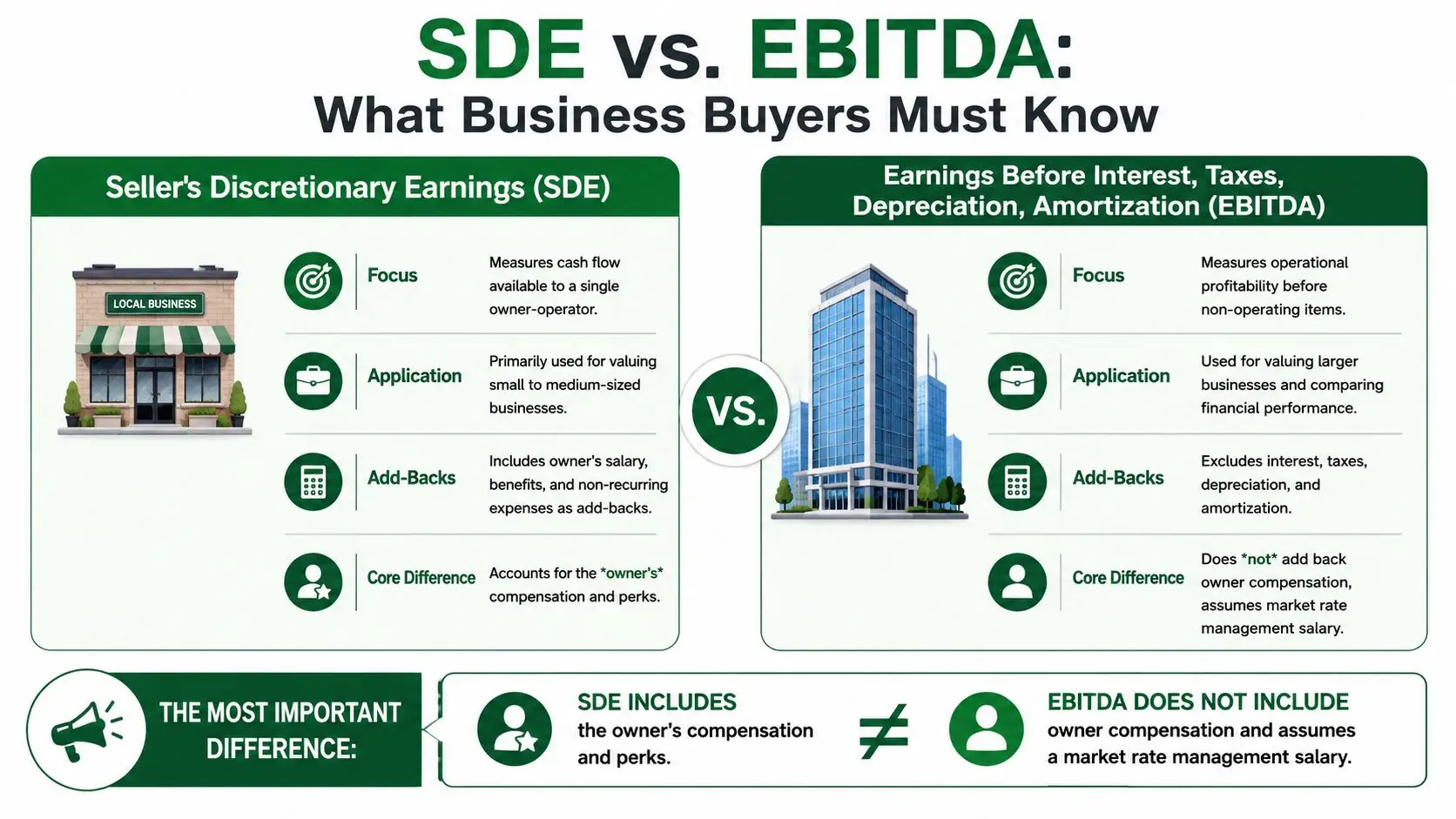
Where the line starts to shift
One common valuation approach treats SDE as the standard in smaller owner-operated companies and EBITDA as the cleaner measure once a real management layer is in place, with a transition zone between the two. That line matters because it changes who is expected to do the work after closing. If the buyer is stepping into the owner's seat, SDE usually reflects the business more accurately. If the buyer is buying a manager-led company, EBITDA tells a more honest story.
That transition zone is where buyers and lenders can misread the deal. Using SDE to value a company that will need a hired general manager, controller, or operations lead can make the cash flow look stronger than it will be after closing. The seller's old compensation disappears from the numbers, but the buyer still has to pay someone to do that work. In underwriting, that replacement cost can reduce the amount of debt the business can support.
Underwriters also look at whether the add-backs behind the SDE figure make sense for the buyer's plan. A seller's salary is usually easy to follow when the buyer will run the company day to day. A lender is more cautious when the proposed post-close model depends on management salaries that were not part of the historical books. That is why the right metric affects both the purchase price and the loan sizing.
A useful way to check the fit is simple. If you will personally perform the owner's job after closing, SDE is usually the cleaner measure. If the business will need paid management from day one, EBITDA deserves a closer look, because it shows the earnings base before the buyer layers in replacement labor.
For a lender-oriented view of how valuation supports financing, see this business valuation guide for SBA loans.
The Role of SDE in Business Valuation and SBA Loans
SDE sits at the center of both pricing and financing because it becomes the common cash-flow language between seller, buyer, broker, and lender. A widely used historical rule in small-business valuation is Business Value = SDE × Multiplier, and that framework is still the starting point for many acquisition conversations (Eton valuation explanation).

Why valuation and loan sizing are tied together
A price that looks fair on paper still has to survive underwriting. The lender's first question is whether the historical earnings can support future debt payments after the business changes hands. That is why SDE matters so much, it tells the lender how much cash was available before the owner's compensation and personal spending got folded into the books.
When the SDE is well documented, the valuation conversation becomes easier because the buyer can defend why the purchase price makes sense. When it is weakly documented, the same multiple can become meaningless, because the earnings base itself is under attack. In practice, lenders spend a lot of time verifying the normalization, not just accepting the broker summary.
What gets a lender comfortable
A strong file usually has a consistent P&L, tax returns that tie to the story, and clear support for each add-back. If those items line up, SDE becomes a credible proxy for debt service capacity. If they don't, the lender may trim the earnings base, which can lower the loan amount or force a larger down payment.
SBA underwriting is really a cash-flow test wrapped around a business purchase. That's why GoSBA Loans publishes acquisition guidance and an SBA DSCR calculator that uses Annual Cash Flow = SDE + Add-backs in its analysis, because the underwriting conversation starts with normalized earnings before it ever gets to structure or collateral.
Practical Guidance for All Parties in a Transaction
Sellers
Prepare early, not when the deal is already in market. Clean books, a stable chart of accounts, and separate personal spending from business spending before you list the company. If an expense is personal or one-time, keep the backup now so the add-back is easy to defend later. Sellers who wait until diligence to reconstruct the story usually lose credibility.
Buyers
Treat every add-back as a question, not an answer. Ask whether the expense disappears after closing, whether it appears repeatedly, and whether the documentation matches the tax return. If the seller cannot support the item with a bank record, invoice, payroll report, or tax filing, assume the lender may discount it. For a buyer, the safest approach is to underwrite against conservative, verified SDE, not the most aggressive broker version.
Brokers and lenders
Package the SDE analysis in a way that lets an underwriter verify it quickly. That means a clear add-back schedule, source documents attached to each item, and a summary that reconciles tax returns to the seller's presentation. If a seller financing component is part of the structure, this seller financing guide is useful context for how the capital stack can affect lender comfort and closing mechanics.
A practical underwriting file saves time for everyone. It also reduces the chance that a lender will revisit the same adjustment three times because the support was scattered across emails and screenshots. The cleaner the package, the less likely the deal gets stuck in committee.
Best habit: document the add-back the same month it happens, not the week before diligence starts.
Conclusion Your Path to a Fundable Deal
Seller's Discretionary Earnings is not just a valuation term. It is the bridge between tax-basis accounting and the actual cash flow a buyer can rely on, and it sits at the center of SBA underwriting for small, owner-operated businesses. When the SDE is accurate, supported, and easy to verify, the deal has a far better chance of making sense to both buyer and lender.
That is the part many first-time buyers miss. They focus on the asking price, but the lender is focused on the quality of the earnings base behind it. A clean SDE file can support a stronger valuation story and a more credible loan request. A sloppy one can shrink the deal before anyone even gets to closing terms.
If you're buying, selling, or brokering a small business acquisition, use SDE as the filter that tells you whether the numbers are real, durable, and financeable. Then build the file like an underwriter will read it, because they will.
A CTA for GoSBA Loans.
