Debt service coverage ratio, or DSCR, compares net operating income with total annual debt payments. A ratio above 1.0 means the business generates more cash than needed to service its debt, and SBA lenders in 2026 typically require between 1.10x and 1.25x depending on loan size and type.
That definition is accurate, but it's not enough to predict an SBA approval. The number that matters is usually the lender-recalculated DSCR, after an underwriter normalizes cash flow, removes unsupported add-backs, adjusts owner compensation, and includes every obligation that competes for repayment cash.
Table of Contents
- Why Most DSCR Explanations Miss What Lenders Actually Check
- The DSCR Formula and How to Calculate It Step by Step
- Underwriting Adjustments That Change Your Real DSCR Number
- Current SBA DSCR Thresholds and Lender Benchmarks for 2026
- Real Deal Scenarios Showing DSCR in Action
- Practical Strategies to Improve Your DSCR Before Applying
- Your DSCR Readiness Checklist for SBA Loan Applications
Why Most DSCR Explanations Miss What Lenders Actually Check
Most explanations stop at a formula: operating income divided by debt service. That's useful for learning the concept, but it can create false confidence. In actual SBA underwriting, DSCR isn't always a fixed number sitting on a tax return. It's a coverage calculation built from financial information that the lender reviews, questions, and adjusts.
JPMorgan describes DSCR as net operating income divided by total debt service, with a ratio above 1.0 indicating that cash flow exceeds required principal-and-interest payments. A commonly used commercial real estate benchmark is 1.25x, meaning the property produces 25% more income than required to service debt (JPMorgan's DSCR explanation). That benchmark is a useful planning target, not a universal approval rule.
The lender's real question is more demanding: How much recurring cash flow remains after reasonable operating costs, normalized compensation, existing obligations, and the proposed loan payment? A business can report strong earnings and still fail if the underwriter concludes that the available cash flow has been overstated.
The ratio is a repayment gate
DSCR has become especially important in SBA and commercial lending because it converts repayment capacity into one comparable multiple across different capital structures. A 1.00x DSCR means operating cash flow exactly matches required principal and interest. A 0.85x DSCR means the borrower is short by 15%, while 1.25x provides a 25% cushion (Investopedia's DSCR overview).
The logic is straightforward:
- Below 1.00x: Cash flow doesn't cover scheduled debt service.
- At 1.00x: There's no margin for weaker sales, higher costs, or timing problems.
- Above 1.00x: The borrower has increasing repayment capacity as coverage improves.
- At 1.25x: The business or property has a meaningful cushion under a widely used benchmark.
Practical rule: Calculate the ratio using the lender's likely definition of cash flow, not the most favorable figure in your internal spreadsheet.
For owner-occupied real estate, acquisitions, and refinancing, lenders typically review the proposed debt alongside existing loans and the operating performance supporting repayment. Borrowers preparing for that review can also benefit from this guide to how SBA lenders underwrite your deal. Businesses in specialized industries, including energy services, may also need a broader financing plan, such as these tips to secure oilfield capital.
The DSCR Formula and How to Calculate It Step by Step
The basic formula is:
DSCR = Net Operating Income or lender-normalized operating cash flow ÷ total annual debt service
The arithmetic is easy. Defining both inputs correctly is where applications succeed or fail.
The numerator may be NOI for a property or a lender-normalized operating cash flow measure for a business. The denominator includes required annual principal and interest payments on the proposed loan, plus existing debt obligations the lender determines must remain in the repayment analysis. CFI describes DSCR as net operating income divided by annual debt service and confirms that 1.00 means cash flow exactly matches required payments, while 1.25 means cash flow exceeds debt service by 25% (CFI's DSCR guide).
Step one, establish operating cash flow
For a business acquisition, start with recurring operating revenue and subtract ordinary operating expenses. Don't treat gross revenue as available repayment cash. Payroll, occupancy, insurance, supplies, professional fees, and other necessary costs reduce the cash available to service debt.
Suppose an acquisition produces $500,000 in lender-accepted operating cash flow, and the proposed acquisition loan requires $320,000 in annual principal and interest. If the business has an additional $30,000 in annual existing debt service, the calculation is:
$500,000 ÷ ($320,000 + $30,000) = 1.43x DSCR
The result is 1.43x, assuming the lender accepts the full $500,000 as recurring, supportable cash flow. If the underwriter removes an unsupported add-back or increases the expense burden, the numerator falls and the ratio changes immediately.
Step two, measure debt service over the same period
The numerator and denominator must cover the same annual period. Include the proposed loan payment and all existing obligations that the lender includes in total annual debt service. A calculation that uses a full year of cash flow but leaves out an existing loan can make the business appear safer than it is.
For projected deals, lenders test assumptions rather than accepting a buyer's forecast. Revenue growth, margins, staffing, owner replacement, and the timing of operational changes need support in the business plan, purchase agreement, historical results, or other documentation.
A useful companion concept for founders evaluating how quickly an investment may return cash is this practical payback guide for founders. Payback period and DSCR answer different questions, but both force the buyer to examine cash generation rather than relying on headline revenue.
Borrowers can use an SBA loan DSCR calculator for an initial estimate, then rebuild the calculation using the adjustments their lender is likely to apply.
Underwriting Adjustments That Change Your Real DSCR Number
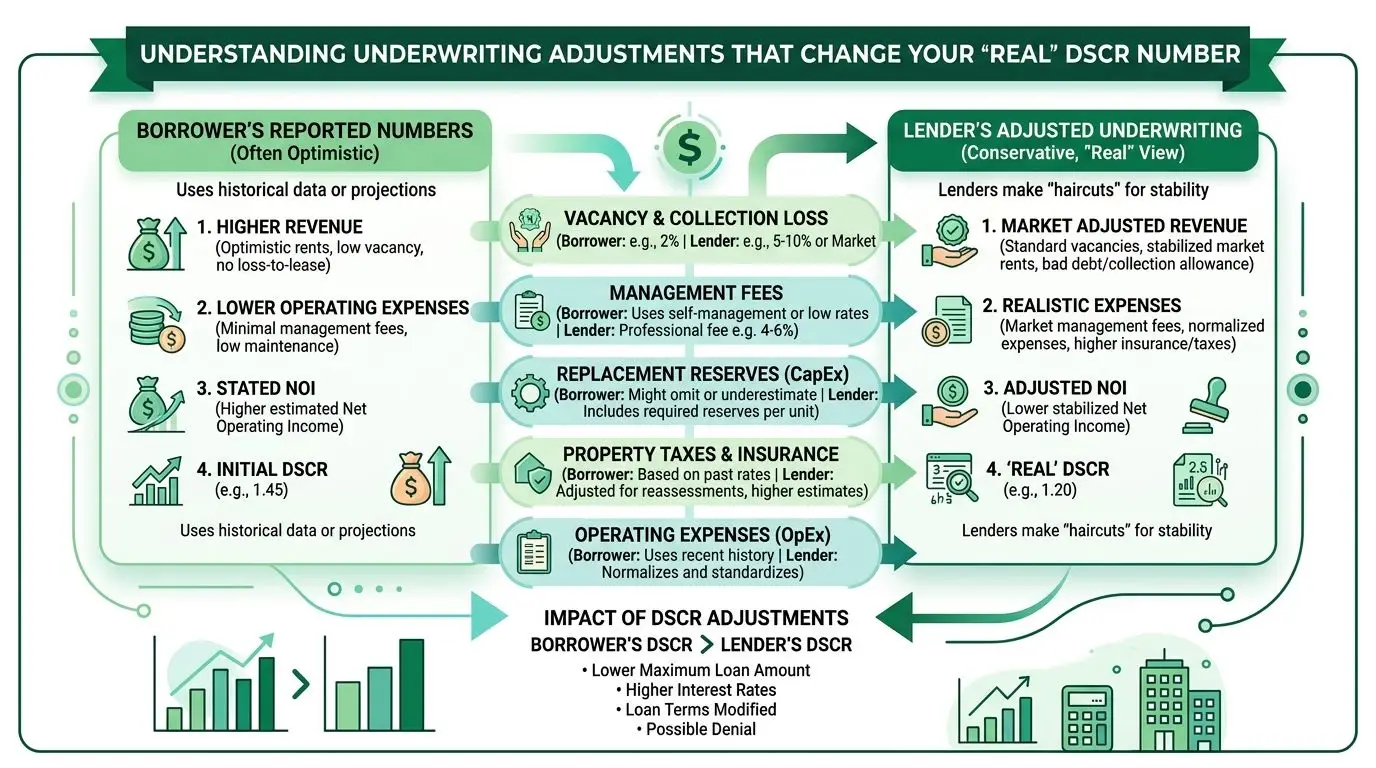
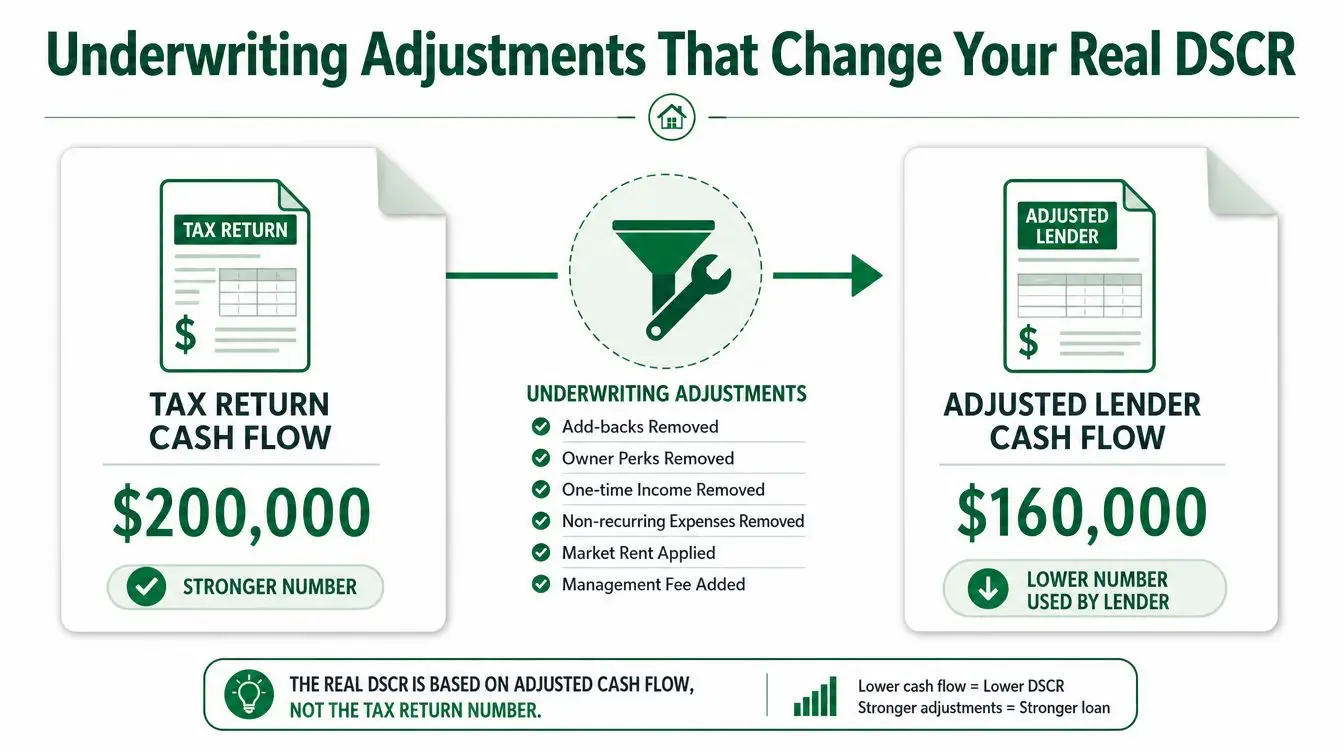
A tax return is evidence, not the lender's finished repayment model. Underwriters use historical filings and financial statements to assess performance, then decide which expenses, add-backs, income sources, and obligations belong in cash flow available for debt service.
That judgment can create a wide gap between a seller-prepared DSCR and the figure used for approval. A seller may add back costs that will continue after closing. The lender accepts an adjustment only when it is documented, non-recurring, and economically defensible.
Owner compensation is a frequent fault line
An owner's salary may be discretionary, while the work performed by that owner is not. If the buyer must handle the same operational duties after closing, the lender may include a replacement wage. Adding back the entire seller salary can therefore inflate cash flow and produce a DSCR the business cannot support.
The underwriter may also normalize the buyer's planned compensation. A historically underpaid owner can imply an unrecognized labor cost. If the seller was paid more than the role reasonably requires, a reduction may be supportable, but the file needs records and a credible explanation.
Non-recurring expenses need proof
A documented one-time legal matter, unusual repair, or transaction cost may be excluded from recurring cash flow. The lender will ask what occurred, why it will not repeat, and whether the financial statements, invoices, and tax records support the adjustment.
Revenue receives the same scrutiny. A one-time contract, unusual sale, insurance recovery, or temporary spike does not automatically increase sustainable operating cash flow. Underwriting focuses on the repayment source available after closing, not the strongest historical month.
Existing obligations can change the denominator
Borrowers often calculate the proposed SBA payment and miss debt already on the books. The lender may include term loans, equipment obligations, business lines with required payments, and other commitments that reduce cash available for the new loan.
For closely held companies, the review can extend to global cash flow. Obligations tied to owners or guarantors may matter when they affect repayment capacity. The question is whether sufficient cash remains after every required payment, not whether the business shows positive earnings before those payments.
Underwriting reality: An undocumented add-back, undisclosed recurring debt, or unrealistic owner-labor assumption can turn a passing spreadsheet into a declined application.
Before applying, separate reported EBITDA or NOI from lender-normalized cash flow. This SBA add-backs guide explains adjustments lenders commonly examine. For real estate obligations, keep DSCR analysis separate from market-rate research, including live mortgage rates from Zillow. Changes in proposed loan terms can alter annual debt service and the resulting ratio.
Current SBA DSCR Thresholds and Lender Benchmarks for 2026
SBA DSCR requirements depend on the loan product and size. The most important distinction for 2026 is between 7(a) Small Loans up to $350,000 and standard 7(a) loans above $350,000.
As of March 1, 2026, SBA 7(a) Small Loans up to $350,000 require at least 1.10:1, while standard SBA 7(a) loans above that size generally require at least 1.15:1 (current SBA underwriting guidance summarized by LenderAnalyzer). Those are minimum underwriting thresholds, not guarantees of approval.
| Loan Type | Loan Size | SBA Minimum DSCR | Lender Comfort Target |
|---|---|---|---|
| 7(a) Small Loan | Up to $350,000 | 1.10:1 | Often 1.25x |
| Standard 7(a) | Above $350,000 | 1.15:1 | Often 1.25x |
| Commercial real estate lending | Varies | Lender-specific | Roughly 1.20x to 1.40x |
The 1.25x benchmark remains common in lender guidance because it provides a larger cushion than the SBA minimums. A borrower at 1.10x may satisfy a product rule but still face a difficult credit discussion if the business has volatile revenue, weak projections, thin liquidity, or questionable adjustments.
Minimum approval threshold versus comfort target
These numbers serve different purposes. The minimum is the point at which the file may satisfy a stated DSCR requirement. The comfort target reflects how much repayment protection a lender wants after considering execution risk and business volatility.
Commercial real estate lenders commonly target roughly 1.20x to 1.40x, with more volatile property sectors often requiring stronger coverage (LenderAnalyzer's SBA 7(a) DSCR discussion). Borrowers evaluating an owner-occupied property should review the broader commercial real estate loan requirements before assuming an SBA minimum will control every part of the credit decision.
For projected acquisition cash flow, industry summaries of SBA SOP 50 10 8 describe testing historical, projected, or both forms of operating cash flow. One summary states that standard 7(a) deals may need to show 1.15x projected DSCR within the first two years (SBA lending white paper). A projection that reaches coverage only after an unsupported turnaround plan is unlikely to carry the same weight as demonstrated performance.
Missing the applicable threshold can alter how a file is processed, move it toward a different SBA product, or end the request. That's why loan size, program selection, and normalized cash flow should be modeled together before the lender receives the package.
Real Deal Scenarios Showing DSCR in Action
The same formula behaves differently depending on the capital structure. The following scenarios use illustrative figures to show the mechanics, not historical case studies or promised outcomes.
Acquisition with seller financing
A buyer acquires a business for $2 million. The proposed SBA loan requires $250,000 in annual principal and interest, and the seller note requires $50,000 in annual payments after its agreed treatment in the capital structure. The lender accepts normalized operating cash flow of $420,000.
The resulting DSCR is:
$420,000 ÷ ($250,000 + $50,000) = 1.40x
At 1.40x, the structure provides more coverage than a generic 1.25x lender comfort benchmark. If the seller note is structured differently, or if the lender adds another obligation, annual debt service rises and coverage falls. The lesson is practical: seller financing can help bridge a purchase price gap, but its payment terms still affect repayment capacity.
Owner-occupied commercial real estate
An operating company produces lender-accepted cash flow of $300,000. The proposed property loan requires $220,000 in annual principal and interest. The property itself doesn't generate third-party rental income for the analysis, so the operating business remains the repayment source.
$300,000 ÷ $220,000 = 1.36x
That calculation may look comfortable, but the lender still reviews the operating company's historical performance, occupancy costs, taxes, insurance, maintenance, and any existing debt. A property purchase that reduces rent could improve the broader operating picture, but the benefit must be supported and modeled rather than assumed.
Refinancing with existing obligations
A business reports $360,000 in lender-normalized operating cash flow. The refinance would create $180,000 in annual debt service, while another existing obligation remains at $90,000 annually.
$360,000 ÷ ($180,000 + $90,000) = 1.33x
If the refinance pays off the existing obligation, the denominator could change substantially. If it doesn't, excluding that payment produces an inaccurate result. Refinancing can improve coverage when it reduces required annual payments, but a lender will evaluate the complete post-closing debt schedule.
Loan structure matters as much as purchase price. A longer amortization can reduce annual principal payments, while a larger down payment can reduce the loan balance. Each choice carries a trade-off involving cash invested, total interest, liquidity, and the lender's view of the transaction.
Practical Strategies to Improve Your DSCR Before Applying
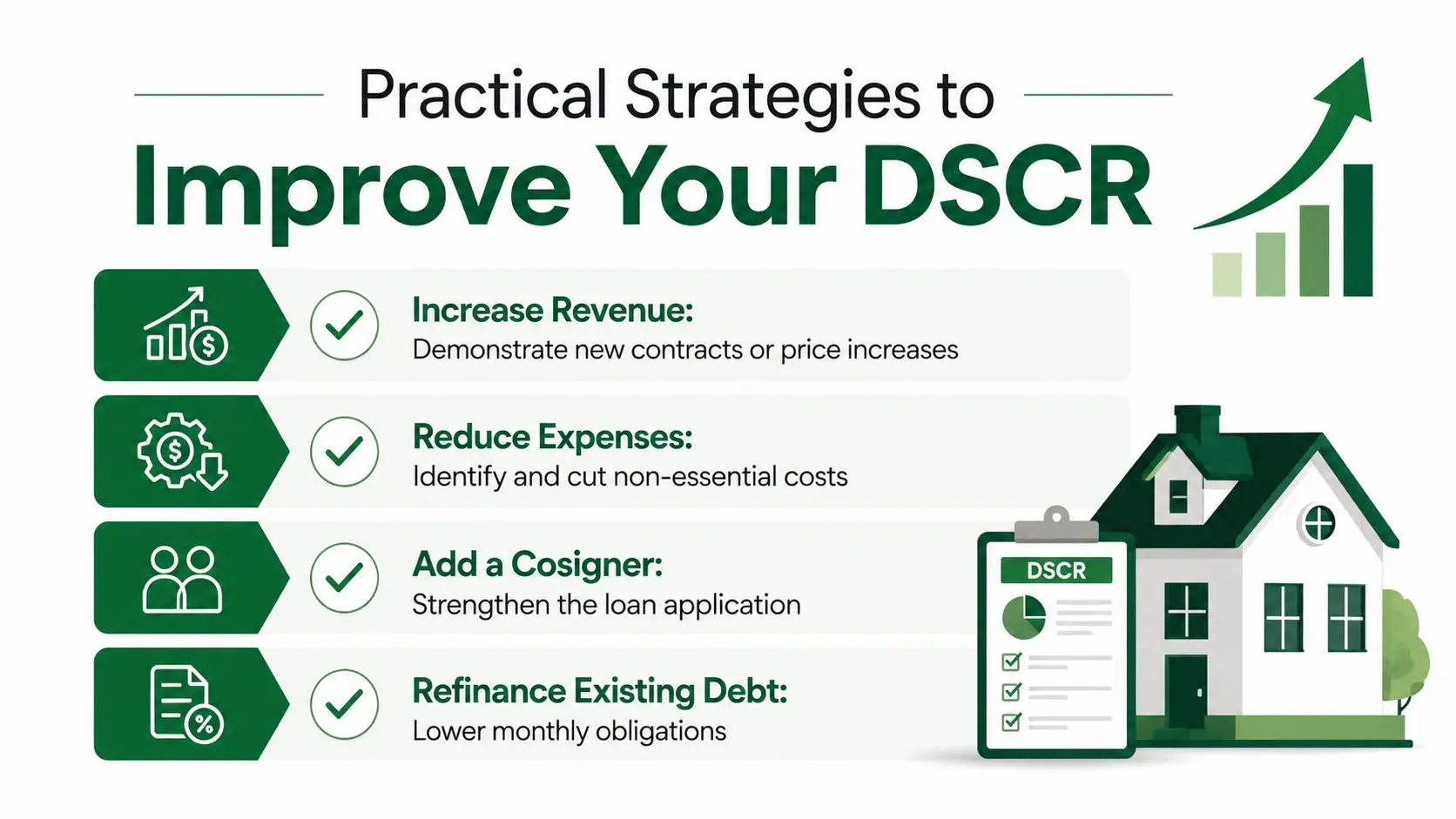
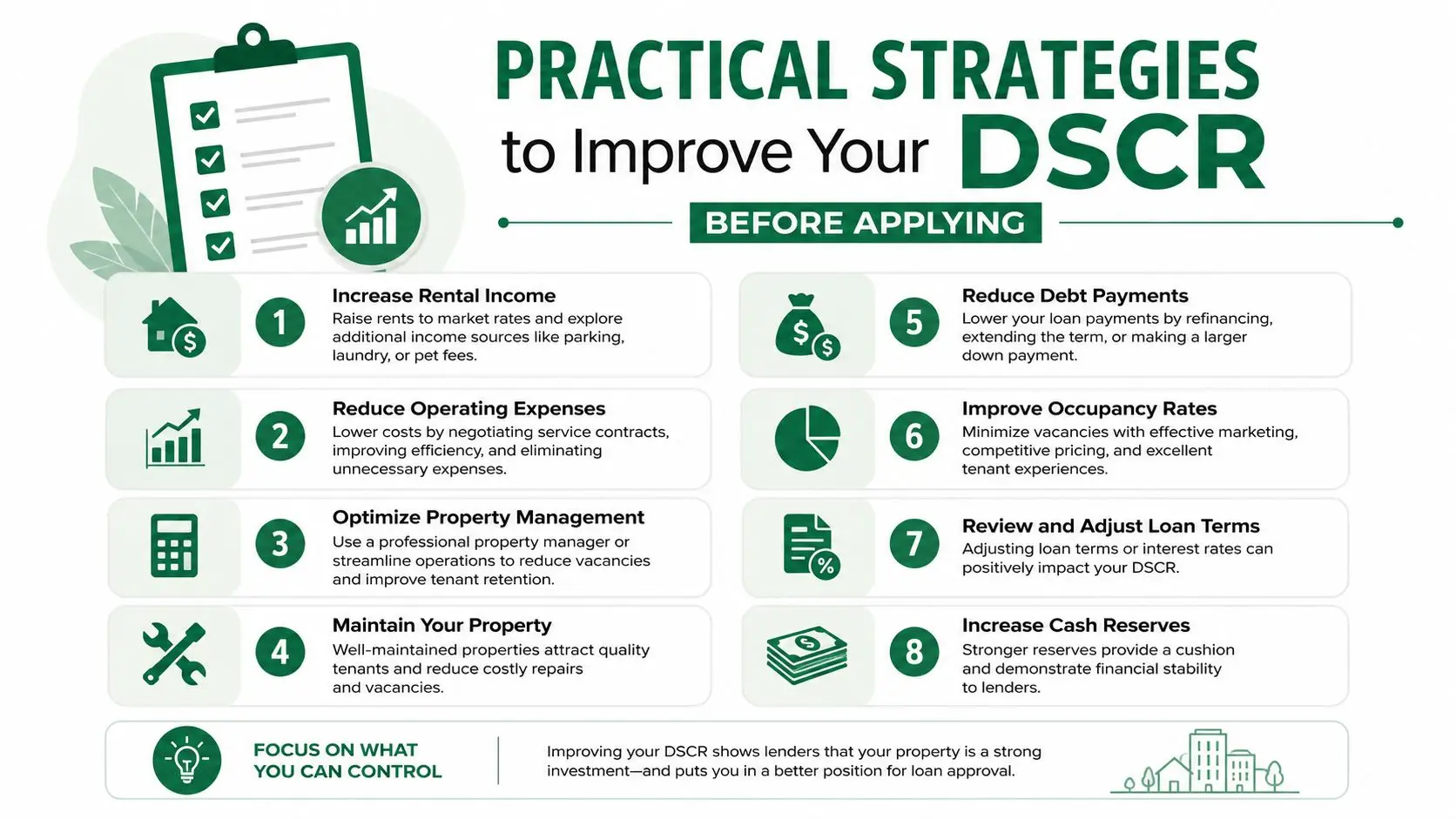
A weak DSCR gives you two levers: increase lender-accepted cash flow or reduce required annual debt service. The strongest preparation usually works both sides without relying on aggressive accounting.
Start with the numerator. Secure customer agreements that make recurring revenue easier to verify, document signed backlog, and separate ordinary sales from unusual transactions. Raising prices may help, but only when the change is commercially supportable and won't cause customers to leave.
Improve operating cash flow
Review expenses line by line with your CPA. Renegotiate vendor terms, remove subscriptions the business doesn't need, and identify costs that won't continue after an acquisition. Don't label a cost “discretionary” merely because management would prefer not to pay it. If the expense supports operations, the lender may treat it as recurring.
Working-capital discipline also helps. Faster invoicing, tighter receivables follow-up, and sensible inventory control can make cash flow more predictable. These actions may not immediately change reported earnings, but they can improve the quality of the repayment story.
Reduce the annual payment burden
Paying off a smaller obligation can reduce the denominator, provided doing so doesn't drain the cash needed for the required equity contribution or operating reserve. Refinancing existing debt may also help when the new structure lowers annual payments without creating unacceptable costs or risk. Borrowers considering that option can review this guide to what debt refinancing involves.
Loan terms deserve deliberate modeling. Compare payment schedules, amortization, seller-note treatment, and the effect of each structure on post-closing liquidity. The lowest payment isn't automatically the best choice if it increases total risk or creates a balloon obligation the business can't handle.
Time the application honestly
Seasonal businesses should avoid presenting a peak period as representative of the full operating cycle. Give the lender complete financial periods and explain known seasonality. If performance is improving, support the change with signed contracts, invoices, staffing records, or other evidence rather than relying on optimistic narrative.
GoSBA Loans offers a DSCR calculator and deal-analysis tools that can help borrowers organize adjusted annual income and annual debt service before approaching lenders. A broker or CPA can then test whether the proposed adjustments are likely to survive underwriting.
Your DSCR Readiness Checklist for SBA Loan Applications
A lender will recalculate your DSCR, so prepare the file around defensible cash flow rather than the strongest version of your spreadsheet. Before submitting an SBA application, complete these checks:
- Rebuild the numerator: Start with operating cash flow, remove unsupported add-backs, and normalize owner compensation. Keep workpapers showing why each adjustment belongs.
- Build the denominator: Include the proposed payment and every existing obligation that remains after closing, including debt affected by refinancing or seller financing.
- Identify the rule: Confirm whether the file is a 7(a) Small Loan up to $350,000, a standard 7(a) loan above $350,000, or another product with different underwriting treatment.
- Test historical and projected cash flow: Tie projections to documented assumptions, contracts, invoices, or operating evidence. Make the timing of improvements realistic.
- Prepare verification documents: Organize tax returns, interim financial statements, debt schedules, leases, payroll information, purchase agreements, and explanations for unusual items.
- Stress the structure: Model seller financing, refinancing, down payment, amortization, and remaining liquidity, not just the purchase price.
- Get a second review: Ask a CPA, experienced SBA broker, or lender to challenge the calculation before formal underwriting.
The target is a ratio that remains credible after lender adjustments. GoSBA Loans helps borrowers model lender-adjusted DSCR, prepare SBA financial projections, and compare financing options. Review the numbers and structure with its team, then visit GoSBA Loans to start a financing conversation based on realistic underwriting.
